
钢铁行业

Search documents
方大特钢:聘任简鹏为公司财务总监
Mei Ri Jing Ji Xin Wen· 2025-08-21 02:35
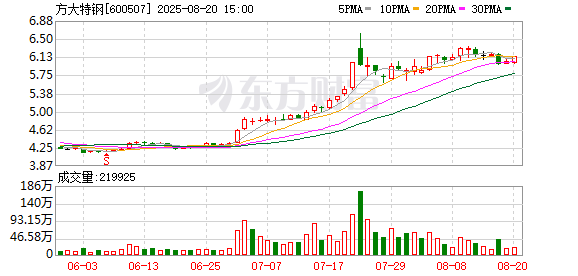
截至发稿,方大特钢市值为142亿元。 每经AI快讯,方大特钢(SH 600507)8月20日晚间发布公告称,经总经理提名,公司董事会审计委员 会、提名委员会审核通过,审议通过《关于聘任财务总监的议案》,聘任简鹏为公司财务总监。 2024年1至12月份,方大特钢的营业收入构成为:钢铁行业占比98.23%,采掘业占比1.56%,其他业务 占比0.21%。 奕瑞科技:聘任蒋燕为公司财务总监 九州一轨:李秀清辞去财务总监及财务负责人职务 宏微科技:聘任王巧巧担任公司财务总监 延伸阅读: ...

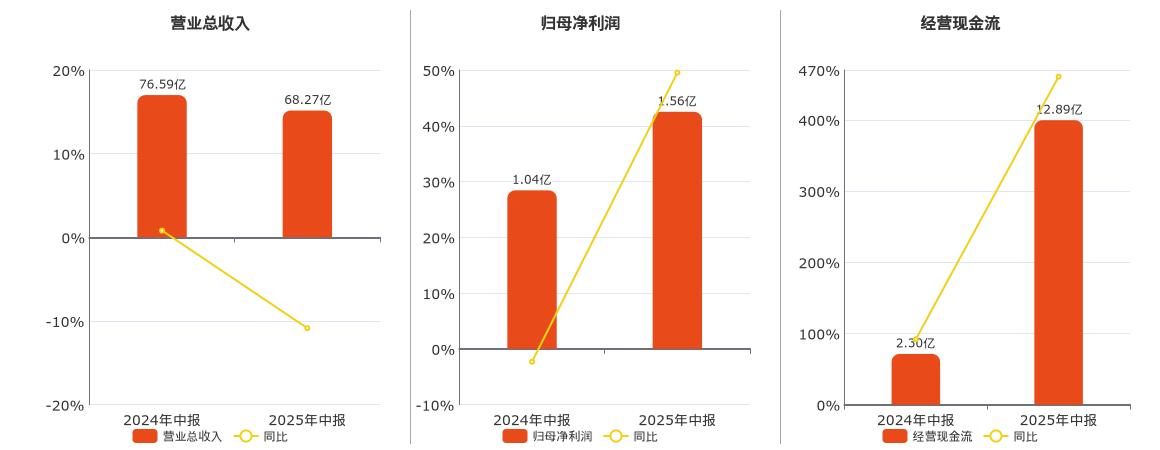
沙钢股份(002075.SZ):2025年中报净利润为1.56亿元、较去年同期上涨49.53%
Xin Lang Cai Jing· 2025-08-21 02:13
Core Insights - The company reported a total revenue of 6.827 billion yuan for the first half of 2025, with a net profit attributable to shareholders of 156 million yuan, representing an increase of 51.53 million yuan or 49.53% year-on-year [1] - The operating cash flow showed a net inflow of 1.289 billion yuan, which is an increase of 1.059 billion yuan compared to the same period last year, marking a 460.71% year-on-year increase [1] Financial Performance - The latest debt-to-asset ratio stands at 62.56%, a decrease of 0.79 percentage points from the previous quarter [3] - The gross profit margin is reported at 8.84%, an increase of 2.32 percentage points from the previous quarter and up 2.96 percentage points year-on-year [3] - The return on equity (ROE) is 2.39%, which is an increase of 0.77 percentage points compared to the same period last year [3] Earnings and Ratios - The diluted earnings per share (EPS) is 0.07 yuan, an increase of 0.02 yuan or 49.58% year-on-year [4] - The total asset turnover ratio is 0.27 times, while the inventory turnover ratio is 3.47 times, reflecting an increase of 0.17 times or 5.16% year-on-year [4] Shareholder Structure - The number of shareholders is 67,200, with the top ten shareholders holding 745 million shares, accounting for 33.94% of the total share capital [4] - The largest shareholder is Jiangsu Shagang Group Co., Ltd., holding 26.80% of the shares [4]


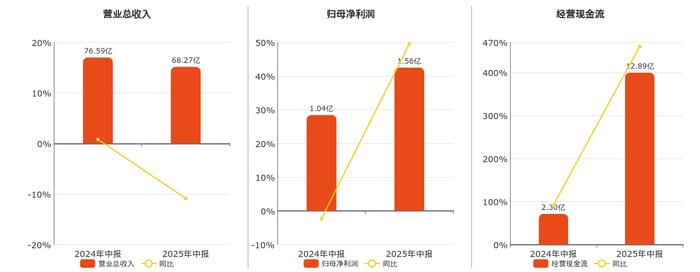
沙钢股份(002075.SZ):2025年中报净利润为1.56亿元
Xin Lang Cai Jing· 2025-08-21 01:40
Financial Performance - The company reported total operating revenue of 6.827 billion yuan, a decrease of 832 million yuan compared to the same period last year, representing a year-on-year decline of 10.86% [1] - The net profit attributable to shareholders was 156 million yuan [1] - The net cash inflow from operating activities was 1.289 billion yuan [1] Financial Ratios - The latest debt-to-asset ratio is 62.56%, an increase of 8.56 percentage points compared to the same period last year [3] - The latest gross profit margin is 8.84% [3] - The return on equity (ROE) is 2.39% [3] - The diluted earnings per share are 0.07 yuan [3] - The total asset turnover ratio is 0.27 times, a decrease of 0.07 times, representing a year-on-year decline of 21.12% [3] - The inventory turnover ratio is 3.47 times [3] Shareholder Information - The number of shareholders is 67,200, with the top ten shareholders holding a total of 745 million shares, accounting for 33.94% of the total share capital [3] - The largest shareholder is Jiangsu Shagang Group Co., Ltd., holding 26.81% of the shares [3]
方大特钢:聘任简鹏为公司财务总监
Mei Ri Jing Ji Xin Wen· 2025-08-20 11:15
Group 1 - The company Fangda Special Steel announced the appointment of Jian Peng as the new Chief Financial Officer after approval from the board's audit and nomination committees [2] - For the year 2024, the revenue composition of Fangda Special Steel is as follows: 98.23% from the steel industry, 1.56% from the mining industry, and 0.21% from other businesses [2]
南京钢铁股份有限公司2025年半年度报告摘要
Shang Hai Zheng Quan Bao· 2025-08-19 19:29
Core Viewpoint - The company has approved a profit distribution plan for the first half of 2025, proposing a cash dividend of 1.186 yuan per 10 shares, which reflects a commitment to shareholder returns and aligns with regulatory requirements [1]. Group 1: Company Overview - The company is named Nanjing Steel Group Co., Ltd., with the stock code 600282 [5]. - The report period covers January to June 2025, with the report date being June 30, 2025 [2]. Group 2: Financial Data - The financial data for the reporting period is presented in RMB, but specific figures are not detailed in the provided text [2]. Group 3: Shareholder Information - The report includes information on the top 10 shareholders, although specific details are not provided in the text [2]. Group 4: Significant Events - The company’s associate, Jiangsu Tiangong Technology Co., Ltd., has received approval to publicly issue shares and list on the Beijing Stock Exchange, which may enhance the company's investment portfolio [3]. - The company has revised its articles of association to eliminate the supervisory board, transferring its responsibilities to the audit and internal control committee, in compliance with the new Company Law [5][6][8]. Group 5: Regulatory Compliance - The revision of the articles of association is in line with the new Company Law effective from July 1, 2024, and aims to improve corporate governance and operational standards [6][8].

中信股份:中信特钢拟开展外汇远期结售汇业务
Zhi Tong Cai Jing· 2025-08-19 12:38
预计中信特钢及子公司自本计划审批通过之日起12个月内任一时点开展远期结售汇业务年累计交易金额 分别不超过1.3亿美元和1.1亿欧元。 中信股份(00267)发布公告,为有效规避和防范外汇市场风险,防止汇率波动对公司生产经营造成的不 利影响,中信特钢(000708)(000708.SZ)及子公司拟开展外汇远期结售汇业务。 ...


华宝期货晨报成材-20250819
Hua Bao Qi Huo· 2025-08-19 03:44
Report Summary 1. Report Industry Investment Rating No investment rating is provided in the report. 2. Core View of the Report - The steel price has corrected due to the drag of raw materials. Although there is still an expectation of production restrictions, the impact of macro - sentiment has decreased, and the steel price has returned to its fundamentals to some extent. Currently, the weak downstream situation persists and is difficult to improve in the short term. The raw materials are expected to fluctuate greatly in the short term and run weakly in a volatile manner [2][3]. 3. Summary by Relevant Content Steel Production Data - In July 2025, key steel enterprises produced 66.8 million tons of crude steel, a year - on - year decrease of 3.2%, with a daily output of 2.1548 million tons, a month - on - month decrease of 5.6% [3]. Home Appliance Retail Data - According to AVC offline market monitoring data, in July, the offline retail sales of color TVs increased by 13.6% year - on - year, refrigerators by 15.7%, washing machines by 15.7%, and air conditioners by 36.5% [3]. Steel Mill Cost and Profit Data - On August 18, the average cost of 76 independent electric arc furnace construction steel mills was 3352 yuan/ton, a daily decrease of 3 yuan/ton. The average profit was - 76 yuan/ton, and the valley - electricity profit was 25 yuan/ton, a daily decrease of 7 yuan/ton [3]. Steel Price Data - On August 18, the ex - factory tax - included price of common billet resources in Qian'an, Tangshan was lowered by 20, reporting 3050. The finished steel fluctuated and declined yesterday. Rebar hit a recent low, and hot - rolled coil fell slightly [3].
特朗普:芯片关税或达300%!
国芯网· 2025-08-18 14:03
Core Viewpoint - The article discusses the potential imposition of high tariffs on semiconductor products by the U.S. government, which could significantly impact the semiconductor industry and supply chain dynamics [1][3]. Group 1: Tariff Announcement - U.S. President Donald Trump plans to announce tariffs on semiconductor products within two weeks, with potential rates exceeding 100% [1]. - Trump suggested that the actual tariff rates could be as high as 200% or 300%, indicating a significant escalation in trade policy [1][3]. Group 2: Impact on Industry - The lack of a clear timeline or rules regarding the tariffs forces semiconductor manufacturers, electronics brands, and AI companies to create contingency plans that may never be utilized, consuming resources and slowing down actual investments [4]. - The ongoing uncertainty regarding whether these tariffs will be implemented creates a dilemma for companies, potentially leading them to hastily shift production to the U.S. without a guarantee of the promised tariff adjustments [4]. Group 3: Investigation and Compliance - The U.S. Department of Commerce has been investigating the semiconductor and pharmaceutical industries since April, as part of a national security review under Section 232, which allows for tariff adjustments based on national security concerns [3][6]. - The timeline for the conclusion of this investigation remains uncertain, adding to the complexity and unpredictability for the affected industries [6].

黄振辉任莱钢集团党委书记,曾长期任职山钢金融板块
Qi Lu Wan Bao· 2025-08-15 02:35
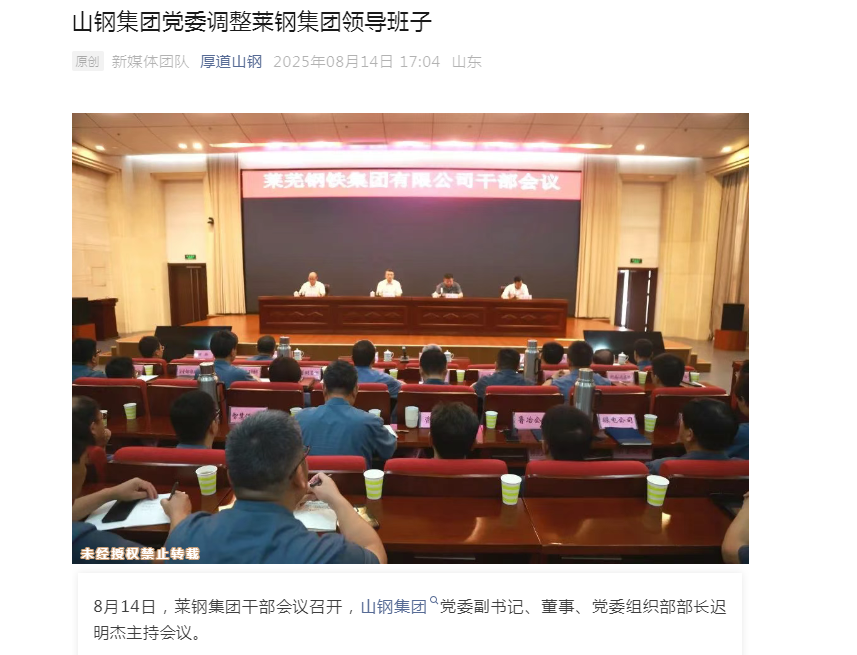
Core Viewpoint - The leadership restructuring at Lai Steel Group has been officially announced, with significant changes in key positions aimed at enhancing management efficiency and strategic direction [4]. Group 1: Leadership Changes - Huang Zhenhui has been appointed as the Party Secretary of Lai Steel Group and designated as the Chairman, while he will no longer be recommended for the position of General Manager [4]. - Qiao Lihai has been appointed as a member and Deputy Secretary of the Party Committee of Lai Steel Group, designated as a director, and recommended as the candidate for General Manager [4]. - Huang Zhenhui has a background in the financial sector of Shandong Steel Group, having previously served as the Deputy Secretary, Director, and General Manager of Shandong Steel Capital [4]. Group 2: Company Background - Lai Steel Group was established in 1999 with a registered capital of 513,254.59 thousand yuan [6]. - Following the restructuring of Shandong Steel in 2008, Lai Steel Group became a wholly-owned subsidiary of Shandong Steel Group [6].

建筑央国企矿产资源重估价值有多大?
GOLDEN SUN SECURITIES· 2025-08-15 00:12
Group 1: Core Insights - The report emphasizes the significant profit contribution of state-owned enterprises in the construction and mineral resources sector, indicating a potential for value reassessment [5] - Key recommendations include companies with high resource contribution and untapped performance potential, such as China Metallurgical Group A (PB 0.64X) and China Metallurgical Group H (PB 0.41X) [5] - Other highlighted companies include China Railway Group A (PB 0.46X) and China Railway Group H (PB 0.30X, 25E dividend yield 4.9%), which have abundant copper and molybdenum resources [5] Group 2: Industry Performance - The report notes that the construction and mineral resources sector is poised for a reassessment of value, driven by the performance potential of untapped resources [5] - The analysis suggests that companies involved in gold business, like Shanghai Construction Group (PB 0.69X), may benefit from rising gold prices [5] - The report indicates that the overall performance of the construction and mineral resources sector is critical for the broader economic landscape, highlighting its importance in the investment strategy [5]