
航运港口

Search documents
重磅!千艘新能源船舶投入长江航运,智慧航道全线覆盖,航运港口板块活跃,招商南油、招商轮船涨停-股票-金融界
Jin Rong Jie· 2025-09-08 02:09
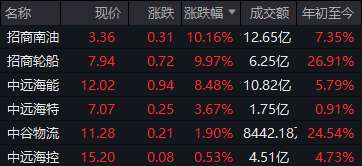
Core Viewpoint - The shipping and port sector is experiencing significant activity, with multiple stocks reaching their daily limit up, driven by advancements in green transformation and smart upgrades in the Yangtze River shipping industry [1][2]. Group 1: Stock Performance - Stocks such as China Merchants Energy (招商南油) and China Merchants Shipping (招商轮船) have hit the daily limit up, while COSCO Shipping Energy (中远海能) rose over 8% [1]. - Other notable performers include China National Offshore Oil Corporation (国航远洋) up over 7%, Ningbo Ocean Shipping (宁波远洋) up over 6%, and Nanjing Port (南京港) up over 5% [1][2]. Group 2: Industry Developments - The Yangtze River shipping sector has made significant progress in green transformation, with over 1,000 new energy inland vessels already in operation [2]. - The construction of 132 new energy vessels on the Sichuan to Anhui section of the Yangtze River has been completed, with an additional 406 expected by 2025 [2]. - The use of shore power for vessels has become routine, with an expected electricity consumption of 190 million kilowatt-hours in 2024, effectively reducing carbon emissions [2]. Group 3: Market Opportunities - The demand for new energy vessels is rapidly increasing, including various power types such as lithium batteries and green methanol, which will drive the transformation and upgrade of shipbuilding enterprises [3]. - The push for smart port construction is increasing the demand for automation and intelligent upgrades in port facilities, creating new market opportunities for equipment manufacturers [3]. - The establishment of a smart shipping system is enhancing operational efficiency, significantly reducing time in processes such as vessel passage and anchoring, while green technologies are lowering operational costs and improving overall industry competitiveness [3]. Group 4: Key Listed Companies - COSCO Shipping Energy (中远海能) is a leading shipping company in China, heavily investing in the transformation towards new energy vessels [4]. - China Merchants Shipping (招商轮船) has a diversified fleet and is actively investing in new energy vessels and smart shipping, enhancing its market competitiveness [4]. - Ningbo Ocean Shipping (宁波远洋) has a strong presence in the Yangtze River Delta and excels in the smart upgrade of ports [4]. - Nanjing Port (南京港) is a crucial port in the lower Yangtze River, leading in smart and green port transformation, showcasing strong development potential [4].


每周股票复盘:海通发展(603162)拟收购两艘船舶
Sou Hu Cai Jing· 2025-09-06 22:24
Core Viewpoint - Haitong Development (603162) has seen a stock price increase of 3.32% this week, closing at 9.03 yuan as of September 5, 2025, with a total market capitalization of 8.359 billion yuan [1] Company Announcements - Haitong Development plans to acquire two multi-purpose cargo ships, PACIFIC HONOUR and PACIFIC HERO, with an assessed value of USD 32,040,000, equivalent to approximately 229.07 million yuan [1] - The market value assessment was conducted by Fuzhou Hedao Asset Appraisal Co., Ltd. as of July 31, 2025, using the market approach [1] - The assessment report is valid from July 31, 2025, to July 0, 2026, and is intended solely for the client's asset acquisition reference [1]

每周股票复盘:凤凰航运(000520)股东户数减少2.46%,拟为孙公司担保1000万元
Sou Hu Cai Jing· 2025-09-06 20:17
Core Viewpoint - Phoenix Shipping's stock price has decreased by 3.56% this week, closing at 4.61 yuan, with a total market capitalization of 4.666 billion yuan, ranking 31st in the shipping and port sector [1] Shareholder Changes - As of August 29, 2025, the number of shareholders decreased by 2.46% to 84,500, with an average shareholding increasing from 11,700 shares to 12,000 shares, and the average shareholding value at 57,200 yuan [1][5] Company Announcements - On September 5, 2025, the company held its 21st meeting of the 9th Board of Directors, approving the appointment of Wang Guozheng as the financial director, and agreeing to provide guarantees for its subsidiary [1] - The company plans to hold its first temporary shareholders' meeting on September 22, 2025, to discuss the guarantee for its subsidiary Shanghai Huatai Shipping [3] Financial Guarantee Details - The company intends to provide a full guarantee for a 10 million yuan credit facility for its wholly-owned subsidiary, Shanghai Huatai Shipping, which has reported a net loss of 4.428 million yuan for the year ending 2024 [2] - The total amount of guarantees provided by the company and its subsidiaries is 50 million yuan, accounting for 10.9% of the latest audited net assets [2]

航运港口板块9月5日涨0.55%,招商轮船领涨,主力资金净流入1.86亿元
Zheng Xing Xing Ye Ri Bao· 2025-09-05 08:56
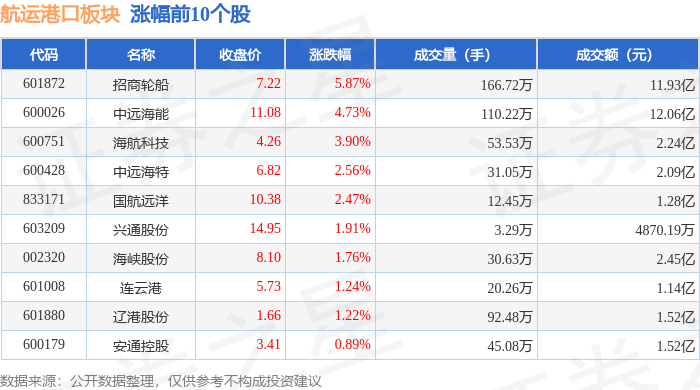
Core Insights - The shipping and port sector experienced a rise of 0.55% on September 5, with China Merchants Energy leading the gains [1] - The Shanghai Composite Index closed at 3812.51, up 1.24%, while the Shenzhen Component Index closed at 12590.56, up 3.89% [1] Sector Performance - The top performers in the shipping and port sector included: - China Merchants Tire (601872) with a closing price of 7.22, up 5.87%, and a trading volume of 1.6672 million shares, totaling 1.193 billion yuan [1] - COSCO Shipping Energy (600026) closed at 11.08, up 4.73%, with a trading volume of 1.1022 million shares, totaling 1.206 billion yuan [1] - HNA Technology (600751) closed at 4.26, up 3.90%, with a trading volume of 535,300 shares, totaling 224 million yuan [1] Market Capital Flow - The shipping and port sector saw a net inflow of 186 million yuan from main funds, while retail investors experienced a net outflow of 89.98 million yuan [2] - The sector's overall trading activity indicated a mixed sentiment among different investor types, with institutional investors showing a positive trend [2]


中谷物流(603565):业绩略超预期,首次中期分红凸显现金牛属性
ZHESHANG SECURITIES· 2025-09-05 08:09
Investment Rating - The investment rating for the company is "Buy" and is maintained [5] Core Views - The company reported a revenue of 5.338 billion yuan for the first half of 2025, a year-on-year decrease of 6.99%, while the net profit attributable to shareholders was 1.072 billion yuan, an increase of 41.59% [1] - The company has a high interim dividend payout ratio of 84.3%, reflecting its strong cash cow characteristics, with a proposed cash dividend of 4.30 yuan per 10 shares, totaling 903 million yuan [3] - The outlook for the second half of 2025 is positive, with expectations for both domestic and foreign trade businesses to maintain good performance due to economic recovery and limited new capacity in the industry [4] Summary by Sections Operating Performance - In Q2 2025, the company achieved a revenue of 2.77 billion yuan, a decrease of 6.25% year-on-year, and a net profit of 525 million yuan, an increase of 42.5%, slightly exceeding the profit expectation of 500 million yuan [1] Business Segments - The decline in revenue was primarily due to market fluctuations and a reduction in domestic shipping capacity, while profit growth was driven by increased contributions from foreign trade leasing, improved domestic freight rates, and effective cost control [2] Dividend Policy - The company has a strong cash reserve of 12.354 billion yuan, supporting its high dividend distribution capability, continuing a tradition of high dividends with a payout ratio of 90.39% in 2024 [3] Profit Forecast - The forecast for net profit attributable to shareholders for 2025-2027 is projected to be 2.01 billion, 2.10 billion, and 2.22 billion yuan respectively, indicating a positive outlook for profitability [5]

航运港口板块9月4日涨0.14%,招商南油领涨,主力资金净流出9751.02万元
Zheng Xing Xing Ye Ri Bao· 2025-09-04 08:48
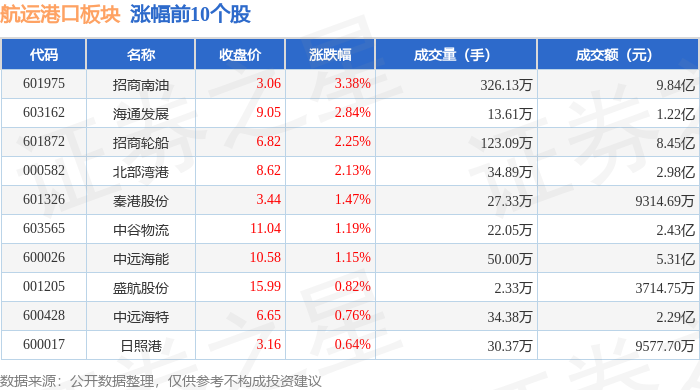
Core Viewpoint - The shipping and port sector experienced a slight increase of 0.14% on September 4, with China Merchants South Oil leading the gains, while the overall market indices, Shanghai Composite and Shenzhen Component, saw declines of 1.25% and 2.83% respectively [1][2]. Group 1: Market Performance - The Shanghai Composite Index closed at 3765.88, down 1.25% [1]. - The Shenzhen Component Index closed at 12118.7, down 2.83% [1]. - The shipping and port sector stocks showed mixed performance, with notable gainers including: - China Merchants South Oil (601975) up 3.38% to 3.06 [1]. - Haitong Development (603162) up 2.84% to 9.05 [1]. - China Merchants Shipping (601872) up 2.25% to 6.82 [1]. Group 2: Trading Volume and Capital Flow - The trading volume for China Merchants South Oil reached 3.2613 million shares, with a transaction value of 984 million yuan [1]. - The shipping and port sector saw a net outflow of 97.51 million yuan from institutional investors and 138 million yuan from speculative funds, while retail investors contributed a net inflow of 235 million yuan [2][3]. - The individual stock capital flows indicated that: - China Merchants South Oil had a net inflow of 73.06 million yuan from institutional investors [3]. - China Merchants Shipping experienced a net outflow of 32.94 million yuan from speculative funds [3].

安通控股: 2025年第三次临时股东会的法律意见书
Zheng Quan Zhi Xing· 2025-09-03 16:18
Core Viewpoint - The legal opinion issued by Shanghai Jintiancheng (Fuzhou) Law Firm confirms that the procedures for convening and holding the 2025 third extraordinary general meeting of shareholders of Antong Holdings Co., Ltd. comply with relevant laws and regulations, ensuring the legality and validity of the meeting and its resolutions [1][8]. Group 1: Meeting Procedures - The meeting was convened by the company's board of directors, with a notice published on August 19, 2025, in major financial newspapers and on the Shanghai Stock Exchange website, meeting the 15-day notice requirement [3][4]. - The meeting took place on September 3, 2025, at 14:00 in Quanzhou, Fujian, utilizing a combination of on-site and online voting methods [4][5]. Group 2: Attendance and Voting - A total of 315 shareholders and their proxies attended the meeting, representing 931,125,201 shares, which is 23.4062% of the total voting shares [5][6]. - Among those, 2 shareholders attended the meeting in person, representing 770,960,151 shares (19.3800% of total voting shares), while 313 shareholders participated via the online voting system, representing 160,165,050 shares (4.0262% of total voting shares) [6][5]. Group 3: Resolutions and Voting Results - The meeting approved the resolution to reappoint Deloitte Touche Tohmatsu Certified Public Accountants LLP as the company's financial auditor for the year 2025, with 928,235,844 votes in favor (99.6896% of votes cast) and 2,754,157 votes against (0.2957% of votes cast) [7]. - The voting results from minority investors showed 157,275,693 votes in favor (98.1960% of minority votes) and 2,754,157 votes against (1.7195% of minority votes) [7]. Group 4: Legal Compliance - The law firm confirmed that all aspects of the meeting, including the convening, attendance, and voting procedures, adhered to the Company Law and relevant regulations, rendering the resolutions passed at the meeting as legal and valid [8].

9月3日晚间重要公告一览
Xi Niu Cai Jing· 2025-09-03 10:18
Group 1 - Shengtun Mining plans to repurchase shares worth between 500 million and 600 million yuan, with a maximum repurchase price of 11.82 yuan per share, aimed at employee stock ownership plans or equity incentives [1] - Kangnbei received a drug registration certificate for Linggui Shugan Granules, which is derived from traditional Chinese medicine and is used for treating phlegm and dampness due to Yang deficiency [2] - Zhangjiang Hi-Tech intends to publicly transfer 100% equity and related debts of Shanghai Jixin Rui Construction Technology Co., Ltd. with a total price not less than 151 million yuan [3] Group 2 - Shankai Intelligent won a bid for a metering device procurement project worth 13.318 million yuan from Hohhot Water Supply Company [4] - Hason Co. plans to jointly establish a supply chain company with a registered capital of 10 million yuan, in which Hason will hold a 10% stake [5] - Pudong Construction's subsidiaries won multiple major projects with a total amount of 1.271 billion yuan [6] Group 3 - Jinling Pharmaceutical received approval for the Phase III clinical trial of Olaratogrel tablets, which are used for treating moderate to severe pain associated with endometriosis [8] - Menohua's subsidiary obtained a drug registration certificate for Mosapride Citrate Tablets, aimed at improving gastrointestinal symptoms [10] - Shapuaisi's major shareholder plans to reduce holdings by up to 2% of the company's shares due to personal financial needs [11] Group 4 - Changyuan Power reported an August electricity generation of 3.771 billion kWh, a year-on-year decrease of 6.03% [15][16] - Xibu Livestock's August fresh milk production increased by 4.8% month-on-month but decreased by 7.27% year-on-year [19] - Yong'an Pharmaceutical's actual controller and chairman had their detention lifted, allowing them to resume normal duties [20] Group 5 - Jinkai Intelligent's director resigned due to work adjustments [22] - Xinhua Medical received a Class II medical device registration for an endoscope cleaning workstation [23] - Haishi Science and Technology's innovative drug HSK47388 received approval for a new indication clinical trial [25] Group 6 - Baotai Co. plans to participate in a land use rights auction in Baoji City with a starting price of 57.34 million yuan [26] - Minfeng Special Paper received a government subsidy totaling 11.2 million yuan [27] - Jiuchang Bio obtained a medical device registration for a heparin-binding protein assay kit [29] Group 7 - Jingao Technology plans to repurchase shares worth between 200 million and 400 million yuan, with a maximum price of 17.36 yuan per share [31] - Youxunda won a bid for a metering equipment project from China Southern Power Grid worth approximately 161 million yuan [32] - Qianli Technology reported an August vehicle sales increase of 168.55% year-on-year [32] Group 8 - Guangzhou Port expects an August container throughput increase of 1.2% year-on-year [32] - Kexing Pharmaceutical's GB08 injection completed the first subject enrollment for Phase II clinical trials [33] - Wu Ming Pharmaceutical plans to transfer 98.9% of its subsidiary's shares to a newly established wholly-owned subsidiary [34] Group 9 - Shanghai Electric's acquisition of K-Electric Limited shares has not yet completed the transfer [35] - Fulai New Materials plans to raise no more than 710 million yuan through a private placement [36] - Huaren Health's drug registration application for a new type of potassium ion competitive acid blocker has been accepted [37]





航运港口板块9月3日跌1.19%,南 京 港领跌,主力资金净流出4.26亿元
Zheng Xing Xing Ye Ri Bao· 2025-09-03 08:40
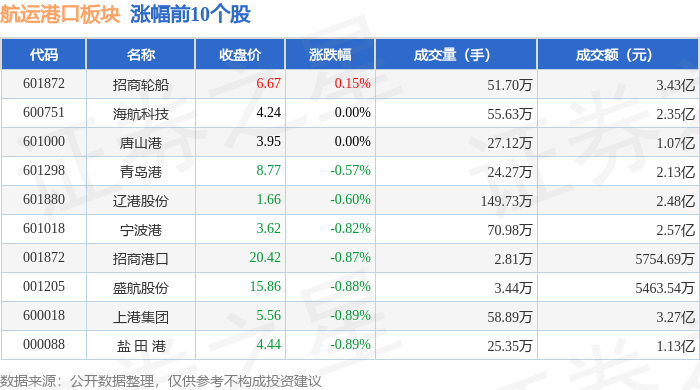
Market Overview - On September 3, the shipping and port sector declined by 1.19%, with Nanjing Port leading the drop [1] - The Shanghai Composite Index closed at 3813.56, down 1.16%, while the Shenzhen Component Index closed at 12472.0, down 0.65% [1] Individual Stock Performance - The closing prices and changes for key stocks in the shipping and port sector are as follows: - China Merchants Energy (601872) closed at 6.67, up 0.15% with a trading volume of 517,000 shares [1] - HNA Technology (600751) closed at 4.24, unchanged with a trading volume of 556,300 shares [1] - Tangshan Port (601000) closed at 3.95, unchanged with a trading volume of 271,200 shares [1] - Qingdao Port (601298) closed at 8.77, down 0.57% with a trading volume of 242,700 shares [1] - Liaoning Port (601880) closed at 1.66, down 0.60% with a trading volume of 1,497,300 shares [1] - Ningbo Port (601018) closed at 3.62, down 0.82% with a trading volume of 709,800 shares [1] - China Merchants Port (001872) closed at 20.42, down 0.87% with a trading volume of 28,100 shares [1] - Shenghang Co. (001205) closed at 15.86, down 0.88% with a trading volume of 34,400 shares [1] - Shanghai Port Group (600018) closed at 5.56, down 0.89% with a trading volume of 588,900 shares [1] - Tantanpu (000088) closed at 4.44, down 0.89% with a trading volume of 253,500 shares [1] Capital Flow Analysis - The shipping and port sector experienced a net outflow of 426 million yuan from institutional investors, while retail investors saw a net inflow of 277 million yuan [2] - Key capital flows for selected stocks include: - Shanghai Port Group (600018) had a net inflow of 61.34 million yuan from institutional investors, but a net outflow of 41.39 million yuan from retail investors [2] - HNA Technology (600751) saw a net inflow of 9.43 million yuan from institutional investors, with retail investors experiencing a net outflow of 6.39 million yuan [2] - China Merchants Port (001872) had a net inflow of 5.52 million yuan from institutional investors, while retail investors faced a net outflow of 3.52 million yuan [2] - Qingdao Port (601298) recorded a net inflow of 5.10 million yuan from institutional investors, with retail investors seeing a net outflow of 4.76 million yuan [2]
航运港口2025年8月专题:原油、干散货吞吐量稳步复苏,集装箱吞吐量稳增
Xinda Securities· 2025-09-03 07:32
Report Industry Investment Rating - The report gives a "Bullish" rating for the shipping and port industry [2] Core Viewpoints - The overall throughput performance is stable, so the report maintains a "Bullish" rating for the shipping and port sector [8] Summary by Directory 1. Overview: National Import-Export Volume and Cargo Throughput - **Import-Export Volume**: From January to July 2025, the national import-export volume reached 25.7 trillion yuan, a year-on-year increase of 3.5%. The national import volume was 10.39 trillion yuan, a year-on-year decrease of 1.6%, and the national export volume was 15.3 trillion yuan, a year-on-year increase of 7.3% [2] - **Cargo Throughput**: From January to July 2025, the cargo throughput of major coastal ports in China reached 66.83 billion tons, a year-on-year increase of 2.9%, and the foreign trade cargo throughput of major coastal ports reached 28.85 billion tons, a year-on-year increase of 2.2% [3] 2. Containers: Container Shipping Freight Rates and Container Throughput - **Container Shipping Freight Rates**: On August 29, 2025, CCFI closed at 1,156.32 points, a year-on-year decrease of 42.74% and a month-on-month decrease of 1.58%. SCFI closed at 1,445.06 points, a year-on-year decrease of 53.35% and a month-on-month increase of 2.1% [4] - **Container Throughput**: From January to July 2025, the container throughput of major coastal ports in China reached 178.71 million TEUs, a year-on-year increase of 6.5%. The year-on-year growth rates of Qingdao, Shanghai, Ningbo-Zhoushan, and Shenzhen were 7.8%, 4.4%, 9.4%, and 8.8% respectively [4] 3. Liquid Bulk: Oil Shipping Freight Rates and Crude Oil Throughput - **Oil Shipping Freight Rates**: On August 29, 2025, BDTI closed at 1,045 points, a year-on-year increase of 18.62% and a month-on-month increase of 0.29%. On August 28, 2025, the TCE of TD3C, TD25, and TD22 routes were 49,000, 42,700, and 43,300 US dollars per day respectively [6] - **Crude Oil Throughput**: From January to July 2025, China's crude oil imports reached 327 million tons, a year-on-year increase of 2.8%. The crude oil throughput of major crude oil unloading port enterprises reached 229 million tons, a year-on-year decrease of 4.34% [6] 4. Dry Bulk: Bulk Shipping Freight Rates and Iron Ore, Coal Throughput - **Bulk Shipping Freight Rates**: On August 29, 2025, BDI closed at 2,025 points, a year-on-year increase of 11.63% and a month-on-month increase of 4.17% [7] - **Iron Ore Throughput**: On August 27, 2025, the port iron ore inventory was 133 million tons. From January to July 2025, the iron ore throughput of major iron ore unloading port enterprises reached 800 million tons, a year-on-year increase of 2% [7] - **Coal Throughput**: On August 29, 2025, the coal inventory in northern ports was 23 million tons. From January to July 2025, the coal throughput of major coal shipping port enterprises in the north reached 395 million tons, a year-on-year decrease of 1.35% [7] 5. Monthly Throughput of Key Port Listed Companies - **Shanghai International Port Group**: In July 2025, the cargo throughput was 51 million tons, and the container throughput was 4.616 million TEUs. From January to July 2025, the cumulative cargo throughput was 348 million tons, and the cumulative container throughput was 31.681 million TEUs [88] - **Ningbo Port**: In July 2025, the cargo throughput was 95 million tons, and the container throughput was 4.31 million TEUs. From January to July 2025, the cumulative cargo throughput was 695 million tons, and the cumulative container throughput was 29.74 million TEUs [88] - **China Merchants Port Holdings**: In July 2025, the container throughput of Pearl River Delta ports was 1.489 million TEUs, and the container throughput of overseas ports was 3.231 million TEUs. From January to July 2025, the cumulative container throughput of Pearl River Delta ports was 10.457 million TEUs, and the cumulative container throughput of overseas ports was 22.441 million TEUs [88] - **Beibu Gulf Port**: In July 2025, the cargo throughput was 30 million tons, and the container throughput was 792,300 TEUs. From January to July 2025, the cumulative cargo throughput was 205 million tons, and the cumulative container throughput was 5.5508 million TEUs [88] - **Guangzhou Port**: In July 2025, the cargo throughput was 50 million tons, and the container throughput was 2.272 million TEUs. From January to July 2025, the cumulative cargo throughput was 337 million tons, and the cumulative container throughput was 15.676 million TEUs [88]