Workflow
教育
icon
Search documents
多部门印发实施方案 支持北京提振和扩大消费 积极开展汽车贷款业务 引导社会资本加大对服务消费重点领域投资
Core Insights - The People's Bank of China Beijing Branch, along with 12 other departments, issued an implementation plan to support the expansion of consumption in Beijing, aiming to enhance financial services in the consumption sector by 2030 [1][2] Group 1: Financial Support for Consumption - The implementation plan emphasizes the need for quality enterprises in the consumption industry to finance through public offerings and "New Third Board" listings [1] - It aims to increase the loan balance for sectors such as accommodation, catering, cultural tourism, education, and elderly services, while enhancing the quality and efficiency of personal consumption financial services [1] - The plan sets a goal to establish a diversified consumption financial service system to support Beijing's development as an international consumption center [1] Group 2: Credit Support and Financial Products - The plan calls for increased credit support for consumer goods, particularly in the automotive sector, by optimizing loan issuance ratios, terms, and interest rates [2] - Financial institutions are encouraged to innovate financial products tailored to various car purchasing scenarios, including first-time purchases and trade-ins, with a focus on electric vehicles [2] - There is a push for financial institutions to meet consumer demand in areas like home appliances, green smart home renovations, and electronics through various promotional activities [2] Group 3: Equity Financing and Investment - The plan supports equity financing for quality enterprises in the consumption industry through public listings and private equity investments [2] - It encourages social capital to invest in key service consumption areas, utilizing "long-term capital" and "patient capital" to meet the financing needs of long-cycle consumption industries [2] - The role of private equity and venture capital funds is highlighted to increase investments in seed and early-stage enterprises [2]
【钛晨报】事关高标准数字园区建设,工信部最新部署;英伟达和微软将向投资人工智能初创公司Anthropic合计投资至多150亿美元;北京:加大对汽车特别是...
Tai Mei Ti A P P· 2025-11-18 23:41
【钛媒体综合】11月18日,工业和信息化部办公厅印发《高标准数字园区建设指南》(下文简称《指 南》)。 《指南》提出,目标到2027年,建成200个左右高标准数字园区,实现园区规上工业企业数字化改造全 覆盖,园区管理、服务数字化水平明显提升,形成一批可复制可推广的数智赋能园区发展的典型模式, 园区发展质量和效益显著提升。工业互联网应用覆盖园区全部行业,规上工业企业数字化改造覆盖率达 100%。数字基础设施支撑作用显著增强,双千兆网络覆盖率达100%,算力基础设施实现有效部署和应 用,数据开放共享、安全保障水平显著提升。 《指南》提出,构筑数据开发利用平台。统筹建设园区统一数字平台,加强对园区各部门、各企业的数 据采集、清洗与标注,构建园区高质量数据集。探索建设可信数据空间,破除多主体数据共享共用信任 壁垒,强化"人工智能+可信数据空间"应用,推动园区数据服务创新。 《指南》提出,打造企业数字化转型标杆。聚焦园区主导产业,依托制造业数字化转型通用评估指标体 系引导企业数字化改造,建设制造业数字化转型促进中心等载体,深化新一代信息技术全链条赋能应 用,推动企业全要素生产率提升。积极开展"人工智能+制造"应用探索, ...
道指、纳指收跌逾1%,亚马逊、AMD跌超4%,中概指数涨0.42%
Ge Long Hui A P P· 2025-11-18 22:18
格隆汇11月19日|美股三大指数集体收跌,道琼斯指数跌1.07%,标普500指数跌0.83%,纳斯达克综合 指数跌1.21%。大型科技股多数下挫,亚马逊、AMD跌超4%,微软、英伟达跌超2%,特斯拉跌超1%。 纳斯达克金龙中国指数收涨0.42%,热门中概股中,大全新能源初步收跌6.7%,阿特斯太阳能跌6.7%, 晶科能源跌6.1%,亚朵跌2.9%,再鼎医药跌2.2%,蔚来跌1.5%,百胜中国、新东方涨超2.6%。 ...
酒店免税数据持续改善,双十一总额增14.2%
Investment Rating - The report assigns an "Accumulate" rating for the industry [4] Core Insights - The report highlights significant improvements in hotel and duty-free data, with a recommendation for stocks such as Shoulv Hotel, Jinjiang Hotel, China Duty Free, and Huazhu [5] - The report emphasizes the shift in major platforms during the Double Eleven shopping festival, focusing on instant retail and AI to enhance consumer experience [2] - The overall e-commerce sales during Double Eleven reached approximately 1,695 billion yuan, marking a year-on-year increase of 14.2% [5] Summary by Relevant Sections Hotel and Duty-Free Sector - The hotel and duty-free sectors have shown substantial improvement, with recommended stocks including Shoulv Hotel, Jinjiang Hotel, China Duty Free, and Huazhu [5] - The report notes that Jinjiang Hotel's stock rose by 13.13% and China Duty Free by 11.76% in the last week [5] Retail Sector - The report indicates that the retail sector is experiencing a transformation, with platforms like Meituan and Taobao enhancing their offerings [5] - Meituan's flash purchase platform reported record high transaction volumes and user spending, with nearly 400 product categories seeing over 100% year-on-year growth [5] E-commerce Performance - The total e-commerce sales during the Double Eleven period reached approximately 1,695 billion yuan, reflecting a 14.2% increase compared to the previous year [5] - The report highlights that comprehensive e-commerce sales totaled 1,619 billion yuan, up 12.3% year-on-year [5] Stock Recommendations - The report recommends stocks with low valuations and high dividends, including Action Education, Sumida, and Chongqing Department Store [5] - It also suggests stocks benefiting from AI advancements, such as Kangnait Optical and Tianli International Holdings [5]
国家育人战略、个人需求共振下的教育行业投资框架解析
Guoxin Securities· 2025-11-18 14:01
Group 1 - The education industry is closely linked to admission and employment, having nurtured several companies with market values exceeding 100 billion RMB, driven by its essential demand and prepayment business model [2][12] - The "impossible triangle" of "large scale, low cost, and personalization" limits the industry, leading to low concentration levels, with K12 training having a CR5 of only 4.7% in 2017 [2][20] - AI education offers a new approach to address the "impossible triangle" by providing low-cost, personalized solutions, which is a significant development direction for the industry [2][24] Group 2 - The adjustment of the "five-five diversion" and the expansion of general high schools in response to national talent strategies present both challenges and opportunities for education service companies related to admissions [2][34] - The demand for education services is strong but varies across segments, with civil service exams seeing a record number of applicants, and vocational education gaining importance as skilled talent is increasingly valued [2][36] - The higher education enrollment rate in China is projected to rise from 48.1% in 2018 to 60.8% in 2024, indicating a strong desire for higher qualifications despite economic pressures [2][38] Group 3 - The K12 training sector is experiencing a slowdown in offline expansion, with leading companies focusing on quality improvement and shareholder returns [2][11] - The civil service exam sector remains robust, with companies like Huatu Education and Fenbi leveraging AI to enhance competitiveness against smaller institutions [2][12] - The vocational education leader, China Oriental Education, is benefiting from an increase in student enrollment and regional center development, leading to a rapid recovery in profit margins [2][11] Group 4 - The education industry is closely tied to policy direction and personal education service demand, with recommendations prioritizing civil service recruitment and vocational education sectors [2][5] - K12 training companies that can adapt to structural changes and improve educational quality are recommended, including companies like Excellence Education Group and New Oriental [2][5] - The transition of private higher education institutions has been slow, but recent positive signals from provinces like Guangdong and Hunan suggest potential for valuation recovery [2][5]
AI是泡沫?50家企业实战证明:真正的机会藏在“落地体系”里
混沌学园· 2025-11-18 11:58
Core Insights - The article discusses the cyclical nature of AI investment, highlighting the trend of initial enthusiasm followed by disillusionment as projects fail to deliver returns [2][3] - It emphasizes the importance of a "mid-level landing" approach, where businesses must align AI technology with their specific operational needs to achieve profitability [7][16] Group 1: AI Investment Trends - Many companies experience a cycle of "initial hype and year-end cooling," leading to project abandonment due to lack of visible returns [2] - The AI landscape is characterized by a divide between grand narratives of large models and practical applications that fail to connect with business needs [2][3] - A significant number of enterprises abandon AI initiatives due to various challenges, with only a small fraction achieving tangible results [3] Group 2: Successful AI Implementation - Companies that successfully monetize AI have identified the "AI + business" mid-level integration path, focusing on practical applications rather than abstract concepts [4][7] - The "Chaos AI Commercial Landing Application White Paper" aims to bridge the gap between macro concepts and micro techniques, providing actionable insights for businesses [4][16] - Successful AI applications are characterized by their ability to enhance operational efficiency and generate revenue, rather than merely serving as technological novelties [10][21] Group 3: Common Pitfalls - Companies often fall into the trap of "showy investments" that do not address real business needs, leading to low usage rates and increased customer complaints [8] - There is a tendency for businesses to become overly focused on minor technical details, neglecting the core business objectives that drive profitability [9] Group 4: Identifying Real Opportunities - The article outlines a framework for identifying genuine opportunities in AI by focusing on mid-level integration that aligns technology with specific business scenarios [10][21] - Successful case studies demonstrate that AI can significantly improve efficiency in repetitive tasks, leading to quick returns on investment [10][19] Group 5: L1-L5 Implementation Framework - The L1-L5 framework provides a structured approach for businesses to implement AI, starting from low-cost, high-impact initiatives to more complex, ecosystem-level integrations [15][18] - Each level of the framework is tailored to different business needs, ensuring that companies can find suitable entry points for AI adoption [16][24] Group 6: Practical Recommendations - Small and medium-sized enterprises are encouraged to start with L1 initiatives, focusing on easily implementable tasks that yield quick results [28] - Mature companies should aim for L2-L3 breakthroughs by optimizing cross-departmental processes and embedding AI into core products [29] - Leading enterprises are advised to pursue L4-L5 strategies, developing AI-native products and building ecosystems to capture long-term value [31]
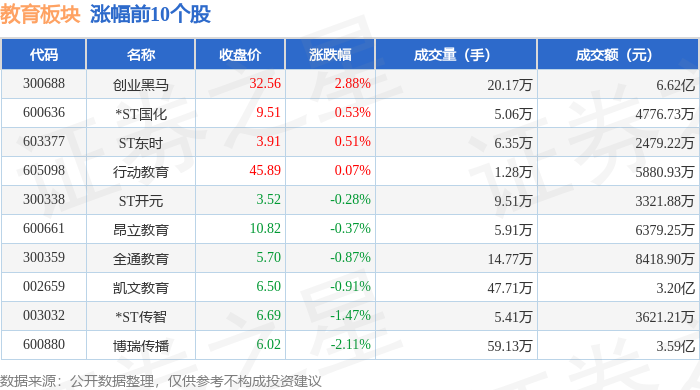
教育板块11月18日涨0.31%,ST开元领涨,主力资金净流入1亿元
Core Insights - The education sector experienced a slight increase of 0.31% on November 18, with ST Kaiyuan leading the gains [1] - The Shanghai Composite Index closed at 3939.81, down 0.81%, while the Shenzhen Component Index closed at 13080.49, down 0.92% [1] Stock Performance - ST Kaiyuan (300338) saw a closing price of 4.69, with a significant increase of 10.61% and a trading volume of 338,600 shares, resulting in a transaction value of 154 million yuan [1] - Other notable performers included ST Dongshi (603377) with a 5.10% increase, closing at 4.33, and Chuangyeti Ma (300688) with a 2.94% increase, closing at 32.22 [1] - Conversely, Kevin Education (002659) and Guomai Technology (002093) experienced declines of 2.20% and 1.48%, closing at 5.79 and 12.01 respectively [2] Capital Flow - The education sector saw a net inflow of 100 million yuan from institutional investors, while retail investors experienced a net outflow of approximately 91 million yuan [2] - The capital flow data indicates that major stocks like Kede Education (300192) and Chuangyeti Ma (300688) attracted significant net inflows of 50.16 million yuan and 45.88 million yuan respectively [3] - In contrast, stocks like Xueda Education (000526) and Angli Education (600661) faced net outflows of 1.19 million yuan and 1.49 million yuan respectively [3]
收评:创业板指跌1.16% 互联网电商板块强势
Zhong Guo Jing Ji Wang· 2025-11-18 07:24
Core Viewpoint - The A-share market experienced a collective decline across the three major indices, with the Shanghai Composite Index falling by 0.81% to 3939.81 points, the Shenzhen Component Index down by 0.92% to 13080.49 points, and the ChiNext Index decreasing by 1.16% to 3069.22 points, indicating a bearish sentiment in the market [1]. Market Performance - The total trading volume for the Shanghai Composite Index was 790.949 billion yuan, while the Shenzhen Component Index recorded a trading volume of 1135.119 billion yuan, and the ChiNext Index had a trading volume of 501.567 billion yuan [1]. - The internet e-commerce sector led the gains with an increase of 2.27%, followed by cultural media at 2.03%, and IT services at 1.17% [2]. - The education sector also saw a rise of 1.17%, while kitchen and bathroom appliances increased by 1.12% [2]. Declining Sectors - The coal mining and processing sector experienced the largest decline at -4.59%, followed by the battery sector at -4.49%, and the steel sector at -3.40% [2]. - Other sectors that faced significant drops include industrial metals at -3.29% and energy metals at -2.94% [2].
异动盘点1118 | 黄金股延续跌势,金科服务复牌后涨超17%;锂矿股集体大涨,小鹏汽车跌超10%
贝塔投资智库· 2025-11-18 04:01
Group 1 - Ctrip Group-S (09961) reported a net operating revenue of 18.3 billion RMB (approximately 2.6 billion USD) for Q3 2025, a 16% increase year-on-year [1] - XPeng Motors-W (09868) experienced a decline of over 9% post-earnings, with Q3 revenue at 20.38 billion RMB, a 102% year-on-year growth, but slightly below market expectations of 20.45 billion RMB [1] - BeiGene (06160) saw a 2.32% increase following positive results from its Phase III HERIZON-GEA-01 study [1] - Kinko Service (09666) surged over 17% after resuming trading, with a revised offer price of 6.67 HKD per share contingent on shareholder approval for delisting [1] Group 2 - Gold stocks continued to decline, with Lingbao Gold (03330) down 6.91% and Tongguan Gold (00340) down 4.66%, as gold prices fell for the fourth consecutive day [2] - Joy City Property (00207) rose 1.67% after announcing plans to withdraw its listing status on November 27 [2] - Semiconductor stocks performed well, with Hua Hong Semiconductor (01347) up 4.45% and SMIC (00981) up 1.58%, indicating high demand with a 95.8% capacity utilization rate in Q3 [2] - Guangzheng Education (06068) fell nearly 10%, projecting a net profit of approximately 37.7 million RMB for the fiscal year ending August 31, 2025, down from 96.4 million RMB in the previous year [2] Group 3 - Coal stocks faced declines, with Yanzhou Coal Mining (01171) down 4.7% and China Shenhua Energy (01088) down 3.59%, despite a quarter-on-quarter recovery in coal prices [3] - Hong Kong Travel (00308) dropped over 17% following the announcement of a cash distribution plan related to its private company shares [4] Group 4 - Dell Technologies (DELL.US) fell 8.43% after Morgan Stanley downgraded its stock rating from "Overweight" to "Underweight," raising concerns about its earnings outlook [5] - XPeng Motors (XPEV.US) dropped 10.32% as its Q3 revenue fell short of market expectations [5] - Lithium stocks surged, with Sigma Lithium (SGML.US) up 32.34%, driven by strong demand rather than supply disruptions [5] - Sohu (SOHU.US) rose 7.26% with a Q3 revenue of 180 million USD, a 19% increase year-on-year [6] - Quantum Computing (QUBT.US) increased 8.49% after reporting better-than-expected earnings and outlining a roadmap for mass production [6] - Google (GOOGL.US) gained 3.11% following Berkshire Hathaway's new investment in Alphabet [6] - Alibaba (BABA.US) rose over 2.54% after announcing its entry into the AI to C market with the "Qianwen" project [6]
11.18犀牛财经早报:A股公司年末忙着资产出售 报道称瑞银总部考虑迁往美国
Xi Niu Cai Jing· 2025-11-18 01:32
Group 1: Commodity ETFs Growth - The total scale of commodity ETFs in the market has increased by over 200% this year, reaching a total of 229.99 billion yuan with a net inflow of 102.02 billion yuan as of November 14 [1] - The primary driver of this growth is the performance of gold ETFs, with leading products like Huaan Gold ETF growing from 1.2 billion yuan at inception to 87.38 billion yuan, a more than 70-fold increase [1] - The rise in commodity prices has created a profit-making effect that attracts capital into commodity ETFs, which offer a low-threshold and transparent investment tool for ordinary investors [1] Group 2: Asset Sales by A-Share Companies - Nearly 250 A-share companies have announced asset sales since October, reflecting a significant increase compared to previous years [1] - Companies are selling assets to focus on core businesses, accelerate capital recovery, or improve annual performance due to unsatisfactory results in the first three quarters [1] - The urgency of asset sales is influenced by new delisting regulations that pressure companies to meet financial data standards, although there are uncertainties in completing these sales by year-end [1] Group 3: Lithium Battery Industry and Energy Storage - The energy storage market has surged since Q3, driving rapid demand for lithium battery materials, with prices for lithium hexafluorophosphate, lithium iron phosphate, and lithium carbonate significantly increasing [2] - Phosphate lithium batteries dominate the new energy storage sector, accounting for over 97% of installed capacity [2] - The energy storage boom is seen as a new growth driver for lithium demand, indicating that this trend may just be beginning [2] Group 4: Major Contracts and Stock Price Catalysts - Nearly 70 A-share companies have signed significant contracts or strategic cooperation agreements since October, which are viewed positively by the market and tend to boost stock prices [3] - The mechanical equipment and power equipment sectors have the highest number of companies involved in these contracts, with notable projects like a 6.16 billion yuan contract for a large-scale energy storage project [3] Group 5: Hong Kong-listed Automakers' Q3 Reports - Xpeng Motors, Leap Motor, and Geely Auto reported their Q3 results, with Xpeng's losses narrowing significantly, Leap continuing to be profitable, and Geely's profits increasing substantially [4] - The automotive industry is expected to face a critical phase next year, with companies needing strong profitability to survive [4] - All three companies expressed optimism about the market outlook and plans to accelerate overseas expansion despite the upcoming reduction in new energy vehicle purchase tax incentives [4]