
数据服务

Search documents
上海钢联(300226) - 上海钢联投资者关系活动记录表20251113
2025-11-13 09:32
Group 1: Business Operations and Strategy - The company has not yet engaged in stablecoin business but will comply with regulations if it does in the future [2] - The company is considering a name change to better reflect its diverse business operations [2] - The company’s production and operations are normal despite the controlling shareholder's share pledge [2] Group 2: Financial Performance and Challenges - The decline in industrial data service revenue is attributed to industry challenges such as "production resilience, weak consumption, and low profits" [3] - The overall gross margin is expected to improve through enhanced data quality, service fee increases, and trade model upgrades [3] - The company acknowledges that net profit growth is primarily driven by interest from idle funds and government subsidies [3] Group 3: Future Growth and Development - The company aims to enhance its core competitiveness through technological innovation, digital transformation, and overseas market expansion [3] - The focus remains on internal growth while actively seeking acquisition opportunities [4] - The company is committed to becoming a leading integrated service provider in steel circulation by optimizing supply chain services [4]

北京大兴机场临空经济区全球招商伙伴大会举办
Zhong Guo Xin Wen Wang· 2025-11-12 18:36
载体建设是产业发展的坚实基石。国际航空总部园、国际再生医学产业园即将迎来开园,两大园区精准 锚定临空经济核心赛道,以高标准规划打造专业化产业空间,为相关领域企业提供从研发、生产到运营 的全链条载体支撑;已投运的大兴临空国际生物医药园、大兴机场综保区公共库、五十六度玫瑰园等成 熟项目,助力企业快速融入跨境贸易、生命健康等领域产业集群,为企业落地提供载体"硬支撑",让合 作前景更加清晰可期。 一批具有临空特色的产业服务平台在大会上集中亮相,为企业发展提供专业"软服务"。由大兴临空国际 生物医药园与卡尔斯集团携手打造的国际口腔医学合作平台,已与全球口腔医疗巨头美国汉瑞祥集团及 其旗下德国科美勒达成全面战略合作,并与中国牙病防治基金会等构建集临床诊疗、技术研发、人才培 养于一体的国际口腔医疗服务高地;由综保区公共库与北京中健云康医药有限公司打造的医药供应链平 台致力于构建以北京为核心,覆盖京津冀200公里直配范围的高效医药物流配送网络,为药品、器械企 业提供专业化的医药仓储、医药配送、专业化订单管理等服务,全球冷链战略服务网络覆盖超120个城 市,大幅提升医药产品流通效率与国际竞争力;由新航城公司建设运营的大兴临空数 ...
奥飞数据(300738.SZ)控股子公司奥飞新能源挂牌申请获受理
智通财经网· 2025-11-12 12:06
Core Viewpoint - Aofei Data (300738.SZ) announced that its subsidiary, Guangdong Aofei New Energy Co., Ltd., has received an acceptance notice for its listing application on the National Equities Exchange and Quotations (NEEQ) [1] Group 1 - Aofei New Energy received the acceptance notice on November 12, 2025 [1] - The application documents submitted by Aofei New Energy met the relevant requirements for acceptance as per the NEEQ listing rules [1] - The acceptance notice is identified with the number GP2025110003 [1]

协创数据(300857.SZ):已在上海、宁波、成都、乌兰察布等国内核心节点以及东南亚及美国等海外市场建立分布式算力网络
Ge Long Hui· 2025-11-12 11:14
Core Viewpoint - The company is actively building a high-end GPU computing server cluster and has established a distributed computing network in key domestic locations and overseas markets [1] Group 1 - The company has set up distributed computing networks in Shanghai, Ningbo, Chengdu, Ulanqab, Southeast Asia, and the United States [1] - The company currently has a substantial backlog of orders and is actively advancing the delivery of these orders [1]

2025年中国城市可信数据空间行业研究报告
艾瑞咨询· 2025-11-12 00:06
Core Insights - The urban trusted data space is a government-led data infrastructure that facilitates the development and utilization of urban data resources, serving as a key carrier for trusted data space [1][2] Development Drivers - **Policy**: The establishment of urban trusted data spaces is encouraged through a series of top-level designs and strategic plans aimed at promoting the compliant and efficient circulation of data [4][5] - **Technology**: Privacy computing and blockchain technology are introduced to address the challenges of trusted data circulation, enabling data sharing while ensuring compliance and security [5][6] - **Demand**: Urban areas face challenges in data resource development and utilization, which the trusted data space aims to address by providing a secure and compliant environment for data circulation [8] Value Proposition - The urban trusted data space aims to break down data circulation barriers, activate the potential of data elements, and promote the modernization of urban governance [11] Overall Framework - The urban trusted data space is built around a foundational infrastructure, two major platforms, and aims to empower urban digital transformation [13] Core Capabilities - The core capabilities of the urban trusted data space include trusted control, resource interaction, and value co-creation, which are essential for establishing a trusted data circulation infrastructure [16] Industry Chain and Ecosystem - The urban trusted data space involves five main entities: operators, data providers, data users, data service providers, and regulatory bodies, each playing a crucial role in the ecosystem [21] Competitive Landscape - In the technical service sector, comprehensive and specialized service providers compete, with ICT background cloud service providers leading the market [24] Application Scenarios - **Government Services**: The urban trusted data space facilitates inter-departmental data connectivity, enhancing government services and decision-making [27] - **Inclusive Finance**: By integrating government and financial data, the urban trusted data space supports the development of dynamic risk assessment models for inclusive finance [30] Case Studies - **Zhangjiakou Trusted Data Space**: This initiative employs a "one space, four platforms, one system" architecture to support the secure circulation of public and social data [33][35] - **Shanghai Trusted Data Space**: This project leverages blockchain technology to meet the complex data needs of a megacity, facilitating the secure and efficient use of data [37][39] Technical Trends - AI technology is becoming a key driver in enhancing data governance efficiency within urban trusted data spaces, transitioning from manual to automated governance strategies [42] Future Trends - The urban trusted data space is expected to evolve from pilot projects to a collaborative ecosystem, attracting industry and enterprise participation to explore vertical applications [44][45]


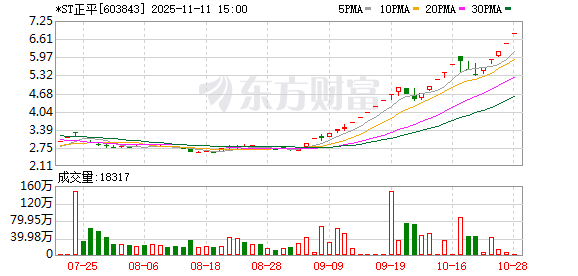
13次提示风险!603843 停牌核查结束 今日复牌
Shang Hai Zheng Quan Bao· 2025-11-11 22:59
Core Viewpoint - *ST Zhengping has completed its stock trading review and will resume trading on November 12, 2025, after a significant stock price increase of 152.42% from September 1 to October 28, 2025, indicating potential market overheating and irrational speculation risks [2][3]. Group 1: Stock Trading and Review - The stock of *ST Zhengping was suspended from trading for review due to concerns over excessive price increases and potential risks [2][3]. - The review confirmed that non-operating fund occupation has been fully repaid, but the company faces significant uncertainties regarding its mineral resource mining capabilities and risks of delisting [3][4]. Group 2: Financial Performance - For the year 2024, *ST Zhengping reported a revenue of 1.362 billion yuan and a net loss of 484 million yuan, with a net loss of 990 million yuan for the first three quarters of 2025 [7]. - The company has been actively expanding into new business areas such as renewable energy construction and intelligent computing services to foster new growth points [7]. Group 3: Mining Operations and Risks - The company has received a mining license but lacks sufficient mining capacity, requiring significant investment for future development, which is uncertain due to financial constraints [6][7]. - As of June 30, 2025, the company had 102 million yuan in cash, with 81.6642 million yuan restricted, and a high debt ratio of 92.22% [6]. Group 4: New Business Ventures - *ST Zhengping has established a partnership with Hangzhou Bingtai Technology Co., focusing on data software development and computing services [8][10]. - The company is working on collaborative projects with local governments to develop intelligent computing and renewable energy initiatives [7].

进博会观察|184岁的邓白氏,主动选择在中国To C了
Jing Ji Guan Cha Wang· 2025-11-11 07:07
Core Viewpoint - Dun & Bradstreet has shifted its focus from B2B to include B2C services in the Chinese market, launching a consumer product "Longyicha" to enhance its data service offerings and reach a broader customer base [2][3]. Group 1: Business Strategy - Dun & Bradstreet has participated in the China International Import Expo for six consecutive years, showcasing its comprehensive solutions for companies going global [2]. - The company aims to adapt its global product model to meet the specific needs of the Chinese market, focusing on local regulations and customer demands [2][3]. - The introduction of the "Longyicha" product represents a strategic pivot to serve individual consumers, thereby enhancing its influence in the B2B sector [3]. Group 2: Product Features - "Longyicha" differentiates itself by utilizing global data rather than just domestic business data, providing a more comprehensive view of companies [4]. - The product includes unique payment data that reveals external payment behaviors, offering insights into a company's financial health [4]. - The global enterprise data coding system developed by Dun & Bradstreet allows for unique identification of companies, facilitating accurate data management even in cases of name duplication [5]. Group 3: Data Security and Compliance - Dun & Bradstreet emphasizes compliance with local laws and regulations, having achieved high standards in data security, including certification from the Ministry of Public Security in China [7]. - The company implements a comprehensive data lifecycle management approach, ensuring data is used within authorized limits to prevent misuse [7]. Group 4: AI and Innovation - The company has embraced AI technology to lower the barriers for data usage, allowing for more efficient decision-making processes [8][9]. - The development of Agented AI marks a significant transformation in how data is utilized, enabling automated workflows and task execution [8]. - Dun & Bradstreet is focused on optimizing existing processes through AI, rather than a complete overhaul, indicating a gradual approach to innovation [9]. Group 5: Market Development and Partnerships - The company recognizes the potential for data utilization among large enterprises in China and aims to empower various industries through partnerships [10]. - Dun & Bradstreet is also targeting mid-sized enterprises, which are seen as having significant growth potential, particularly in regions like the Yangtze River Delta and the Pearl River Delta [10][11].

AI能预测人心么?
伍治坚证据主义· 2025-11-10 03:33
Core Insights - The article discusses the rise and fall of Simulmatics, a company founded in 1960 that aimed to predict human behavior through data modeling, initially gaining fame by assisting John F. Kennedy's presidential campaign [2][3][4] - Simulmatics transitioned from political modeling to commercial applications, promoting the idea of using scientific methods to predict consumer behavior, but faced challenges due to the complexity of the commercial world and competition from established advertising firms [5][6] - The company found temporary revival during the Vietnam War by creating psychological models for military applications, but ultimately faced criticism and failure due to the ethical implications and lack of scientific validity in their reports [7][8][10][11] - The narrative serves as a cautionary tale about the overconfidence in data and algorithms to predict human behavior, drawing parallels to contemporary trends in AI and finance, emphasizing that human emotions and complexities cannot be fully quantified [12][13][15][16] Group 1: Company Background and Initial Success - Simulmatics was founded by Ithiel de Sola Pool and others, who believed that human behavior could be predicted with sufficient data [2] - The company gained its first client, Kennedy's campaign, by using extensive polling data to create a political database and model voter behavior [3][4] - Their predictive model was notably accurate during the 1960 election, leading to increased recognition and a belief in the potential of data-driven predictions [4] Group 2: Commercialization and Challenges - After Kennedy's victory, Simulmatics sought to commercialize their political models, targeting major corporations with their Media-Mix program to predict advertising effectiveness [5] - The company struggled with competition from established advertising firms that had more consumer data and faster processing capabilities, leading to financial difficulties [6] Group 3: Military Applications and Ethical Concerns - The Vietnam War provided a new opportunity for Simulmatics to apply their modeling techniques to military strategies, but this led to ethical dilemmas and negative consequences for individuals involved in their studies [7][8] - Their reports were ultimately deemed scientifically invalid, leading to the termination of government contracts and a decline in reputation [10][11] Group 4: Lessons and Reflections - The story of Simulmatics highlights the dangers of over-reliance on data and algorithms to predict human behavior, a theme that resonates with current trends in AI and finance [12][13][15] - The article warns that while data can enhance decision-making, it cannot replace human judgment and understanding of emotions, emphasizing the need for a balanced approach to technology and data [16]

国家数据基础设施建设第一批先行先试工作取得积极成效
Xin Hua She· 2025-11-08 08:09
Core Insights - The National Data Bureau has reported significant progress in the construction of national data infrastructure, with 18 cities including Beijing and Nanjing establishing data nodes and over 3,900 entities involved in data transactions and development [1][2] - As of September, the total volume of high-quality data sets in the country exceeded 500PB, with 362 companies in data labeling and 85,000 professionals contributing to a related output value of 16.3 billion [1] - The average daily Token consumption has surpassed 40 trillion, marking a growth of over 400 times compared to early 2024 [1] Group 1 - The first batch of pilot projects for national data infrastructure has successfully incubated over 100 business scenarios and provided more than 13,000 data products [1] - The National Data Bureau aims to achieve comprehensive pilot testing by the end of 2026, basic coverage in major cities by the end of 2028, and the completion of the main structure of national data infrastructure by the end of 2029 [1][2] - The second batch of pilot projects will build on the first, focusing on technical maturity, scenario effectiveness, standard applicability, and institutional compatibility while ensuring security [2]
国办印发实施意见:打造一批新领域新赛道应用场景
Zhong Guo Zheng Quan Bao· 2025-11-08 05:10
Core Insights - The State Council of China has issued implementation opinions aimed at accelerating the cultivation and opening of new application scenarios, emphasizing the importance of integrating technology and industry to promote innovation and economic development [1][2]. Group 1: New Application Scenarios - The opinions focus on creating new application scenarios in five areas: digital economy, artificial intelligence, industrial transformation, social governance, and improving people's livelihoods, proposing 22 key areas for cultivation and opening [2][3]. - In the digital economy, the opinions highlight the need to explore the potential of data elements, support technological innovation in data analysis, circulation, and security, and promote the integration of the digital and real economies through technologies like the metaverse and virtual reality [2][3]. - For artificial intelligence, the emphasis is on strengthening core technology breakthroughs and promoting high-value application scenarios to meet diverse development needs across various sectors [2][3]. Group 2: Industrial Transformation and Upgrading - In the manufacturing sector, the opinions advocate for the application of core technologies such as smart manufacturing and green manufacturing, and the development of flexible production lines and smart factories [3]. - The transportation sector is encouraged to innovate in smart traffic management and optimize urban traffic structures, enhancing efficiency while ensuring safety [3]. - The opinions also call for collaborative efforts to improve market access environments and optimize the allocation of resources, including exploring new market-based configurations for elements like space and deep-sea resources [3].