
核聚变能源

Search documents
西部证券:核聚变产业进程加速 多技术路线并行发展
智通财经网· 2025-10-22 04:04
Core Insights - Nuclear fusion is expected to become the ultimate energy source due to its high energy density and safety advantages, with significant support from policies and capital accelerating the industrial process [2][5] - Major global economies are strategically focusing on the prospects of nuclear fusion, providing support in terms of policies and funding to expedite industrialization [2][5] Group 1: Industry Overview - Nuclear fusion involves the combination of two light atomic nuclei under high temperature and pressure, releasing a large amount of energy, and is seen as a potential ultimate energy source for humanity [2] - Despite existing technical challenges such as energy balance and material performance, strong policy and capital support will drive the acceleration of research and development in the industry [2] - The CFETR in China, EU-DEMO in Europe, and K-DEMO in South Korea are planned to begin construction between 2035 and 2040, with operations expected to start by 2050 [2] Group 2: Technological Developments - Various technological routes for nuclear fusion exist, with the Tokamak being the most mature, while other routes like Z-pinch also show potential [3] - The Tokamak technology, which uses magnetic fields to confine plasma, is the most widely applied and developed, with significant milestones such as the EAST achieving high-quality burning at 100 million degrees Celsius for 1000 seconds [3] Group 3: Cost Structure - The main cost components of Tokamak systems include the magnetic system, vacuum chamber, and other supporting systems, with the magnetic system accounting for 28% of costs, vacuum chamber 8%, and internal components 17% [4] - The industry is focusing on superconducting magnets to enhance plasma confinement time, with high-temperature superconductors expected to improve fusion reaction rates and reduce cooling costs as technology matures [4] Group 4: Investment Opportunities - With major fusion devices like BEST in planning or construction phases and large-scale bidding imminent, investment opportunities are emerging in related sectors [5] - Companies to watch include those involved in low-temperature superconductors, high-temperature superconductors, vacuum chambers, and power systems, such as Western Superconducting, Lianchuang Optoelectronics, and others [5]

院士领衔,获联想等机构投资,「安东聚变」完成近亿元首轮融资 | 36氪首发
3 6 Ke· 2025-10-22 03:35
Core Insights - Antong Fusion has completed nearly 100 million yuan in its first round of financing, with investments from Lenovo Star, Qif Capital, Pangu Chuangfu, Daoyi Capital, and Tsinghua Alumni Fund, aimed at talent development, fusion driver system R&D, and testing platform construction [1] - Antong Fusion, established in November 2022, is the first commercial team in China focused on Z-pinch fusion technology, aiming to accelerate the development of controllable nuclear fusion technology and support future commercial power generation [1][3] - The company is led by Chief Scientist Peng Xianjue, a member of the Chinese Academy of Engineering, who has proposed the "Z-pinch fusion fission hybrid reactor" energy technology [1][4] Industry Overview - Controlled nuclear fusion is seen as a key solution for future energy needs, with significant investments and support from governments and tech giants globally [2][3] - In China, 2023 has been marked as the year of commercialization for controllable nuclear fusion, with 19 public investment events and over 10 billion yuan in total financing [3] - The maturity of controllable nuclear fusion technology is estimated to take 10-15 years, with challenges in achieving energy gain and control [4] Z-Pinch Technology - The Z-pinch method involves using a metal sleeve to load plasma with axial current, creating a magnetic field that compresses the plasma, leading to fusion reactions [5][6] - This method is considered more straightforward and cost-effective compared to other fusion techniques, with the potential for high energy conversion efficiency [5][6] Commercialization Strategy - Antong Fusion aims to leverage China's industrial capabilities in energy storage, electricity, and manufacturing to accelerate the commercialization of controllable nuclear fusion [6] - The company plans to develop a series of equipment, including the "Kuiniu" discharge unit and "Leizhenzi" integrated discharge module, with the goal of achieving mass production capabilities by 2030 [8][9] Talent Development - Antong Fusion has established a collaborative research team comprising experienced scientists from top universities and research institutions, ensuring a robust talent pipeline for its long-term goals [9] - The team includes senior scientists like Peng Xianjue, mid-level experts like Yang Qingwei, and younger scientists led by CEO Liu Cheng, focusing on both technological breakthroughs and commercialization efforts [9]


可控核聚变板块震荡上扬,安泰科技涨停
Xin Lang Cai Jing· 2025-10-22 03:00
可控核聚变板块震荡上扬,安泰科技涨停,中国核建涨超6%,大西洋、合锻智能、天力复合、辰光医 疗跟涨。 ...

新奥亮相聚变能“奥林匹克”盛会 氢硼聚变技术引国际瞩目
Xin Lang Zheng Quan· 2025-10-21 06:28
Core Viewpoint - Newao's participation in the World Fusion Energy Group's second ministerial meeting and the IAEA's 30th Fusion Energy Conference highlights its recognition in the international fusion field and showcases China's strength in global fusion exploration [1][4]. Group 1: Event Participation and Recognition - Newao was invited to the prestigious World Fusion Energy Group's second ministerial meeting and the IAEA's 30th Fusion Energy Conference, emphasizing its role as a representative of hydrogen-boron fusion technology [1]. - The conference gathered nearly 2,000 experts and officials from 61 countries and international organizations, showcasing the global interest in fusion energy [1]. - Newao's achievements, particularly the "Xuanlong-50U" device's breakthroughs, were included in the IAEA's "Fusion Energy Outlook 2025" report, receiving high praise for China's advancements in fusion technology [1]. Group 2: Technological Advancements and Future Plans - Newao's exhibition at the conference attracted significant attention, with experts engaging in discussions about the latest advancements in hydrogen-boron fusion and its commercialization prospects [2]. - The company has built two generations of spherical tokamak experimental devices and is currently constructing the next-generation device "Helong-2," aiming to conduct hydrogen-boron combustion experiments by 2027 [2]. - Newao's strategic plan includes a three-step approach: experimentation, ignition, and power generation, contributing to a clear timeline for fusion energy development in China [2]. Group 3: Collaborative Efforts and Ecosystem Building - Newao emphasizes an open collaboration approach, actively promoting fusion research and applications through various technical exchange activities during the conference [5]. - The company has established partnerships with top institutions across four continents and initiated a hydrogen-boron fusion research fund, attracting proposals from 19 domestic institutions [8]. - Newao's presence at the international conference reflects its commitment to participating in the global energy revolution and advancing the commercialization of hydrogen-boron fusion [8].


实现“终极能源”自由?聚变能正加速商业化
Sou Hu Cai Jing· 2025-10-20 09:12
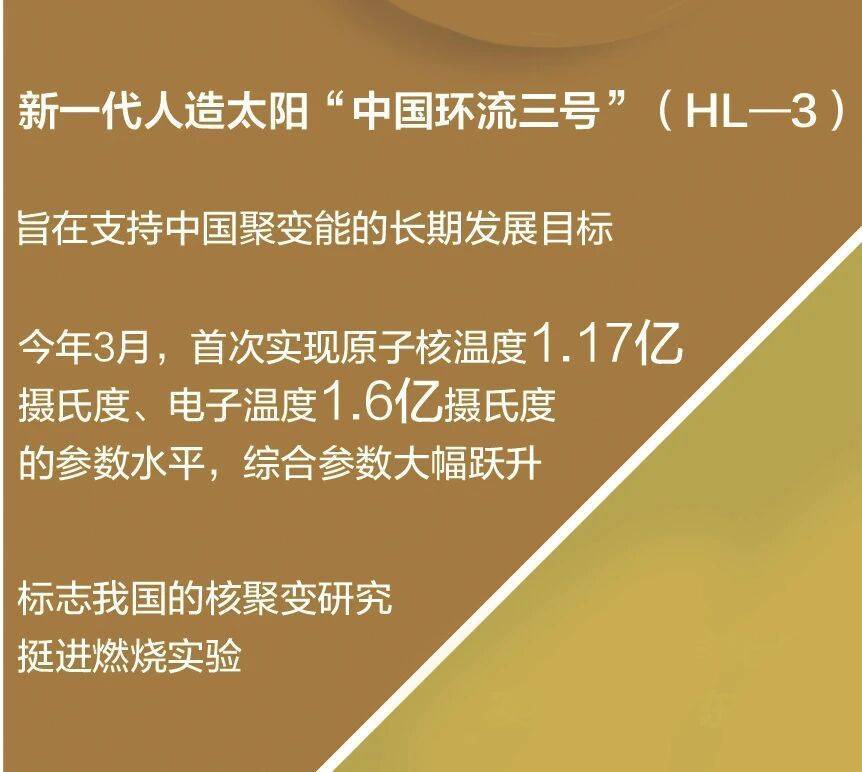
Core Insights - The commercialization of fusion energy is a hot topic at the recent ministerial meeting and the 30th International Conference on Fusion Energy held in Chengdu, China, highlighting the acceleration of fusion technology from research to engineering and commercial applications [1] Group 1: Technological Advancements - China's fusion research facilities are rapidly transitioning from experimental tools to industrial hubs, providing a solid hardware foundation for engineering and commercialization breakthroughs [1] - The "Chinese Circulation No. 3" (HL-3) has achieved significant milestones, including reaching atomic temperatures of 117 million degrees Celsius and electron temperatures of 160 million degrees Celsius, laying the groundwork for future fusion reactor applications [4] - The "East" (EAST) facility has set a world record by maintaining a plasma temperature of 100 million degrees Celsius for 1066 seconds, showcasing over 200 core technologies developed independently [7] - The "Kua Fu" (CRAFT) facility has successfully developed the largest and highest thermal load prototype component for fusion reactors, addressing critical engineering challenges [9][11] Group 2: Global Trends and Investments - Globally, nearly 40 countries are advancing fusion plans, with over 160 fusion devices either operational, under construction, or planned, and private investments exceeding $10 billion [13] - Italy and the U.S. are making significant investments in fusion energy, with Italy aiming for its first plasma by 2030 and the U.S. Department of Energy funding new fusion innovation projects [13] Group 3: Challenges and Future Outlook - The commercialization of fusion energy faces multiple challenges, including technical hurdles related to plasma stability, high-temperature materials, and the economic viability of supply chains [14] - China aims to initiate fusion energy burning experiments by 2027 and develop its first engineering experimental reactor by around 2035 [14] - A comprehensive ecosystem supporting the engineering and industrialization of fusion energy is being established through policy guidance, international cooperation, and innovative mechanisms [15][16] Group 4: International Collaboration - China is a key partner in the ITER project, successfully completing the design and manufacturing of 18 critical components, contributing to global fusion engineering efforts [16] - The establishment of the China Fusion Energy Company aims to enhance collaboration between state-owned enterprises, private companies, and research institutions, fostering a synergistic approach to fusion technology development [16]
“人造太阳”加速商业化意味着什么
Ren Min Ri Bao· 2025-10-20 07:48
Core Insights - The commercialization of fusion energy technology is accelerating from scientific research to engineering practice and application, as highlighted in the recent international conference held in Chengdu, China [2][3] Group 1: Technological Advancements - China's fusion research facilities are transitioning from experimental tools to industrial hubs, providing a solid hardware foundation for engineering and commercialization breakthroughs [3] - The "Chinese Circulation No. 3" (HL-3) achieved significant milestones, including reaching nuclear temperatures of 117 million degrees Celsius and electron temperatures of 160 million degrees Celsius, marking a leap in fusion parameters [3] - The "East" (EAST) facility set a world record by maintaining a plasma state at 1 million degrees Celsius for 1066 seconds, showcasing over 200 core technologies developed independently [4] - The "Kua Fu" (CRAFT) facility successfully tested a prototype component that addresses critical engineering challenges in fusion reactor operations [4][5] Group 2: Global Trends and Investments - Globally, nearly 40 countries are advancing fusion plans, with over 160 fusion devices in operation, under construction, or planned, and private investments exceeding $10 billion [6] - Italy and the U.S. are making significant investments in fusion energy, with Italy aiming for its first plasma by 2030 and the U.S. Department of Energy funding new collaborative projects [6] Group 3: Challenges to Commercialization - The commercialization of fusion energy faces multiple challenges, including technological hurdles related to plasma stability, material durability, and fuel sustainability [7] - The industry ecosystem must address supply chain maturity, economic viability, investment sustainability, and regulatory adaptability [7] Group 4: Policy and Ecosystem Development - China is building an ecosystem to support the engineering and industrialization of fusion energy through policy guidance and international cooperation [8] - Recent policies have prioritized controlled nuclear fusion as a key area for low-carbon technology development, with significant investments in research and infrastructure [8] Group 5: International Collaboration - China has established partnerships with over 140 fusion research institutions across 50 countries, contributing to the global fusion energy landscape [9] - The formation of the China Fusion Energy Company aims to enhance collaboration between research institutions and enterprises, fostering innovation and market vitality [9] Group 6: Future Outlook - The vision for fusion energy is to provide abundant, clean energy, with expectations for significant advancements in experimental and commercial fusion reactors by 2035 and beyond [10]
核聚变产业进程加速,多技术路线并行发展
2025-10-19 15:58
Summary of Fusion Industry Conference Call Industry Overview - The fusion industry is experiencing accelerated progress with multiple technological routes developing in parallel, including magnetic confinement (tokamak, stellarator) and inertial confinement (laser, Z-pinch) [1][10] - Fusion technology offers high energy density, abundant reactants, high safety, and environmental benefits, making it a potential ultimate energy source for humanity [1][3] - The energy release efficiency of fusion is a million times higher than traditional chemical energy, with 1 gram of deuterium-tritium fusion equivalent to 11.2 tons of standard coal [1][3] Key Developments - The U.S. National Ignition Facility (NIF) has validated feasibility with a laser energy output of 8.6 megajoules from 2.08 megajoules input [5] - Japan's JT60U achieved an energy gain factor of 1.25, confirming the viability of magnetic confinement [5] - China plans to complete the BEST experimental reactor and CFEDR engineering experimental reactor by around 2030, gradually moving towards commercial power generation [1][5] Market Expectations - According to the report "The Global Fusion Industry in 2024," most companies expect commercial power generation between 2031-2035, with over 70% anticipating it before 2035 [6] - The fusion sector is seen as a clear industrial trend, not just a thematic investment, driven by policy, capital, and AI support [2][24] Investment Opportunities - The fusion sector presents significant investment opportunities, particularly in low-temperature superconducting magnets, high-temperature superconductors, vacuum chambers, and power systems [3][21][23] - Major players include Western Superconducting Technologies for low-temperature superconductors and Lianchuang Optoelectronics for high-temperature superconductors [21] - The expected market space for fusion-related projects in China from 2025 to 2030 is over 300 billion yuan, with more than 30 devices anticipated to be operational [24] Challenges and Solutions - Current limitations in fusion technology include energy balance, material performance, and tritium self-sustainability [9] - The extreme environments faced by components like filters and blankets pose significant challenges, but advancements in experimental reactors and AI are expected to accelerate solutions [9][8] Policy and Capital Support - The fusion industry is receiving strong backing from government policies and capital investments, with significant involvement from state-owned enterprises and tech giants [7][8] - AI is playing a crucial role in optimizing reaction conditions and material development, enhancing the overall progress of fusion technology [8] Conclusion - The fusion industry is on the brink of significant advancements, with a clear trajectory towards commercialization and substantial investment potential, driven by technological innovations and supportive policies [24]
聚变能研发进入新阶段,“人造太阳”离我们有多远?
Xin Hua She· 2025-10-19 07:09
Core Insights - The concept of creating a "man-made sun" for limitless clean energy is a significant human aspiration, but achieving controlled nuclear fusion remains a complex challenge due to the extreme conditions required for fusion reactions [1][2]. Group 1: Challenges of Nuclear Fusion - Nuclear fusion requires creating conditions similar to those in the sun, specifically heating deuterium-tritium plasma to over 100 million degrees Celsius, which is 6 to 7 times the temperature at the sun's core [2]. - The complexity of controlled nuclear fusion encompasses various scientific fields, including plasma physics, nuclear engineering, and materials science, making it one of the most intricate energy systems conceived by humanity [2]. Group 2: Current Global Developments - Global research on fusion energy has entered a new phase characterized by parallel pathways and rapid iterations, with two main technological routes: magnetic confinement and inertial confinement [3]. - The International Thermonuclear Experimental Reactor (ITER) is the largest global fusion research project, aiming to demonstrate the feasibility of magnetic confinement fusion by 2040 to 2050 [3]. Group 3: China's Role in Fusion Energy - China has established itself as a significant player in the fusion energy sector, with the International Atomic Energy Agency's fusion research and training collaboration center recently established in Chengdu [4]. - The "Chinese Circulation No. 3" project aims to achieve temperatures exceeding 100 million degrees Celsius by 2025, marking a major advancement in China's controlled nuclear fusion technology [4][5]. - The EAST facility in Hefei has set a world record by achieving 1000 seconds of high-quality burning at 100 million degrees Celsius, indicating progress in fusion research [5].
科学与健康丨聚变能研发进入新阶段,“人造太阳”离我们有多远?
Xin Hua Wang· 2025-10-18 23:28
Core Insights - The development of fusion energy has entered a new phase, with significant advancements in technology and international collaboration [3][4]. Group 1: Fusion Energy Challenges and Opportunities - Achieving controlled nuclear fusion requires creating extreme conditions, with plasma needing to be heated to over 100 million degrees Celsius, which is 6 to 7 times the temperature at the sun's core [2]. - Successful controlled fusion could lead to profound changes, providing a nearly limitless clean energy source and reducing reliance on fossil fuels [2]. Group 2: Global Progress in Fusion Research - The global fusion energy research is now characterized by parallel pathways and rapid iterations, with two main technical routes: magnetic confinement and inertial confinement [3]. - The International Thermonuclear Experimental Reactor (ITER) is the largest global fusion research project, aiming to demonstrate the feasibility of magnetic confinement fusion by 2040 to 2050 [3]. Group 3: China's Role in Fusion Energy Development - China has established itself as a key player in fusion energy, with a complete nuclear industrial system and a collaborative innovation framework involving academia and industry [4][5]. - Significant milestones include the "Chinese Circulation No. 3" achieving over 100 million degrees Celsius and the EAST facility setting a world record for high-quality burning at 100 million degrees for 1000 seconds [5].
聚变能技术从科研向工程实践和应用迈进 “人造太阳”加速商业化意味着什么(瞰前沿·大国重器)
Ren Min Ri Bao· 2025-10-18 22:08
Core Insights - The commercialization of fusion energy is a hot topic at the recent ministerial meeting and the 30th International Conference on Fusion Energy held in Chengdu, China, highlighting the acceleration of fusion technology from research to engineering and commercial applications [1][2] Group 1: Technological Advancements - China's fusion research facilities are transitioning from experimental tools to industrial hubs, providing a solid hardware foundation for engineering and commercialization breakthroughs [2] - The "Chinese Tokamak" (HL-3) achieved significant milestones, including reaching atomic temperatures of 117 million degrees Celsius and electron temperatures of 160 million degrees Celsius, marking a leap in fusion parameters [2] - The "East" (EAST) facility set a world record by maintaining a plasma state of 1 million degrees Celsius for 1066 seconds, showcasing over 200 core technologies developed independently [3] Group 2: Industry Participation - Private enterprises are making strides in advanced fusion configurations, with New Hope Group's "Xuanlong-50U" achieving significant breakthroughs in plasma current and magnetic field performance [4] - Start-up Energy Singularity successfully developed a high-temperature superconducting magnet, achieving a peak magnetic field strength of 21.7 Tesla, aimed at next-generation Tokamak devices [4] Group 3: Global Trends and Investments - The global landscape for fusion energy commercialization is accelerating, with nearly 40 countries advancing fusion plans and over 160 fusion devices in operation, under construction, or planned, with private investments exceeding $10 billion [5][6] - Italy and the U.S. are implementing policies to enhance nuclear energy and fusion research, with significant funding allocated for various projects [6] Group 4: Challenges Ahead - Despite significant progress, the commercialization of fusion energy faces multiple challenges, including technological hurdles related to plasma stability, material durability, and fuel sustainability [7] - The industry ecosystem must address supply chain maturity, economic viability, investment sustainability, and regulatory adaptability [7] Group 5: Policy and Ecosystem Development - China is building an ecosystem to support the engineering and industrialization of fusion energy through policy guidance, international cooperation, and innovative mechanisms [8] - Various local governments are implementing supportive policies to foster fusion energy industry clusters, such as in Anhui and Sichuan [8] Group 6: International Collaboration - China is a key partner in the ITER project, successfully completing the design and manufacturing of critical components, contributing to global fusion engineering [9] - The establishment of the Controlled Fusion Innovation Alliance, which includes 38 members from various sectors, aims to integrate research and market advantages [9] Group 7: Future Outlook - The vision for fusion energy is to provide abundant, clean energy, with expectations for significant advancements in experimental and commercial fusion technologies by 2030 and beyond [10]