消费金融

Search documents
央行启动信用修复,1万元以下逾期还清不影响买房买车
3 6 Ke· 2025-12-24 09:51
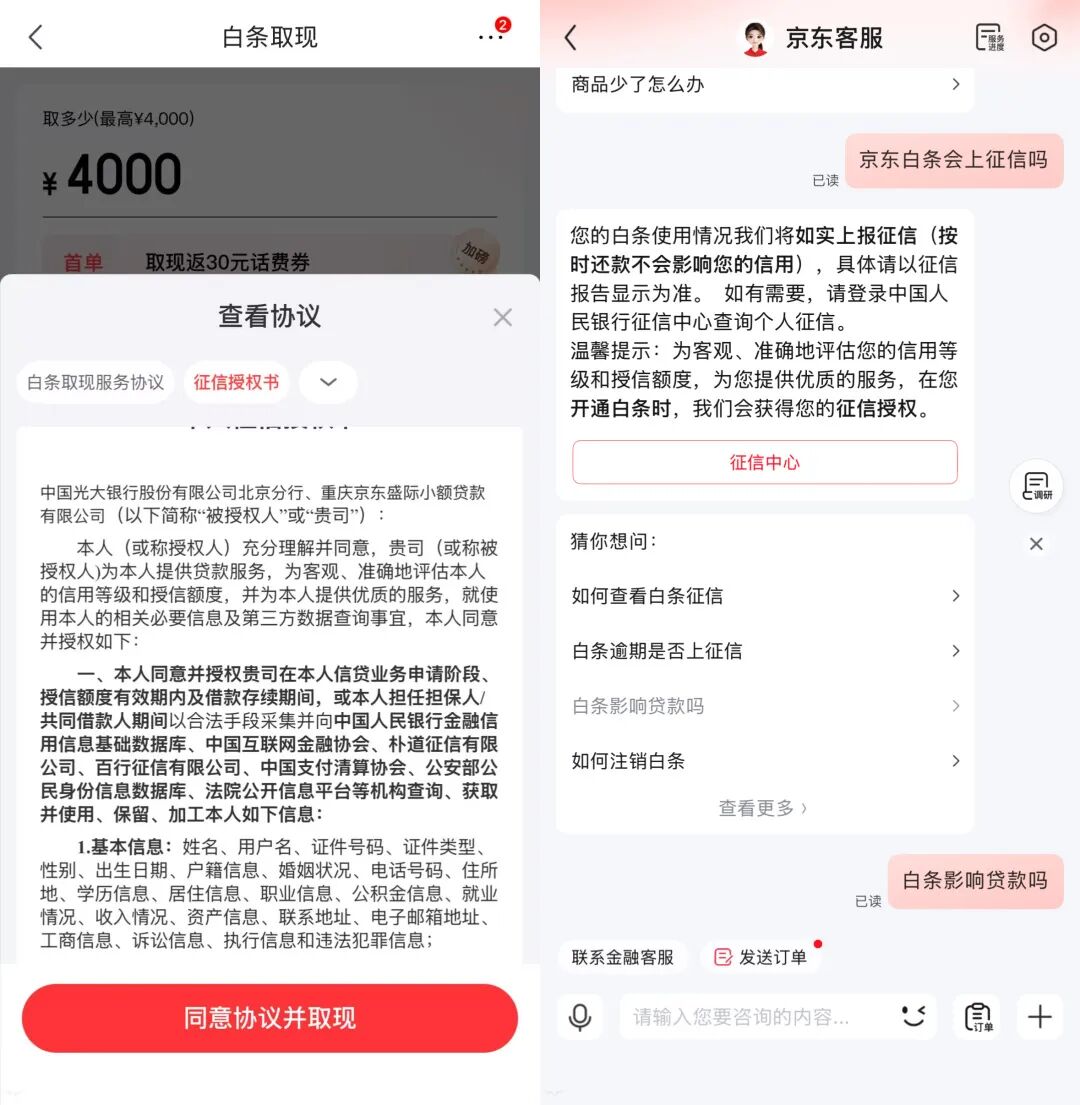
Core Insights - The article discusses the impact of credit records on individuals' financial opportunities, particularly in relation to loans and mortgages, highlighting the growing concern over credit management in the context of increasing credit consumption [1][3][13] Group 1: Credit Information and Its Implications - As of November 2025, the central bank's credit system has recorded credit information for 810 million individuals, indicating the extensive reach of credit data [1] - Small overdue amounts, even as low as 100 yuan, can lead to significant consequences, such as loan rejections, affecting individuals' ability to secure mortgages or business loans [1][3] - The article emphasizes that all credit products, including "Huabei" and "JD White Bar," are reported to the credit system, and consumers often overlook the implications of their credit behavior when using these services [7][9] Group 2: Risks Associated with "Buy Now, Pay Later" Schemes - The "Buy Now, Pay Later" model has become increasingly popular, but it poses risks such as impulsive spending and potential credit damage due to missed payments [9][12] - Many consumers are unaware of the credit implications of these services, as they are often set as default payment options, leading to unintentional credit obligations [9][12] Group 3: Credit Repair Initiatives - The People's Bank of China has introduced a one-time credit repair policy aimed at individuals with small overdue amounts, allowing for the removal of certain overdue records if debts are settled by specific deadlines [16] - This policy applies to various types of loans, including personal, housing, and consumer loans, and aims to alleviate the credit challenges faced by individuals [16] - The initiative reflects a broader trend towards improving the credit repair system, with recent regulations and guidelines being established to support this effort [14][16]

政策给劲儿吗?工作到位吗?发展合规吗?他们这么说……
Jin Rong Shi Bao· 2025-12-24 08:55
Core Viewpoint - Consumption is seen as the "ballast" for economic growth, while finance acts as the "lifeblood" that supports aspirations for a better life across various scenarios and urban-rural divides. Consumer finance companies play a crucial role in driving consumption and supporting new urban residents and county-level consumption upgrades [1] Policy Insights - By 2025, multiple policies related to consumption and consumer finance will be implemented, making it essential for consumer finance companies to adapt to regulatory changes and convert policy benefits into consumption potential [2] - Policies such as the "Special Action Plan to Boost Consumption" and "Guidance on Financial Support for Expanding Consumption" have provided a solid foundation and market confidence for the consumer finance industry [2] - Companies like China Post Consumer Finance are actively responding to new lending regulations by implementing a dynamic management whitelist for lending partners to ensure compliance and consumer protection [2] Development Strategies - The implementation of various policies has injected stronger momentum into consumption and provided clear directions for the standardized development of consumer finance companies [4] - Companies are leveraging technology to enhance compliance management and have established systems for fraud detection and risk control [4] - Strict regulatory requirements are viewed as a stabilizing force that can eliminate poor industry participants and create a fair competitive environment for compliant businesses [4] Technological Advancements - Technology remains a core competitive advantage for the consumer finance industry, with companies accelerating their digital transformation to provide more accessible financial services [7] - Ant Consumer Finance has upgraded its risk control system using AI to better match consumer needs and enhance the efficiency of credit decisions [7] - Companies like Xinyu Consumer Finance are focusing on standardizing their technology and processes to support the entire lifecycle of consumer credit services [7] Financial Focus Areas - Consumer finance companies are committed to serving the real economy through five key areas: technology finance, green finance, inclusive finance, pension finance, and digital finance [9] - Companies are developing tailored products for different consumer segments, such as flexible personal loans for younger consumers and enhancing financial education for the elderly [9] - Haier Consumer Finance has initiated the first ESG-linked syndicated loan in the industry, directing funds to green consumption scenarios [9]
消费金融2025:于变局中开创新局
Jin Rong Shi Bao· 2025-12-24 02:35
Core Insights - The consumer finance industry in China has undergone significant transformation and quality upgrades since the establishment of the first pilot consumer finance companies in 2010, with 31 licensed companies currently operating. The year 2025 will focus on "boosting consumption," "compliance development," "technology empowerment," and the "five major financial themes" as key drivers for the industry [1] Group 1: Boosting Consumption - Multiple consumption-boosting policies implemented this year provide clear guidance for the development of the consumer finance industry through 2025 and beyond. The challenge for consumer finance companies is to adapt to regulatory changes and convert policy benefits into consumption potential [2] - Companies like Zhongyou Consumer Finance and Mengshang Consumer Finance are actively implementing national consumption-boosting policies, focusing on expanding services to key demographics such as new citizens and enhancing consumer experiences through partnerships with platforms like Ele.me and Guangdong UnionPay [3][4] - The policies have provided a solid foundation and market confidence for the consumer finance industry, guiding financial resources towards essential consumer and emerging sectors [5] Group 2: Compliance Development - Regulatory policies have injected stronger momentum into boosting consumption while providing clear directions for the standardized development of consumer finance companies, promoting a more transparent and healthy industry [8] - Companies view compliance as a core competitive advantage, with strict regulations helping to eliminate poor industry participants and create a fairer competitive environment [11] - The focus on compliance is also seen as a means to enhance risk management and protect consumer rights, ensuring that companies can effectively support the real economy and boost consumption [11] Group 3: Technology Empowerment - Technology remains a core competitive advantage for the consumer finance industry, with companies accelerating their digital transformation to provide more convenient and inclusive financial services [12] - Companies are leveraging advanced technologies such as AI and big data to enhance operational efficiency and customer service, with significant investments in technology development and application [13][16] - The integration of technology into business processes has led to improved risk control and customer service capabilities, with companies developing intelligent management platforms and automated response systems [13][14] Group 4: Financial "Five Major Themes" - The consumer finance industry aims to integrate the "five major financial themes" of technology finance, green finance, inclusive finance, pension finance, and digital finance into consumer scenarios and public services [17] - Companies are actively exploring opportunities in green finance and digital finance, with initiatives such as personal carbon accounts and fully online service processes to enhance accessibility [18][20] - The focus on inclusive finance is evident in efforts to tailor products to different customer segments, ensuring that financial services meet the diverse needs of the population [19]
一次性信用修复政策落地,消金公司快速响应,有望打开增量市场
Bei Jing Shang Bao· 2025-12-23 12:43
一次性信用修复政策重磅落地,12月22日,中国人民银行发布一次性信用修复政策:明确对特定时期、特定金额的个人逾期信息进行一次性修 复,且实行"免申即享"的便捷模式。作为政策落地的"最后一公里",北京商报记者注意到,截至12月23日,除了多家银行行动外,也有多家消金 公司响应,包括系统改造升级、专项触达与引导、设计专项服务流程等,通过官网官微通知、短信推送、人工电话沟通等多种渠道,向目标用户 讲解政策适用条件,主动引导客户深入了解政策内容。目前,各项任务正有序开展。 部分机构火速响应 所谓一次性信用修复政策,是指自2026年1月1日起,征信系统将自动识别符合条件的逾期信息并调整展示状态。无论是信用卡、房贷还是消费 贷,只要满足"2020—2025年逾期、单笔≤1万元、2026年3月底前结清"三大条件,均可享受"免申即享"的一次性信用修复福利。从操作来看,该政 策实行"免申即享",个人无需申请和操作,也无需提交证明材料,即由中国人民银行征信系统对符合条件的逾期信息进行自动识别和统一处理。 该政策对消金公司有哪些影响?机构又有哪些响应举措?12月23日,北京商报记者对多家消金公司进行了采访,大多机构仍在观望状态,正 ...

服务2.2亿人,1200万信用白户!马上消费的普惠金融实践
Xin Lang Cai Jing· 2025-12-23 06:27
Core Viewpoint - The article emphasizes the importance of consumer finance in stimulating China's economy, highlighting the role of companies like Ma Shang Consumer Finance in providing tailored financial services to underserved populations, particularly new citizens and rural residents [1][19]. Group 1: Economic Context - The Central Economic Work Conference has set the tone for China's economic strategy, focusing on "stability while seeking progress" and prioritizing domestic demand as a cornerstone for economic growth [1][16]. - The Ministry of Commerce, the People's Bank of China, and the financial regulatory authority have jointly called for enhanced collaboration between commerce and finance to significantly boost consumption [1][16]. Group 2: Company Performance - Ma Shang Consumer Finance has reported over 120 billion yuan in cumulative taxes and has served more than 220 million users, facilitating 958 million transactions with sales exceeding 1 trillion yuan [1][19]. - The company has successfully reached nearly 100 million new citizens, helping approximately 12 million individuals establish their credit records for the first time [19]. Group 3: Financial Services and Innovations - Ma Shang Consumer Finance focuses on providing customized credit services that are short-term, small-scale, frequent, and urgent, targeting populations that traditional finance often overlooks [19]. - The company has deepened partnerships with over 200 mainstream internet consumption platforms and more than 200,000 merchants, launching over 200 promotional events to stimulate consumption in key areas like green consumption and appliance upgrades [19][4]. Group 4: Technological Advancements - The company has invested over 6 billion yuan in research and development, applying for more than 2,900 patents and establishing over 1,000 core technology systems [21]. - Ma Shang has developed an AI-driven retail finance model, "Tianjing," which has improved operational efficiency, achieving a 93% accuracy rate in intent understanding and over 90% in automated approvals and self-service completion rates [22]. Group 5: Social Impact Initiatives - The company has launched a job-matching platform that has successfully connected 910,000 new citizens with employment opportunities, thereby supporting stable employment and boosting consumer confidence [25]. - The "Fuhuiyang" smart farming project has been implemented in 23 districts in Chongqing, creating over 6,000 jobs and increasing farmers' income by nearly 70 million yuan [26][11]. Group 6: Security Measures - In response to rising risks in digital finance, Ma Shang has developed the "Yulei" system to combat fraud, successfully aiding law enforcement in apprehending 65 suspects involved in a cross-border scam [28][29]. - The company has established a financial safety alliance with over 172 members to enhance collaborative efforts in combating illegal financial activities, successfully preventing potential losses exceeding 2.4 billion yuan [29].
兴业消费金融:多维发力赋能实体经济,精准滴灌激活消费动能
2 1 Shi Ji Jing Ji Bao Dao· 2025-12-22 23:07
Core Insights - The company, Xinyi Consumer Finance Co., Ltd., has been a pioneer in expanding consumer finance trials in China since its establishment in 2014, focusing on "finance for the people" and providing tailored financial services to various customer segments [1][2] Group 1: Product and Service Innovation - Xinyi Consumer Finance has developed a comprehensive product system covering the entire lifecycle of consumer credit, including products like "Xingjia Loan" and "Youke Tong," designed to meet diverse consumer needs [2][3] - The company employs a risk-based pricing model to offer personalized credit policies, ensuring a "one-size-fits-one" approach to consumer finance [2][3] Group 2: Market Expansion and Service Delivery - The company has been recognized as a key player in boosting consumption through its role as one of the few consumer finance companies involved in the implementation of the personal consumption loan subsidy policy [4] - Xinyi Consumer Finance utilizes both online and offline channels to enhance service delivery, with a focus on integrating user experience and expanding service capabilities [4][5] Group 3: Risk Management and Operational Efficiency - The company emphasizes a strong risk management culture, ensuring compliance and ethical standards in its operations while building a comprehensive risk governance system [5] - Xinyi Consumer Finance has achieved full online processing of consumer loan products, enhancing operational efficiency through digital technology [5] Group 4: Regional Focus and Community Engagement - The company tailors its financial services to regional characteristics, aligning with local economic conditions and the rural revitalization strategy to enhance service precision [6][7] - Xinyi Consumer Finance actively develops financial products that cater to the specific needs of rural customers, contributing to improved living standards and stimulating rural consumption [6][7]

央行一次性信用修复政策来了,哪些人可“免申即享”?
Guo Ji Jin Rong Bao· 2025-12-22 15:41
Core Viewpoint - The People's Bank of China has implemented a one-time credit repair policy aimed at supporting individuals with damaged credit who are actively repaying their debts, allowing them to efficiently restore their credit status [1][4] Group 1: Policy Details - The credit repair policy adheres to three principles: a specific time frame (2020 to 2025), a maximum amount (individual overdue amounts not exceeding 10,000 RMB), and specific conditions (debts must be repaid by March 31, 2026) [2] - Individuals who repay overdue debts by November 30, 2025, will have their overdue information removed from the credit database starting January 1, 2026 [2] - The policy applies to various types of loans, including personal loans, housing loans, consumer loans, and credit cards, without charging any fees or requiring third-party agents [2] Group 2: Impact on Individuals - The policy aims to break the cycle of "once untrustworthy, always restricted," providing a pathway for those who have made mistakes but are willing to correct them [5][6] - It is expected to improve the core qualifications for personal credit applications, potentially increasing approval rates for housing and consumer loans [4][5] - The policy targets non-malicious, long-tail credit users, particularly benefiting young workers, individual business owners, and flexible employment individuals [6] Group 3: Benefits for Financial Institutions - The credit repair initiative encourages borrowers to repay overdue debts, which may help banks recover overdue loans and improve asset quality [7] - It establishes an incentive mechanism for debtors to repay their debts by setting a repayment deadline of March 31, 2026, aiding financial institutions in quickly recovering non-performing assets [7] - The policy also aims to eliminate illegal credit repair intermediaries by providing a free, automatic system for credit information processing [7][8] Group 4: Broader Social Implications - The credit repair mechanism is expected to enhance the social credit system by balancing punitive measures for dishonesty with benefits for trustworthiness [8] - It can alleviate social tensions caused by long-term credit issues, providing hope and promoting social harmony [8] - The policy is anticipated to stimulate consumer potential and economic vitality, allowing millions to access reasonable financial services, thereby boosting consumption and internal demand [8]
降息、分化与突围:中国消费金融市场竞争格局重塑
Lian He Zi Xin· 2025-12-22 12:40
Industry Overview - China's consumer finance market has evolved from a dominance of bank credit cards to a technology-driven inclusive ecosystem over 40 years[2] - As of September 2025, the balance of consumer loans (excluding personal housing loans) reached CNY 21.29 trillion, growing by 1.33% year-on-year, indicating a significant slowdown in growth[5] Market Dynamics - The consumer finance industry is entering a phase of stock operation, with increasing pressure on some participants to transform their business models due to slowing growth rates[19] - The introduction of new regulations has led to a significant impact on the industry, pushing institutions to abandon high-interest, high-risk business models in favor of refined risk management and pricing strategies[19] Competitive Landscape - Commercial banks hold a dominant position in the consumer finance market, accounting for approximately 70% of the total consumer credit market, although the internal structure is changing with a decline in credit card usage and an increase in self-operated consumer loans[9] - Consumer finance companies are experiencing growth in loan balances, but their market share remains low compared to commercial banks, and they face pressure from regulatory changes and competition[10] Risk and Regulation - The average loan interest rates for consumer finance companies are on a downward trend, with many institutions receiving guidance to keep new loan rates below 20%[14] - The credit risk level in the consumer finance industry has increased, with asset quality facing downward pressure due to macroeconomic conditions and competitive dynamics[17] Future Outlook - The consumer finance market is expected to continue its growth but at a slower pace, with a shift towards more regulated and standardized operations as high-risk businesses contract[19] - Internet financial platforms are likely to maintain significant roles in the market, leveraging their advantages in technology and customer acquisition, while smaller platforms may face greater challenges[20]
加强商务金融协同 消费金融“精准对接”迎来关键指引
Zhong Guo Jing Ying Bao· 2025-12-22 11:41
Core Viewpoint - The core of the 447 document is to enhance collaboration between the business and financial systems to boost consumption, focusing on durable goods, service consumption, new consumption types, and county-level consumption [1][2]. Group 1: Policy and Industry Response - The 447 document breaks away from previous policies that operated in isolation, allowing for precise alignment of supply scenarios, policy support, and financial resources [1]. - Licensed consumer finance companies are adjusting their product structures and cooperation models to explore differentiated paths for embedding financial services into consumption scenarios [2][3]. - The document encourages financial institutions to focus on vertical integration within industries and large-scale consumption, moving beyond mere cash loan models [2]. Group 2: Innovations in Consumer Finance - Haier Consumer Finance has launched the "Smart Home Installment" service, allowing consumers to benefit from both national subsidies and industry interest subsidies, covering over 2,000 Haier stores [2][3]. - Zhaolian Consumer Finance has introduced a one-stop service for "old-for-new" exchanges, enabling users to complete the entire process from valuation to purchase and installment payments through their app [3]. Group 3: Service Expansion and Consumer Engagement - Consumer finance institutions are expanding into vertical service areas, such as education and medical beauty, to enhance financial inclusivity [4]. - Companies are advised to deepen their service models throughout the entire consumption process, adjusting repayment methods based on income fluctuations and utilizing consumption data for comprehensive coverage [5]. Group 4: Financial Incentives and Customer Benefits - The consumer loan interest subsidy policy has been implemented, with Zhaolian Consumer Finance reporting significant customer engagement and loan amounts due to this initiative [6]. - Zhongyuan Consumer Finance has provided benefits to over 331,000 individuals through subsidies and interest-free offers, enhancing customer experience with a unique "28-day interest-free borrowing" feature [5][6].
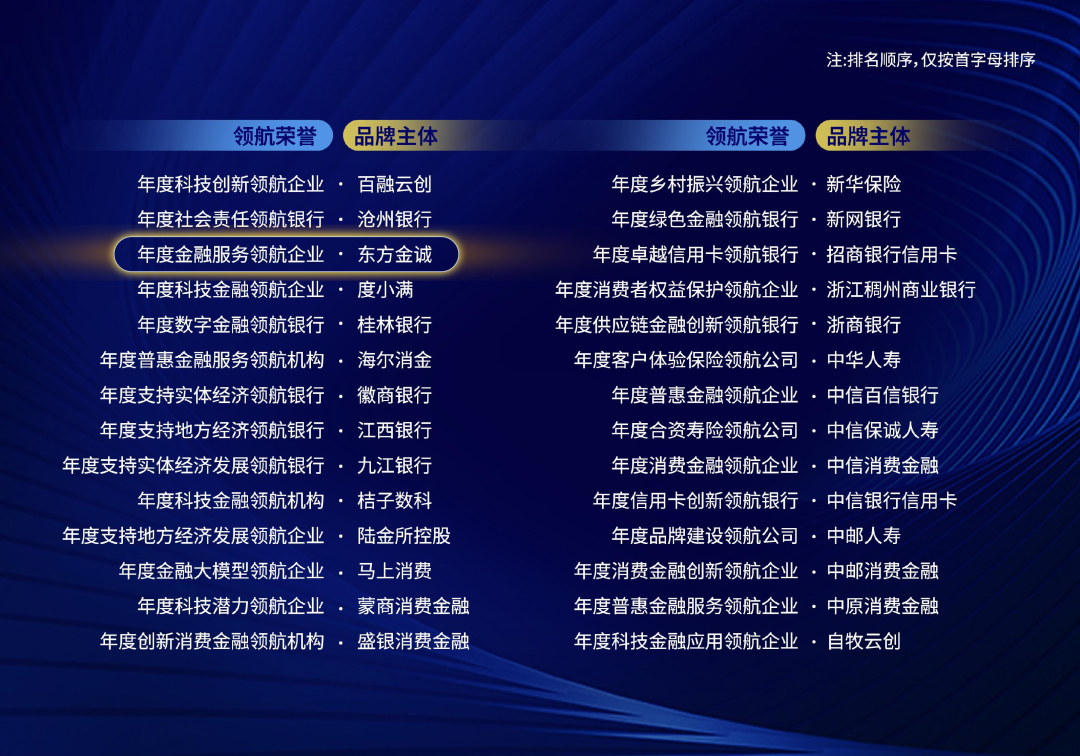
高质量发展 | 中国东方旗下东方金诚获评《经济观察报》2025年度金融服务领航企业
Xin Lang Cai Jing· 2025-12-22 11:19
Core Viewpoint - Dongfang Jincheng has been awarded the title of "Annual Financial Service Pioneer Enterprise" for its significant contributions to serving the national financial strategy and empowering high-quality development of the real economy [1][4]. Group 1: Awards and Recognition - The "2025 Annual Pioneer Enterprise Case" honor list was officially announced on December 19, highlighting institutions that excel in five key areas: technology finance, green finance, inclusive finance, pension finance, and digital finance [1][4]. - Dongfang Jincheng's recognition reflects the market and media's acknowledgment of its long-term commitment to the mission of a state-owned rating agency [6][4]. Group 2: Contributions to Financial Strategy - The company integrates professional rating services into the national development framework, using credit ratings as a core engine to bridge capital markets and real industries [6][4]. - Dongfang Jincheng has developed a systematic rating methodology for technology enterprises and localized ESG assessment tools to effectively identify credit risks and sustainable development capabilities [3][7]. Group 3: Future Outlook - The company aims to continue focusing on the five key areas of finance, enhancing its professional service system centered on credit ratings [7]. - Dongfang Jincheng plans to collaborate with various participants in the bond market to promote high-quality and standardized development, reinforcing the bridge between finance and the real economy [7].