
空调

Search documents
新股消息 | 空调巨头奥克斯电气今启招股 今年一季度收入超93亿元 海外市场发展迅猛
智通财经网· 2025-08-25 10:00
Core Viewpoint - Aux Electric, one of the top five global air conditioning providers, has officially launched its IPO, aiming to raise funds for product development and market expansion [1][3] Group 1: IPO Details - Aux Electric plans to issue approximately 207 million shares, with 5% allocated for Hong Kong and 95% for international offerings, at a maximum price of HKD 17.42 per share [1] - The IPO is expected to debut on the Hong Kong Stock Exchange on September 2, 2025, following other major players like Hisense and Haier [1] - Key cornerstone investors include China Post Insurance, Huabao Hong Kong, and CICC FT, with total subscriptions amounting to approximately USD 124.3 million (HKD 974.2 million), representing 27% of the offered shares [1] Group 2: Company Performance - Aux Electric's revenue is projected to grow from RMB 19.528 billion in 2022 to RMB 29.759 billion in 2024, reflecting a compound annual growth rate (CAGR) of 23.4% [2] - The net profit attributable to the parent company is expected to increase from RMB 1.442 billion in 2022 to RMB 2.910 billion in 2024, with a CAGR of 42.1% [2] - As of Q1 2025, the company reported revenues and net profits of approximately RMB 9.352 billion and RMB 0.925 billion, respectively [2] Group 3: Market Position and Strategy - Aux Electric is the fifth largest air conditioning provider globally, with a market share of 7.1%, and holds the top position in China's mass market for home air conditioners with a 25.7% market share [1][2] - The company focuses on energy efficiency, comfort, health, and smart technology in its product matrix, which includes both home and central air conditioning systems [2] - The overseas market contributes significantly to the company's performance, with international revenue accounting for 57.1% of total revenue in the first quarter of 2025 [2] Group 4: Use of IPO Proceeds - The funds raised from the IPO will be allocated to new product development, upgrading existing products, establishing overseas R&D centers, and enhancing the global R&D team [3] - The company aims to improve its smart manufacturing systems and supply chain management, as well as strengthen sales and distribution channels [3] - The IPO is expected to enhance the company's brand influence and market share, presenting new investment opportunities for investors [3]
奥克斯电气启动招股:全球空调行业领军者 近三年销量复合增长率达30.0%
Jing Ji Guan Cha Wang· 2025-08-25 09:09
空调行业作为现代生活与工业生产的关键支撑,对调节室内环境、提升生活品质及保障工业生产稳定性 至关重要。近年来,随着新兴市场的崛起、消费的不断升级以及技术创新的持续推动,全球空调产业蓬 勃发展,市场规模不断扩大。 在空调产业持续升级与全球扩张的关键节点,8月25日,全球空调行业中的领军企业——奥克斯电气电 气有限公司(奥克斯电气,股份代号:2580.HK)正式启动招股,阔步迈向港股市场,中金公司 (601995)为其独家保荐人。 同时,奥克斯电气紧跟时代步伐,快速迭代产品,不断丰富产品矩阵,产品应用场景广泛覆盖家庭住 宅、办公楼宇、商场、酒店、医院、工业产业园等,全方位契合全球碳中和的绿色愿景与消费升级大趋 势。 此外,奥克斯电气还是智能空调领域的重要参与者,凭借在语音识别、语义理解等尖端技术领域的深厚 积累与持续创新,始终保持着行业领先地位,为用户带来更加便捷、智能的空调使用体验。 加速全球化布局 海外销售业绩持续攀升 在全球化战略方面,近年来,奥克斯电气坚定不移地推进全球化纵深布局,稳步践行全球化发展的宏伟 蓝图。早在2019年,公司便以前瞻性的眼光在日本设立研发中心,同年,泰国生产基地顺利投产,以先 进的 ...
新股消息 | 空调巨头奥克斯电气(02580)今启招股 今年一季度收入超93亿元 海外市场发展迅猛
智通财经网· 2025-08-25 08:40
Core Viewpoint - Aux Electric Co., Ltd. has officially launched its IPO, aiming to raise funds for product development and market expansion, positioning itself as a leading player in the air conditioning industry [1][3] Group 1: IPO Details - The company plans to issue approximately 207 million shares, with 5% allocated for Hong Kong and 95% for international offerings, at a maximum price of HKD 17.42 per share [1] - The IPO is expected to be listed on the Hong Kong Stock Exchange on September 2, 2025, following other major players in the air conditioning sector [1] - Key cornerstone investors include China Post Insurance, Huabao Hong Kong, and others, with total subscriptions amounting to approximately USD 1.243 billion (HKD 9.742 billion), representing 27% of the offered shares [1] Group 2: Company Performance - Aux Electric is one of the top five air conditioning providers globally, with a market share of 7.1% and the leading brand in China's mass-market home air conditioning sector, holding a 25.7% market share [1][2] - The company's revenue is projected to grow from RMB 19.528 billion in 2022 to RMB 29.759 billion in 2024, reflecting a compound annual growth rate (CAGR) of 23.4% [2] - Net profit attributable to shareholders is expected to increase from RMB 1.442 billion in 2022 to RMB 2.910 billion in 2024, with a CAGR of 42.1% [2] - As of Q1 2025, the company reported revenues and net profits of approximately RMB 9.352 billion and RMB 0.925 billion, respectively [2] - The overseas market has significantly contributed to the company's performance, with overseas revenue accounting for 57.1% of total revenue in the first quarter of 2025 [2] Group 3: Strategic Focus - The product matrix focuses on home and central air conditioning, emphasizing energy efficiency, comfort, health, and intelligence [2] - The funds raised from the IPO will be used for new product development, upgrading existing products, establishing overseas R&D centers, and enhancing the smart manufacturing system and supply chain management [3] - The company aims to leverage capital market opportunities to enhance brand influence, expand market share, and improve its industry chain layout [3]
格力高管质疑小米高管引用数据真实性
Xin Lang Ke Ji· 2025-08-25 02:33
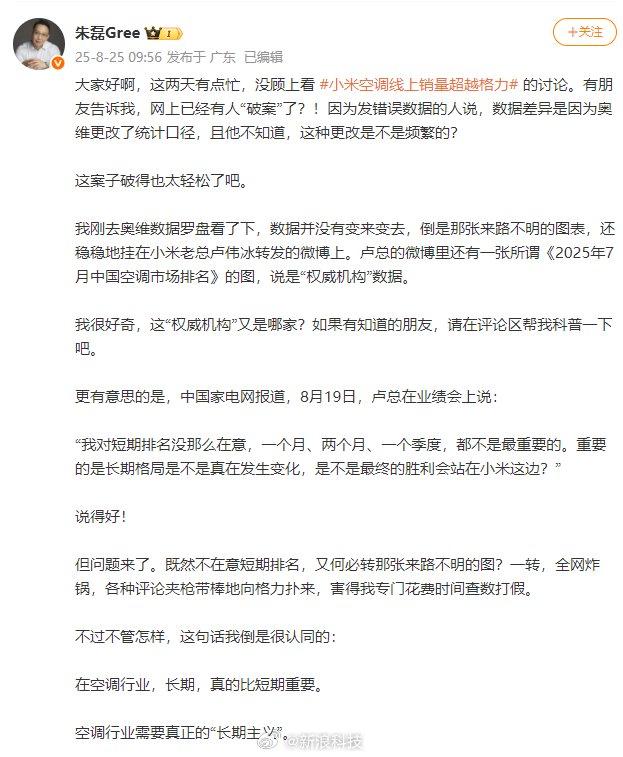
更有意思的是,中国家电网报道,8月19日,卢总在业绩会上说: "我对短期排名没那么在意,一个月、两个月、一个季度,都不是最重要的。重要的是长期格局是不是 真在发生变化,是不是最终的胜利会站在小米这边?" 说得好! 但问题来了。既然不在意短期排名,又何必转那张来路不明的图?一转,全网炸锅,各种评论夹枪带棒 地向格力扑来,害得我专门花费时间查数打假。 【#格力高管再谈空调销量排名争议##格力高管回应卢伟冰言论#】珠海格力电器股份有限公司市场总监 @朱磊Gree 再次发文谈空调销量排名争议,称: 我刚去奥维数据罗盘看了下,数据并没有变来变去,倒是那张来路不明的图表,还稳稳地挂在小米老总 卢伟冰转发的微博上。卢总的微博里还有一张所谓《2025年7月中国空调市场排名》的图,说是"权威机 构"数据。 我很好奇,这"权威机构"又是哪家?如果有知道的朋友,请在评论区帮我科普一下吧。 我刚去奥维数据罗盘看了下,数据并没有变来变去,倒是那张来路不明的图表,还 稳稳地挂在小米老总卢伟冰转发的微博上。卢总的微博里还有一张所谓《2025年7 月中国空调市场排名》的图,说是"权威机构"数据。 我很好奇,这"权威机构"又是哪家?如果有知道 ...



奥克斯(AUX):全球领先的空调提供商已启动招股
Xin Lang Cai Jing· 2025-08-24 23:31
Core Viewpoint - Aux Air Conditioning Co., Ltd. has launched its IPO, positioning itself as a leading global air conditioning provider with a comprehensive business model covering design, R&D, production, sales, and service across over 150 countries and regions [1][2]. Company Overview - Aux has over 30 years of experience in the air conditioning industry, utilizing the "AUX" brand to penetrate both domestic and international markets through a multi-brand strategy to meet diverse consumer needs [2]. - The product matrix focuses on home and central air conditioning, emphasizing energy efficiency, comfort, health, and intelligence, with rapid product iteration and expansion to cover various application scenarios such as residential and commercial buildings [2]. - Aux has established a robust global R&D network with centers in Ningbo, Zhuhai, and Japan, employing over 1,600 dedicated R&D personnel [2]. - The company has innovated a new retail model called "Xiao Aux Direct Sales," integrating online and offline channels to enhance operational efficiency [2]. - Aux has developed an industrial internet platform to achieve refined management across the entire value chain, improving efficiency in various business segments [2]. - During the performance record period, Aux demonstrated strong revenue and net profit growth, indicating a positive development trend [2].
奥克斯电气(02580.HK)预计9月2日上市 引入中邮保险等多家基石
Ge Long Hui· 2025-08-24 23:01
Core Viewpoint - Aokai Electric (02580.HK) plans to globally offer approximately 207 million shares, with a price range of HKD 16.00 to 17.42 per share, aiming to raise around HKD 3.2874 billion for various strategic initiatives [1][3] Group 1: Company Overview - Aokai Electric is one of the top five air conditioning providers globally, involved in the design, R&D, production, sales, and service of both residential and central air conditioning systems [1] - The company has a market share of 7.1% in the global air conditioning market, which is projected to reach RMB 1.3128 trillion by 2024 [1] - Aokai Electric has experienced a compound annual growth rate (CAGR) of 30.0% in sales from 2022 to 2024, significantly outpacing the global air conditioning market's CAGR of 4.6% during the same period [1] Group 2: Fundraising and Use of Proceeds - The cornerstone investors have agreed to subscribe for shares totaling approximately USD 124.3 million, with a potential subscription of about 58.3 million shares at a midpoint price of HKD 16.71 [2] - The estimated net proceeds of approximately HKD 3.2874 billion will be allocated as follows: 20% for global R&D expansion, 50% for upgrading smart manufacturing systems and supply chain management, 20% for enhancing sales and distribution channels, and 10% for working capital and general corporate purposes [3]
奥克斯电气(02580)于8月25日至8月28日招股,引入中邮保险、中邮理财等基石投资者
智通财经网· 2025-08-24 22:46
Core Viewpoint - The company, AUX Electric (02580), is set to launch an initial public offering (IPO) from August 25 to August 28, 2025, aiming to raise approximately HKD 3.287 billion through the global sale of 207 million shares, with a price range of HKD 16.00 to 17.42 per share [1][3]. Group 1: Company Overview - AUX Electric is one of the top five air conditioning providers globally, involved in the design, research and development, production, sales, and service of both household and central air conditioning systems [1]. - The company has a significant presence in the global air conditioning market, covering over 150 countries and regions, with a market share of 7.1% as of 2024 [1]. Group 2: Financial Performance - The company has demonstrated strong revenue growth, with revenue increasing from RMB 19.528 billion in 2022 to RMB 24.832 billion in 2023 (up 27.2%), and further to RMB 29.759 billion in 2024 (up 19.8%) [2]. - Net profit also saw substantial growth, rising from RMB 1.442 billion in 2022 to RMB 2.487 billion in 2023 (up 72.5%), and to RMB 2.91 billion in 2024 (up 17.0%) [2]. - The net profit margin for the years 2022, 2023, and 2024 was recorded at 7.4%, 10.0%, and 9.8% respectively, with a margin of 10.2% for the three months ending March 31, 2025 [2]. Group 3: Use of Proceeds - Approximately 20% of the net proceeds from the IPO are expected to be allocated to global research and development, 50% for upgrading smart manufacturing systems and supply chain management, 20% for enhancing sales and distribution channels, and 10% for working capital and general corporate purposes [3].
长虹美菱20250822
2025-08-24 14:47
Summary of Changhong Meiling's Conference Call Company Overview - **Company**: Changhong Meiling - **Date**: 2025 H1 Key Points Industry Performance - **Refrigerator and Freezer Business**: Revenue decreased by 4% to 4.4 billion yuan [2][3] - **Air Conditioning Business**: Revenue increased by 36% to 11.6 billion yuan [2][3] - **Washing Machine Business**: Revenue increased by 32.7% to 1.04 billion yuan [2][3] - **Kitchen and Small Appliances**: Slight decline in revenue, close to 700 million yuan [2][3] - **Biomedical Business**: Revenue increased to 150 million yuan [2][3] Financial Performance - **Total Revenue**: 18.072 billion yuan, a year-on-year increase of 20% [3] - **Net Profit**: Remained stable compared to the previous year [3] - **Income Tax**: Increased by approximately 50% to over 80 million yuan, primarily due to profit growth in headquarters and central air conditioning department [2][8] - **Asset and Credit Impairment**: Increased due to rising inventory and accounts receivable, with potential recovery dependent on market conditions [2][9] Strategic Initiatives - **Marketing Transformation**: Implementing user direct strategies and product integration to address domestic market pressures [2][5] - **Dual-Drive Strategy for Air Conditioning**: Focusing on both B2B and B2C markets to achieve growth [2][5] - **Washing Machine Focus**: Emphasizing core channels and differentiated products, particularly in overseas markets [2][5] - **Inventory Management**: Plans to optimize inventory and improve supply chain efficiency to mitigate impairment risks [2][6] Future Outlook - **Market Challenges**: Facing intensified competition in the domestic appliance market and international trade barriers [2][3] - **Production Capacity Expansion**: Ongoing projects for air conditioning, washing machines, and high-end refrigerators to meet future demand [4][12][16][17] - **Profitability Improvement**: Aiming to enhance product structure and increase the proportion of high-value products [7][33] International Market Performance - **Emerging Markets**: Significant growth in overseas markets, particularly in Europe, with a focus on high-end and cost-effective products [22][25] - **Sales Channels**: Domestic sales channels are evenly split between online and offline, with an expected increase in online sales [26] Challenges and Responses - **External Market Pressures**: High tariffs and competitive pricing in international markets affecting profitability [14][29] - **Response Strategies**: Early production, inventory management optimization, and strengthening customer collaboration [14] Product Development - **High-End Product Focus**: Approximately 30% of sales from high-end refrigerators and washing machines, with margins between 30% to 40% [21] - **New Product Launches**: Plans to introduce new high-end product lines to enhance market performance [21] Conclusion - **Overall Strategy**: Changhong Meiling aims to leverage both domestic and international markets, focusing on innovation, resource integration, and enhancing operational efficiency to achieve growth targets in 2025 and beyond [32][33]


董明珠豪掷111.7亿分红回馈投资者,雷军又被拉出来对比?
Sou Hu Cai Jing· 2025-08-22 07:32
Core Viewpoint - Gree announced a cash dividend of 11.17 billion yuan, distributing 20 yuan for every 10 shares to shareholders, showcasing its commitment to shareholder returns [1] Group 1: Company Actions - Gree's total cash dividend amounts to 11.17 billion yuan, based on a share base of 5.585 billion shares after excluding repurchased shares [1] - The dividend distribution is seen as a direct response to competitors, particularly Xiaomi, highlighting Gree's focus on maximizing shareholder interests [1][3] Group 2: Competitive Landscape - The historical "bet" between Gree's Dong Mingzhu and Xiaomi's Lei Jun remains a topic of discussion, with Gree continuing to dominate the air conditioning market while Xiaomi expands its ecosystem [3][5] - The contrasting business models of Gree and Xiaomi are emphasized, with Gree focusing on manufacturing and stable cash flow, while Xiaomi invests in research and new business ventures [7][10] Group 3: Market Reactions - The significant dividend has sparked discussions among netizens regarding the motivations behind Gree's generous payout, particularly in relation to Dong Mingzhu's personal financial benefits [5][10] - The differing strategies of Gree and Xiaomi have led to varied public perceptions, with some viewing Gree's approach as more shareholder-friendly compared to Xiaomi's long-term investment strategy [7][10]

中国银河证券:受高温天气影响 7月空调市场需求超预期
智通财经网· 2025-08-22 05:33
智通财经APP获悉,中国银河证券发布研报称,7月全国天气炎热带动空调需求释放,7月空调内销出货 量 1058 万台,超市场预期。外销有所承压,空调出口仍然受关税及高库存影响,7月空调出口出货量 585 万台,延续此前下滑趋势。618后价格竞争压力有所缓和,多品牌线上零售均价均有不同程度的改 善。家电行业估值处于历史偏低水平,具备长期投资价值。 1)产业在线数据,7月空调出口出货量585 万台,同比-15.5%(之前 7 月出口排产量较去年实绩同 比-16.3%),延续此前下滑趋势,主要是因为美国关税影响,以及海外市场的高库存压力。 2)空调龙头全球生产基地分布广泛,生产订单被快速分配到海外生产基地。产业在线数据,7月美的/海 尔空调出口出货量分别-22.2%/-30%,格力/海信出口出货量分别-15%/-11.9%。 中国银河证券主要观点如下: 7月空调内销受益于天气炎热,超市场预期 1)产业在线数据,7月空调内销出货量 1058 万台,同比+14.3%(之前 7 月内销排产量较去年实绩同比 +8.1%),超市场预期,主要是因为 7月全国天气炎热带动空调需求释放。但部分地区国补每日限量,补 贴效果有所减弱。 ...
