
建筑业

Search documents
国家统计局:12月官方制造业PMI为50.1% 升至扩张区间
Guo Jia Tong Ji Ju· 2025-12-31 01:45
(原标题:国家统计局:12月官方制造业PMI为50.1% 升至扩张区间) 一、中国制造业采购经理指数运行情况 12月份,制造业采购经理指数(PMI)为50.1%,比上月上升0.9个百分点,升至扩张区间。 从分类指数看,在构成制造业PMI的5个分类指数中,生产指数、新订单指数和供应商配送时间指数均 高于临界点,原材料库存指数和从业人员指数均低于临界点。 生产指数为51.7%,比上月上升1.7个百分点,表明制造业企业生产活动加快。 新订单指数为50.8%,比上月上升1.6个百分点,表明制造业市场需求有所改善。 原材料库存指数为47.8%,比上月上升0.5个百分点,表明制造业主要原材料库存量降幅收窄。 从业人员指数为48.2%,比上月下降0.2个百分点,表明制造业企业用工景气度小幅回落。 供应商配送时间指数为50.2%,比上月上升0.1个百分点,表明制造业原材料供应商交货时间继续加快。 分行业看,建筑业商务活动指数为52.8%,比上月上升3.2个百分点;服务业商务活动指数为49.7%,比 上月上升0.2个百分点。从服务业行业看,电信广播电视及卫星传输服务、货币金融服务、资本市场服 务等行业商务活动指数均位于60.0 ...
国家统计局解读:12月份中国采购经理指数均升至扩张区间
智通财经网· 2025-12-31 01:45
Group 1 - The manufacturing Purchasing Managers' Index (PMI) rose to 50.1% in December, marking the first time it has entered the expansion zone since April [4] - Among the 21 surveyed industries, 16 reported an increase in PMI compared to the previous month, indicating improved production and operational conditions [4] - The production index and new orders index were 51.7% and 50.8%, respectively, both showing significant increases from the previous month [4] Group 2 - The non-manufacturing business activity index reached 50.2% in December, reflecting an improvement in the non-manufacturing sector's economic climate [6] - The service sector's business activity index was 49.7%, with certain industries like telecommunications and financial services showing strong growth [6] - The construction sector's business activity index rose to 52.8%, indicating a notable recovery in the industry due to favorable weather and increased construction activity [7] Group 3 - The comprehensive PMI output index increased to 50.7%, suggesting overall expansion in production and business activities across sectors [8] - The manufacturing production index and non-manufacturing business activity index were 51.7% and 50.2%, respectively, contributing to the rise in the comprehensive PMI [8]
国家统计局:16个行业PMI较上月回升,相关企业生产经营情况有所改善
Guo Jia Tong Ji Ju· 2025-12-31 01:40
Core Viewpoint - In December 2025, China's Purchasing Managers' Index (PMI) for manufacturing, non-manufacturing, and composite output all rose above the expansion threshold, indicating an overall improvement in the economic climate [2][3]. Group 1: Manufacturing PMI - The manufacturing PMI reached 50.1%, marking the first time it has entered the expansion zone since April [3]. - Production index and new orders index were at 51.7% and 50.8%, respectively, both showing significant increases of 1.7 and 1.6 percentage points from the previous month [3]. - Sixteen out of twenty-one surveyed industries reported a rise in PMI compared to the previous month, indicating improved production and operational conditions [3]. - Large enterprises' PMI returned to the expansion zone at 50.8%, while medium-sized enterprises were at 49.8%, and small enterprises fell to 48.6% [3][4]. Group 2: Non-Manufacturing PMI - The non-manufacturing business activity index was 50.2%, up 0.7 percentage points from the previous month, reflecting an improvement in the non-manufacturing sector [5]. - The service sector's business activity index was 49.7%, with certain industries like telecommunications and financial services showing strong growth [5]. - The construction sector saw a significant increase in its business activity index to 52.8%, driven by favorable weather conditions and pre-holiday construction activities [5]. Group 3: Composite PMI - The composite PMI output index reached 50.7%, an increase of 1.0 percentage point from the previous month, indicating overall expansion in production and business activities [7]. - The manufacturing production index and non-manufacturing business activity index contributed to this composite index, standing at 51.7% and 50.2%, respectively [7].
2025年12月中国采购经理指数运行情况
Guo Jia Tong Ji Ju· 2025-12-31 01:38
国家统计局服务业调查中心 中国物流与采购联合会 一、中国制造业采购经理指数运行情况 从企业规模看,大型企业PMI为50.8%,比上月上升1.5个百分点,高于临界点;中型企业PMI为49.8%, 比上月上升0.9个百分点,仍低于临界点;小型企业PMI为48.6%,比上月下降0.5个百分点,低于临界 点。 从分类指数看,在构成制造业PMI的5个分类指数中,生产指数、新订单指数和供应商配送时间指数均 高于临界点,原材料库存指数和从业人员指数均低于临界点。 生产指数为51.7%,比上月上升1.7个百分点,表明制造业企业生产活动加快。 新订单指数为50.8%,比上月上升1.6个百分点,表明制造业市场需求有所改善。 原材料库存指数为47.8%,比上月上升0.5个百分点,表明制造业主要原材料库存量降幅收窄。 从业人员指数为48.2%,比上月下降0.2个百分点,表明制造业企业用工景气度小幅回落。 供应商配送时间指数为50.2%,比上月上升0.1个百分点,表明制造业原材料供应商交货时间继续加快。 12月份,制造业采购经理指数(PMI)为50.1%,比上月上升0.9个百分点,升至扩张区间。 表1 中国制造业PMI及构成指数(经季 ...

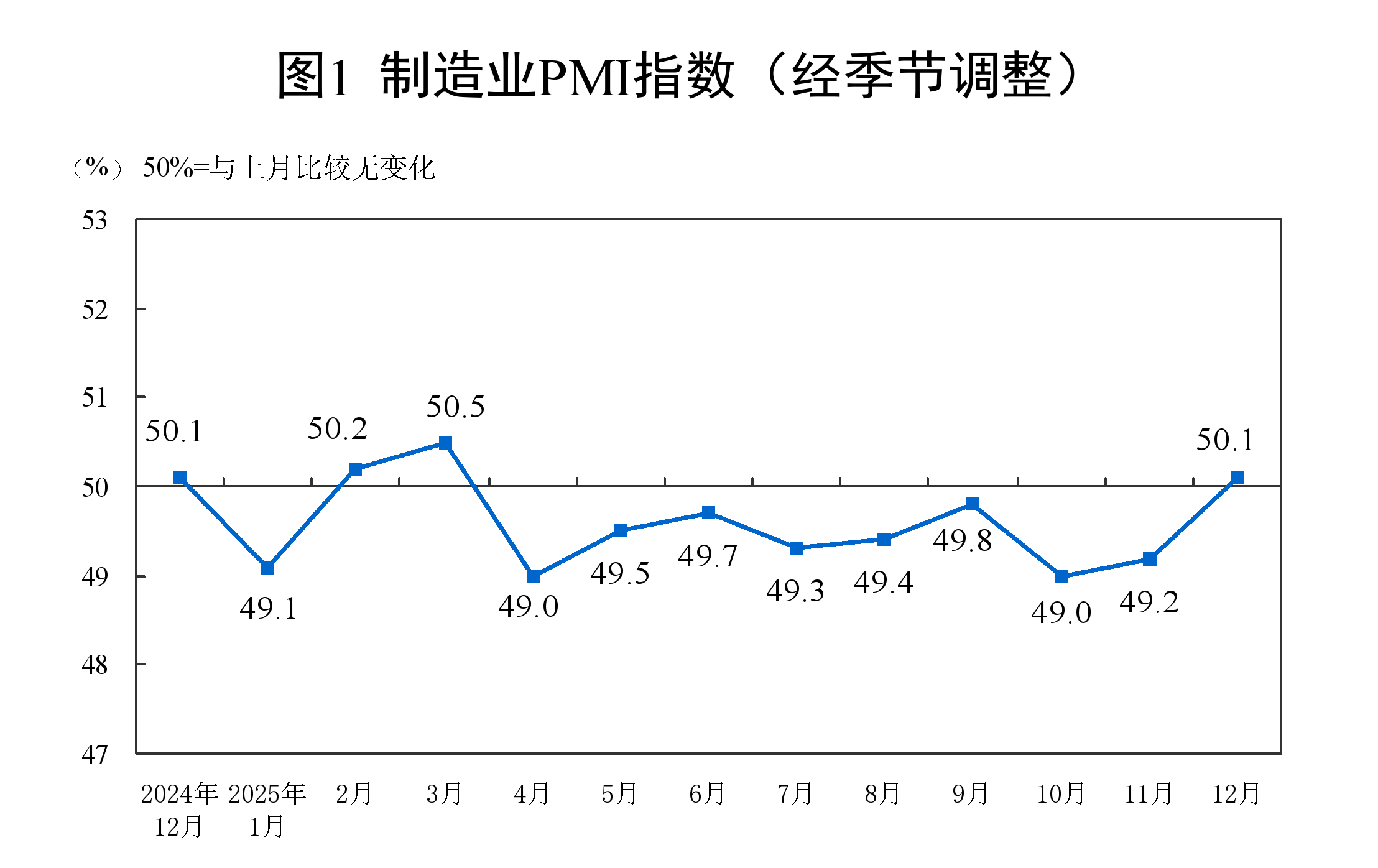
12月中国制造业PMI为50.1%,较上月上升0.9个百分点
Guo Jia Tong Ji Ju· 2025-12-31 01:37
一、中国制造业采购经理指数运行情况 12月份,制造业采购经理指数(PMI)为50.1%,比上月上升0.9个百分点,升至扩张区间。 新订单指数为50.8%,比上月上升1.6个百分点,表明制造业市场需求有所改善。 原材料库存指数为47.8%,比上月上升0.5个百分点,表明制造业主要原材料库存量降幅收窄。 从业人员指数为48.2%,比上月下降0.2个百分点,表明制造业企业用工景气度小幅回落。 供应商配送时间指数为50.2%,比上月上升0.1个百分点,表明制造业原材料供应商交货时间继续加快。 从企业规模看,大型企业PMI为50.8%,比上月上升1.5个百分点,高于临界点;中型企业PMI为49.8%,比上月上升0.9个百分点,仍低于临界点;小型企业 PMI为48.6%,比上月下降0.5个百分点,低于临界点。 二、中国非制造业采购经理指数运行情况 从分类指数看,在构成制造业PMI的5个分类指数中,生产指数、新订单指数和供应商配送时间指数均高于临界点,原材料库存指数和从业人员指数均低于 临界点。 12月份,非制造业商务活动指数为50.2%,比上月上升0.7个百分点,重返扩张区间。 生产指数为51.7%,比上月上升1.7个百 ...
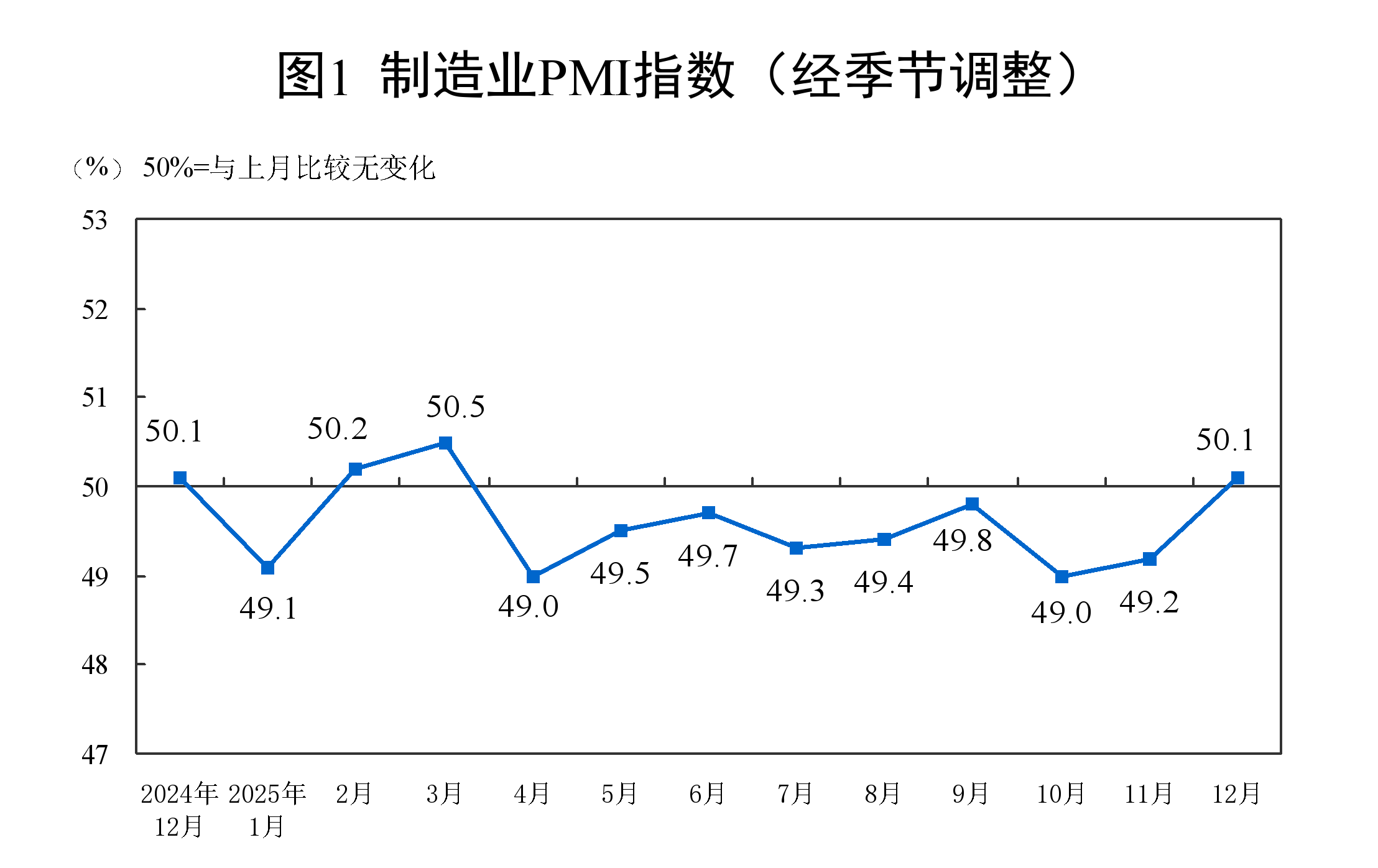
国家统计局:12月份非制造业商务活动指数为50.2% 重返扩张区间
Guo Jia Tong Ji Ju· 2025-12-31 01:36
Core Viewpoint - The non-manufacturing business activity index in December rose to 50.2%, indicating a return to the expansion zone with a month-on-month increase of 0.7 percentage points [1] Industry Summary - The construction industry business activity index reached 52.8%, up by 3.2 percentage points from the previous month, signaling strong growth [1] - The service industry business activity index was at 49.7%, showing a slight increase of 0.2 percentage points compared to last month, but still below the expansion threshold [1] Sector Performance - Within the service sector, industries such as telecommunications, broadcasting, television, and satellite transmission services, monetary financial services, and capital market services reported business activity indices above 60.0%, indicating a high level of economic activity [1] - Conversely, retail and catering industries had business activity indices below the critical point, suggesting weaker performance in these areas [1]
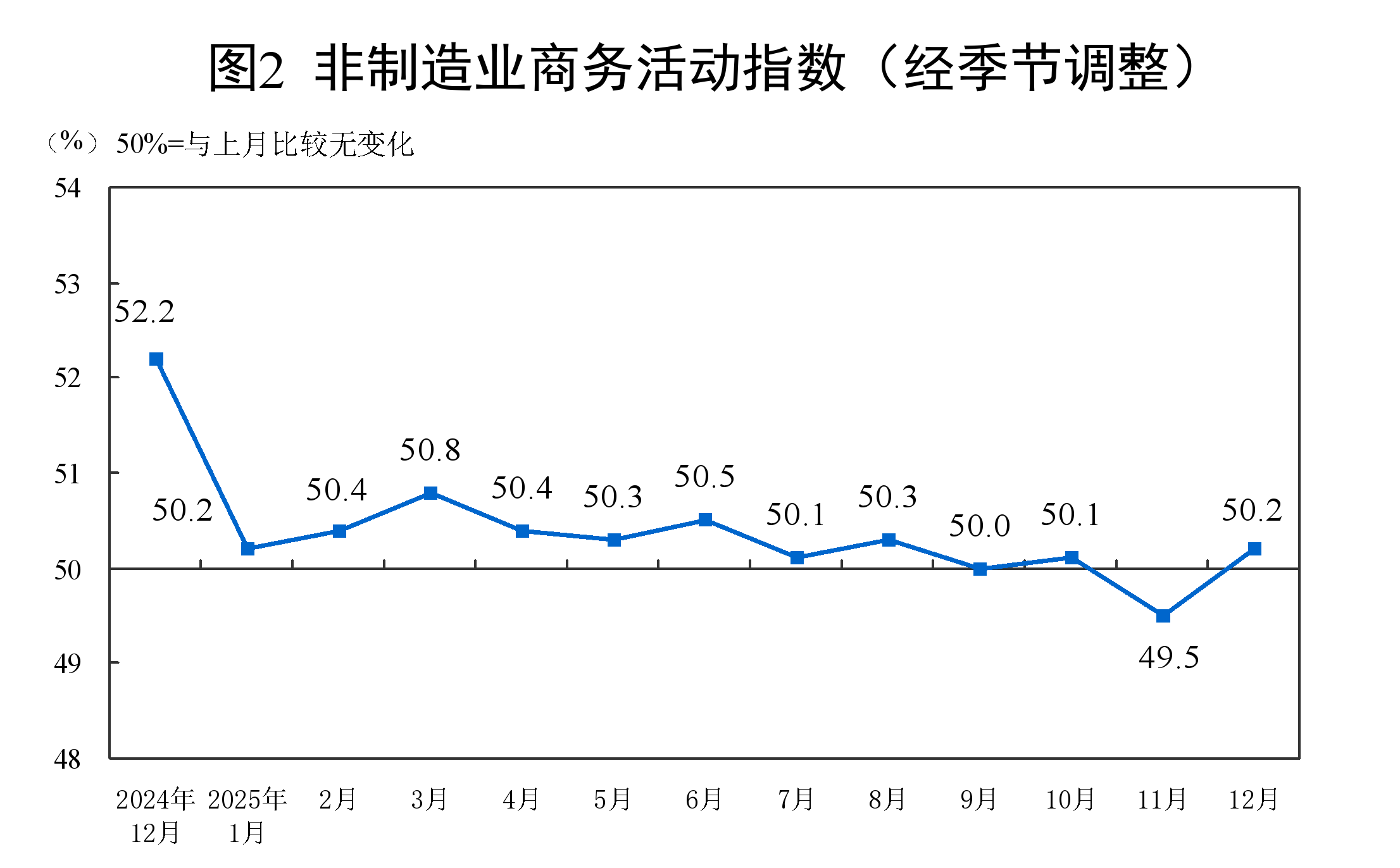
中国12月制造业PMI为50.1%,比上月上升0.9个百分点
Guo Jia Tong Ji Ju· 2025-12-31 01:35
一、中国制造业采购经理指数运行情况 12月份,制造业采购经理指数(PMI)为50.1%,比上月上升0.9个百分点,升至扩张区间。 从企业规模看,大型企业PMI为50.8%,比上月上升1.5个百分点,高于临界点;中型企业PMI为49.8%,比上月上升0.9个百分点,仍低于临界点;小型企业 PMI为48.6%,比上月下降0.5个百分点,低于临界点。 从分类指数看,在构成制造业PMI的5个分类指数中,生产指数、新订单指数和供应商配送时间指数均高于临界点,原材料库存指数和从业人员指数均低于 临界点。 生产指数为51.7%,比上月上升1.7个百分点,表明制造业企业生产活动加快。 新订单指数为50.8%,比上月上升1.6个百分点,表明制造业市场需求有所改善。 原材料库存指数为47.8%,比上月上升0.5个百分点,表明制造业主要原材料库存量降幅收窄。 从业人员指数为48.2%,比上月下降0.2个百分点,表明制造业企业用工景气度小幅回落。 | | | | | | | | | == 17: 70 | | --- | --- | --- | --- | --- | --- | --- | --- | --- | | | 新出口 ...
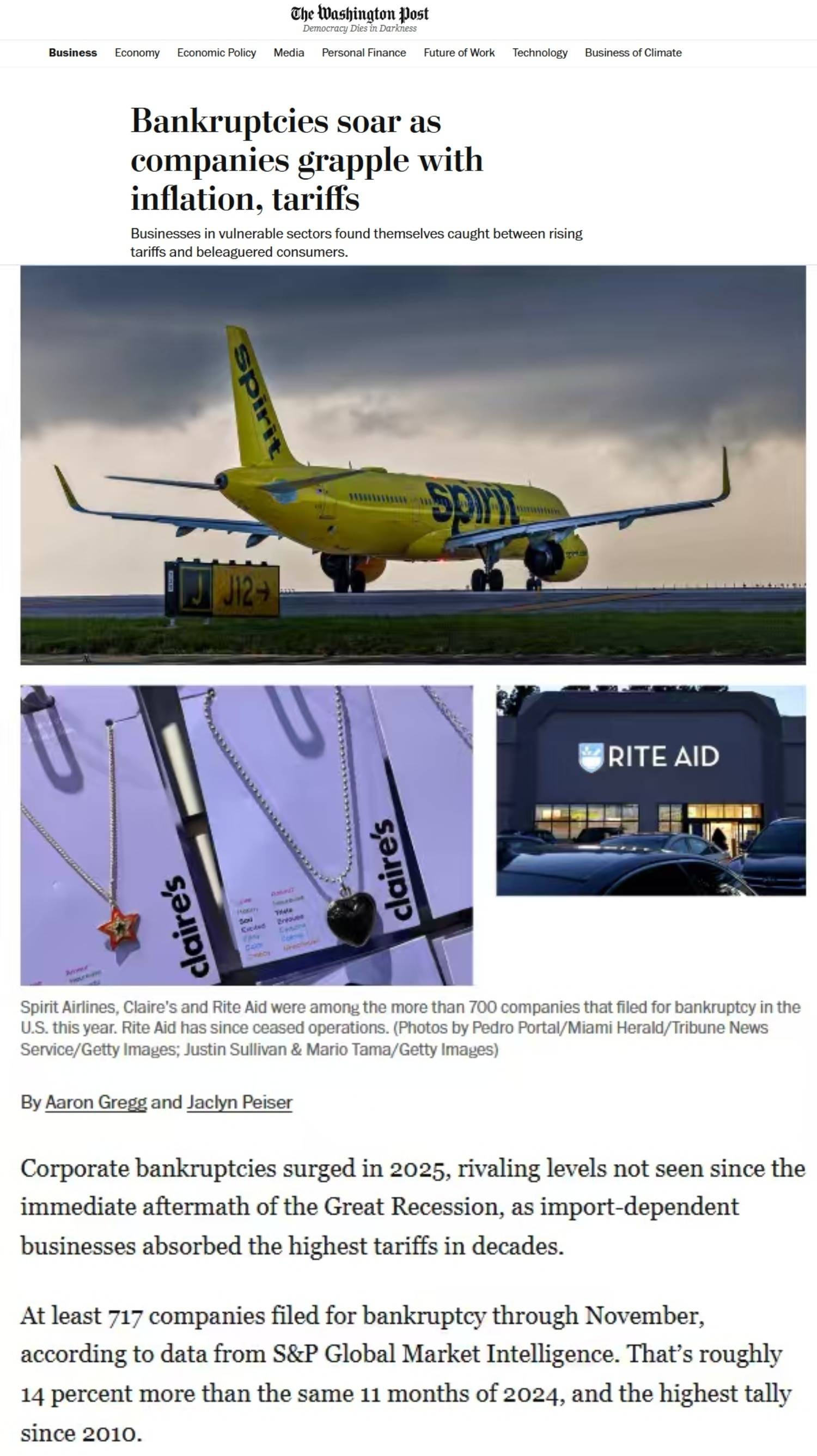
美媒:美国企业破产申请创15年新高
Sou Hu Cai Jing· 2025-12-30 11:49
Group 1 - The number of bankruptcy filings by U.S. companies has surged to the highest level in 15 years, with at least 717 companies filing for bankruptcy by the end of November, according to S&P Global Market Intelligence data [1][7] - The increase in bankruptcies is most pronounced in the industrial sector, including manufacturing, construction, and transportation, heavily impacted by fluctuating U.S. trade policies and tariffs [1][7] - Over 70,000 jobs were cut in the U.S. manufacturing sector within a year, highlighting the severe impact of these economic pressures [7] Group 2 - Inflation and rising interest rates are cited as significant factors contributing to the financial distress of many companies, alongside the disruptive effects of U.S. trade policies on supply chains and costs [1][7] - There is a notable increase in bankruptcies among large companies, with 17 bankruptcy cases involving firms with assets exceeding $1 billion reported in the first half of 2025, marking the highest number since 2020 [7] - Companies are struggling to pass on increased costs to consumers due to fears of losing customers, leading to a market shakeout where weaker firms may be eliminated [7]
普惠金融—小微指数显示:2025年三季度,小微企业融资成本稳步下降
Zhong Guo Jing Ji Wang· 2025-12-30 05:22
Core Insights - The "Inclusive Finance - Micro and Small Enterprises Index" indicates a significant decrease in financing costs for micro and small enterprises by Q3 2025, with a continuous increase in funding supply and improved quality of financial services [1][2] Group 1: Financing Trends - By the end of September 2025, the balance of inclusive micro and small loans reached 36.1 trillion yuan, a year-on-year increase of 12.2%, driven by ongoing optimization of systems and innovation in products and services [1] - The financing supply index reached 209.45 points in Q3 2025, reflecting a quarter-on-quarter increase of 2.12%, indicating ample financing supply [1] - Over 70% of micro and small enterprises reported that the financing amounts met their needs, showing high satisfaction with financing [1] Group 2: Cost and Efficiency - The financing price index fell to 65.32 points, a decrease of 4.92% quarter-on-quarter, indicating a stable decline in comprehensive financing costs for inclusive micro and small enterprises [2] - The weighted average interest rate for newly issued loans in September was approximately 3.1%, down about 40 basis points from the same period last year [2] - The financing efficiency index rose to 215.09 points, with nearly 60% of micro and small enterprises able to receive loans in a timely manner, reflecting improved financing efficiency [2] Group 3: Financial Service Quality - The inclusive finance service index showed improvements in both accessibility and quality, with the accessibility index at 203.47 points (up 3.02% quarter-on-quarter) and the quality index at 111.76 points (up 0.31% quarter-on-quarter) [2] - The inclusive finance development index remained stable at 52.48 points, with a slight increase of 0.21% quarter-on-quarter, indicating a positive trend in the development of micro and small enterprises [3] - The business environment for micro and small enterprises continues to improve, with the inclusive finance - micro business index at 57.85 points, reflecting a slight increase of 0.02% quarter-on-quarter [3] Group 4: Sector Analysis - Financing price indices across five major sample industries (wholesale and retail, manufacturing, leasing and business services, construction, and scientific research and technical services) showed declines, indicating the effectiveness of accommodative monetary policies [3] - The accessibility and quality indices for financial services in these sectors also increased, with construction, manufacturing, and scientific research sectors seeing over 2% growth in accessibility [3]
财政部:1—11月国有企业营业总收入756257.6亿元,同比增长1.0%
Jing Ji Guan Cha Wang· 2025-12-29 10:13
Core Insights - The Ministry of Finance reported that from January to November 2025, the total operating revenue of state-owned and state-controlled enterprises increased by 1.0% year-on-year, while total profits decreased by 3.1% [1][2] Revenue Summary - From January to November, the total operating revenue of state-owned enterprises reached 7,562.576 billion yuan, reflecting a year-on-year growth of 1.0% [1] Profit Summary - The total profit of state-owned enterprises for the same period was 371.945 billion yuan, showing a year-on-year decline of 3.1% [1] Tax Obligations Summary - The tax obligations of state-owned enterprises amounted to 528.03 billion yuan from January to November, which is a year-on-year increase of 0.2% [1] Debt Summary - As of the end of November, the asset-liability ratio of state-owned enterprises stood at 65.2%, which is an increase of 0.3 percentage points year-on-year [2]