网络文学

Search documents
“潮”起东方!世界热情拥抱“酷中国”
Xin Hua She· 2025-06-23 13:33
Core Perspective - The article highlights the global embrace of Chinese cultural IPs, showcasing how they are becoming trendy and influential worldwide, reflecting a youthful and dynamic image of China [1][4][12] Group 1: Cultural IP Globalization - The popularity of the LABUBU toy from Pop Mart has led to a 475% year-on-year increase in overseas revenue in Q1 [1] - LABUBU has gained international recognition, being named "Magical Thailand Experience Officer" and featured in various global events [2] - The rise of Chinese pop culture products, such as C-Dramas and national style fashion, has captivated international audiences [4] Group 2: Digital and Technological Integration - The game "Black Myth: Wukong" has achieved global sales of over 9 billion yuan within four months, showcasing the blend of traditional culture and digital technology [6] - Digital technologies are enhancing the global understanding of Chinese culture, with significant progress in digitizing cultural artifacts [7][8] - The Chinese gaming industry is projected to generate $18.557 billion in overseas sales in 2024, reflecting a 13.39% growth [6] Group 3: Global Participation and Co-Creation - The international success of Chinese web literature, with approximately 6000 translated works and nearly 450,000 overseas authors, indicates a global cultural phenomenon [10] - The engagement of global audiences in co-creation, as seen with characters from popular Chinese media being involved in international events, enhances cultural exchange [11] - The cultural export model has evolved into a complex system combining digital content, IP operation, and technological services [10]

文化“走出去”更要“走进去”
Jing Ji Ri Bao· 2025-06-22 22:02
Core Insights - The article emphasizes the need for a multi-layered approach to build a new ecosystem for the overseas expansion of domestic IPs, focusing on technological empowerment and narrative upgrades [1][3][4] Group 1: Cultural Industry Expansion - China's cultural industry is transitioning from a one-way output model to a deeper integration model, characterized by successful overseas reception of works like "Ne Zha" and "Mountain and Sea Love" [1][2] - The overseas market for online literature has surpassed 4.35 billion yuan, with nearly 6000 translated works and a significant increase in readership [2] - The gaming sector has seen actual sales revenue of $18.557 billion in 2024, marking a 13.39% year-on-year growth [2] Group 2: Challenges in Cultural Export - Language translation remains a critical barrier, with AI translations often leading to a flattening of classic works [3] - The industry faces challenges such as copyright infringement and reliance on platform revenue, which limits the growth of smaller cultural enterprises [3] - The lack of high-quality Chinese language data in global AI training datasets is becoming a bottleneck for the development of large models [3] Group 3: Future Directions - To avoid the fleeting success of domestic IPs abroad, a focus on technological empowerment and narrative upgrades is essential, including the promotion of philosophical IPs like "Tao Te Ching" [3] - Active participation in establishing global digital cultural trade rules is necessary to enhance China's influence in the global cultural landscape [3][4] - The ultimate goal of cultural export is not merely market expansion but fostering deeper understanding between civilizations, transitioning from "going out" to "going in" [4]
去年营收440亿元!网络文学平台持续红火
Jiang Nan Shi Bao· 2025-06-19 14:19
Core Insights - The revenue of the online literature industry in China reached approximately 44 billion yuan in the past year, with a steady growth trend observed [1][2] - The user base for online literature has expanded to 575 million domestically, representing 51.9% of the total internet users in China [1] - The demographic of online literature readers is diverse, with significant representation from various age groups, particularly those aged 26 to 45 and the younger "post-2000" generation [1] Revenue and Growth - The total annual revenue for the online literature industry is estimated at around 44 billion yuan, showing stable growth compared to the previous year [1] - The total number of literary works has surpassed 33 million, with 2 million new works added in the past year, reflecting a year-on-year growth of 7% [1] User Demographics - The core readership consists of individuals aged 26 to 45, accounting for 50% of the total readership [1] - The "post-2000" generation has emerged as a significant new reader group, making up nearly 25% of the audience [1] - The proportion of readers aged 60 and above has exceeded 10%, indicating a growing interest among older demographics [1] IP Adaptation and Expansion - The number of new adaptations and authorizations for various media formats reached approximately 30,000, with notable increases in film and short drama adaptations [2] - The number of new film adaptations rose by 18%, while micro-short drama adaptations surged by 81% [2] - The online literature industry is increasingly integrating with film, animation, and gaming sectors, enhancing the cultural and economic impact [2] International Growth - The number of active overseas users of Chinese online literature is around 200 million, with 30 million new registrations in the past year [2] - The ecosystem for overseas local authors and works is developing, with 120,000 new local authors and 500,000 new works created [2] - The industry is transitioning from merely exporting content to building a global IP ecosystem, characterized by technological innovation and cultural collaboration [2] Report Significance - The "2024 China Online Literature Blue Book" emphasizes objectivity, authority, and guidance, focusing on new industry phenomena and trends [2] - The report aims to promote high-quality development within the online literature sector [2]
2024年度中国网络文学影响力榜发布 精品意识与破圈发展成亮点
Xin Hua She· 2025-06-18 01:22
Core Insights - The 2024 China Online Literature Influence List highlights the increasing awareness of quality and literary consciousness in online novel creation [1][2] - The trend of IP adaptation in online literature continues to thrive, showcasing strong momentum in "breaking the circle" development [1][2] - The effectiveness of overseas dissemination of online literature has improved significantly with the assistance of AI [1] - Young online writers are actively engaging with contemporary themes, pursuing narrative breakthroughs, and enhancing quality awareness [1] Summary by Categories Online Novel Rankings - The top 10 online novels include works like "Next Stop, Pengcheng Square," which breaks traditional narrative rules and showcases contemporary life and regional culture [1] - "Ten Days of End" features a unique worldview that conveys civilizational fables, challenging the genre rigidity of online literature [1] IP Influence Rankings - The top 10 IP works include adaptations such as "Celebrating More Than a Year" for TV, "Sword Comes" for animation, and "I Am a Stepmother in the 1980s" for micro-dramas, demonstrating strong conversion power from online literature to visual media [1] Overseas Dissemination Rankings - The top 10 works in overseas dissemination, such as "Princess Chang" and "River Clear and Sea Calm," utilize innovative narrative techniques and rich Chinese aesthetic appeal, resonating widely with global readers [1][2] Objectives of the Influence List - The release of the list aims to strengthen creative guidance, optimize genre structure, and enhance quality awareness in online literature [2] - It promotes the transformation of online literature into films, games, and animations, improving the IP development industry chain [2] - The initiative seeks to position online literature as a pioneer of world culture in the digital age, facilitating the global reach of Chinese civilization [2] - The event also included the archiving of the 30 listed works in the National Version Library in a digital format [2]
跨境电商去年出口超2万亿,高息高返购车贷被叫停 | 财经日日评
吴晓波频道· 2025-06-17 17:02
Trade Agreements - The US and UK have reached a preliminary trade agreement covering various sectors including steel, automobiles, ethanol, beef, and aerospace, marking the first such agreement since Trump's administration began imposing tariffs [1] - The agreement allows for increased market access for US agricultural products in the UK, particularly beef and ethanol, with the US setting an annual quota of 100,000 vehicles for UK imports, subject to a 10% tariff [1][2] - While the agreement is seen as a foundation for expanding trade, it is limited in scope and does not cover several key industries such as pharmaceuticals and steel [1] Cross-Border E-commerce - China's cross-border e-commerce exports reached approximately 2.15 trillion yuan in 2024, a year-on-year increase of 16.9%, while imports were about 555.25 billion yuan, growing by 4.1% [3] - The export of consumer goods constitutes 97.5% of cross-border e-commerce, with major products including apparel, digital devices, and home goods, primarily exported to the US, UK, and Germany [3] - The growth of cross-border e-commerce is supported by favorable policies, contributing significantly to overall foreign trade despite rising trade protectionism [4] Online Literature - The user base for Chinese online literature has reached 575 million, with a significant portion of readers aged 26 to 45, and nearly 25% being from the "post-2000" generation [5] - The revenue from online literature is estimated at around 44 billion yuan in 2024, with a total of over 33 million works published [5] - Despite the large user base, the industry faces challenges such as content homogenization and competition from short video formats, leading to a slowdown in user growth [6] Automotive Financing - The "high interest, high return" car loan model has been halted in several regions, with banks suspending such business practices due to regulatory changes [7] - This model involved dealerships receiving high commissions from banks to subsidize car prices, but it has led to various issues, including disputes over early loan repayments [8] - The cessation of this model may indicate a shift towards more sustainable lending practices, as banks need to focus on genuine consumer demand rather than artificially created demand [8] AI and Technology - Alibaba has launched a new version of its Qwen3 model optimized for Apple's MLX framework, which is expected to enhance AI deployment across Apple devices [9] - This move signals a strengthening partnership between Alibaba and Apple, as the models will be available in various precision versions to cater to different devices [9][10] - The growing influence of Qwen in the open-source model space may help revitalize Apple's presence in the Chinese market [10] Pension Funds - As of the first quarter of 2025, China's enterprise annuity fund has accumulated a scale of 3.73 trillion yuan, with a three-year cumulative return rate of 7.46% [11] - The shift to reporting cumulative returns aligns with a long-term investment strategy, reflecting the ability of pension funds to achieve consistent returns, particularly in stock investments [12][13] - The favorable environment for pension fund management, free from the pressures faced by traditional fund companies, allows for a focus on long-term value investment [13] Stock Market Trends - The stock market experienced slight declines, with the Shanghai Composite Index closing at 3387.4 points, down 0.04%, amid a lack of strong market momentum [16] - Despite fluctuations, certain sectors such as oil and gas remain active, while consumer sectors like gaming and beauty faced declines [16] - Upcoming policy announcements from the Lujiazui Forum may create short-term market disturbances but are unlikely to change the overall market trend [17]

中国网络文学2024年海外活跃用户约2亿人
Zhong Guo Xin Wen Wang· 2025-06-17 16:36
Group 1 - The user base of Chinese online literature has reached 575 million, with approximately 200 million active users overseas, representing 51.9% of the total internet users in China [1][2] - The core reading demographic is aged between 26 to 45 years, accounting for about 50% of all readers, while the "post-2000" generation constitutes nearly 25% of the readership, driving growth [1] - The "silver-haired" demographic, aged 60 and above, has expanded significantly, now making up over 10% of the reading population, influencing the themes and content of online literature [1] Group 2 - In 2024, there were approximately 30,000 new adaptations authorized for various types of intellectual property (IP), indicating a vibrant downstream industry [1] - The emergence of the "Z generation" as a significant force in online literature creation is highlighted, with 2.8 million new registered authors and 350,000 new signed authors, nearly four-fifths of whom are from this generation [1] - Chinese online literature is transitioning from mere content output to building a global IP ecosystem, with notable works being included in prestigious institutions and achieving global distribution [2]
海棠作者再度被警方传唤,如何定性网络文学灰色地带?
Nan Fang Du Shi Bao· 2025-06-09 10:35
Core Viewpoint - The recent police summons of authors from Haitang Literature Network has sparked significant public attention and debate regarding the legal implications of "producing, copying, publishing, selling, and disseminating obscene materials for profit" in the context of the BL (Boys' Love) literary genre [1][2][4]. Group 1: Incident Overview - Multiple authors from Haitang Literature Network were summoned by the Lanzhou police, reportedly linked to local reader complaints [1][4]. - This incident follows a previous crackdown in Anhui province, where several prominent authors were also investigated for similar charges [2][5]. - Approximately 50 authors were reportedly summoned in this latest round, although official numbers have not been disclosed [2][4]. Group 2: Legal and Social Context - The legal framework surrounding the definition of obscene materials has been criticized for being outdated, with calls for updated standards that reflect the current digital landscape [1][10][15]. - The existing legal standards, established in 2004, set thresholds for criminal liability based on click counts and profit, which many legal experts argue are no longer appropriate given the evolution of internet usage [13][14][15]. - The controversy centers on how to objectively assess the social impact of literary works and the appropriate thresholds for criminal liability [12][16]. Group 3: Community and Cultural Impact - The BL literary genre, while niche, has gained significant attention due to its unique themes and predominantly female readership [2][3]. - The community has expressed concerns over the potential mischaracterization of BL literature as solely pornographic, which could undermine its artistic value [3][4]. - The incident has led to increased anxiety among authors and readers, with many seeking legal advice and considering measures to protect themselves from potential repercussions [16][6]. Group 4: Industry Dynamics - Haitang Literature Network, established in 2015, operates as a platform for various literary genres, including BL, and has been criticized for its lenient content moderation policies [3][4]. - The platform's business model, which includes paid content and reader donations, has drawn scrutiny in light of the legal actions against its authors [5][8]. - The evolving regulatory environment has prompted authors to adapt their writing styles and content to comply with stricter guidelines, impacting the creative freedom within the community [9][10].
网文“出海”——为读懂中国打开一扇魅力之窗
Ren Min Ri Bao· 2025-06-08 22:04
Core Viewpoint - Chinese online literature has become a significant cultural bridge, allowing overseas audiences to engage with Chinese culture through various adaptations like novels, TV series, and games [1][5]. Group 1: Cultural Exchange and Impact - Chinese online literature is facilitating cultural exchange between the East and West, with stories resonating with readers from diverse backgrounds [3][5]. - The platform "元气阅读" has attracted nearly one million active users monthly, with an average reading time exceeding 50 minutes per day, indicating a strong interest in Chinese online literature in French-speaking regions [3][4]. - Readers in regions like France and Canada are finding personal connections and enjoyment in Chinese online literature, which influences their real-life perspectives and experiences [3][4]. Group 2: Publishing and Translation Efforts - French publishers are increasingly interested in Chinese online literature, with collaborations leading to the publication of translated works such as "武极天下" and adaptations into comics [4][5]. - The translation and adaptation of Chinese online literature into various languages, including French and Korean, are expanding its reach and popularity [12][13]. - The presence of dedicated online communities and platforms for sharing and discussing Chinese online literature is enhancing its visibility and accessibility [3][12]. Group 3: Reader Engagement and Future Plans - Young readers, particularly those born in the 1990s and 2000s, are driving the interest in Chinese online literature, seeking deeper understanding of Chinese culture through these narratives [4][9]. - Future plans include promoting Chinese online literature through various media, including short dramas and social media, to reach a broader audience [4][12]. - The growing influence of Chinese online literature in regions like South Asia is evident, with more young people engaging with these works and expressing interest in learning Chinese to access original texts [8][9].
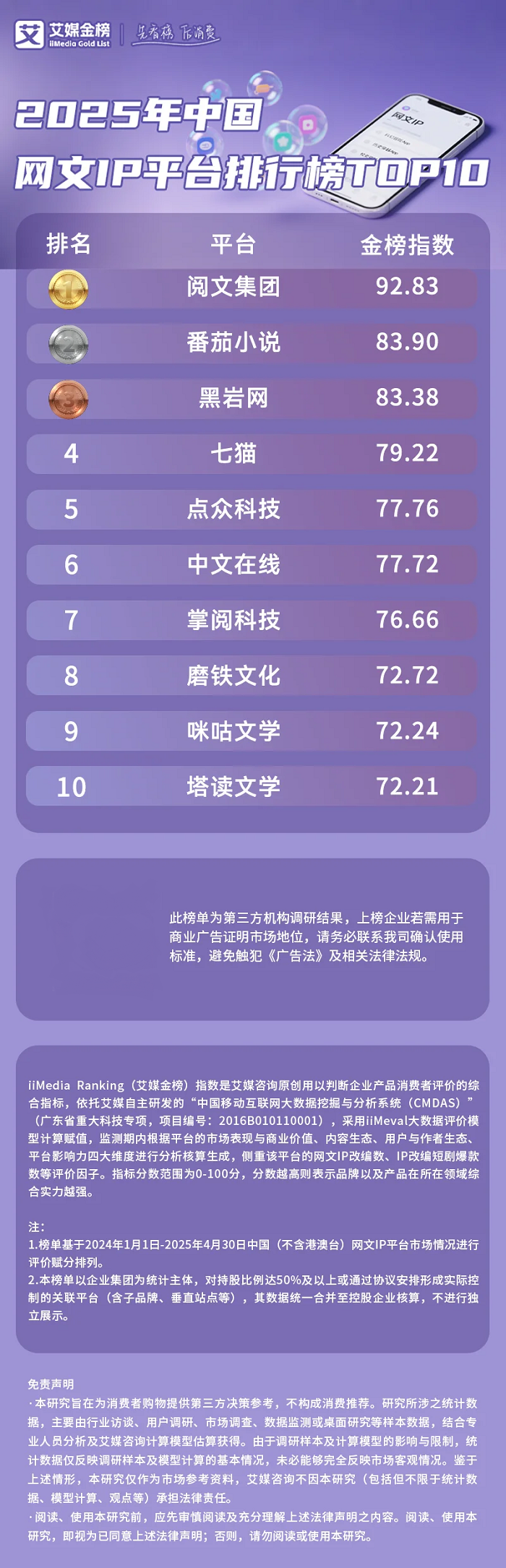
艾媒金榜 | 2025年中国网文IP平台排行榜TOP10
Sou Hu Wang· 2025-06-06 01:00
Core Insights - The Chinese online literature market is undergoing a deep transformation driven by social and cultural demands, technological innovations, and capital investments, with content and traffic remaining the core drivers of the industry [1] User Growth - By December 2024, the user base of Chinese online literature is expected to reach 575 million, an increase of 54.74 million from December 2023, accounting for 51.9% of the total internet users [1] Industry Rankings - The top ten online literature IP platforms in China for 2025, based on a comprehensive evaluation model, are: 1. Yuewen Group 2. Tomato Novel 3. Heiyan Network 4. Qimao 5. Dianzhong Technology 6. Zhongwen Online 7. Zhangyue Technology 8. Motie Culture 9. Migu Literature 10. Tadu Literature [1][2] Market Performance and Commercial Value - The evaluation of market performance and commercial value is based on the number of IP licensing collaborations and the number of hit adaptations in short dramas. Yuewen Group, Tomato Novel, and Heiyan Network lead in IP licensing, while Tomato Novel, Dianzhong Technology, and Zhangyue Technology excel in hit adaptations [7][8] - Yuewen Group's IP commercial revenue grew by 33.5% to 4.09 billion yuan, driven by successful adaptations of major IPs like "Douluo Dalu" and "Qing Yu Nian" [7] Content Ecosystem - In 2024, Yuewen Group signed 650,000 new works, leading the industry with over 42 billion new words. Tomato Novel and Heiyan Network also showed strong performance in content creation and adaptation [9][11] - AI-assisted creation is becoming popular, significantly enhancing content production efficiency across platforms [11] User and Author Ecosystem - Tomato Novel achieved 218 million monthly active users in June 2024, a 35.5% increase year-on-year. Yuewen Group's average monthly paid users rose by 4.6% to 9.1 million [12] - Seven Cat Novel attracted many authors with favorable signing policies, while Tomato Novel implemented various support measures to foster content incubation [12] Platform Influence - Tomato Novel's WeChat index peaked during short drama marketing events, reflecting its strong cross-platform engagement. Heiyan Network's small program matrix has become a key tool for user acquisition and experience enhancement [13] Industry Trends for 2025 - The online literature IP market is expected to see improved IP development efficiency, with a focus on micro-short dramas and global expansion aided by AI translation [14][15] - The rise of micro-short dramas is predicted to transform the adaptation landscape, with a projected market size exceeding 100 billion yuan by 2027 [14] Historical Context - The evolution of the Chinese online literature industry from 2018 to 2025 has been marked by significant shifts in platform dynamics, user engagement, and content monetization strategies [16][20]
阅文(马宇峰):AIGC在阅文集团的实践落地
Sou Hu Cai Jing· 2025-06-05 16:00
Core Insights - The article discusses the integration of artificial intelligence (AI) in the digital content industry, particularly focusing on the practices of Yuewen Group in the realm of online literature, emphasizing AI as an auxiliary tool for creators rather than a replacement for human creativity [1][3]. Group 1: Intelligent Creation - Yuewen positions intelligent creation as a "comprehensive assistant" for writers, utilizing its self-developed "Miaobi" system to provide robust support across multiple dimensions [1]. - The system enhances the "web literature feel" by training a 200 billion parameter model specifically for web literature genres, improving text processing capabilities from 2K to 32K tokens [1]. - The "Miaobi" system assists in the entire creative process, including world-building, character development, expression optimization, and knowledge consulting [1]. Group 2: Role Playing - Yuewen aims to "revive" characters from stories, enabling deep interaction between readers and characters through data-driven definitions of character essence [1]. - The company employs Retrieval-Augmented Generation (RAG) technology to address issues like hallucinations and outdated knowledge in character dialogues [1]. - By combining supervised fine-tuning and reinforcement learning from human feedback, Yuewen seeks to provide personalized character interactions that surpass generic dialogue models [1]. Group 3: Challenges and Solutions - Yuewen's practices offer reusable solutions to three major challenges in vertical AIGC: defining fields, data storage, and scaling applications [1]. - The company quantifies subjective concepts like "web literature feel" using data and addresses data storage challenges by reducing manual annotation time by 70% through large model-assisted labeling [1]. - To achieve scalable implementation, Yuewen focuses on creating a business closed-loop and optimizing reasoning costs while monitoring core metrics [1][3]. Group 4: Future Outlook - Yuewen's exploration confirms its core belief that AI serves as "auxiliary driving" in creation, with the true control remaining in the hands of writers [3]. - The evolution of AIGC is expected to lead to three major transformations: democratization of creation, interactive reading experiences, and industry upgrades for faster IP incubation [3][4][5]. - The company has accumulated over 17,000 practical cases, establishing a sustainable ecosystem for web literature vertical AIGC through its four-ring model of pre-training, fine-tuning, feedback alignment, and production returns [5].