
航空发动机

Search documents
5月盘点:成都重要投融资事件及产业环境数据汇总
Sou Hu Cai Jing· 2025-05-30 12:01
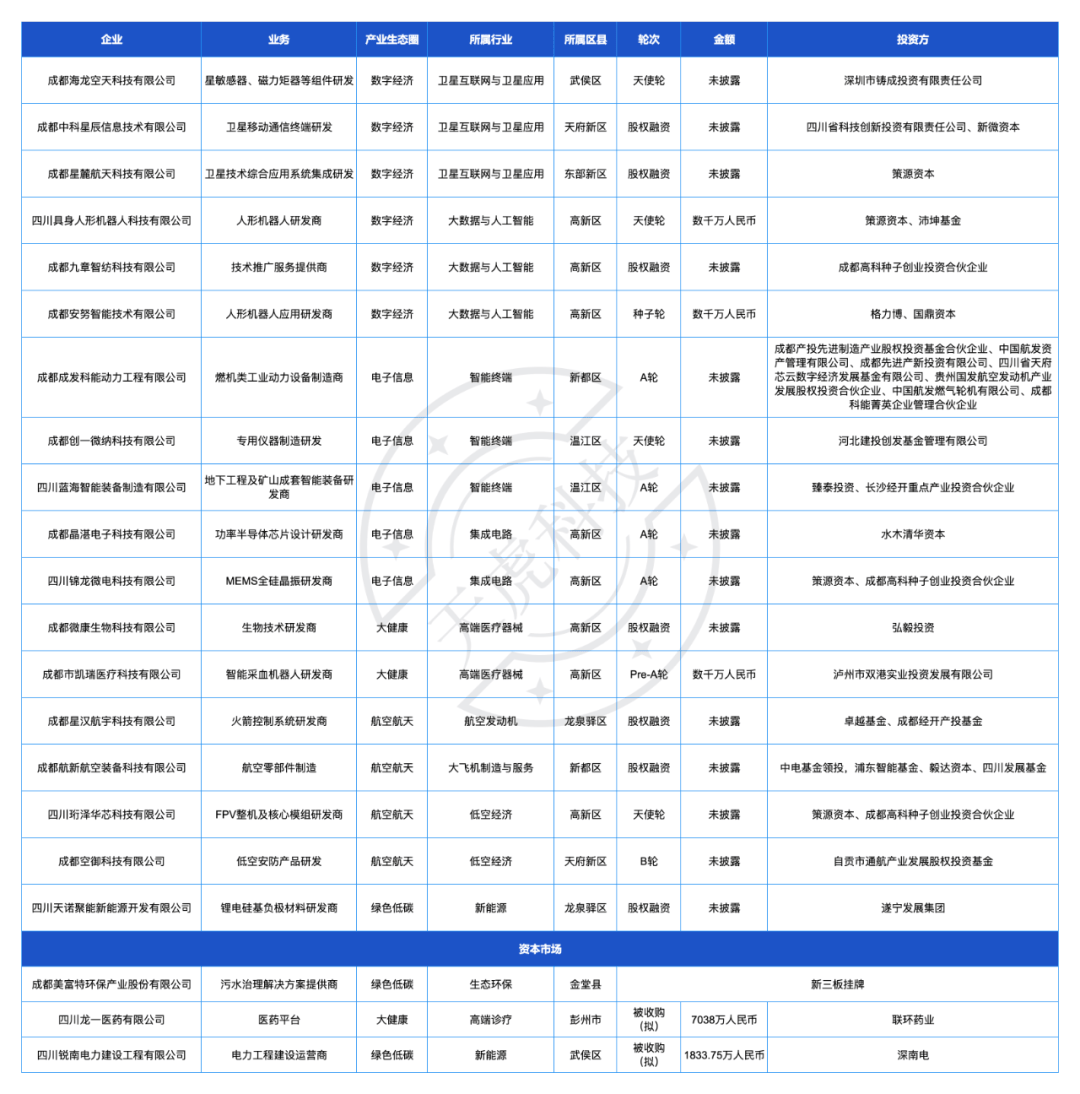
Core Insights - In May, Tianhu Technology recorded 21 investment and financing events related to technology innovation and entrepreneurship in Chengdu, indicating a vibrant investment landscape in the region [1][3]. Group 1: Investment Events - Chengdu Hailong Aerospace Technology Co., Ltd. completed angel round financing, focusing on the development of star sensors and magnetic moment devices [2][10]. - Chengdu Zhongke Xingchen Information Technology Co., Ltd. secured equity financing, specializing in satellite mobile communication terminals [2][11]. - Chengdu Xinglu Aerospace Technology Co., Ltd. completed equity financing, engaged in satellite technology integration [2][12]. - Sichuan Jushen Humanoid Robot Technology Co., Ltd. raised tens of millions in angel round financing, focusing on humanoid robots [2][13]. - Chengdu Jiuzhang Zhifang Technology Co., Ltd. completed equity financing, providing technology promotion services [2][14]. - Chengdu Annu Intelligent Technology Co., Ltd. raised tens of millions in seed round financing, focusing on humanoid robot applications [2][15]. - Chengdu Chengfa Kenen Power Engineering Co., Ltd. completed A round financing, specializing in industrial power equipment [4]. - Chengdu Chuangyi Micro-Nano Technology Co., Ltd. completed angel round financing, focusing on specialized instrument manufacturing [6]. - Sichuan Blue Ocean Intelligent Equipment Manufacturing Co., Ltd. completed A round financing, specializing in intelligent equipment for underground engineering [7]. - Chengdu Jingzhan Electronic Technology Co., Ltd. completed A round financing, focusing on power semiconductor chip design [8]. - Sichuan Jinlong Microelectronics Technology Co., Ltd. completed A round financing, specializing in MEMS silicon oscillators [9]. - Chengdu Weikang Biotechnology Co., Ltd. completed equity financing, focusing on biotechnology research [17]. - Chengdu Kerry Medical Technology Co., Ltd. completed tens of millions in Pre-A round financing, focusing on intelligent blood collection robots [18]. - Sichuan Tiannuo Juneng New Energy Development Co., Ltd. completed equity financing, focusing on lithium-silicon anode materials [19]. - Chengdu Hangxin Aviation Equipment Technology Co., Ltd. completed equity financing, specializing in aviation parts manufacturing [21]. - Chengdu Xinghan Aerospace Technology Co., Ltd. completed equity financing, focusing on rocket control systems [22]. Group 2: Market Trends - The majority of financing events were in the seed and angel round stages, indicating a focus on early-stage investments [3]. - The digital economy and electronic information sectors were the hottest investment areas in Chengdu, with nearly 30% of projects related to the digital economy and about 25% related to electronic information [3].

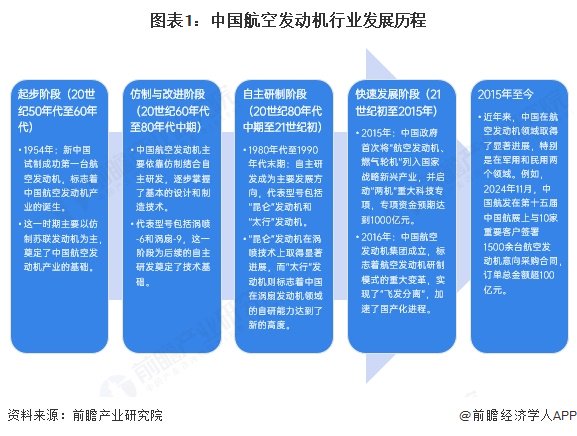
2025年中国航空发动机行业发展概述 产品领域多,发展前景好【组图】
Qian Zhan Wang· 2025-05-23 06:58
Core Viewpoint - The Chinese aviation engine industry has transitioned from imitation to independent research and development, demonstrating strong self-innovation capabilities and moving towards high-quality development supported by national policies [1]. Industry Overview - The aviation engine industry is a crucial segment of the national economy and security, with its comprehensive level reflecting a country's overall strength. Aviation engines can be categorized into various types based on thrust generation principles, oxidizer sources, and the presence of compressors [3]. Technical and Financial Barriers - The aviation engine industry is characterized by high technical and financial barriers, requiring expertise across multiple modern technology fields. The demanding operational conditions necessitate significant foundational research, engineering technology accumulation, and financial investment, making it challenging for new entrants to compete [5]. Engine Types and Applications - Different types of aviation engines serve distinct applications, with the turbofan engine being the most widely used due to its efficiency and low fuel consumption. A summary of various engine types and their applications includes: - Piston engines: Low cost and high fuel efficiency, primarily used in small low-speed aircraft and drones [9]. - Ramjet engines: Simple structure and high thrust, used in supersonic missiles and targets [9]. - Turbojet engines: High thrust but high fuel consumption, used in older fighter jets and ballistic missiles [9]. - Turbofan engines: High efficiency and low fuel consumption, used in modern military and civilian aircraft [9]. - Turboprop engines: High fuel economy at medium to low speeds, used in small transport and general aviation aircraft [9]. - Turboshaft engines: The only power source for helicopters [9]. - Propfan engines: Complex structure and high noise, with limited application [9]. Future Development Directions - The Chinese aviation engine manufacturing industry is expected to focus on independent innovation, improving quality and reliability, international cooperation, R&D investment, and sustainable development, positioning itself as a significant player in the global aviation sector [11].


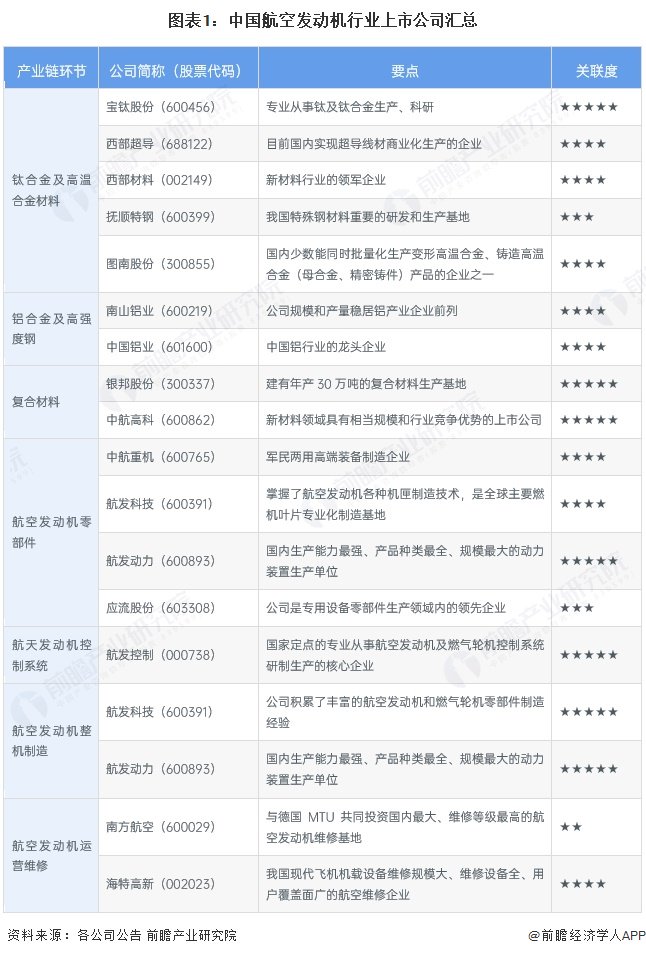
【最全】2025年航空发动机行业上市公司全方位对比(附业务布局汇总、业绩对比、业务规划等)
Qian Zhan Wang· 2025-05-17 03:10
Summary of Key Points Core Viewpoint - The aviation engine industry in China is primarily dominated by a few key players, with a significant focus on innovation, research and development, and market expansion to enhance their competitive edge in both military and civilian sectors [1][18]. Group 1: Industry Overview - The aviation engine manufacturing segment includes four main types: turbojet, turbofan, turboshaft, and turboprop engines, largely monopolized by the China Aviation Engine Group [1]. - Key companies in the industry include Aviation Power (航发动力), Aviation Technology (航发科技), and Aviation Control (航发控制), among others [1][3]. Group 2: Company Performance - Aviation Power reported a revenue of 449.94 billion yuan in 2024, leading the industry in terms of revenue [16]. - The average gross margin for listed companies in the aviation engine sector is around 25%, with individual margins ranging from 10% to 35% [16]. - Aviation Control achieved a gross margin of 28.11% in 2024, reflecting its strong technological innovation capabilities [16]. Group 3: Business Layout and Market Position - Aviation Power and Aviation Technology have over 50% of their business focused on aviation engines, indicating a strong commitment to this sector [13]. - The regional distribution of companies shows that titanium alloy leaders are mainly located in Shaanxi, while other material representatives are concentrated in the East China region [5]. Group 4: Future Business Plans - Companies are focusing on innovation and R&D investments to expand their aviation engine business, with plans to enhance their capabilities in high-temperature alloy components and precision casting [19]. - Aviation Technology aims to participate in the development of the C919 aircraft's engines and expand its international subcontracting business [19]. Group 5: Key Financial Metrics - The largest revenue-generating company in the aluminum and high-strength steel sector is China Aluminum, with a revenue of 2370.66 billion yuan [4]. - The revenue of Aviation Power in the aviation engine sector is projected to exceed 400 billion yuan in 2024, highlighting its market leadership [4]. Group 6: Patent and Employee Information - China Aluminum and Aviation Power hold over 1000 patents, indicating a strong focus on innovation [8]. - Southern Airlines has the largest employee count among listed companies, exceeding 100,000 [8].




高毅资产吴任昊:航空发动机行业的投资启示
高毅资产管理· 2025-05-15 05:18
Core Insights - The aviation engine industry seeks optimal solutions under the "impossible triangle," aiming to balance three core performance goals: strong power, ultra-low fuel consumption, and extreme reliability [5][8][9] - Investment opportunities lie in identifying companies with unique business models and significant long-term value, particularly when pricing is relatively insufficient [4][30] Group 1: Aviation Engine Fundamentals - Aviation engines are characterized by the need to meet three conflicting performance indicators: powerful thrust, low fuel consumption, and high reliability [5][8] - The industry standard for civil aviation engines requires engines to provide sufficient power for aircraft weighing up to 80 tons while achieving fuel consumption of 2 liters per 100 kilometers per seat [7] - Reliability standards demand that engines operate without failure for approximately 30 years, equating to 100,000 hours of operation with a maximum of one unscheduled stop [7][8] Group 2: Business Model and Competitive Landscape - The aviation engine industry exemplifies the "super knife and blade" model, where engines are sold at low initial costs, while high-margin maintenance and service revenues are generated over time [9][10] - The CFM56 engine serves as a prime example, with a 17-year development cycle and a delivery span of 33 years, showcasing the long-term technological advantage [10][12] - The high resale value of engines is attributed to rigorous lifecycle management and maintenance, ensuring that engines retain significant value even as the aircraft depreciates [12][13] Group 3: Market Dynamics and Investment Opportunities - The aviation engine market is currently characterized by a stable operating environment, with after-market service revenues becoming increasingly critical [26][27] - The global supply chain's disruptions have led to delays in aircraft deliveries, which paradoxically boosts after-market service demand as older engines require more maintenance [27][28] - Market inefficiencies arise from a lack of understanding and accurate pricing in the aviation engine sector, presenting opportunities for investors to capitalize on mispriced assets [29][30]

2025年中国航空发动机国产替代分析 国产化布局正在不断进行【组图】
Qian Zhan Wang· 2025-05-14 07:10
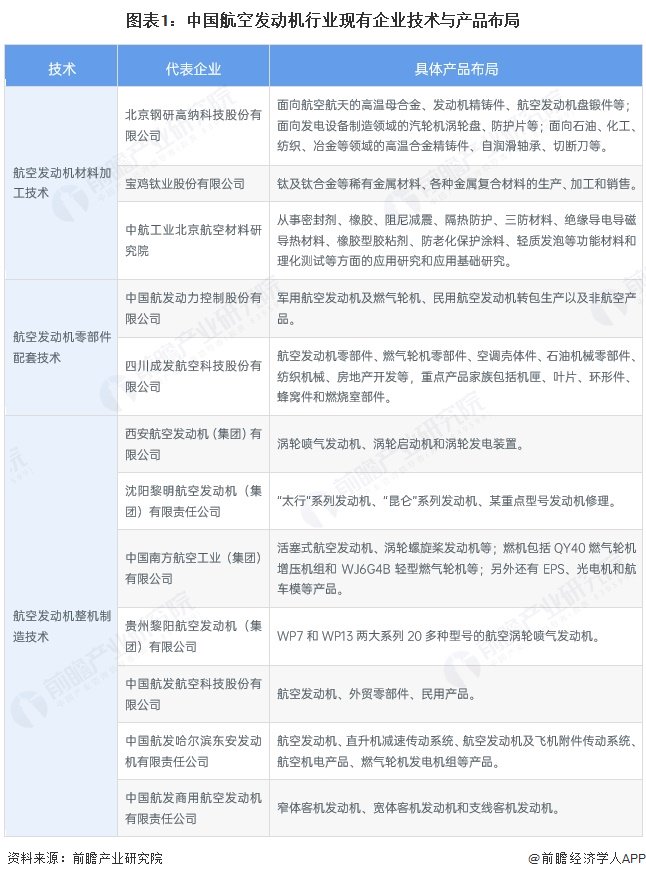
Core Insights - The Chinese aviation engine industry has achieved significant technological breakthroughs, focusing on three main areas: material processing, component manufacturing, and complete engine production [1][3]. Group 1: Technological Breakthroughs - Major companies in the aviation engine materials processing sector include Beijing Steel Research Technology Co., Ltd., which produces high-temperature alloys and precision castings for aerospace applications [2]. - In the component manufacturing sector, companies like Sichuan Chengfa Aviation Technology Co., Ltd. and Xi'an Aero Engine (Group) Co., Ltd. have developed various engine components, including turbine engines and combustion chamber parts [2][3]. - The complete engine manufacturing sector is represented by companies such as Guizhou Liyang Aviation Engine (Group) Co., Ltd., which has produced over 20 models of aviation turbine engines [3]. Group 2: Domestic Production and Development - China has established a relatively complete aviation engine research and production system, capable of developing various types of engines, including turboprop, turbojet, turbofan, and turboshaft engines [3]. - The domestically developed WS-20 engine is now used in the Y-20 transport aircraft, marking a significant step towards the complete domestic production of military aircraft engines [4]. Group 3: Market Position and Future Outlook - In the global military aircraft market, China ranks third with 3,309 military aircraft, accounting for 6% of the total, following the United States and Russia [6]. - The global fleet size is projected to grow from 20,563 aircraft in 2021 to 47,531 by 2041, with a shift towards the Chinese and Asia-Pacific markets [9].
航发动力: 中国航发动力股份有限公司关于参加2025年陕西辖区上市公司投资者集体接待日暨2024年度业绩说明会的公告
Zheng Quan Zhi Xing· 2025-05-12 10:28
证券代码:600893 证券简称:航发动力 公告编号:2025-012 网址:http://rs.p5w.net 中国航发动力股份有限公司 关于参加"2025 年陕西辖区上市公司 投资者集体接待日暨 2024 年度业绩说明会"的公告 本公司董事会及全体董事保证本公告内容不存在任何虚假记载、误导性陈述 或者重大遗漏,并对其内容的真实性、准确性和完整性承担个别及连带责任。 为促进上市公司规范运作、健康发展,增强上市公司信息透明度,加强与广 大投资者沟通交流,进一步提升投资者关系管理水平,陕西上市公司协会在陕西 证监局指导下,联合深圳市全景网络有限公司举办"2025 年陕西辖区上市公司 投资者集体接待日暨 2024 年度业绩说明会"。 届时,中国航发动力股份有限公司(以下简称公司)主要负责人及相关高管 人员将通过互动平台与投资者进行网络沟通和交流,欢迎广大投资者踊跃参加。 活动时间:2025 年 5 月 20 日(星期三)15:00-17:00 活动地址:"全景路演" 为尊重投资者意见并提升交流效率,公司将提前向投资者公开征集问题。投 资者可将问题以邮件方式发送至公司指定邮箱 hkdl2008@XAE.AECC.C ...
领跑低空经济,来自无人机产业的最前线洞察|OpenTalk回顾
3 6 Ke· 2025-05-12 02:51
Core Insights - The event "Trillion Low-altitude Market, Drones Take Off First" highlighted the development of a digital low-altitude intelligent service system and its applications in various sectors, emphasizing the importance of drone technology in urban management and emergency response [2][3]. Group 1: Digital Low-altitude Intelligent Service System - The digital low-altitude intelligent service system is being constructed under government guidance, featuring a model of "three networks, two platforms, one center, and N applications" [3][5]. - The "three networks" include a low-altitude facility network, a low-altitude data network, and a low-altitude route network, which together support low-altitude flight operations [5]. - The "two platforms" consist of a low-altitude application service platform, which enhances regional observation capabilities and public service levels [5][6]. - The "one center" refers to a low-altitude operation service center that provides essential services such as flight planning and emergency response [5][6]. - The "N applications" indicate the wide applicability of the system across various sectors, including urban management, energy, environmental monitoring, and public safety [6]. Group 2: Drone Governance and Countermeasures - The governance of drones involves two categories: cooperative targets and non-cooperative targets, each requiring different management methods and technical approaches [10][11]. - For cooperative targets, the governance relies on known communication links, while non-cooperative targets present higher technical challenges due to their unpredictable communication frequencies [11][12]. - The industry is moving towards a more complex drone governance landscape, necessitating advanced electronic countermeasures and multi-modal detection methods [13][14]. - The implementation of the "Interim Regulations on the Management of Unmanned Aerial Vehicle Flights" marks a significant shift in drone governance from managing cooperative targets to defending against non-cooperative threats [13]. Group 3: Domestic Aviation Engine Development - The focus on developing low-cost, domestically controllable aviation engines is crucial for the low-altitude economy, with companies like Hongpeng Aviation leading the way [18][19]. - Hongpeng Aviation aims to meet the demand for small to medium-sized aviation engines, targeting the low-altitude economic sector [19]. - The company has adopted strategies to reduce costs significantly, with some products expected to be priced at one-third of competitors' prices [19][23]. - The Chinese aviation engine industry excels in material and processing capabilities but faces challenges in design and engineering applications [23]. Group 4: Industry Trends and Future Directions - The event discussed the current state of drone chip localization and the effectiveness of AI technology in enhancing drone safety and operational capabilities [24]. - The integration of unmanned systems is expected to lower operational costs for government agencies, as data can be shared across various units [25]. - Investors are encouraged to focus on companies with strong R&D capabilities in the drone governance sector, particularly those addressing non-cooperative target detection and countermeasures [26]. - The future of drone technology may hinge on breakthroughs in signal-level control and the ability to manage non-cooperative targets effectively [27].

【干货】航空发动机行业产业链全景梳理及区域热力地图
Qian Zhan Wang· 2025-05-07 05:12
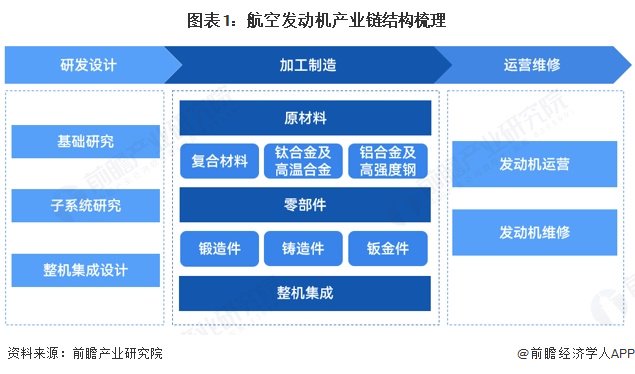
Core Insights - The article discusses the development and current state of the aviation engine industry in China, highlighting the complete manufacturing system that has been established [1][2]. Industry Overview - The aviation engine industry includes research and design, manufacturing (raw materials, components, complete machine manufacturing), operation, and maintenance [1]. - Key participants in research and design include major universities and research institutes, such as Beihang University and Nanjing University of Aeronautics and Astronautics [2]. - The complete machine manufacturing segment is primarily dominated by China Aviation Engine Group, while raw material processing involves companies like Fushun Special Steel and Baosteel [2][4]. Regional Distribution - The distribution of aviation engine manufacturing companies is mainly concentrated in inland regions of China, with titanium alloy material leaders located in Shaanxi and other material representatives in Jiangsu [4]. Company Performance - Aviation Power (航发动力) leads the industry with projected revenue of 44.994 billion yuan in 2024, with an average gross margin of around 25% across the industry [5][7]. - Other notable companies include: - AVIC Heavy Machinery (中航重机) with revenue of 8.108 billion yuan and a gross margin of 23.69% [7]. - AVIC Control (航发控制) with revenue of 4.882 billion yuan and a gross margin of 28.11% [7]. - AVIC Technology (航发科技) with revenue of 2.572 billion yuan and a gross margin of 16.09% [7]. - Yingliu Co. (应流股份) with revenue of 1.208 billion yuan and a gross margin of 34.24% [7]. Investment Trends - Recent investment trends in the aviation engine industry focus on enhancing the supply chain and improving technological capabilities [9]. - Aviation Power has invested in multiple subsidiaries to strengthen its industry chain, while AVIC Heavy Machinery has acquired stakes in precision casting companies to enhance its technical strength [10].

梯度培育持续发力,南京83家企业入选
Nan Jing Ri Bao· 2025-05-06 23:44
Group 1 - Nanjing has announced a list of 83 provincial specialized, refined, distinctive, and innovative small and medium-sized enterprises (SMEs) for 2025, reflecting the city's commitment to fostering high-quality development in this sector [1] - The city has established a tiered cultivation system for specialized and innovative enterprises, supporting their growth from innovative SMEs to "little giant" enterprises and manufacturing champions [1] - In 2024, Nanjing added 13 national manufacturing champions, 121 national-level "little giant" enterprises, and 570 provincial specialized and innovative SMEs [1] Group 2 - Companies like Zhongcai New Energy Technology Co., Ltd. are leveraging their proprietary lithium battery technology, achieving a 14.6% market share in the global cylindrical battery market, ranking fourth [1] - Various sectors are represented among the 83 selected enterprises, including electronic information, biomedicine, and aerospace [1] - Companies such as Zhongcang Robotics and Nanjing San Die Ji Pharmaceutical Technology Co., Ltd. are innovating in automated logistics and 3D-printed pharmaceuticals, respectively, showcasing the city's diverse industrial capabilities [2] Group 3 - The city aims to accelerate the growth of specialized and innovative enterprises by enhancing collaboration across finance, technology, industry, and talent policies [3] - The goal for the current year is to reach 30 national manufacturing champions, 300 national-level "little giant" enterprises, 1,000 provincial specialized and innovative SMEs, and 10,000 innovative SMEs [3]
港股概念追踪|特朗普将提出创纪录的1.01万亿美元国家安全预算 军工板块高景气延续(附概念股)
智通财经网· 2025-05-02 01:53
天风证券指出,2025Q1主动型基金前十大军工股持有流入总市值绝对值的前十中,军工电子板块标的 占80%。 过去三年军工电子板块较其他军工子板块超跌较多,在长尾效应下周期反弹锐度或将凸显,板块景气度 修复时或成为先选,军工电子持仓占比有望持续提升。2025Q1航空发动机产业相关标的在主动型基金 前十大军工股持有流出总市值占公司总市值前十中占比30%,我们认为,航发产业或受制于2025年周期 相对底部的影响,伴随国产商发持续加速,新型号装备型号持续成熟,航发子板块有望企稳修复。 军工板块相关企业港股: 中航科工(02357)、中船防务(00317) 智通财经APP获悉,据知情政府官员透露,美国总统特朗普将为10月1日开始的下一财年申请创纪录的 1.01万亿美元国家安全支出,比当前财年的数字高出13%以上。 美国国防预算将为金穹导弹防御项目、造船和核现代化、边境安全提供资金。其中包括3.8%的军人加 薪。其中一位要求不具名的官员说,13%的增幅与里根总统领导下的国防建设相呼应。作为埃隆·马斯 克削减成本努力的一部分,特朗普政府试图削减五角大楼的一些开支,但表示希望提高总体国防预算。 中国银河证券研报表示,新质筑基 ...