晶圆代工

Search documents
格芯与中国本地晶圆厂达成最终协议!
国芯网· 2025-08-06 14:10
Group 1 - The core viewpoint of the article emphasizes the strategic partnership between GlobalFoundries and a local Chinese wafer foundry to enhance semiconductor supply in China, particularly focusing on automotive-grade CMOS technology [1] - GlobalFoundries reported a revenue of $1.688 billion for Q2 2025, reflecting a year-on-year growth of 3% and a quarter-on-quarter growth of 6% [1] - The company shipped 581,000 12-inch wafers in Q2 2025, which is a 12% increase year-on-year and a 7% increase quarter-on-quarter [1] Group 2 - The collaboration aims to meet the domestic demand for semiconductors in China without requiring customers to redevelop and tape out at a new foundry [1] - The focus of the partnership will initially be on automotive-grade processes, targeting both domestic and international semiconductor companies operating within China [1] - GlobalFoundries is still awaiting a meaningful recovery in the consumer electronics market [1]

台积电的封神之路
半导体芯闻· 2025-08-06 11:22
Core Viewpoint - TSMC has established itself as the leading player in the foundry industry through strategic technological advancements and expansions over the decades, starting from its inception in 1986 to becoming a dominant force in semiconductor manufacturing [2]. Phase 1 - Initiation - TSMC was founded in 1986 with an initial capital of $48 million, primarily funded by the Taiwanese government and Philips [4]. - The company began production in 1987 using 6-inch wafers and quickly advanced to 3.0-micron technology, marking its first significant production milestone [4][5]. - By 1994, TSMC had developed a 0.6-micron process and achieved a sales increase from NT$2.2 billion to NT$19.3 billion between 1990 and 1994, indicating a robust growth trajectory [7]. Phase 2 - Expansion and Catch-Up - In 1995, TSMC launched its 8-inch Fab III and introduced tungsten plugs, enhancing its manufacturing capabilities [11]. - The company achieved NT$50 billion in revenue in 1998, despite a semiconductor downturn, and began producing 0.22-micron nodes [14]. - By 2000, TSMC's sales grew by 127% compared to 1999, with a compound annual growth rate of 50% from 1992 to 2000 [19]. Phase 3 - Leveling Up and Leading - TSMC's 180nm node positioned it competitively against major manufacturers like IBM and Intel, with a slight edge in the use of fluorosilicate glass (FSG) [24]. - Despite a 32% decline in the semiconductor market in 2001, TSMC's 150nm products still accounted for 21% of sales by Q4 [26]. - The introduction of 130nm technology in 2002 marked a significant milestone, with TSMC adopting copper interconnects and low-k dielectrics [29]. Phase 4 - 300mm and Consolidation - TSMC's 90nm process was the first to achieve full production on 300mm wafers, adopted by over 30 customers in its launch year [37]. - By 2006, TSMC had become the largest foundry globally, with a sales figure 2.5 times higher than its nearest competitor [46]. - The establishment of "GigaFabs" aimed at enhancing manufacturing excellence through automation and efficiency [49]. Phase 5 - HKMG and Expansion - In 2010, TSMC announced the construction of its third 300mm fab, focusing on 40nm and 28nm processes, while also developing high-k metal gate (HKMG) technology [63]. - The introduction of 20nm technology in 2014 required advanced double patterning techniques, showcasing TSMC's commitment to cutting-edge manufacturing [84]. - By 2011, TSMC's monthly capacity exceeded 270,000 wafers, reflecting significant growth despite a challenging semiconductor market [80]. Conclusion - TSMC's journey from a startup to a semiconductor powerhouse illustrates its strategic focus on innovation, capacity expansion, and technological leadership, solidifying its position in the global market [2].

晶合集成筹划赴港IPO 引入华勤技术24亿元战略投资
Jing Ji Guan Cha Wang· 2025-08-03 11:59
Core Viewpoint - The company, Jinghe Integrated Circuit (688249), is planning to issue H-shares and list on the Hong Kong Stock Exchange to optimize its capital structure and broaden financing channels, without changing the control of its major shareholders [2] Group 1: Company Overview - Jinghe Integrated Circuit is one of China's leading semiconductor foundries, established in May 2015, and is the first 12-inch wafer foundry in Anhui Province [2] - The company officially listed on the STAR Market in May 2023 and primarily engages in 12-inch wafer foundry services, with capabilities in various technology platforms including DDIC, CIS, PMIC, MCU, and Logic [2] - The company has achieved mass production of products such as display driver chips (DDIC), CMOS image sensors (CIS), microcontrollers (MCU), power management ICs (PMIC), and logic applications, which are widely used in consumer electronics, smartphones, smart home appliances, security, industrial control, and automotive electronics [2] Group 2: Recent Developments - The company has successfully achieved mass production of its 40nm high-voltage OLED display driver chips and 55nm full-process stacked CIS chips, with 28nm OLED display driver chips and 28nm logic chips expected to enter risk mass production by the end of this year [3] - In July, Jinghe Integrated Circuit accelerated its capital market activities, with several semiconductor companies, including Chipsea Technology and Lattice Semiconductor, also disclosing plans for Hong Kong IPOs [3] Group 3: Shareholder Changes - On the same day Jinghe Integrated Circuit announced its Hong Kong IPO, Huakin Technology, the largest mobile ODM manufacturer in China, announced a cash acquisition of 120 million shares (6% of total shares) from the Taiwanese-backed investor, Liching Innovation Investment, for 2.39 billion yuan, at a price of 19.88 yuan per share, a 10% discount to the market price [3][4] - Following the transaction, Huakin Technology will become the fourth-largest shareholder of Jinghe Integrated Circuit and gain a board nomination seat, while Liching Innovation's shareholding will decrease to 13.08% [4] Group 4: Financial Performance - In 2024, Jinghe Integrated Circuit reported approximately 9.249 billion yuan in revenue, a year-on-year increase of 27.69%, attributed to the favorable semiconductor industry conditions and increased sales [5] - The net profit attributable to shareholders was approximately 533 million yuan, a significant year-on-year increase of 151.78% [5] - In Q1 2025, the company achieved approximately 2.568 billion yuan in revenue, a year-on-year increase of 15.25%, with a net profit of approximately 135 million yuan, reflecting a 70.92% year-on-year growth [6] Group 5: Market Position - As of August 1, Jinghe Integrated Circuit's stock closed at 21.57 yuan per share, with a market capitalization of 43.3 billion yuan [7]


晶合集成拟港股上市,公司回应
Zhong Guo Zheng Quan Bao· 2025-08-03 09:53
Group 1 - The core viewpoint of the news is that Jinghe Integrated is planning to list H-shares in Hong Kong to expand its overseas customer base and for strategic investment purposes [1][2] - The company is currently in the planning stage for the H-share issuance, and the specific use of raised funds has not yet been determined [1] - The H-share listing is not expected to significantly impact the company's A-share market [1] Group 2 - Jinghe Integrated reported a revenue of approximately 9.249 billion yuan for 2024, representing a year-on-year growth of 27.69%, attributed to the favorable semiconductor industry conditions and increased sales volume [2] - The net profit attributable to shareholders for 2024 was approximately 533 million yuan, showing a significant year-on-year increase of 151.78%, driven by revenue growth, high capacity utilization, reduced unit sales costs, and improved product gross margins [2] - In the first quarter of 2025, the company achieved a revenue of about 2.568 billion yuan, a year-on-year increase of 15.25%, with a net profit of approximately 135 million yuan, reflecting a year-on-year growth of 70.92% [2] Group 3 - As of August 1, Jinghe Integrated's stock closed at 21.57 yuan per share, with a market capitalization of 43.3 billion yuan [3]
台积电的封神之路
半导体行业观察· 2025-08-02 02:13
Core Insights - TSMC has established itself as the leading player in the foundry industry, playing a crucial role in the semiconductor sector through decades of growth and innovation [2][7][45]. Phase 1 - Initiation - TSMC was founded in 1986 with an initial capital of $48 million, primarily funded by the Taiwanese government and Philips [2]. - The company began production in 1987 using 6-inch wafers and quickly advanced to 3.0-micron technology [2][7]. - By 1994, TSMC had developed a 0.6-micron process and had shipped 2.5 million wafers, with revenues growing from NT$2.2 billion to NT$19.3 billion from 1990 to 1994 [7]. Phase 2 - Expansion and Catch-Up - In 1995, TSMC launched its 8-inch Fab III and introduced tungsten plugs, enhancing its manufacturing capabilities [11]. - By 1998, TSMC's revenue reached NT$50 billion, despite a semiconductor downturn, and it began producing 0.22-micron nodes [15]. - The company achieved a compound annual growth rate of 50% from 1992 to 2000, with sales increasing by 127% in 2000 compared to 1999 [19][21]. Phase 3 - Leveling Up and Leading - TSMC's 180nm node was competitive with leading manufacturers, and it was the first to implement low-k dielectrics [25]. - In 2001, despite a 32% market decline, TSMC's 150nm products accounted for 21% of its sales [26]. - The company introduced 130nm technology in 2002, marking a significant milestone in its production capabilities [29]. Phase 4 - 300mm and Consolidation - TSMC's 90nm process was the first to achieve full-scale production on 300mm wafers, adopted by over 30 customers in its first year [37]. - By 2006, TSMC had become the largest foundry globally, with sales exceeding those of its nearest competitor by 2.5 times [45]. - The company expanded its production capacity significantly, with GigaFabs achieving near 100% automation [48]. Phase 5 - HKMG and Further Expansion - In 2010, TSMC announced the construction of its third 300mm fab, focusing on 40nm and 28nm processes [64]. - The introduction of high-k metal gate (HKMG) technology marked a significant advancement in TSMC's manufacturing processes [66]. - By 2012, TSMC's 28nm process accounted for 42% of its revenue, demonstrating its dominance in the market [88].
三星电子Q2营业利润大跌逾半,芯片业务暴跌94%拖累业绩 | 财报见闻
Hua Er Jie Jian Wen· 2025-07-31 08:20
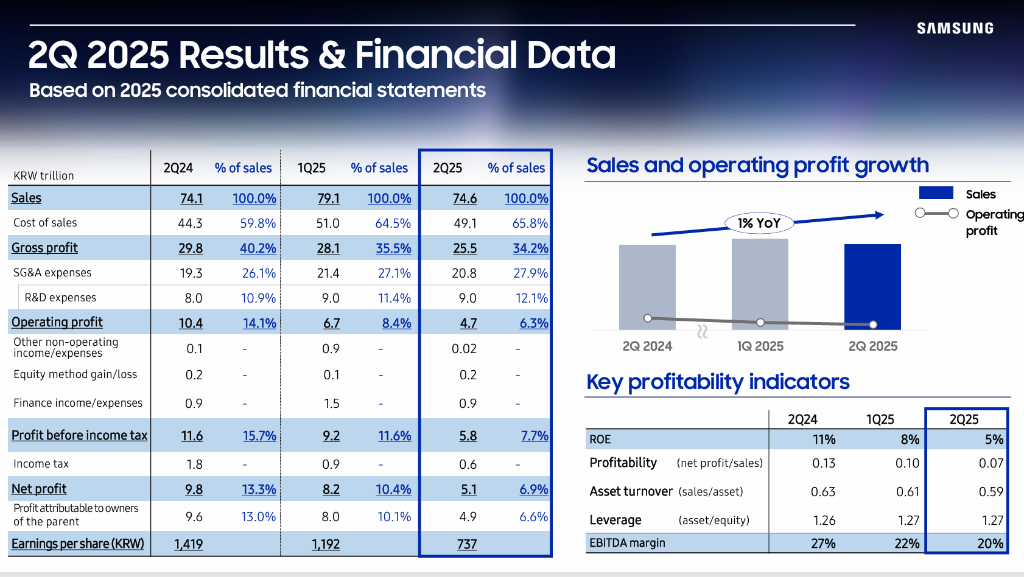
Core Viewpoint - Samsung Electronics reported a significant decline in Q2 performance, with operating profit dropping 55.8% year-on-year to 4.7 trillion KRW, primarily due to a 94% plunge in chip business profits, which fell to 400 billion KRW from 6.5 trillion KRW in the same period last year [1][6]. Financial Performance Summary - Q2 2024 sales reached 74.1 trillion KRW, a 1% increase year-on-year [4]. - Operating profit was 4.7 trillion KRW, down from 10.4 trillion KRW in the same quarter last year, marking a 55.8% decline [4]. - Net profit margin decreased to 6.9%, with gross margin falling from 40.2% to 34.2% [4]. - Return on Equity (ROE) dropped from 11% to 5%, and EBITDA margin fell to 20% [2][4]. Chip Business Challenges - The chip business faced severe setbacks, with operating profit in the Device Solutions (DS) segment plummeting 93.8% to 400 billion KRW [6]. - Revenue from the chip business decreased from 28.56 trillion KRW to 27.9 trillion KRW year-on-year [6]. - Samsung is experiencing intense competition in the storage chip market, particularly from SK Hynix, which has caught up in revenue and is leading in high-bandwidth memory (HBM) chips [6]. Mobile Business Performance - In contrast to the chip business, Samsung's mobile division showed strong performance, with operating profit rising 39% to 3.1 trillion KRW [8]. - The mobile segment's revenue reached 29.2 trillion KRW, up from 27.38 trillion KRW year-on-year, driven by strong sales of the Galaxy S25 and Galaxy A series smartphones [8]. - Samsung maintained a 19% market share in the global smartphone market by volume, largely due to the success of the Galaxy A series [8]. Future Outlook - The company anticipates a rebound in performance in the second half of the year, driven by recovery in the IT sector due to AI and robotics [6]. - Despite challenges, Samsung's foundry business is expected to improve, aided by a significant contract with Tesla for AI chip production [7]. - The overall smartphone demand is projected to slightly contract due to inflation and tariff concerns, but the high-end market is expected to see moderate growth [9].
华勤技术24亿战投晶合集成寻协同 深耕ODM行业20年成千亿全球龙头
Chang Jiang Shang Bao· 2025-07-31 00:05
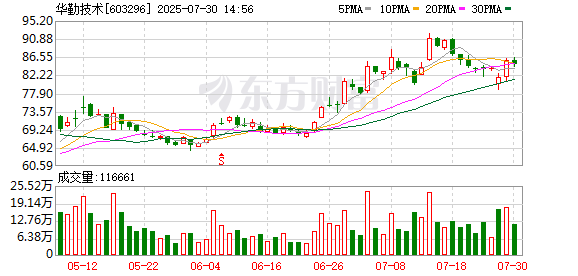
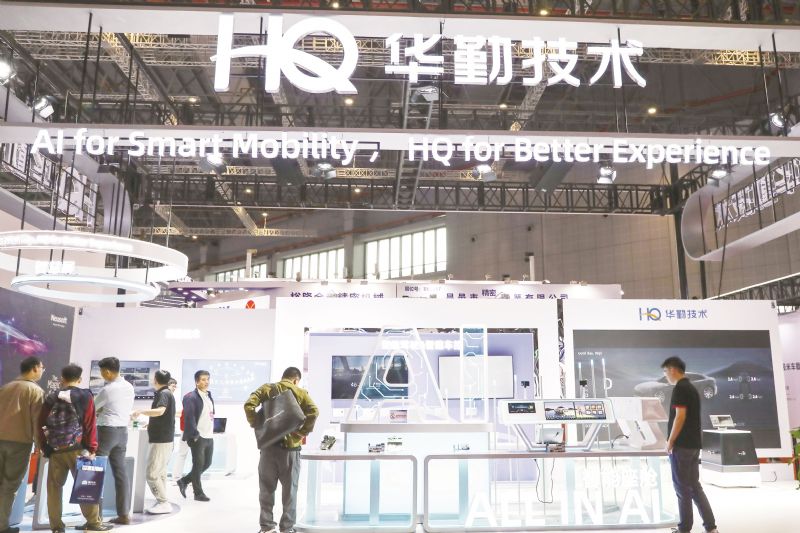
Core Viewpoint - Huqin Technology (603296.SH), a leading ODM enterprise, announced a strategic investment of nearly 2.4 billion yuan to acquire a 6% stake in the A-share Sci-Tech Innovation Board company, Jinghe Integrated (688249.SH), aiming to enhance resource integration and collaboration within the industry chain [2][4]. Investment Details - The investment involves Huqin Technology purchasing approximately 120 million shares from Lichuang Innovation Investment Holdings at a price of 19.88 yuan per share, totaling around 2.393 billion yuan, which is about 10% lower than Jinghe's closing price on July 18 [3]. - Following the transaction, Huqin Technology will become the fourth largest shareholder of Jinghe Integrated, while Lichuang's stake will decrease to 13.08% [3][4]. Strategic Intent - Huqin Technology aims to deepen resource integration and explore potential collaborations in various business projects through this investment, reflecting confidence in Jinghe Integrated's future development and long-term investment value [4][5]. - The company plans to appoint a director to Jinghe Integrated and has secured a commitment from Lichuang to maintain a minimum shareholding of 8% for three years [4]. Company Background - Established in 2005, Huqin Technology has become a global leader in the ODM industry, serving major brands like Samsung, OPPO, and Xiaomi, with a diverse product line including smartphones, laptops, and AIoT products [5][6]. - The company reported a revenue of 109.878 billion yuan in 2024, marking a 28.76% year-on-year increase, and a net profit of 2.926 billion yuan, up 8.10% [6]. Recent Performance - In the first quarter of 2025, Huqin Technology achieved significant growth, with revenues and net profits reaching 34.998 billion yuan and 842 million yuan, respectively, reflecting year-on-year increases of 115.65% and 39.05% [6]. - The company's growth trajectory has been supported by strategic acquisitions, including a planned acquisition of 80% of Yiluda International for 2.85 billion HKD and a 65% stake in Nanchang Chunqiu for approximately 348 million yuan [7]. Global Expansion - Huqin Technology has established a dual supply system with core domestic bases and overseas VMI bases in Vietnam, Mexico, and India, to meet diverse customer demands and external uncertainties [7].
拟24亿拿下晶合集成6%股权,代工巨头华勤技术扩张“上瘾”?
Huan Qiu Lao Hu Cai Jing· 2025-07-30 12:08
ODM龙头计划入股晶圆代工企业晶合集成。 7月29日晚间,双方发布公告称,华勤技术拟以现金方式协议受让力晶创新投资控股股份有限公司(以 下简称"力晶创投")持有的晶合集成约1.20亿股股份。转让价格为每股19.88元,总交易金额达23.93亿 元。 交易完成后,华勤技术将持有晶合集成6.00%的股份,超越美的创新投资有限公司,跃居晶合集成第四 大股东。而力晶创投的持股比例则将从19.08%降至13.08%。 公开资料显示,力晶创投是台湾晶圆大厂力积电的母公司,曾在晶合集成的成长过程中提供重要技术支 持。然而,伴随晶合集成的持续发展壮大,力晶创投却逐步寻求退出路径。此前于2024年12月,力晶创 投已通过询价转让方式减持晶合集成3009.20万股,套现约5.98亿元。 近年来,华勤技术的对外扩张步伐明显加快。除此次入股晶合集成外,2024年12月,该公司宣布以 28.50亿港元完成对易路达企业控股有限公司(以下简称"易路达")80%股份的收购;2025年1月,又收 购了深圳豪成智能科技有限公司(以下简称"豪成智能")75%的股权。 这一系列"买买买"动作背后,反映了华勤技术推动业务转型的战略意图。作为全球ODM ...
英特尔转型,重创设备厂?
半导体芯闻· 2025-07-30 10:54
Core Viewpoint - Intel's latest financial report indicates a potential shift in strategy, with CEO Pat Gelsinger stating that if the next-generation 14A process does not attract "large customers," continued investment in this process may not be economically viable [1] Group 1: Intel's Strategy and Market Impact - Intel is currently pushing forward with the 14A process, but this is contingent on confirming customer commitments; without sufficient external orders and technical collaborations, it will be difficult to recoup investments [1] - Bernstein warns that if Intel abandons the 14A or more advanced processes, it could severely impact the overall wafer fabrication equipment (WFE) market, as Intel accounts for 20% of global logic chip equipment spending and 10-15% of overall semiconductor equipment [1] - The potential exit of Intel from advanced process development could lead to a significant market contraction [1] Group 2: Supply Chain Implications - The EUV equipment supply chain is particularly sensitive, with Japan's Lasertec having about 40% of its unfulfilled orders from Intel, and ASML relying on Intel for 15-20% of its EUV revenue; a halt in Intel's process upgrades could delay the adoption of High-NA EUV equipment [2] - TSMC is expected to be the biggest beneficiary of Intel's potential exit, as it has the capability to take over Intel's orders due to its advanced process technology and yield [2] - The supply chain may undergo restructuring, with HOYA potentially increasing its market share from 70% to 100% if Intel withdraws from the EUV mask substrate supply [2] Group 3: Financial Considerations - Transitioning to a fabless model could theoretically improve Intel's stock price, but if it only halts the 14A process while retaining the 18A process, it would still incur high capital expenditures and potentially lower margins due to outsourcing [2] - Bernstein cautions that this scenario could exacerbate market uncertainties, leading the firm to recommend reallocating funds to other investment opportunities rather than buying Intel stock [2]

华勤技术24亿入股晶合集成,ODM龙头携手晶圆新锐剑指何方?
2 1 Shi Ji Jing Ji Bao Dao· 2025-07-30 06:55
Core Viewpoint - Huqin Technology plans to strategically invest in Jinghe Integrated Circuit, marking its first foray into the semiconductor wafer manufacturing sector, aiming for vertical integration of "end products + chip manufacturing" [2][4] Group 1: Transaction Details - Huqin Technology will acquire 120 million shares of Jinghe Integrated Circuit, representing 6% of its total share capital, at a price of 19.88 yuan per share, totaling 2.393 billion yuan [2][3] - Prior to this transaction, Lichip Venture held 19.08% of Jinghe Integrated Circuit's shares, which will decrease to 13.08% post-transaction [3] Group 2: Strategic Implications - The investment is intended to deepen resource integration and collaboration along the industry chain, enhancing Huqin Technology's overall competitiveness and market position [5] - Huqin Technology will nominate one director to Jinghe Integrated Circuit, becoming a significant strategic shareholder and partner [2] Group 3: Company Profiles - Huqin Technology is a leading global smart product platform company, providing end-to-end services from product development to operational manufacturing, and is a major supplier for well-known global tech brands [4] - Jinghe Integrated Circuit is the third-largest wafer foundry in China, producing various semiconductor chips widely used in consumer electronics [4] Group 4: Market Context - Huqin Technology's revenue for 2024 is projected to reach 109.9 billion yuan, with a market capitalization of 86 billion yuan, surpassing its competitor Wentai Technology [6] - The company expects a significant revenue increase of 110.7% to 113.2% year-on-year for the first half of 2025, driven by global digital transformation and the rise of artificial intelligence [6] Group 5: Industry Trends - The ODM/IDH market is transitioning, with a current penetration rate of about 40%, indicating substantial growth potential compared to the 80% penetration in the laptop industry [7] - Huqin Technology holds a leading market share of approximately 28% in the ODM/IDH sector, positioning it well for future growth [7]