云计算

Search documents
Alphabet三大市场融资315.1亿美元,科技巨头"宽松条款"发债引发投资者保护隐忧
Sou Hu Cai Jing· 2026-02-14 21:19
Group 1 - Alphabet's parent company completed a large-scale financing round, raising a total of $31.51 billion across the dollar, pound, and Swiss franc bond markets, with $20 billion from the dollar market attracting over $100 billion in demand [1] - The issuance included a rare 100-year "century bond" in the pound market, driven by a wave of capital expenditure fueled by artificial intelligence [1] - The lack of basic protective clauses in these bonds has raised concerns among industry experts, as they typically include "change of control" clauses to protect investors during mergers or ownership changes [3] Group 2 - Major tech companies have significantly increased their debt issuance, with Amazon, Alphabet, Meta, Microsoft, and Oracle collectively issuing $121 billion in U.S. corporate bonds last year [4] - Analysts predict that the debt issuance from these major cloud service providers could exceed $300 billion by 2026 due to rising demand for AI infrastructure [4] - The trend of issuing bonds without substantial protective clauses may lead to increased volatility in bond prices and reduced reliance on established rules in the secondary market [3][4]


2000亿美元投资换来股价跳水 最新爆料揭示亚马逊的内部焦虑
Xin Lang Cai Jing· 2026-02-14 13:37
Core Viewpoint - Amazon's stock has experienced a significant decline following the announcement of a $200 billion capital expenditure for AI infrastructure, marking its longest losing streak in nearly 20 years, with a cumulative drop of over 20% in two weeks [1]. Group 1: Financial Performance and Market Position - Amazon's AWS remains the largest cloud service provider globally, generating $130 billion in annual revenue, contributing nearly 60% to the company's net profit [5]. - Analysts predict that Microsoft's cloud services may surpass Amazon's within three years due to the increasing demand for AI services [5]. Group 2: Strategic Adjustments and Internal Concerns - Amazon is undergoing strategic adjustments, including the integration of its chip, model, and research teams under a unified management structure to enhance its AI strategy, while also implementing cost-cutting measures, including layoffs of over 30,000 employees [4]. - Internal concerns have been raised about Amazon's ability to leverage its first-mover advantage in cloud computing, particularly after the launch of ChatGPT by OpenAI [4][5]. Group 3: Competitive Landscape - Amazon has invested $8 billion in Anthropic and is negotiating to participate in its next funding round, aiming to ensure that the developer of ChatGPT utilizes Amazon's chips [7]. - Competitors like Microsoft and Google have established significant partnerships and contracts with AI companies, with Microsoft securing a $250 billion exclusive cloud computing agreement with OpenAI [6]. Group 4: Product Development and Performance - Amazon is developing its own chips, Graviton and Trainium, to create a business generating over $10 billion annually and reduce reliance on Nvidia GPUs [7]. - Despite efforts to position its AI model, Nova, as a cost-effective alternative, it has not performed as well as leading models from OpenAI and Google in benchmark tests [8]. Group 5: Employee Sentiment and Company Culture - Employees express concerns about the pressure to regain competitive ground in the AI race, with some fearing the company is entering a "day two" phase, indicating stagnation and potential decline [9]. - Amazon has set goals for its developers to utilize its AI tools regularly, but many prefer using competitors' products, indicating a challenge in internal adoption [9].

大摩上调美国GDP增长预期至2.6%
Jin Rong Jie· 2026-02-14 11:15
Group 1 - Morgan Stanley raised its forecast for U.S. economic growth in 2026 to 2.6% due to stronger capital expenditure assumptions [1] - The increase in business investment is linked to the growth in spending by large cloud computing companies, indicating more stability [1] - The biggest risk to the U.S. economy is now identified as the AI bubble risk rather than trade protectionism [1]
南凌科技业绩预降股价异动,多重因素交织影响
Jing Ji Guan Cha Wang· 2026-02-14 02:19
Company Fundamentals - Despite a significant decline in net profit forecast for 2024, the company reported a substantial improvement in its 2025 performance, with a 287% year-on-year increase in net profit and a gross margin of 33.75% as of Q3 2025 [1] - The company's operating cash flow also saw a remarkable increase of 404.33% [1] Industry Policy Status - Since February 2026, the demand for computing power has surged due to the promotion of AI applications, leading to a price increase trend among cloud service providers [2] - As a provider of "cloud + network" solutions, the company's revenue from its Lingyun services grew by 23.76% year-on-year in the first three quarters of 2025, indicating potential benefits from the industry's favorable cycle [2] Financial Situation - Between December 2025 and January 2026, the company's controlling shareholders and some institutional investors executed a reduction plan, which may have exerted pressure on the stock price [3] - On February 13, 2026, the company experienced a net outflow of 70.97 million yuan in principal funds, indicating increased financial divergence and contributing to stock price volatility [3] Sector Changes - On February 13, 2026, the A-share cloud computing sector index fell by 0.90%, suggesting that individual stocks are susceptible to overall sector sentiment [4] - The company's stock had previously risen in late January due to active institutional buying, and recent fluctuations may also include technical adjustments [4]

继微软后,亚马逊成第二家跌入熊市的“七巨头”
Di Yi Cai Jing Zi Xun· 2026-02-14 01:31
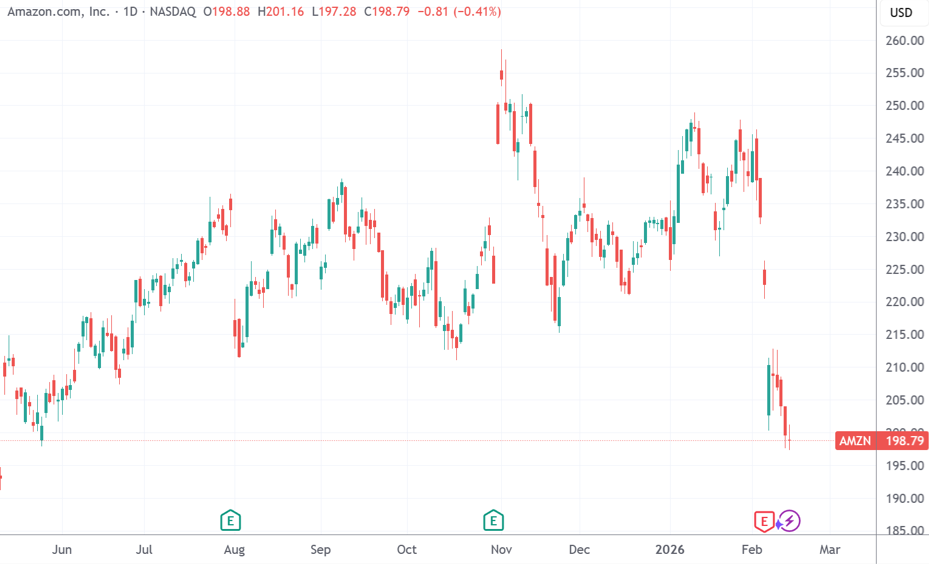
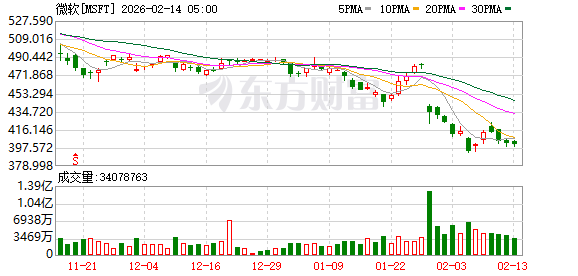
Core Viewpoint - The market remains concerned about excessive AI spending, leading to significant stock declines among major tech companies, particularly Amazon, which is facing fears of becoming the first cloud giant with negative free cash flow by 2026 [2][3]. Group 1: Amazon's Stock Performance - Amazon's stock has fallen for nine consecutive trading days, marking its longest losing streak since 2006 and officially entering a technical bear market, with a drop of nearly 23% from its historical closing price of $254 on November 3 to below $200 [3]. - Following its earnings report, Amazon has joined Microsoft as the second member of the "seven tech giants" to enter a bear market, with Microsoft's stock also down over 25% from its historical closing price of $542.07 on October 28 [3]. Group 2: AI Investment Concerns - Amazon's substantial AI investment plan, projected at $200 billion, has surprised investors and overshadowed the impressive 24% growth of its AWS segment in the fourth quarter [3]. - Analysts express concerns that such high capital expenditures could lead Amazon to become the first cloud giant with negative free cash flow, raising alarms about the sustainability of its investment strategy [3]. Group 3: Analyst Perspectives - Some analysts, like Deutsche Bank's Lee Horowitz, argue that Amazon's increased capital spending is a proactive measure for future cloud computing needs, suggesting that the risk of underinvestment is greater than that of overinvestment [4]. - William Blair analyst Dylan Carden acknowledges the risks associated with increased capital spending but believes it reflects Amazon's inherent advantages in upgrading its AWS infrastructure, potentially allowing for faster capacity deployment than competitors [4]. Group 4: Market Sentiment and Comparisons - The market's negative sentiment towards AI investments has persisted for months, with Meta also experiencing a significant stock drop after raising capital expenditure expectations last year [5]. - Recent market trends indicate a divergence among the "seven tech giants," with companies like Google benefiting from a more integrated technology system, while Amazon, Microsoft, and Meta face greater stock price pressures due to investor skepticism about their AI investments [6]. Group 5: Future Catalysts - The next key catalyst for the AI sector is Nvidia's earnings report on February 25, which will provide insights into whether the AI boom is cooling and if Nvidia can deliver substantial returns on its large customer investments [7].

继微软后,亚马逊成第二家跌入熊市的“七巨头”
第一财经· 2026-02-14 01:27
Core Viewpoint - The article discusses the ongoing concerns regarding excessive AI spending by major tech companies, particularly Amazon, which has led to significant stock price declines among the "Big Seven" tech giants [3][5]. Group 1: Amazon's Financial Performance - Amazon's stock has fallen for nine consecutive trading days, marking its longest losing streak since 2006, and has entered a technical bear market with a drop of over 20% from its peak [5]. - The stock price fell to nearly $200, down approximately 23% from its historical closing price of $254 on November 3 [5]. - Amazon is projected to have a capital expenditure of $200 billion for AI by 2026, the highest among cloud service giants, contributing to concerns about it becoming the first cloud giant with negative free cash flow [6]. Group 2: Market Reactions and Analyst Opinions - Analysts express mixed views on Amazon's AI investments, with some believing that the market's pessimism is overblown and that the company is strategically investing for future growth [7]. - Deutsche Bank analyst Lee Horowitz argues that the risk of underinvestment is greater than that of overinvestment, suggesting that Amazon's capital expenditures are aimed at driving digital transformation [7]. - William Blair analyst Dylan Carden acknowledges the risks but sees the increased spending as a sign of Amazon's competitive advantage in upgrading its AWS infrastructure [7]. Group 3: Broader Market Trends - The article highlights a trend of investors withdrawing from stocks related to Microsoft, Nvidia, and Oracle due to concerns over their AI investments, while favoring companies like Google and Broadcom [9]. - Google has managed to avoid severe stock declines due to its integrated technology system, which provides a buffer against excessive spending concerns [9]. - The upcoming Nvidia earnings report on February 25 is anticipated to be a key catalyst for the AI sector, potentially indicating whether the AI boom is cooling off [10].

继微软后,亚马逊成第二家跌入熊市的七巨头
Xin Lang Cai Jing· 2026-02-14 00:47
Core Viewpoint - Concerns over excessive AI spending persist in the market, leading to significant stock declines among the "Big Seven" tech companies [1] Group 1: Company Impact - Investors are strongly resisting aggressive AI investment plans from tech giants, resulting in a sharp drop in stock prices [1] - Amazon's stock has been on a continuous decline, with Wall Street worried that its large-scale investments may lead to negative free cash flow by 2026, making it the first cloud business giant to experience this [1]
继微软后 亚马逊成第二家跌入熊市的“七巨头” 下一个或是这家
Di Yi Cai Jing· 2026-02-14 00:43
Core Viewpoint - Concerns over excessive AI spending have led to significant stock declines among major tech companies, particularly Amazon, which is facing fears of becoming the first cloud giant with negative free cash flow by 2026 [2][3]. Group 1: Stock Performance - Amazon's stock has fallen for nine consecutive trading days, marking its longest losing streak since 2006 and entering a technical bear market with a drop of over 20% from its peak [3]. - As of the latest close, Amazon's stock price has decreased nearly 23% from its historical closing price of $254 on November 3, now trading below $200 [3]. - Microsoft also entered a bear market earlier this year, with its stock down over 25% from its historical closing price of $542.07 on October 28 [3]. Group 2: AI Investment Plans - Amazon plans to invest $200 billion in AI capital expenditures by 2026, the highest among the four major cloud service providers, contributing to a total expected AI capital expenditure of $650 billion across Amazon, Microsoft, Meta, and Google [3]. - Despite a strong 24% growth in Amazon Web Services (AWS) for the fourth quarter, investor skepticism remains regarding the alignment of Amazon's AI strategy with its cloud business growth [3]. Group 3: Analyst Perspectives - Some analysts believe the market's negative sentiment towards Amazon's AI investments is overblown, arguing that the company is strategically investing in future cloud computing capabilities [4]. - Deutsche Bank analyst Lee Horowitz suggests that the risk of underinvestment is greater than that of overinvestment for Amazon, and he has set a target price of $290 for Amazon's stock [4]. - William Blair analyst Dylan Carden acknowledges the risks associated with increased capital spending but sees it as a sign of Amazon's competitive advantage in rapidly scaling its AWS infrastructure [4]. Group 4: Market Dynamics - The recent sell-off in tech stocks reflects a growing divide among the "Seven Giants," with concerns about AI spending impacting companies like Amazon, Microsoft, and Meta more severely than others like Google [5][6]. - Google has managed to avoid the worst of the sell-off due to its vertically integrated technology system, which provides a buffer against excessive spending concerns [6]. - The upcoming Nvidia earnings report on February 25 is anticipated to be a key catalyst for the AI sector, potentially revealing whether the AI boom is cooling off [7].
继微软后,亚马逊成第二家跌入熊市的“七巨头”,下一个或是这家
Di Yi Cai Jing Zi Xun· 2026-02-14 00:41
Core Viewpoint - Concerns over excessive AI spending have led to significant stock declines among the "Seven Giants," particularly Amazon, which is facing fears of becoming the first cloud giant with negative free cash flow by 2026 [1][2]. Group 1: Amazon's Stock Performance - Amazon's stock has fallen for nine consecutive trading days, marking its longest losing streak since 2006 and officially entering a technical bear market, down nearly 23% from its historical closing price of $254 on November 3 [2]. - The company's substantial AI investment plans have not been well-received by investors, leading to skepticism about the alignment of its AI strategy with cloud business growth [2][3]. Group 2: AI Capital Expenditure - Amazon, along with Microsoft, Meta, and Google, is projected to spend a total of $650 billion on AI capital expenditures by 2026, with Amazon's share being $200 billion, the highest among global cloud service giants [2]. - This unexpected capital expenditure has overshadowed Amazon Web Services' (AWS) impressive 24% growth in the fourth quarter, raising concerns that such large investments could result in negative free cash flow [2]. Group 3: Analyst Perspectives - Some analysts believe that the market's pessimism towards Amazon is overblown, arguing that the company is not becoming more capital-intensive but is instead investing in future cloud computing capabilities to drive digital transformation [3]. - Analysts from Deutsche Bank and William Blair acknowledge the risks associated with increased capital spending but suggest that it may reflect Amazon's inherent advantages in upgrading its existing AWS infrastructure [3]. Group 4: Support for Amazon - Notable investors, such as Bill Ackman's Pershing Square Capital, have disclosed holdings in Amazon, indicating confidence in the company's long-term prospects despite current market challenges [4]. - The fund's report highlights expectations for AWS to double its data center capacity by 2027, driven by demand from AI inference business expansion [4]. Group 5: Market Trends and Comparisons - The recent sell-off in tech stocks has highlighted a divergence in performance among the "Seven Giants," with concerns about AI spending impacting companies like Amazon, Microsoft, and Meta more severely than others like Google [5][6]. - The upcoming earnings report from Nvidia is anticipated to be a key catalyst for the AI sector, potentially revealing whether the AI boom is cooling and if Nvidia can deliver substantial returns on its large customer investments [6].
9连跌,亚马逊跌入熊市!
华尔街见闻· 2026-02-13 23:46
Core Viewpoint - Amazon's stock has experienced a nine-day consecutive decline, marking the longest losing streak in nearly 20 years [2]. Group 1: Stock Performance - Amazon's stock price fell to $198.79, down over 23% from recent highs, officially entering a bear market on Thursday [5]. - Following Amazon, Meta is at risk of becoming the next member of the Mag7 to enter a bear market, having dropped 19.6% from its peak, just 0.4% away from the 20% threshold [7]. - Microsoft was the first Mag7 member to enter a bear market, with its stock down 27.8% from recent highs [7]. Group 2: AI Spending Concerns - Investors have shown strong resistance to the aggressive AI spending plans of tech giants, leading to significant declines in these stocks [4]. - Amazon plans to have the highest capital expenditure among the four major cloud service providers, reaching $200 billion by 2026 [6]. - The total expected capital expenditure in AI for Amazon, Microsoft, Meta, and Alphabet by 2026 is projected to be $650 billion [7]. Group 3: Market Dynamics - There is a noticeable rotation among Mag7 members, highlighting increasing divergence among them [9]. - Since last fall, investors have shifted away from OpenAI-related trades associated with Microsoft, Nvidia, and Oracle, favoring Alphabet and Broadcom instead [10]. - Alphabet's vertically integrated tech stack has somewhat mitigated concerns over excessive spending, allowing it to avoid the worst impacts of the tech stock sell-off [10][11]. Group 4: Financial Implications - Increased capital expenditure for Amazon may lead to negative free cash flow this year, necessitating the company to enter the debt market for additional capital [13]. - The next significant catalyst for AI trades is expected to be Nvidia's earnings report on February 25, which will indicate whether the AI boom is cooling or if Nvidia has successfully captured substantial investments from its largest clients [14].