
AI泡沫风险

Search documents
中金公司:2026年国际货币秩序重构仍是全球资产主线
Sou Hu Cai Jing· 2026-02-27 00:20
Core Viewpoint - The restructuring of the international monetary order will remain a key theme for global assets in 2026, with support for a bull market in Chinese stocks and gold, and an expectation that Chinese stocks will outperform U.S. stocks [1] Group 1: Market Trends - 2025 is expected to be a year of accelerated restructuring of the international monetary order, continuing into 2026 [1] - The "new order" of monetary restructuring will not happen overnight, and the global reassessment of capital is a process that is still strengthening, favoring a slow bull market [1] - The revaluation of Chinese assets is still ongoing [1] Group 2: U.S. Monetary Policy - The "WASH shock" is anticipated to influence the Federal Reserve's easing policies, with current political, economic, and market constraints suggesting that aggressive balance sheet reduction is not feasible [1] - The WASH shock may lead to interest rate cuts by the Federal Reserve that exceed market expectations, but it will not reverse the decline in the Fed's credibility and the safety of dollar assets [1] Group 3: Investment Recommendations - The company recommends an overweight position in Chinese stocks and gold, a benchmark allocation in commodities, U.S. stocks, and U.S. Treasuries, and an underweight position in Chinese government bonds [1]

2026,中美经济差距有望逆转,中国股市有望跑赢美股
Sou Hu Cai Jing· 2026-02-15 16:23
Core Insights - The core narrative highlights a significant structural transformation in the global economy, particularly between China and the U.S., with a focus on the shift in economic growth drivers rather than the mere comparison of economic gaps [1][3][18] Economic Performance - In 2025, China's GDP reached 140.2 trillion yuan, growing by 5.0% year-on-year, while the U.S. reported a January CPI increase of 2.4%, the lowest since June of the previous year [1] - China's manufacturing value added grew by 6.1% in 2025, with high-tech manufacturing leading at a growth rate of 7.0%, outpacing overall industrial production by approximately 2.3 percentage points [3] Technological Advancements - The launch of the domestic AI model DeepSeek in 2025 exemplifies China's rapid technological advancements, showcasing its cost efficiency and ability to solve practical problems in manufacturing [4] - The rise of "new quality productivity" is characterized by AI's integration across various industries, the acceleration of hard technology supply chain advantages, and the high-end transformation of traditional industries [5] Investment Trends - A historical shift in capital flow is observed, with significant investments moving from real estate to manufacturing and technology sectors, indicating a new financial cycle centered around "new quality productivity" [5][12] - Foreign investment attitudes towards Chinese assets have shifted from cautious observation to strategic planning, driven by the certainty provided by China's "14th Five-Year Plan" [12] Market Dynamics - The A-share market is transitioning from valuation-driven to profit-driven dynamics, supported by a recovery in the Producer Price Index (PPI) and various policies aimed at improving corporate profit margins [12] - Predictions indicate that the MSCI China Index will rise by 20% in 2026, with corporate profit growth accelerating from 4% in 2025 to 14% in 2026, reflecting a shift in market driving forces from valuation recovery to profit growth [10][12] Global Economic Context - The U.S. Federal Reserve is expected to continue lowering interest rates in 2026, with a projected cumulative reduction of approximately 63 basis points, while concerns about AI bubble risks have emerged [7] - The dollar index fell by about 10% in 2025, marking one of the largest annual fluctuations since 1973, as global de-dollarization trends gain momentum [7][10] International Trade and Supply Chains - The traditional "Western R&D - Eastern manufacturing" model is evolving into a more complex structure, with Chinese firms increasingly involved in R&D and extending into branding and sales channels [14] - The economic growth dependency is shifting from final product exports to the output of technology, standards, and supply chain systems [14] Future Implications - The ongoing economic transformation is expected to redefine growth, wealth, and opportunities over the next decade, influencing global capital market valuation systems and corporate strategies [18]

AI颠覆担忧跨板块蔓延 下周聚焦美GDP初值、PCE指数 摩根士丹利上调2026美增长预期至2.6%
Sou Hu Cai Jing· 2026-02-14 22:43
Group 1 - The market is experiencing concerns that new AI tools may disrupt various industries, including insurance, wealth management, and transportation, with a shift in investor sentiment towards previously lagging sectors such as energy, consumer staples, materials, and industrials [1] - B Riley Wealth's chief market strategist Art Hogan likens the current market sentiment to a "whack-a-mole" game, where investors speculate on which industry AI will impact next, reflecting a broader anxiety about the technology's potential [1] - Nationwide's chief market strategist Mark Hackett notes that the shift in market leadership is becoming ingrained in investor psychology [1] Group 2 - Upcoming key economic indicators include the preliminary Q4 GDP, monthly consumer confidence survey, and the preferred inflation measure of the Federal Reserve, the Personal Consumption Expenditures (PCE) price index [1] - Morgan Stanley has raised its 2026 U.S. economic growth forecast to 2.6%, citing stronger capital expenditure assumptions, while warning that the biggest risk to the U.S. economy has shifted from trade protectionism to AI bubble risks [1] - The Federal Reserve's January monetary policy meeting minutes will be released next Wednesday, which may provide insights into the rationale behind the "wait-and-see" stance and arguments for potential rate cuts [2]
大摩上调美国GDP增长预期至2.6%
Jin Rong Jie· 2026-02-14 11:15
Group 1 - Morgan Stanley raised its forecast for U.S. economic growth in 2026 to 2.6% due to stronger capital expenditure assumptions [1] - The increase in business investment is linked to the growth in spending by large cloud computing companies, indicating more stability [1] - The biggest risk to the U.S. economy is now identified as the AI bubble risk rather than trade protectionism [1]
大摩上调2026年美国GDP增长预期至2.6%
Xin Lang Cai Jing· 2026-02-14 10:19
Group 1 - Morgan Stanley raised its forecast for U.S. economic growth in 2026 to 2.6%, attributing this to stronger capital expenditure assumptions [1] - The firm noted that business investments related to spending growth from large cloud computing companies are more stable [1] - However, Morgan Stanley warned that the biggest risk to the U.S. economy is no longer trade protectionism, but rather the risk of an AI bubble [1]

银河期货铜12月报-20251201
Yin He Qi Huo· 2025-12-01 08:25
1. Report Industry Investment Rating No relevant content provided. 2. Core Viewpoints of the Report - Long - term, the US loose monetary policy is expected to drive up inflation, and the copper - gold ratio will support prices. The supply side of copper concentrates faces more disturbances, and the smelting industry is expected to reduce internal competition. Consumption is in a stage of transformation between old and new drivers. Although traditional consumption with low added - value is weakening, the growth of energy - storage batteries, new - energy vehicles, and future AI will offset the negative impact of the decline in traditional consumption to some extent, so the long - term upward trend of copper remains unchanged. In the short term, after the previous upward trend, there is a lack of new stimuli, and the downstream needs time to accept the price, so the market will mainly consolidate at a high level [5]. - The supply of copper mines is tightening, and the increase in refined copper production is expected to be 950,000 tons or a year - on - year increase of 3.53%, lower than 4.3% in 2024. The consumption growth rate is expected to decline to 3%, lower than 3.76% last year. The market is expected to fluctuate between 85,000 - 90,000 yuan/ton in the short term, and the long - term upward trend continues, so a low - buying strategy is recommended [5][11]. 3. Summary by Relevant Catalogs First Part: Copper Market Review a. Market Review - In November 2025, copper prices consolidated at a high level, with the lowest reaching 84,900 yuan/ton for SHFE copper on November 5 and the highest reaching 87,920 yuan/ton on November 14. The market focused on the December interest - rate cut expectation and the AI bubble risk. The Fed's hawkish remarks in the middle of the month lowered the interest - rate cut expectation to 40%, weakening market sentiment. Later, the release of NVIDIA's earnings report and the Fed's dovish turn increased the probability of a December interest - rate cut to over 80%, supporting prices [4][9]. - Fundamentally, Freeport expects the Grasberg output to decline to 1 billion pounds in 2026, and the spot processing fee is reported at over - 40 dollars/ton. The Cl spread remained at 3% - 5% this month. The reasons for the decrease in US copper imports may be the decline in Chilean copper production, some goods being held by traders, and the narrowing of cross - market arbitrage space. The supply tension in the LME market has been alleviated, and domestic downstream buyers mostly priced at below 86,000 yuan/ton [10]. b. Market Outlook - In terms of supply, the increase in copper mine supply is adjusted down to - 30,000 tons, and the overall supply tension of copper mines has intensified. Overseas smelters are increasing production cuts, and domestic smelters are also affected by problems such as the decline in anode plate supply, regular maintenance, and insufficient raw material supply. It is expected that the refined copper production will increase by 950,000 tons or a year - on - year increase of 3.53%, lower than 4.3% in 2024. The negotiation of TC and long - term premium is difficult, and attention should be paid to the signing of long - term import contracts [11]. - In terms of price, macroscopically, whether there is an interest - rate cut in December or not, the US loose - money policy has not ended, which will have a positive feedback on the market. Fundamentally, the supply tension persists, and the downstream's acceptance of high prices is insufficient, but the overall market remains resilient. It is expected to fluctuate between 85,000 - 89,000 yuan/ton, and the long - term upward trend continues, so a low - buying strategy is recommended [11]. Second Part: Repeated Expectations of Fed Interest - Rate Cut - In November 2025, the release of US non - farm payroll data in September lowered the market's expectation of a Fed interest - rate cut in December to below 40%. Later, Williams' remarks increased the probability of a 25 - basis - point interest - rate cut to 69.4%. The market seems more willing to believe that the Fed will cut interest rates in December. The NAR expects that the sales of existing and new residential properties in the US will increase in 2026 due to lower expected loan interest rates, continuous employment growth, and market stability [21]. - In October 2025, China's manufacturing PMI fell to 49%, a month - on - month decrease of 0.8%. The personal income tax increased year - on - year, but the per - capita disposable income growth rate was lower than last year, and the consumption growth momentum was insufficient [22][25]. Third Part: Increased Disturbances in Copper Mines, and the Supply Tension is Difficult to Alleviate a. Sharp Decline in the Increase of Copper Concentrate Supply - In September 2025, the global copper concentrate production was 1.914 million tons, a year - on - year decrease of 1,000 tons. From January to September, the global copper concentrate production was 17.232 million tons, a year - on - year increase of 440,000 tons. Chile's copper production in September was 456,663 tons, a year - on - year decrease of 4.5%. Peru's copper production in September was 240,995 tons, a year - on - year increase of 3.7% [35]. - Many mining companies have lowered their production plans. It is expected that the global copper concentrate increase in 2025 will drop to - 30,000 tons, far lower than 665,500 tons in 2024. The supply tension of copper mines is difficult to alleviate, and the processing fee is likely to be less than 0 dollars/ton. China's copper concentrate imports in October 2025 increased by 5.94% year - on - year [36][37]. b. Decline in the Start - up of Recycling and Processing Enterprises, and the Tension in Scrap Copper Supply is Alleviated Temporarily - In October 2025, China's imports of copper scrap and scraps reached 197,000 physical tons, a year - on - year increase of 7.35%. The imports from the US through Japan and Thailand increased significantly, while the imports from the EU decreased. The policy of standardizing investment promotion may affect the start - up of recycled copper rod enterprises. In October 2025, China's imports of anode copper decreased year - on - year, while the imports of scrap copper ingots increased [47][48][50]. c. Accelerated Transmission of Insufficient Raw Material Supply to the Smelting End - In 2025, the supply of copper mines is tight. It is expected that the global refined copper production will increase by 950,000 tons or a year - on - year increase of 3.53%, lower than 4.3% in 2024. Overseas smelters are increasing production cuts, and domestic smelter production has also declined. The supply of imported refined copper may slow down [53][54][56]. Fourth Part: Consumption Analysis a. Obvious Decline in Traditional Consumption Growth - In the real - estate market, from January to October 2025, the sales area of new commercial housing and the completion area decreased year - on - year. The real - estate market is in an adjustment and bottom - building stage, and the decline in real - estate completion will continue to drag down electrolytic copper consumption. It is estimated that the copper consumption in the construction industry will decrease by 123,700 tons to 1.1137 million tons [64][65]. - In the power grid and power - source projects, from January to October 2025, the investment in power grids and power - source projects increased year - on - year, but at a lower rate than last year. High copper prices inhibited the procurement willingness of downstream enterprises, and the wire - and - cable start - up rate decreased. In October 2025, the export of wire and cable decreased month - on - month [71]. - In the household - appliance industry, from January to October 2025, the cumulative sales of air conditioners increased year - on - year, but in October, the sales decreased year - on - year. The air - conditioner production plan for December 2025 decreased significantly year - on - year. It is expected that the annual consumption growth rate of air conditioners will decline to 2%, and the copper consumption will decrease slightly [76][77]. b. Resilience in Automobile Consumption - In China, from January to October 2025, the production and sales of automobiles and new - energy vehicles increased year - on - year. The new - energy vehicle production and sales accounted for 46.7% of the total. The resumption of the new - energy vehicle purchase tax in 2026 will drive the sales in 2025 [85][86]. - In Europe and the US, from January to October 2025, the sales of new - energy vehicles increased year - on - year. BNEF expects that the sales of new - energy passenger vehicles will reach 21.9 million this year, with China accounting for nearly two - thirds. The global new - energy vehicle copper consumption is expected to increase to 1.4011 million tons [93][95]. c. Unexpected Growth in Wind and Solar Power Generation - In terms of photovoltaic installation, from January to October 2025, China's new photovoltaic installation increased by 39.47% year - on - year. The China Photovoltaic Industry Association raised the new installation forecast for this year. The IEA expects that the global new photovoltaic installation will reach 630GW in 2025 [105][106]. - In terms of wind - power installation, from January to October 2025, China's new wind - power installation increased by 52.86% year - on - year. The CWEA predicts that China's new wind - power installation will reach 105 - 115GW in 2025. The GWEC expects that the global new wind - power installation will increase to 138GW in 2025. The copper consumption of wind and solar power is expected to increase by 208,500 tons in 2025 [119][120]. d. Explosive Growth in Lithium - Ion Copper Foil - In 2024, the global copper - foil production capacity was 2.544 million tons, with the lithium - ion copper - foil production capacity growing by 37.55% year - on - year. From January to September 2025, China's lithium - ion copper - foil production increased by 38% year - on - year. It is estimated that the production will reach 853,800 tons this year, driving domestic consumption by 1.38%. The GGII expects that China's energy - storage shipments will reach 580GW in 2025, with a copper consumption of about 300,000 tons [126]. e. Consumption Summary - It is expected that the global consumption growth rate will decline to 3% in 2025, lower than 3.76% last year, and China's consumption growth rate will decline from 4.5% to 3.5%. Overseas demand remains stable, while domestic demand weakens marginally in the second half of the year. New - energy vehicles, energy - storage batteries, etc. are the key factors driving consumption, and downstream procurement is concentrated below 86,000 yuan/ton [130]. Fifth Part: Supply - Demand Balance Sheet - In terms of supply, it is expected that the copper - mine growth in 2025 will be - 30,000 tons, and the refined - copper production will increase by 950,000 tons. In terms of consumption, the consumption growth rate is expected to decline to 3.4% in 2025. The supply gap of copper concentrates is expected to widen to 790,000 tons in 2025, and the refined - copper surplus is expected to be 380,000 tons [135]. - The report also provides the supply - demand balance sheets of China's refined copper and global copper, showing the production, import, export, consumption, and balance of copper in different years [137][138].
中加基金配置周报|中日关系持续恶化,全球风险偏好回落
Xin Lang Ji Jin· 2025-11-27 08:10
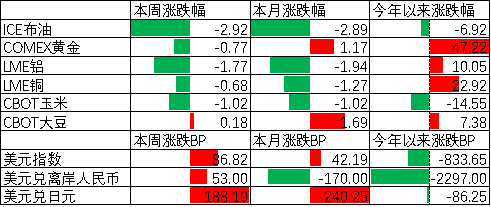
Group 1 - The new LPR in China remains stable for the sixth consecutive month, with the 1-year and 5-year rates at 3.0% and 3.5% respectively [1] - The U.S. non-farm employment increased by 119,000 in September, exceeding expectations, but the unemployment rate unexpectedly rose to 4.4%, the highest since October 2021 [1] - The U.S. manufacturing PMI for November is at 51.9, a four-month low, while the services PMI is at 55, a four-month high, indicating mixed economic signals [1] Group 2 - The Federal Reserve's October meeting minutes reveal significant divisions among officials regarding future rate cuts, with some advocating for a potential cut in December [2] - New York Fed President Williams suggests there is still room for further rate cuts as the labor market cools, while other officials express caution about high asset valuations [2] - Market expectations for a December rate cut have increased, with probabilities rising from 44% to 71% following supportive comments from several Fed officials [13] Group 3 - In the futures market, various commodities experienced price declines, with ICE Brent crude oil down 2.92% and COMEX gold down 0.77% [4] - The U.S. dollar index rose by 86.82 basis points, influenced by deteriorating Sino-Japanese relations and Fed meeting minutes that dampened rate cut expectations [4] - The A-share market saw declines across major indices, with the ChiNext index dropping 6.15%, attributed to falling risk appetite and Fed meeting outcomes [6] Group 4 - The bond market showed mixed movements, with credit bonds slightly rising while interest rate bonds experienced minor fluctuations [10] - U.S. Treasury yields generally declined, particularly the 5-year yield, which fell by 12 basis points, amid mixed economic signals and Fed officials' support for potential rate cuts [12]
观点汇总:美国AI资本支出的可持续性研究
雪球· 2025-11-22 05:24
Group 1: Current AI Capital Expenditure Landscape - The current AI capital expenditure in the U.S. is at a historical high but still represents less than 1% of GDP, significantly lower than previous technology cycles which ranged from 2% to 5% [3][4] - AI computing demand is growing at an annual rate of 400%, while the cost of computing is decreasing at 40% annually, creating a widening gap that drives capital expenditure expansion [3] - The absolute scale and growth rate of U.S. AI capital expenditure have raised market concerns, with a projected revenue increase of approximately $300 billion in AI-related infrastructure by 2025 [3][4] Group 2: Financial Risks and External Financing - Major U.S. tech companies are increasingly relying on debt financing, with $1.4 trillion in bonds issued recently, raising concerns about financial risks [5][6] - Meta's net profit is projected to drop by 82.73% in Q3 2025, despite increasing capital expenditures, indicating a significant erosion of profits due to AI R&D spending [5] - The technology debt market reflects changing market sentiments, with the proportion of tech debt in U.S. investment-grade bonds rising from 7% to 34% [6] Group 3: Profitability and Return on Investment Concerns - The profitability of AI capital expenditures is under scrutiny, with high R&D costs significantly impacting net profit margins [7][8] - The return on investment for AI infrastructure is expected to take 15 years or longer, conflicting with the short-term performance expectations of tech companies [8] - Market concerns about the sustainability of AI investments are reflected in stock price declines for companies like Nvidia and Meta [9] Group 4: Infrastructure and Supply Chain Challenges - Electricity supply is a critical constraint on AI capital expenditure, with data center electricity consumption projected to rise from 4.4% to between 6.7% and 12% of total U.S. electricity by 2028 [10][11] - Regional electricity policy differences exacerbate the challenges, with states like Virginia facing rising electricity costs due to increased demand from data centers [10] - The energy policies and high costs of domestic chip manufacturing pose additional challenges for AI project profitability [12] Group 5: Macroeconomic Environment and Future Outlook - The Federal Reserve's cautious monetary policy and rising financing costs may suppress capital expenditure growth in AI [12][13] - Geopolitical factors and supply chain disruptions are increasing chip manufacturing costs, further squeezing profit margins for AI projects [12][13] - Future sustainability of AI capital expenditure will depend on technological advancements, financing conditions, and stable energy supply [15][16] Group 6: Market Sentiment and Investment Strategies - Market concerns about AI capital expenditure sustainability are not uniform, with some institutions like Goldman Sachs believing the current investment level is sustainable [14] - The divergence in market sentiment indicates that while some companies may face financial pressures, others with stronger financial positions may navigate these challenges more effectively [6][14] - Companies are encouraged to balance short-term profitability pressures with long-term technological advantages and explore strategies to optimize energy costs [16][17]

永安期货有色早报-20251121
Yong An Qi Huo· 2025-11-21 01:36
Report Industry Investment Ratings - Not provided in the documents Core Views - This week, copper prices fluctuated within a narrow range. Supported by the precious metals market, copper prices were strong in the first half of the week and adjusted on Friday. The downstream price - fixing volume rebounded significantly. The market has both liquidity easing expectations and AI bubble risks. The price around 85,000 may be the psychological price for downstream price - fixing [1]. - Overseas production halt news and expectations boosted the domestic aluminum price, making it stronger than the overseas price. Short - term profit - taking led to a correction in the Shanghai aluminum futures. Aluminum ingots continued to accumulate inventory, while aluminum rods, sheets, and foils slightly reduced inventory. The downstream consumption was acceptable, and the acceptance of high prices increased. It may show a volatile trend in the short term [2]. - Zinc prices fluctuated this week. The domestic and imported TC decreased further. The domestic zinc ore supply will be tight from the fourth quarter to the first quarter of next year. The processing fee has dropped significantly, but the smelter's profit is still acceptable. The demand is seasonally weak domestically, while overseas, European demand is average and Middle - East demand has high growth. The domestic social inventory fluctuates, and the overseas LME inventory is oscillating at a low level. The export window has opened. The price may not fall deeply, and it is recommended to wait and see for unilateral trading, pay attention to reverse arbitrage opportunities, and consider the positive arbitrage opportunity of 01 - 03 for the month - spread [5]. - Nickel's short - term fundamental situation is weak. The price of nickel sulfate is relatively stable, the output of pure nickel decreased slightly, the demand is weak, and the inventory at home and abroad continued to increase. There are continuous disturbances in the Indonesian nickel ore market, and the policy side has the motivation to support prices. It is recommended to consider short - selling opportunities [6]. - The fundamentals of stainless steel remain weak. The steel mill's production in October increased slightly month - on - month, the demand is mainly for rigid needs, the prices of nickel iron and chrome iron are stable, and the inventory remains at a high level. The Indonesian policy side has the motivation to support prices. It is recommended to consider short - selling opportunities [7]. - Lead prices fluctuated at a high level this week. The supply of recycled lead increased, and the social inventory accumulated. The demand for batteries may weaken. It is expected that lead prices will fluctuate within a narrow range next week, and it is recommended to wait and see the resumption of recycled lead production and the increase in warehouse receipts [9]. - The center of tin prices rose this week. The supply has been marginally restored, but there are still uncertainties overseas. The demand is mainly rigid. In the short term, it follows the macro - sentiment, and in the long - term, it is recommended to hold near the cost line or use it as a long - position in the non - ferrous metals portfolio [11]. - The price of industrial silicon is expected to fluctuate in the short term and oscillate at the bottom of the cycle in the long - term. The supply and demand in the fourth quarter are expected to be in a balanced and slightly loose state [15]. - The price of lithium carbonate is running strongly. The raw material supply is tight, the upstream inventory has decreased significantly, and the downstream inventory is relatively sufficient. The trading is light, and the basis has weakened slightly. In the long - term, the pattern may change in the next 1 - 2 years if the energy storage demand remains high and the power demand is stable [17]. Summary by Metal Copper - This week, copper prices fluctuated within a narrow range. The downstream price - fixing volume rebounded significantly. The market has both liquidity easing expectations and AI bubble risks. The price around 85,000 may be the psychological price for downstream price - fixing [1]. Aluminum - Overseas production halt news and expectations boosted the domestic aluminum price, making it stronger than the overseas price. Short - term profit - taking led to a correction in the Shanghai aluminum futures. Aluminum ingots continued to accumulate inventory, while aluminum rods, sheets, and foils slightly reduced inventory. The downstream consumption was acceptable, and the acceptance of high prices increased. It may show a volatile trend in the short term [2]. Zinc - Zinc prices fluctuated this week. The domestic and imported TC decreased further. The domestic zinc ore supply will be tight from the fourth quarter to the first quarter of next year. The processing fee has dropped significantly, but the smelter's profit is still acceptable. The demand is seasonally weak domestically, while overseas, European demand is average and Middle - East demand has high growth. The domestic social inventory fluctuates, and the overseas LME inventory is oscillating at a low level. The export window has opened. The price may not fall deeply, and it is recommended to wait and see for unilateral trading, pay attention to reverse arbitrage opportunities, and consider the positive arbitrage opportunity of 01 - 03 for the month - spread [5]. Nickel - Nickel's short - term fundamental situation is weak. The price of nickel sulfate is relatively stable, the output of pure nickel decreased slightly, the demand is weak, and the inventory at home and abroad continued to increase. There are continuous disturbances in the Indonesian nickel ore market, and the policy side has the motivation to support prices. It is recommended to consider short - selling opportunities [6]. Stainless Steel - The fundamentals of stainless steel remain weak. The steel mill's production in October increased slightly month - on - month, the demand is mainly for rigid needs, the prices of nickel iron and chrome iron are stable, and the inventory remains at a high level. The Indonesian policy side has the motivation to support prices. It is recommended to consider short - selling opportunities [7]. Lead - Lead prices fluctuated at a high level this week. The supply of recycled lead increased, and the social inventory accumulated. The demand for batteries may weaken. It is expected that lead prices will fluctuate within a narrow range next week, and it is recommended to wait and see the resumption of recycled lead production and the increase in warehouse receipts [9]. Tin - The center of tin prices rose this week. The supply has been marginally restored, but there are still uncertainties overseas. The demand is mainly rigid. In the short term, it follows the macro - sentiment, and in the long - term, it is recommended to hold near the cost line or use it as a long - position in the non - ferrous metals portfolio [11]. Industrial Silicon - The price of industrial silicon is expected to fluctuate in the short term and oscillate at the bottom of the cycle in the long - term. The supply and demand in the fourth quarter are expected to be in a balanced and slightly loose state [15]. Lithium Carbonate - The price of lithium carbonate is running strongly. The raw material supply is tight, the upstream inventory has decreased significantly, and the downstream inventory is relatively sufficient. The trading is light, and the basis has weakened slightly. In the long - term, the pattern may change in the next 1 - 2 years if the energy storage demand remains high and the power demand is stable [17].
永安期货有色早报-20251120
Yong An Qi Huo· 2025-11-20 01:53
Group 1: Report Industry Investment Rating - No relevant content found Group 2: Report Core Views - This week, copper prices fluctuated narrowly. Supported by the precious metals market, copper prices were strong in the first half of the week and adjusted on Friday. The downstream point - pricing volume rebounded significantly. The price around 85,000 may be the psychological price for downstream point - pricing [1]. - Overseas production suspension news and expectations boosted the domestic aluminum price, which was stronger than the overseas price. Short - term profit - taking led to a correction in the Shanghai aluminum futures. Aluminum ingots continued to accumulate inventory, while aluminum rods, sheets, and foils slightly reduced inventory. The downstream consumption was okay, and the acceptance of high prices increased. In the short term, it may show a fluctuating trend [1][2]. - This week, zinc prices fluctuated. The domestic and imported TC decreased further this week. The domestic zinc ore will be tighter from the fourth quarter to the first quarter of next year. The processing fee has dropped significantly. The demand is seasonally weak domestically, while overseas, the demand in Europe is average and the growth rate in the Middle East is high. The price center may be difficult to decline deeply. In the short term, it is recommended to wait and see for unilateral trading; pay attention to the reverse arbitrage opportunity and be cautious when increasing positions; for the month - spread, pay attention to the positive arbitrage opportunity of 01 - 03 [5]. - Nickel prices decreased this week. The supply of pure nickel decreased slightly month - on - month, the demand was weak overall, and the inventory continued to accumulate at home and abroad. There are continuous disturbances at the Indonesian ore end, and the policy side has the motivation to support prices. Pay attention to the short - selling opportunities [6]. - Stainless steel prices were weak. The steel mill's production plan in October increased slightly month - on - month, the demand was mainly for rigid needs, the cost remained stable, and the inventory remained at a high level. The Indonesian policy side has the motivation to support prices. Pay attention to the short - selling opportunities [7]. - This week, lead prices fluctuated at a high level. The supply of primary and recycled lead was tight, and the supply - demand mismatch was serious. Now the resumption of recycled lead production has alleviated some of the contradictions, and the social inventory has increased. The demand is expected to weaken. It is expected that the lead price will fluctuate narrowly next week, and it is recommended to wait and see [9]. - This week, tin prices increased. The processing fee of tin ore remained at a low level, and the supply has been marginally repaired. The overseas output is still controversial. The demand is mainly rigid, and the overseas LME inventory has recovered. In the short term, it follows the macro - sentiment. In the long - term, the supply will increase, but the elasticity is limited. It is recommended to hold at a low price close to the cost or use it as a long - position allocation in non - ferrous metals [11]. - This week, the price of industrial silicon was stable. The production in the northwest region was basically stable, and the overall change was small. In the fourth quarter, the supply and demand of industrial silicon are expected to be in a balanced and slightly loose state. In the short term, the price is expected to fluctuate; in the long - term, the price is expected to fluctuate at the bottom of the cycle [15]. - Affected by the lithium - battery demand expectation and the market's bullish sentiment, the price of lithium carbonate was strong. The upstream inventory has been significantly reduced, and the downstream inventory is still relatively sufficient. The basis has slightly weakened. In the long - term, if the energy - storage demand remains high and the power demand is stable, the pattern of lithium carbonate may change in the next 1 - 2 years [17]. Group 3: Summary According to Related Catalogs Copper - **Price and Inventory**: From November 13th to 19th, the Shanghai copper spot price changed from 55 to 95, the waste - refined copper price difference increased by 130, the LME inventory increased by 17,375, and the LME注销仓单 increased by 800 [1]. - **Market Analysis**: This week, copper prices fluctuated narrowly. Supported by the precious metals market, copper prices were strong in the first half of the week and adjusted on Friday. The downstream point - pricing volume rebounded significantly. The price around 85,000 may be the psychological price for downstream point - pricing [1]. Aluminum - **Price and Inventory**: From November 13th to 19th, the Shanghai aluminum ingot price decreased by 90, the domestic alumina price decreased by 5, the aluminum LME inventory decreased by 2,000, and the aluminum LME注销仓单 increased by 29,450 [1]. - **Market Analysis**: Overseas production suspension news and expectations boosted the domestic aluminum price, which was stronger than the overseas price. Short - term profit - taking led to a correction in the Shanghai aluminum futures. Aluminum ingots continued to accumulate inventory, while aluminum rods, sheets, and foils slightly reduced inventory. The downstream consumption was okay, and the acceptance of high prices increased. In the short term, it may show a fluctuating trend [1][2]. Zinc - **Price and Inventory**: From November 13th to 19th, the Shanghai zinc ingot price increased by 100, the zinc social inventory remained unchanged, the LME zinc inventory increased by 1,550, and the LME zinc注销仓单 increased by 100 [5]. - **Supply and Demand**: The domestic and imported TC decreased further this week. The domestic zinc ore will be tighter from the fourth quarter to the first quarter of next year. The demand is seasonally weak domestically, while overseas, the demand in Europe is average and the growth rate in the Middle East is high. The export window has opened [5]. - **Strategy**: The domestic consumption of zinc is weak, but there will be a phased reduction in supply at the end of the year. The price center may be difficult to decline deeply. In the short term, it is recommended to wait and see for unilateral trading; pay attention to the reverse arbitrage opportunity and be cautious when increasing positions; for the month - spread, pay attention to the positive arbitrage opportunity of 01 - 03 [5]. Nickel - **Price and Inventory**: From November 13th to 19th, the price of 1.5% Philippine nickel ore decreased by 1, the Shanghai nickel spot price decreased by 700, the LME inventory decreased by 1,986, and the LME注销仓单 decreased by 2,238 [6]. - **Supply and Demand**: The supply of pure nickel decreased slightly month - on - month, the demand was weak overall, and the inventory continued to accumulate at home and abroad. There are continuous disturbances at the Indonesian ore end, and the policy side has the motivation to support prices [6]. Stainless Steel - **Price and Inventory**: From November 13th to 19th, the price of 304 cold - rolled coil decreased by 100, the price of waste stainless steel increased by 50 [7]. - **Supply and Demand**: The steel mill's production plan in October increased slightly month - on - month, the demand was mainly for rigid needs, the cost remained stable, and the inventory remained at a high level. The Indonesian policy side has the motivation to support prices [7]. Lead - **Price and Inventory**: From November 13th to 19th, the lead spot price increased by 10, the LME inventory decreased by 325, and the LME注销仓单 decreased by 2,500 [8][9]. - **Supply and Demand**: The supply of primary and recycled lead was tight, and the supply - demand mismatch was serious. Now the resumption of recycled lead production has alleviated some of the contradictions, and the social inventory has increased. The demand is expected to weaken [9]. - **Strategy**: It is expected that the lead price will fluctuate narrowly next week, and it is recommended to wait and see [9]. Tin - **Price and Inventory**: From November 13th to 19th, the tin spot import profit decreased by 236.31, the LME inventory increased by 60, and the LME注销仓单 decreased by 10 [10][11]. - **Supply and Demand**: The processing fee of tin ore remained at a low level, and the supply has been marginally repaired. The overseas output is still controversial. The demand is mainly rigid, and the overseas LME inventory has recovered [11]. - **Strategy**: In the short term, it follows the macro - sentiment. In the long - term, the supply will increase, but the elasticity is limited. It is recommended to hold at a low price close to the cost or use it as a long - position allocation in non - ferrous metals [11]. Industrial Silicon - **Price and Inventory**: From November 13th to 19th, the 421 Yunnan basis decreased by 410, the 421 Sichuan basis decreased by 410, the 553 East China basis decreased by 410, the 553 Tianjin basis decreased by 410, and the warehouse receipt increased by 10 [15]. - **Supply and Demand**: The production in the northwest region was basically stable, and the overall change was small. In the fourth quarter, the supply and demand of industrial silicon are expected to be in a balanced and slightly loose state [15]. - **Price Trend**: In the short term, the price is expected to fluctuate; in the long - term, the price is expected to fluctuate at the bottom of the cycle [15]. Lithium Carbonate - **Price and Inventory**: From November 13th to 19th, the SMM electric - grade lithium carbonate price increased by 1,500, the SMM industrial - grade lithium carbonate price increased by 1,450, the main - contract basis decreased by 4,280, the near - month contract basis increased by 1,500, and the warehouse receipt increased by 155 [17]. - **Supply and Demand**: The upstream inventory has been significantly reduced, and the downstream inventory is still relatively sufficient. The basis has slightly weakened [17]. - **Price Trend**: In the long - term, if the energy - storage demand remains high and the power demand is stable, the pattern of lithium carbonate may change in the next 1 - 2 years [17].