Azure云业务

Search documents
9连跌,亚马逊跌入熊市!
美股研究社· 2026-02-15 06:24
Core Viewpoint - Amazon's stock has experienced a nine-day consecutive decline, marking the longest losing streak in nearly 20 years, and has entered a technical bear market [2][3]. Group 1: Stock Performance - Amazon's stock closed at $198.79 on Friday, down over 23% from its recent peak, officially entering bear market territory on Thursday [5]. - Meta is at risk of becoming the next member of the Mag7 to enter a bear market, having dropped 19.6% from its last year's peak, just 0.4% away from the 20% bear market threshold [7]. - Microsoft was the first Mag7 member to enter a bear market, with its stock down 27.8% from its recent high as of Friday [7]. Group 2: AI Spending and Investor Sentiment - Investors have shown strong resistance to the aggressive AI spending plans of tech giants, leading to significant declines in these stocks [4]. - Amazon plans to have the highest capital expenditure among the four major cloud service providers, reaching $200 billion by 2026 [6]. - The total expected capital expenditure in AI for Amazon, Microsoft, Meta, and Alphabet by 2026 is projected to be $650 billion [7]. Group 3: Market Dynamics and Cash Flow - There is a noticeable rotation among Mag7 members, highlighting increasing divergence within the group, as noted by Apex Fintech Solutions' VP Mike Treacy [9]. - Since last fall, investors have shifted away from OpenAI-related trades associated with Microsoft, Nvidia, and Oracle, favoring Alphabet and Broadcom instead [10]. - Treacy emphasizes that Google's self-sufficiency should command a premium compared to other companies that may be adversely affected by issues in their supply chains [11]. Group 4: Future Outlook - Amazon's increased capital expenditure may lead to negative free cash flow this year, necessitating the company to enter the debt market for additional capital [13]. - The next significant catalyst for AI trades is expected to be Nvidia's earnings report on February 25, which will indicate whether the AI boom is cooling or if Nvidia has successfully captured substantial investments from its major clients [13].



9连跌!“资本开支最高”的亚马逊跌入熊市,投资者对Mag 7“用脚投票”
美股IPO· 2026-02-14 04:12
Core Viewpoint - Amazon's stock has entered a technical bear market, marking the second company in the Mag7 group to do so, driven by investor resistance to aggressive AI spending plans [2] Group 1: Amazon's Stock Performance - Amazon's stock closed at $198.79, down over 23% from recent highs, officially entering bear market territory on Thursday [2] - Amazon plans to spend $200 billion on capital expenditures by 2026, the highest among the four major cloud service providers [2] - The total expected capital expenditure in AI by Amazon, Microsoft, Meta, and Alphabet by 2026 is projected to reach $650 billion [2] Group 2: Meta and Microsoft's Market Position - Meta is close to entering a bear market, with a cumulative decline of 19.6% from last year's peak, just 0.4% away from the 20% threshold [2] - Despite exceeding Wall Street expectations for Q4 revenue and earnings, Meta's increased AI spending and pressure on profit margins have undermined investor confidence [2] - Microsoft was the first Mag7 member to enter a bear market, with its stock down 27.8% from recent highs following disappointing Azure cloud business growth [2] Group 3: Investor Sentiment and Market Dynamics - Recent sell-offs highlight the growing divergence among Mag7 members, with investors shifting away from OpenAI-related stocks like Microsoft and Nvidia towards Alphabet and Broadcom [4] - Alphabet's vertically integrated technology stack has somewhat mitigated concerns over excessive spending, allowing it to avoid the worst impacts of the tech stock sell-off [4] - Increased capital expenditure levels for Amazon may lead to negative free cash flow this year, prompting the company to seek additional capital through debt markets [4] - The next significant catalyst for AI stocks is expected to be Nvidia's earnings report on February 25, which will indicate whether the AI boom is cooling or if Nvidia is successfully capturing billions in investments from its largest clients [4]



继微软后,亚马逊成第二家跌入熊市的“七巨头”
Di Yi Cai Jing Zi Xun· 2026-02-14 01:31
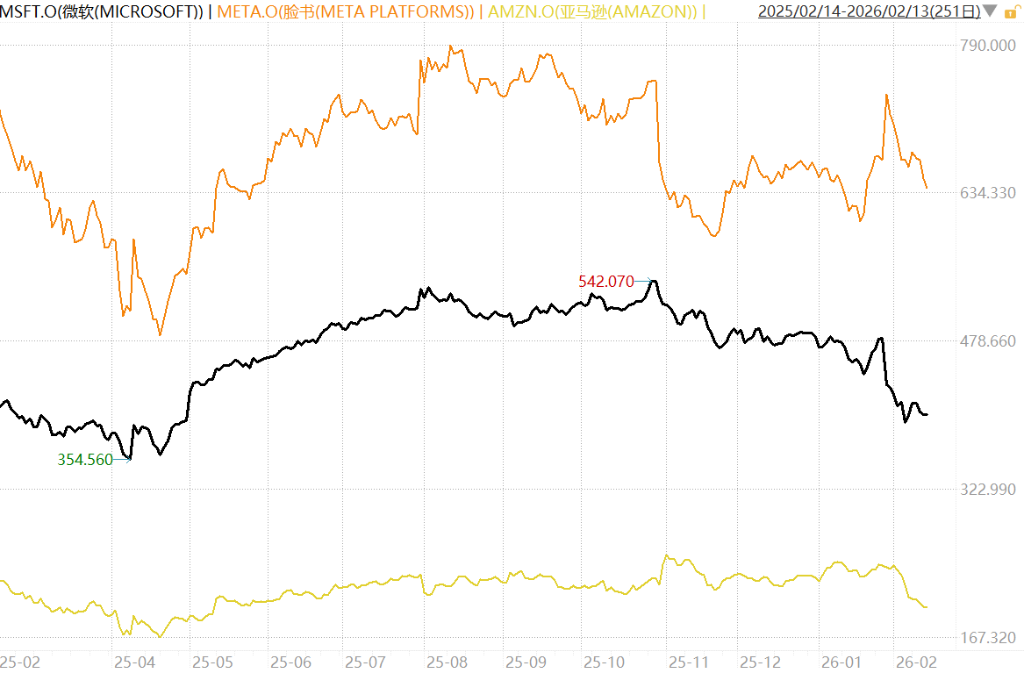
Core Viewpoint - The market remains concerned about excessive AI spending, leading to significant stock declines among major tech companies, particularly Amazon, which is facing fears of becoming the first cloud giant with negative free cash flow by 2026 [2][3]. Group 1: Amazon's Stock Performance - Amazon's stock has fallen for nine consecutive trading days, marking its longest losing streak since 2006 and officially entering a technical bear market, with a drop of nearly 23% from its historical closing price of $254 on November 3 to below $200 [3]. - Following its earnings report, Amazon has joined Microsoft as the second member of the "seven tech giants" to enter a bear market, with Microsoft's stock also down over 25% from its historical closing price of $542.07 on October 28 [3]. Group 2: AI Investment Concerns - Amazon's substantial AI investment plan, projected at $200 billion, has surprised investors and overshadowed the impressive 24% growth of its AWS segment in the fourth quarter [3]. - Analysts express concerns that such high capital expenditures could lead Amazon to become the first cloud giant with negative free cash flow, raising alarms about the sustainability of its investment strategy [3]. Group 3: Analyst Perspectives - Some analysts, like Deutsche Bank's Lee Horowitz, argue that Amazon's increased capital spending is a proactive measure for future cloud computing needs, suggesting that the risk of underinvestment is greater than that of overinvestment [4]. - William Blair analyst Dylan Carden acknowledges the risks associated with increased capital spending but believes it reflects Amazon's inherent advantages in upgrading its AWS infrastructure, potentially allowing for faster capacity deployment than competitors [4]. Group 4: Market Sentiment and Comparisons - The market's negative sentiment towards AI investments has persisted for months, with Meta also experiencing a significant stock drop after raising capital expenditure expectations last year [5]. - Recent market trends indicate a divergence among the "seven tech giants," with companies like Google benefiting from a more integrated technology system, while Amazon, Microsoft, and Meta face greater stock price pressures due to investor skepticism about their AI investments [6]. Group 5: Future Catalysts - The next key catalyst for the AI sector is Nvidia's earnings report on February 25, which will provide insights into whether the AI boom is cooling and if Nvidia can deliver substantial returns on its large customer investments [7].

继微软后,亚马逊成第二家跌入熊市的“七巨头”
第一财经· 2026-02-14 01:27
Core Viewpoint - The article discusses the ongoing concerns regarding excessive AI spending by major tech companies, particularly Amazon, which has led to significant stock price declines among the "Big Seven" tech giants [3][5]. Group 1: Amazon's Financial Performance - Amazon's stock has fallen for nine consecutive trading days, marking its longest losing streak since 2006, and has entered a technical bear market with a drop of over 20% from its peak [5]. - The stock price fell to nearly $200, down approximately 23% from its historical closing price of $254 on November 3 [5]. - Amazon is projected to have a capital expenditure of $200 billion for AI by 2026, the highest among cloud service giants, contributing to concerns about it becoming the first cloud giant with negative free cash flow [6]. Group 2: Market Reactions and Analyst Opinions - Analysts express mixed views on Amazon's AI investments, with some believing that the market's pessimism is overblown and that the company is strategically investing for future growth [7]. - Deutsche Bank analyst Lee Horowitz argues that the risk of underinvestment is greater than that of overinvestment, suggesting that Amazon's capital expenditures are aimed at driving digital transformation [7]. - William Blair analyst Dylan Carden acknowledges the risks but sees the increased spending as a sign of Amazon's competitive advantage in upgrading its AWS infrastructure [7]. Group 3: Broader Market Trends - The article highlights a trend of investors withdrawing from stocks related to Microsoft, Nvidia, and Oracle due to concerns over their AI investments, while favoring companies like Google and Broadcom [9]. - Google has managed to avoid severe stock declines due to its integrated technology system, which provides a buffer against excessive spending concerns [9]. - The upcoming Nvidia earnings report on February 25 is anticipated to be a key catalyst for the AI sector, potentially indicating whether the AI boom is cooling off [10].

继微软后 亚马逊成第二家跌入熊市的“七巨头” 下一个或是这家
Di Yi Cai Jing· 2026-02-14 00:43
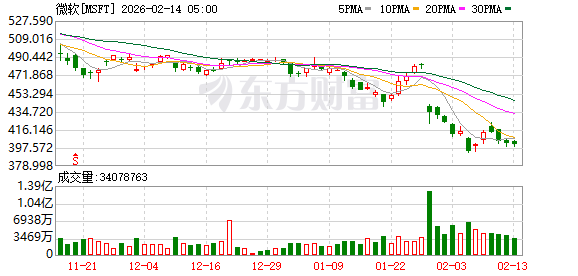
Core Viewpoint - Concerns over excessive AI spending have led to significant stock declines among major tech companies, particularly Amazon, which is facing fears of becoming the first cloud giant with negative free cash flow by 2026 [2][3]. Group 1: Stock Performance - Amazon's stock has fallen for nine consecutive trading days, marking its longest losing streak since 2006 and entering a technical bear market with a drop of over 20% from its peak [3]. - As of the latest close, Amazon's stock price has decreased nearly 23% from its historical closing price of $254 on November 3, now trading below $200 [3]. - Microsoft also entered a bear market earlier this year, with its stock down over 25% from its historical closing price of $542.07 on October 28 [3]. Group 2: AI Investment Plans - Amazon plans to invest $200 billion in AI capital expenditures by 2026, the highest among the four major cloud service providers, contributing to a total expected AI capital expenditure of $650 billion across Amazon, Microsoft, Meta, and Google [3]. - Despite a strong 24% growth in Amazon Web Services (AWS) for the fourth quarter, investor skepticism remains regarding the alignment of Amazon's AI strategy with its cloud business growth [3]. Group 3: Analyst Perspectives - Some analysts believe the market's negative sentiment towards Amazon's AI investments is overblown, arguing that the company is strategically investing in future cloud computing capabilities [4]. - Deutsche Bank analyst Lee Horowitz suggests that the risk of underinvestment is greater than that of overinvestment for Amazon, and he has set a target price of $290 for Amazon's stock [4]. - William Blair analyst Dylan Carden acknowledges the risks associated with increased capital spending but sees it as a sign of Amazon's competitive advantage in rapidly scaling its AWS infrastructure [4]. Group 4: Market Dynamics - The recent sell-off in tech stocks reflects a growing divide among the "Seven Giants," with concerns about AI spending impacting companies like Amazon, Microsoft, and Meta more severely than others like Google [5][6]. - Google has managed to avoid the worst of the sell-off due to its vertically integrated technology system, which provides a buffer against excessive spending concerns [6]. - The upcoming Nvidia earnings report on February 25 is anticipated to be a key catalyst for the AI sector, potentially revealing whether the AI boom is cooling off [7].
9连跌!“资本开支最高”的亚马逊跌入熊市,投资者对Mag 7“用脚投票”
智通财经网· 2026-02-14 00:02
Group 1 - Amazon's stock price has fallen for nine consecutive days, entering a technical bear market, becoming the second company in the "Mag 7" to do so, with a Friday closing price of $198.79, down over 23% from recent highs [1] - Amazon plans to have the highest capital expenditure among the four major cloud service providers, reaching $200 billion by 2026, contributing to a total expected capital expenditure of $650 billion in AI by Amazon, Microsoft, Meta, and Alphabet [1] - Meta is at risk of becoming the next member of the "Mag 7" to enter a bear market, with a 19.6% decline from last year's peak, just 0.4% away from the 20% bear market threshold [1] Group 2 - Investor sentiment has shifted within the "Mag 7," highlighting a growing divergence among its members, with a preference for Alphabet and Broadcom over Microsoft, Nvidia, and Oracle [3] - Alphabet's vertically integrated technology stack has mitigated concerns over excessive spending, resulting in a smaller decline of 9.2% from recent highs, compared to other companies [3] - Increased capital expenditure for Amazon may lead to negative free cash flow this year, necessitating the company to enter the debt market for additional capital [3]
8连跌!“资本开支最高”的亚马逊跌入熊市,投资者对Mag 7“用脚投票”
美股IPO· 2026-02-13 03:27
Core Viewpoint - Amazon has officially entered a technical bear market after its stock price dropped 21.4% from recent highs, while Microsoft became the first member of the Mag7 to enter a bear market. Investor confidence in the return on investment from AI spending by these companies is low, with Amazon planning capital expenditures of up to $200 billion by 2026 [1][3]. Group 1: Amazon and Microsoft Performance - Amazon's stock closed at $199.60 after eight consecutive days of decline, marking its entry into a technical bear market as the second company in the Mag7 to do so [3]. - Microsoft’s stock price fell 25.9% from recent highs after its Azure cloud business growth failed to meet investor expectations, leading to its entry into a bear market on January 29 [3]. Group 2: AI Spending and Investor Sentiment - The total projected capital expenditure for AI by Amazon, Microsoft, Meta, and Alphabet is expected to reach $650 billion by 2026, with Amazon having the highest planned expenditure [3]. - Meta's stock is close to entering a bear market, just 2.3% away from the threshold, despite exceeding Wall Street expectations for Q4 revenue and earnings, as increased AI spending and profit margin pressures have affected investor confidence [3]. Group 3: Market Dynamics and Cash Flow Concerns - There is a noticeable rotation among Mag7 members, with investors moving away from Microsoft, Nvidia, and Oracle-related OpenAI trades towards Alphabet and Broadcom ecosystems [5]. - Alphabet's vertically integrated technology stack has somewhat mitigated concerns over excessive spending, allowing it to avoid the worst impacts of the tech stock sell-off, with its stock down 9.2% from recent highs [5]. - Increased capital expenditure levels for Amazon may lead to negative free cash flow this year, prompting the company to seek additional capital through debt markets [5].

科技多头旗手”力挺五大软件股 称AI冲击被市场“过度计入末日情景
Zhi Tong Cai Jing· 2026-02-05 16:12
Core Viewpoint - The software sector in the U.S. has recently experienced significant sell-offs, but Wedbush believes the market is overreacting to fears of an impending "software winter" driven by AI advancements [1][2] Group 1: Market Sentiment and Analysis - Wedbush argues that concerns about AI disrupting traditional software business models are exaggerated, with the current market pricing reflecting a worst-case scenario [1][2] - The IGV index, which measures software industry performance, has dropped approximately 18% year-to-date, while the S&P 500 index has remained flat, indicating a significant market reaction [2] - The software sector has seen a market capitalization loss exceeding $300 billion, reflecting heightened pessimism [2] Group 2: AI Integration and Corporate Caution - Many enterprise clients are cautious about migrating to AI platforms, preferring to maintain their existing software infrastructure built over decades, despite AI being a short-term headwind [2][3] - The report highlights that AI is more likely to be integrated as "embedded tools" within existing software platforms rather than completely replacing them [2] Group 3: Individual Company Insights - Microsoft (MSFT) has a target price of $575, with expectations that its Azure cloud business and AI commercialization will accelerate, making it a key beneficiary in the AI landscape [3][4] - Palantir (PLTR) is assigned a target price of $230, with its AI platform showing strong demand in critical applications, positioning it well as enterprises move from AI trials to actual deployment [4] - Snowflake (SNOW) has a target price of $270, as it serves as a "trusted intermediary" connecting enterprise data with external AI models, emphasizing the importance of data governance [4] - Salesforce (CRM) is given a target price of $375, with its extensive data assets and recent acquisitions enhancing its competitive edge in the AI era [4] - CrowdStrike (CRWD) maintains a target price of $600, with its AI-driven security operations platform becoming increasingly vital in the context of growing cybersecurity needs [5] Group 4: Long-term Investment Opportunities - Despite the current negative sentiment surrounding the software sector, Wedbush identifies potential long-term investment opportunities, suggesting that extreme market emotions may create favorable conditions for investors [6]
“科技多头旗手”力挺五大软件股 称AI冲击被市场“过度计入末日情景”
智通财经网· 2026-02-05 16:11
Core Viewpoint - The software sector in the US stock market has recently faced significant sell-offs due to the rapid development of artificial intelligence (AI), but Wedbush believes the market is overreacting to these concerns, labeling the situation as an exaggerated "doomsday scenario" for the software industry [1][2] Group 1: Market Sentiment and Analysis - The IGV index, which measures software industry performance, has dropped approximately 18% year-to-date, while the S&P 500 index has remained relatively stable, indicating a market pricing in worst-case scenarios for the software sector [2] - Concerns about AI potentially disrupting traditional SaaS models have led to widespread investor panic, especially following the launch of AI tools by companies like Anthropic [3] - Approximately 80% of CIOs currently prioritize AI and machine learning in their IT budgets, raising fears that software budgets may be squeezed by AI investments [3] Group 2: Company-Specific Insights - Microsoft is maintained with a target price of $575, with expectations that its Azure cloud business and AI commercialization will accelerate, potentially marking a key turning point by 2026 [4] - Palantir is given a target price of $230, with its AI platform AIP showing strong demand in commercial and government sectors, particularly in critical applications [4] - Snowflake is assigned a target price of $270, as it is seen as a crucial intermediary for connecting enterprise data with external AI models, emphasizing the importance of data governance and security [4] - Salesforce is maintained with a target price of $375, with its high-quality enterprise data assets viewed as irreplaceable in the AI era [5] - CrowdStrike is given a target price of $600, with the belief that the rise of AI will enhance the importance of cybersecurity, positioning its AI-driven security operations platform as a leading solution [5] Group 3: Long-Term Investment Perspective - Despite the current negative sentiment surrounding the software sector, Wedbush suggests that this "software doomsday" scenario presents a unique opportunity for long-term investors to position themselves favorably [6]


美股科技软件板块大崩盘,罪魁祸首竟是这家公司?
阿尔法工场研究院· 2026-02-05 07:48
Core Viewpoint - The emergence of native AI models, exemplified by Anthropic's new automation tools, poses a significant threat to traditional software companies, raising questions about the sustainability of their business models and competitive advantages [2][3]. Group 1: Impact of Anthropic's Tools - Anthropic's release of a legal tool plugin for its Claude Cowork platform has triggered panic selling in the software sector, particularly affecting legal software and data service companies [2]. - Major companies like Thomson Reuters and LegalZoom saw their stock prices plummet by 21% and over 20% respectively, as their core business models were directly challenged by the cost-effective and integrated solutions offered by AI [3]. - The market fears that if companies can use a single AI plugin to handle legal compliance tasks that previously required multiple expensive software subscriptions, the subscription value of traditional SaaS companies will be severely undermined [3]. Group 2: Subscription Model Crisis - The term "SaaSpocalypse" reflects the growing concern that AI advancements may not just assist growth but could potentially replace traditional subscription models entirely [5]. - The traditional software industry's reliance on high-margin recurring revenue from seat-based billing is threatened as AI agents can perform tasks that previously required multiple personnel [5]. - This shift in expectations regarding future growth is a key driver behind the current wave of panic selling in the software sector [5]. Group 3: Performance Discrepancies - Among S&P 500 software stocks, only 69% reported revenues above expectations, significantly lower than the tech sector's overall 85% success rate, indicating a weak position in the AI-driven market [6]. - Even strong performers like Microsoft are under scrutiny as their Azure cloud business shows signs of slowing growth, leading to a decline in stock price over four consecutive trading days [6]. - In contrast, Palantir emerged as a rare "safe haven" with a 70% revenue increase in Q4, suggesting that the market is selectively favoring companies that can effectively leverage AI to enhance productivity [6]. Group 4: Market Reallocation - Despite the Nasdaq's poor performance, the S&P 500 shows a "seesaw" effect, with companies like FedEx and Walmart gaining market value, indicating a shift of funds from vulnerable software stocks to more defensively positioned sectors [7]. - The selling pressure on software stocks is characterized by a "surrender" mentality among investors, who are eager to exit positions regardless of price [7]. - From an investment perspective, extreme panic often creates opportunities, as evidenced by Microsoft's valuation dropping to a three-year low with a forward P/E ratio around 25 [7]. Group 5: Future Outlook - The year 2026 is anticipated to be a pivotal moment for the software industry, as AI programming and automation lower development barriers and diminish traditional business moats [8]. - The consensus on Wall Street has shifted fundamentally, with software no longer seen as a guaranteed profit generator in the face of competition from companies like Anthropic that possess foundational AI models [8]. - Investors are advised to focus on identifying companies with core competencies that are not easily replaceable by automation, rather than blindly attempting to catch falling stocks [8].