造船

Search documents
美方暂停实施对华造船等行业301调查措施,商务部发声;今日一只新股申购……盘前重要消息还有这些
证券时报· 2025-11-10 23:50
Group 1 - The State Council issued measures to promote private investment, encouraging private capital participation in specific sectors such as railways and energy, with a potential holding ratio of over 10% for qualified projects [3] - The Ministry of Commerce announced the suspension of the 301 investigation into China's shipbuilding industry, which includes halting additional tariffs on related equipment, marking a step towards improved US-China trade relations [4] - The National Development and Reform Commission (NDRC) introduced opinions to accelerate the cultivation of application scenarios, promoting fair and efficient allocation of resources, which will provide opportunities for social capital and private enterprises [5] Group 2 - The NDRC reported a price increase for gasoline and diesel effective from November 10, with an increase of 125 and 120 yuan per ton respectively, translating to an increase of 0.10 yuan per liter for 92 and 95 gasoline [7] - The NDRC and the National Energy Administration released guidelines to promote the consumption and regulation of renewable energy, aiming to establish a multi-level system by 2030 to meet the growing demand for renewable energy [8] - A research team from the Chinese Academy of Sciences achieved a significant breakthrough in perovskite solar cells, developing a prototype with a conversion efficiency of 27.2%, which is crucial for the commercialization of this technology [9] Group 3 - The Hong Kong stock market saw a milestone with net purchases through the southbound trading channel exceeding 1.3 trillion HKD this year, marking a record since the opening of the mutual market access mechanism [6] - Several companies are making headlines, including *ST Yuancheng, which is facing mandatory delisting, and Mindray Medical, which has submitted an application for H-share listing in Hong Kong [11][18]

财经早报:国办发文!扩范围、清障碍,促进民间投资13条来了,新能源赛道,利好来了!丨2025年11月11日
Xin Lang Zheng Quan· 2025-11-10 23:34
Group 1 - The U.S. has announced a suspension of the 301 investigation measures against China's shipbuilding industry, which includes halting port fees and tariffs on certain equipment, marking a step towards mutual cooperation between the U.S. and China [2] - The Chinese Ministry of Commerce responded positively to the U.S. announcement, indicating it as a significant move in implementing the consensus reached during the U.S.-China economic discussions [2] Group 2 - The Ministry of Industry and Information Technology plans to accelerate the cultivation of application scenarios in five key areas, including 5G and artificial intelligence, to enhance industrial capabilities [4][5] - The government has introduced 13 measures to promote private investment, focusing on expanding market access and ensuring fair competition, which aims to boost investment in emerging sectors [6] Group 3 - A strategic partnership has been established between CPE Yuanfeng and Burger King, with an initial investment of $350 million to support expansion and innovation in the Chinese market [11] - Gree Electric's CEO addressed concerns regarding the company's entry into the refrigerator market, emphasizing the commitment to quality and advanced manufacturing processes [12] Group 4 - The virtual power plant sector is set to benefit from favorable policies, indicating a shift towards large-scale development [13] - The demand for storage chips remains strong, with significant investments observed in several stocks since November [13]


美方暂停实施对华造船等行业301调查措施
Ren Min Ri Bao· 2025-11-10 22:34
Core Viewpoint - The suspension of the 301 investigation measures by the U.S. against China's shipbuilding industry is a significant step towards mutual cooperation and the implementation of the consensus reached during the China-U.S. economic and trade consultations in Kuala Lumpur [1] Group 1: U.S. Actions - The U.S. Trade Representative's Office announced on November 9 that it would suspend the 301 investigation measures against China's shipbuilding industry starting from November 10 [1] - The suspension includes halting the collection of port fees on relevant Chinese vessels and the imposition of additional tariffs on Chinese shore cranes and other equipment [1] Group 2: China's Response - In response, China also decided to suspend its corresponding countermeasures [1] - China expresses willingness to engage in communication and consultation with the U.S. based on mutual respect and equal negotiation principles [1] Group 3: Future Outlook - Both parties are expected to work together to maintain a fair competitive environment in the international shipping and shipbuilding markets [1] - The cooperation aims to inject more certainty and stability into China-U.S. economic and trade relations and the global economy [1]
陆家嘴财经早餐2025年11月11日星期二
Wind万得· 2025-11-10 22:31
Group 1 - The US has officially announced a one-year suspension of the 301 investigation measures against China's shipbuilding industry, while China has reciprocated by suspending special port fees for US ships for one year [2] - The US Congress has passed a temporary funding bill to end the government shutdown, with a final vote expected soon in the House of Representatives [2] - Warren Buffett's Thanksgiving letter indicates he will no longer write annual reports and plans to convert 1,800 Class A shares into 2.7 million Class B shares for donations, retaining a significant amount of Class A shares until confidence in the successor CEO is established [2] Group 2 - The State Council has issued measures to promote private investment, including encouraging private capital participation in smaller city infrastructure projects for the first time [3] - A plan has been released to promote logistics data sharing, with ten categories of logistics data to be made publicly available [3] - The China International Import Expo concluded with a record intended transaction amount of $83.49 billion, a 4.4% increase from the previous year [3] - Central enterprises have increased investment in key areas such as technology innovation and equipment updates, with fixed asset investment exceeding 3 trillion yuan in the first three quarters [3] Group 3 - The China Securities Regulatory Commission is seeking opinions on guidelines for public fund thematic investment style management to address issues of style drift [4] - A-shares showed mixed performance with consumer sectors surging, while the overall trading volume reached 2.19 trillion yuan [4] Group 4 - The Hang Seng Index closed up 1.55%, driven by consumer stocks, with net inflows from southbound funds exceeding 66.54 billion HKD [5] - The China Securities Index Company will launch new indices to provide more investment benchmarks [5] Group 5 - TSMC reported October revenue of 367.47 billion NTD, a 16.9% year-on-year increase, but the lowest growth rate since February 2024 [8] Group 6 - Domestic retail prices for refined oil have been raised for the seventh time this year, with gasoline and diesel prices increasing by 125 yuan and 120 yuan per ton, respectively [9] - The State Administration for Market Regulation has issued compliance guidelines for e-commerce platforms during the "Double Eleven" sales event [9] - The National Development and Reform Commission and the National Energy Administration have outlined goals for large-scale development and high-quality consumption of new energy [9] Group 7 - The US Commodity Futures Trading Commission is in discussions to launch cryptocurrency spot trading products next month [10] - The US Treasury and IRS have released new guidelines for cryptocurrency exchange-traded products [10] - The Bank of England has proposed new regulations for stablecoins, allowing significant investments in short-term government bonds [10] Group 8 - Douyin has clarified rumors regarding penalties for selling products below market price, emphasizing a campaign against false advertising [11] - WeRide has received approval to operate a fully autonomous Robotaxi service in Abu Dhabi, marking a significant milestone in autonomous driving [11] - Tesla's Cybertruck project leader announced his departure after eight years, with sales significantly below production capacity [11] Group 9 - The US and Thailand have reached a trade framework agreement, with Thailand eliminating tariffs on 99% of goods [12] - The Federal Reserve is considering further interest rate cuts to prevent economic downturns [12] - October container imports in the US fell by 7.5% year-on-year, with predictions of further declines in November and December [12] Group 10 - China's gold consumption in the first three quarters decreased by 7.95%, while gold ETF holdings increased significantly [17] - The Shanghai Gold Exchange announced fee waivers for certain international contracts starting November 2025 [17] - International precious metals futures saw widespread gains, driven by geopolitical risks and a weaker dollar [17] Group 11 - The domestic bond market showed strength, with long-term bonds outperforming short-term ones, and the central bank conducted significant reverse repo operations [16] - The Ministry of Finance plans to issue up to 47.71 billion yuan in electronic savings bonds [16] - Hong Kong is set to launch a new round of multi-currency digital bond issuance [16]
美方暂停实施对华造船等行业301调查措施,商务部表态
Di Yi Cai Jing· 2025-11-10 13:55
Core Viewpoint - The U.S. has announced a suspension of the Section 301 investigation measures against China's shipbuilding industry, which is seen as a step towards mutual cooperation and stability in U.S.-China trade relations [1] Group 1: U.S. Actions - The U.S. Trade Representative's Office announced on November 9 that it would suspend the Section 301 investigation measures against China's shipbuilding industry starting from November 10 at 12:01 AM [1] - The suspension includes halting the collection of port fees on relevant Chinese vessels and the imposition of additional tariffs on Chinese shore cranes and other equipment [1] Group 2: China's Response - China has noted the U.S. announcement and has also decided to suspend its corresponding countermeasures [1] - China expresses willingness to engage in communication and consultation with the U.S. based on mutual respect and equal negotiation principles [1] Group 3: Implications for Trade - The actions taken by both countries are viewed as important steps in implementing the consensus reached during the U.S.-China economic consultations in Kuala Lumpur [1] - There is an expectation that both sides will continue to work towards maintaining a fair competitive environment in the international shipping and shipbuilding markets, contributing to greater certainty and stability in U.S.-China economic cooperation and the global economy [1]
美方暂停实施对华造船等行业301调查措施,中方回应!
Zhong Guo Zheng Quan Bao· 2025-11-10 13:45
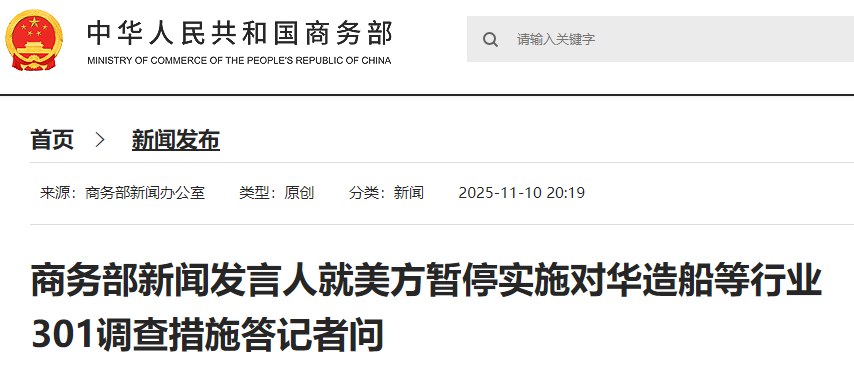
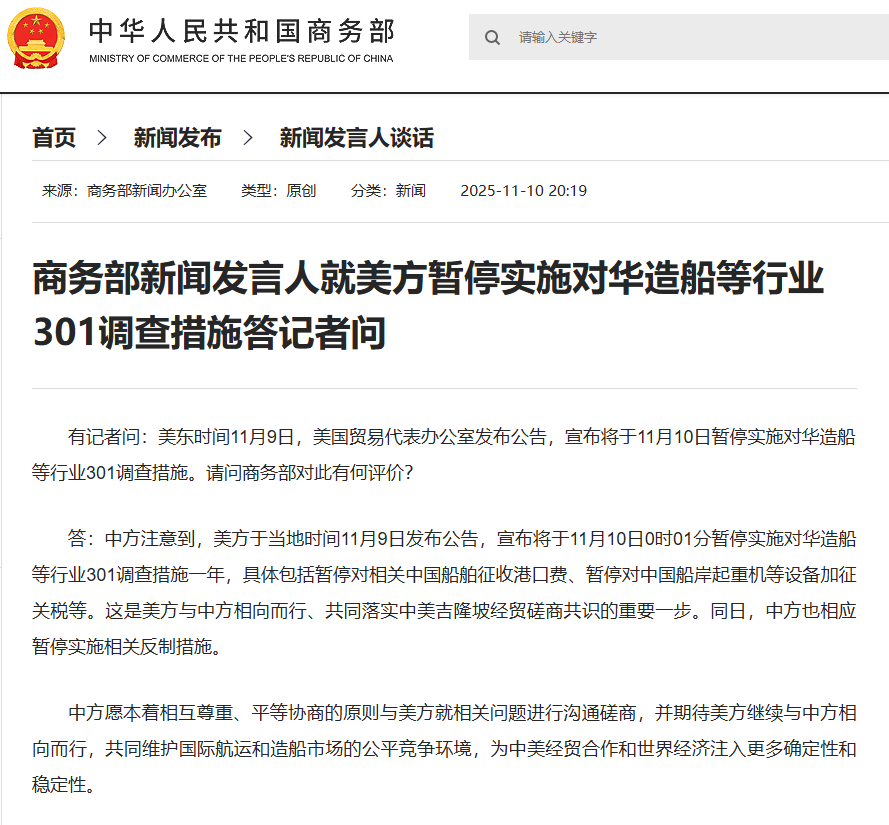
商务部网站截图 商务部新闻发言人就美方暂停实施对华造船等行业301调查措施答记者问 有记者问:美东时间11月9日,美国贸易代表办公室发布公告,宣布将于11月10日暂停实施对华造船等行业301调查措施。请问 商务部对此有何评价? 答:中方注意到,美方于当地时间11月9日发布公告,宣布将于11月10日0时01分暂停实施对华造船等行业301调查措施一年, 具体包括暂停对相关中国船舶征收港口费、暂停对中国船岸起重机等设备加征关税等。这是美方与中方相向而行、共同落实中 美吉隆坡经贸磋商共识的重要一步。同日,中方也相应暂停实施相关反制措施。 中方愿本着相互尊重、平等协商的原则与美方就相关问题进行沟通磋商,并期待美方继续与中方相向而行,共同维护国际航运 和造船市场的公平竞争环境,为中美经贸合作和世界经济注入更多确定性和稳定性。 来源:商务部网站 (文章来源:中国证券报) ...
11月10日重要资讯一览
Zheng Quan Shi Bao Wang· 2025-11-10 13:41
Group 1: New Policies and Measures - The State Council issued measures to promote private investment, emphasizing the need for feasibility studies for private capital participation in certain sectors like railways and energy, allowing private ownership to exceed 10% in qualified projects [3] - The Ministry of Commerce announced the suspension of the 301 investigation into China's shipbuilding industry, which includes halting additional tariffs on Chinese vessels and equipment, marking a step towards improved US-China trade relations [4] - The National Development and Reform Commission (NDRC) introduced implementation opinions to accelerate the cultivation of application scenarios, aiming to enhance the participation of social capital and private enterprises in major projects [5] Group 2: Market Developments - The Hong Kong stock market saw a significant milestone with net purchases through the southbound trading channel reaching 66.54 billion HKD, bringing the total net inflow for the year to over 1.3 trillion HKD [6] - The NDRC announced an increase in domestic retail prices for gasoline and diesel by 125 and 120 CNY per ton, respectively, effective from November 10, reflecting fluctuations in international oil prices [7] Group 3: Company News - *ST Yuancheng is facing mandatory delisting conditions, leading to a suspension of its stock trading starting November 11 [10] - Tianji Co., Ltd. is advancing the industrialization of lithium sulfide material preparation patents [11] - Sichuan Jinding clarified that its affiliated company, Kaiwu Information, is not involved in space computing businesses [12] - *ST Yuanshang confirmed that there are no undisclosed significant information [13] - Huasheng Lithium Battery noted uncertainties in the recovery of the downstream lithium battery industry [14] - Shannon Chip Creation acknowledged reports of rising storage chip prices but stated that its fundamentals remain unchanged [15] - Chengxing Co. warned of potential irrational speculation risks regarding its stock price [16] - Mindray Medical has submitted an application for H-share listing on the Hong Kong Stock Exchange [17] - Victory Co. plans to acquire gas-related assets from its controlling shareholder, with stock resuming trading on November 11 [18] - Demingli is planning refinancing activities, with no significant changes in its operating environment [19] - Huada Technology has recently secured project designations from several domestic automotive and new energy battery companies [20]
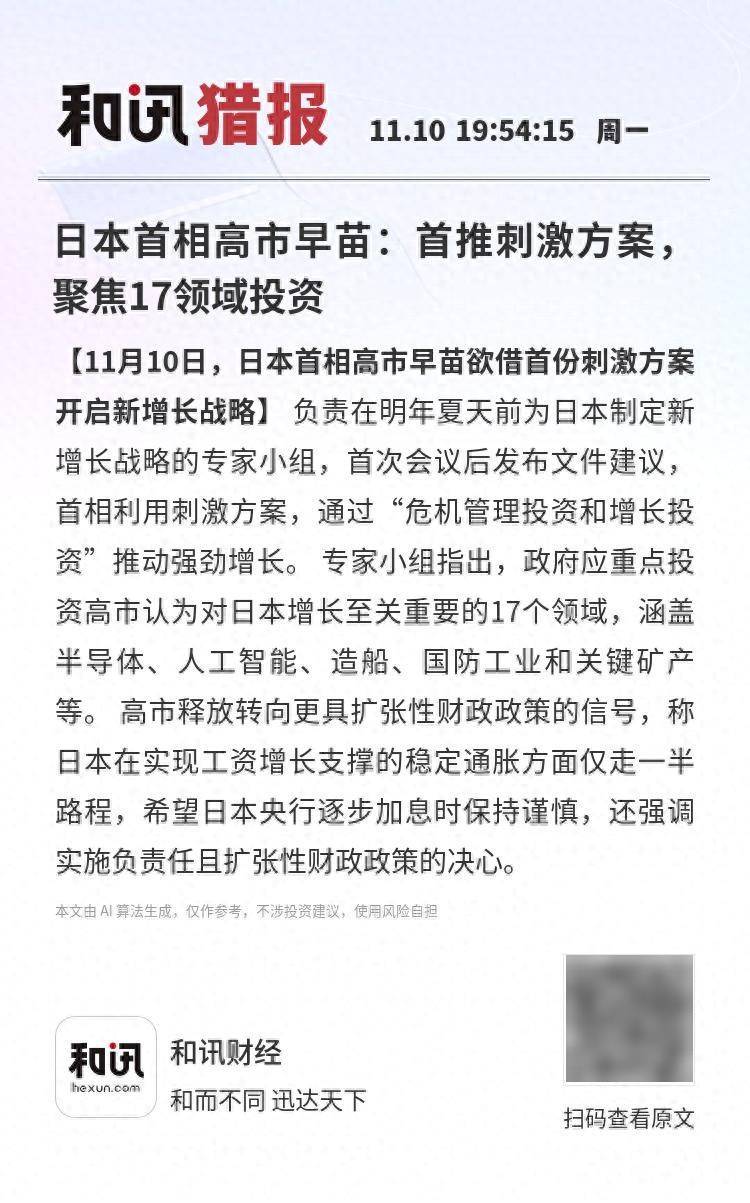
日本首相高市早苗:首推刺激方案,聚焦17领域投资
Sou Hu Cai Jing· 2025-11-10 13:17
Group 1 - The core viewpoint of the article is that Japanese Prime Minister Sanna Takashi aims to initiate a new growth strategy through a stimulus plan, focusing on "crisis management investment and growth investment" to drive strong growth [1] - An expert group has been tasked with formulating a new growth strategy for Japan by next summer, emphasizing the importance of investing in 17 key sectors identified by Takashi, including semiconductors, artificial intelligence, shipbuilding, defense industry, and critical minerals [1] - Takashi signals a shift towards a more expansionary fiscal policy, stating that Japan has only made half the journey towards stable inflation supported by wage growth, and expresses a cautious approach as the Bank of Japan gradually raises interest rates [1]
美方暂停实施对华造船等行业301调查措施,商务部回应
券商中国· 2025-11-10 13:14
Core Viewpoint - The U.S. announced a one-year suspension of the 301 investigation measures against China's shipbuilding industry, which includes halting port fees and tariffs on related equipment, marking a step towards mutual cooperation between the U.S. and China [1] Group 1 - The U.S. Trade Representative's office issued a notice on November 9, stating that the suspension will take effect on November 10 at 12:01 AM [1] - The suspension includes the cessation of port fees on Chinese ships and additional tariffs on Chinese shore cranes and related equipment [1] - China responded by also suspending relevant countermeasures, indicating a willingness to engage in dialogue based on mutual respect and equal consultation [1] Group 2 - The Chinese side expressed hope for continued cooperation with the U.S. to maintain a fair competitive environment in the international shipping and shipbuilding markets [1] - The announcement is seen as a significant step in implementing the consensus reached during the China-U.S. economic and trade consultations in Kuala Lumpur [1] - The move aims to inject more certainty and stability into China-U.S. economic cooperation and the global economy [1]
中美大消息!商务部,最新回应
Zheng Quan Shi Bao· 2025-11-10 13:07
Core Points - The U.S. Trade Representative's Office announced a suspension of the Section 301 investigation measures against China's shipbuilding and related industries, effective from November 10, 2025, for one year [1] - The Chinese Ministry of Commerce noted this as a significant step towards mutual cooperation and maintaining a fair competitive environment in international shipping and shipbuilding markets [1] - Both China and the U.S. are expected to engage in further discussions based on mutual respect and equal consultation [1] Group 1 - The U.S. will suspend the collection of port fees on Chinese vessels and additional tariffs on Chinese shore cranes and related equipment [1] - In response, China will also suspend its countermeasures against related U.S. companies, specifically targeting five subsidiaries of Hanwha Ocean Co., Ltd. [3] - The Ministry of Transport of China announced the suspension of special port fees for U.S. vessels and investigations into the impacts on the shipping and shipbuilding industries, effective from November 10, 2025 [5]