微短剧

Search documents
五百亿微短剧市场迎版权战,像素级抄袭与AI换脸侵权频发
Nan Fang Du Shi Bao· 2025-08-05 09:21
Core Insights - The micro-short drama market in China has surpassed 50.5 billion yuan by 2024, with a continuous increase in both creators and viewers [1] - Copyright infringement issues such as script plagiarism, piracy, and AI face-swapping are rampant, severely disrupting the industry ecosystem and undermining the confidence of original creators and investors [1][2] Group 1: Industry Growth and Challenges - The micro-short drama format caters to modern users' fragmented viewing habits, promoting content innovation and enriching the audiovisual ecosystem [2] - The surge in micro-short drama production has led to significant copyright protection challenges, becoming a bottleneck for industry development [2] - The low production costs and rapid dissemination of micro-short dramas have made plagiarism and script theft particularly prevalent [2][3] Group 2: Impact on Investment and Production - Copyright and piracy issues are critical factors undermining investment confidence in the film and television industry [3] - Companies face significant losses due to rampant piracy, which disrupts their original commercial expectations [3] - The experience of companies facing copyright infringement highlights the difficulties in protecting intellectual property, especially when similar works are released before the original [3][4] Group 3: Legal and Regulatory Responses - Experts emphasize the need for a new copyright identification and authorization system, alongside existing enforcement measures [5] - The "notice-and-takedown" mechanism is highlighted as a necessary legal framework to address copyright issues in the micro-short drama sector [6] - The China Copyright Association has developed guidelines to enhance the "notice-and-takedown" process, aiming to improve efficiency and reduce barriers for rights holders [6] Group 4: Platform Initiatives - Platforms are establishing dedicated copyright protection centers to support authors in rights confirmation, monitoring, and complaint handling [7] - Efforts are being made to create long-term revenue-sharing models and mechanisms to extend the lifecycle of content, thereby enhancing creators' income stability [7]
2025H1海外微短剧:预估收入超45亿,月活占比不足10%,IAA、IAP、IAAP将三分天下
3 6 Ke· 2025-08-04 09:13
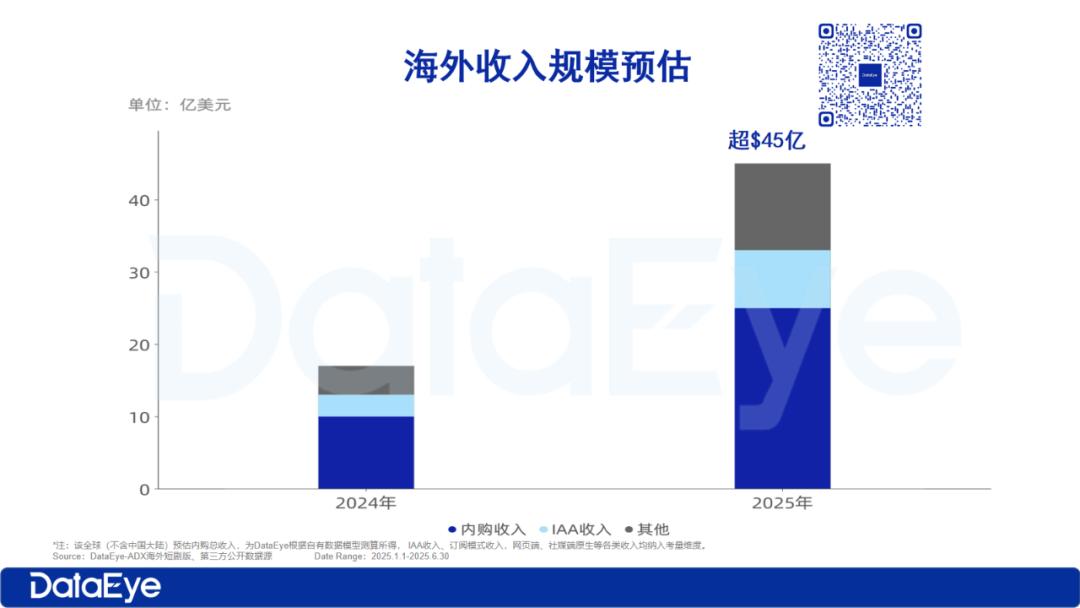
Group 1: Overseas Micro-Short Drama Revenue Forecast - The total revenue for overseas micro-short dramas is expected to exceed $4.5 billion in 2025, with a growth rate of over 164% [3] - In-app purchases (IAP) are leading the revenue, driven by lower tolerance for ads among overseas users compared to domestic users [3][4] - The rise of free models in regions like Latin America, India, and Southeast Asia is expected to boost IAA revenue growth [3] Group 2: Overall User Scale Forecast - The total short video user base in overseas markets is nearly 2 billion, with potential micro-short drama users estimated at 900 million [4] - Current monthly active users for micro-short dramas are only 80 million, indicating a penetration rate of less than 10% [4] - The overseas micro-short drama market is at a critical point of transitioning from niche to mainstream, with significant growth potential [4] Group 3: In-App Purchase Revenue and Download Volume - In the first half of 2025, overseas micro-short drama apps generated $1.079 billion in in-app purchase revenue, with a total of 665 million downloads [7] - Download volume increased by 62.87% from January to June, indicating enhanced user acquisition capabilities [7] - The highest growth in in-app purchase revenue was observed in Southeast Asia, contributing over 10% of total revenue [7] Group 4: Overseas Advertising Trends - The number of overseas micro-short drama apps reached 309 in the first half of 2025, a 109.5% increase year-on-year [10] - The market is experiencing explosive growth, with an average of 27 new apps launched each month [10] - The expansion of both domestic and foreign companies into overseas markets is accelerating [10] Group 5: Material Investment Overview - The total material investment for overseas micro-short dramas reached 4.427 million sets in the first half of 2025, with 3.693 million new sets [15] - Monthly material investment has shown a stable increase, with a notable spike in April [15] - The growth in material investment is driven by competition, with companies testing multiple materials to find successful content [15] Group 6: Genre and Regional Distribution - Female-oriented content dominates the overseas micro-short drama market, accounting for 77.05% of material [17] - Emotional, urban, and revenge themes are the most popular, comprising 70% of the material [17] - The distribution of material investment shows a narrowing gap between local and translated dramas, with local dramas slightly leading [21] Group 7: Market Trends and Future Outlook - The overseas market is more open to diverse themes, including LGBTQ+ content, allowing for bolder creative expressions [25] - The IAA, IAP, and IAAP models are becoming increasingly prevalent, with IAP apps showing significant growth [28] - The top 20 apps account for 78% of total downloads, indicating a strong concentration of market share among leading apps [31] Group 8: Competitive Landscape - The top two apps, ReelShort and DramaBox, generated over $400 million in combined revenue, dominating the market [33] - The disparity in revenue between top and tail apps is significant, highlighting a pronounced "Matthew Effect" [33] - Localization strategies are proving effective, with apps like FlickReels successfully entering the top revenue rankings through targeted content [33]

“AI大模型+数千创作者”助力微短剧出海
Xin Hua Ri Bao· 2025-08-04 02:46
Group 1 - The core viewpoint of the article highlights the rapid growth and increasing investment in the micro-drama industry in China, with the advertising expenditure expected to reach 420 billion yuan in 2024 and nearly 400 billion yuan in 2025 [1][2] - Nanjing Zhiying Cultural Media Co., Ltd. has developed an AI creation platform called "Beidou Zhiying," which offers automated content analysis and editing suggestions for micro-drama production, enhancing the efficiency of video creation [1][2] - The company has established a comprehensive ecosystem covering creation, distribution, and monetization, collaborating with multiple content platforms and managing over 60,000 copyrights for novels, micro-dramas, and films [2] Group 2 - The platform allows creators to easily distribute their works across various video platforms and tracks the effectiveness of their promotions through unique search codes or links, ensuring proper revenue sharing [2] - Currently, the platform has around 6,000 creators, with an average daily user growth of nearly 100, indicating a strong engagement despite some accounts having lower follower counts [2] - The company plans to expand its operations to Malaysia, aiming to replicate its micro-drama promotion model internationally and explore reverse business opportunities by promoting Southeast Asian short dramas in China [3]
如火如荼的微短剧,盈利模式悄然生变
Xin Hua Ri Bao· 2025-08-04 02:12
Core Insights - The micro-short drama industry is characterized by short duration, low investment, rapid creation, and diverse themes, with a market size exceeding 634 billion yuan and a user base of 690 million, covering 68.4% of internet users [1] - The industry faces challenges such as content homogenization and reliance on established formulas, leading to viewer fatigue and sustainability issues in profitability [1] - The industry is exploring new development models, shifting from single monetization to multi-dimensional breakthroughs and from short-term gains to long-term value [1] Production Process - The production of a micro-short drama involves several stages, including topic selection, script writing, filming preparation, and post-production, with a focus on precision despite the fast-paced nature of the format [2][3] - The average script undergoes 8-12 revisions, with some projects requiring over 20 revisions, highlighting the complexity of coordinating multiple stakeholders [3] - The production timeline is tight, with filming needing to adapt to actors' schedules, increasing the difficulty of coordination [3] Cost and Profitability - The cost of producing micro-short dramas has increased significantly, with typical production costs now ranging from 50,000 to 150,000 yuan, influenced by factors such as script development, actor fees, and marketing expenses [4][5] - Traditional revenue models include free trials, paid subscriptions, and advertising partnerships, but the industry is evolving towards more diverse monetization strategies, including IP extensions and collaborations with live commerce [5][6] New Business Models - Companies are increasingly collaborating with local cultural and tourism projects to create content that attracts viewers while promoting regional attractions, leading to a more sustainable revenue model [6][7] - The integration of micro-short dramas with tourism initiatives has been supported by government policies, enhancing cultural heritage and economic development [6][7] Future Trends - The industry is shifting focus from mere traffic to content quality, with leading platforms investing in diverse themes and high-quality productions [8][9] - New operational models are emerging, such as using AI for animation and creating interactive content that appeals to younger audiences, thereby expanding commercial value [10][11] - The incorporation of advertising elements into storylines is creating a synergistic relationship between content and brand promotion, enhancing viewer experience while meeting marketing needs [11]
城市24小时 | 这个中部省会发力,打造“微短剧创作之都”
Mei Ri Jing Ji Xin Wen· 2025-08-01 14:21
Group 1 - Zhengzhou aims to become a "micro-short drama creation capital" with a market size target of 10 billion yuan by 2027 [1] - The plan includes fostering 1-2 influential micro-short drama industrial chain bases and cultivating over 10 competitive production and distribution companies [1][2] - The micro-short drama market in China is projected to grow from 50.5 billion yuan in 2024 to 63.43 billion yuan in 2025, reaching 85.65 billion yuan by 2027, with a compound annual growth rate of 19.2% [1] Group 2 - In 2023, Xi'an produced 80% of the top micro-short drama works in the national market, with 60 out of 100 top dramas originating from the city [2] - Zhengzhou's micro-short drama market reached 2.3 billion yuan in 2023, a 27.4% increase from the previous year, with over 820 production companies [2] - The lack of a centralized, high-standard headquarters for micro-short drama in Zhengzhou has led to resource dispersion and inefficiencies, especially as other cities like Beijing and Hangzhou ramp up support for their own micro-short drama industries [2] Group 3 - The implementation plan includes skill training for professionals in acting, filming, and editing to enhance the overall quality of the micro-short drama workforce [3] - The innovative dissemination of micro-short dramas allows audiences to experience unique cultural elements, enhancing cultural influence and outreach [3] Group 4 - Zhengzhou plans to integrate local cultural tourism resources into micro-short dramas, promoting projects that highlight historical and cultural landmarks [5] - The city aims to leverage its unique position as a historical center to produce high-quality micro-short dramas that reflect its cultural heritage [5]

湖南湘江新区以灵活的人才引进政策吸引短剧专业人才汇聚长沙
Chang Sha Wan Bao· 2025-07-31 23:59
Core Insights - The article highlights the rapid growth of the short drama industry in Changsha, particularly in the Hunan Xiangjiang New Area, driven by flexible talent recruitment policies and a vibrant creative environment [1][6][7] Industry Overview - The micro-short drama sector is gaining popularity due to its fast-paced, strong narrative, and low production costs, making it a new favorite for content consumption and a high-traffic area [3][4] - The market for micro-short dramas in China is projected to reach 50.5 billion yuan in 2024, surpassing the box office revenue of films for the first time [7] Company Insights - Qin Jiu Network, a key player in the short drama industry, has produced between 300 to 400 short dramas annually, achieving a staggering content output that includes over 10 billion in cumulative recharge and more than 100 billion views [6][7] - The company has established a comprehensive production environment that integrates script development, filming, post-production, and distribution, enhancing operational efficiency [6] Talent and Production - Young actors and directors are increasingly drawn to the short drama field, finding it a space for creative expression and professional growth, as evidenced by the experiences of actors like Li Enming and Shen Jiani [4][5] - The production cycle for short dramas is notably shorter than traditional long dramas, with filming often taking place over just a few days, allowing for a high volume of content creation [5][6] Creative Environment - The Hunan Xiangjiang New Area offers a unique filming environment with diverse natural and urban settings, facilitating efficient production processes and reducing logistical challenges for film crews [6][7] - The area is characterized by a supportive business environment, including subsidies and rapid response to business needs, which fosters the growth of companies like Qin Jiu Network [6]

多维推进“微短剧+文旅”深度融合
Xiao Fei Ri Bao Wang· 2025-07-31 02:52
Core Viewpoint - The integration of "micro short dramas + cultural tourism" is emerging as a new engine for breaking through challenges in the cultural tourism industry, providing immersive experiences for consumers through fragmented storytelling and social dissemination [1][2]. Policy Guidance - The National Radio and Television Administration has launched the "Travel with Micro Short Dramas" initiative to promote deep integration of micro short drama content with cultural tourism resources, with over 20 provinces actively supporting this initiative [2]. - The initiative has already produced multiple high-quality works that transform intangible cultural heritage, landmark scenery, and folk customs into engaging narratives for younger audiences [2]. Content Practice - Diverse micro short dramas are becoming the "business cards" of cultural tourism, showcasing local delicacies and cultural stories, such as "My Journey Has Wind," "Summer in Sanjing Hutong," and "Scenic Hunter: Chaka Salt Lake" [3]. - These dramas not only highlight regional culture but also enhance the viewer's connection to the local heritage and experiences [3]. Market Dynamics - As of December 2024, the user base for micro short dramas in China is projected to reach 662 million, with a market size of 50.4 billion yuan [6]. - The filming of micro short dramas has significantly boosted local economies, as seen in Yantai, where filming generated over 5 million yuan in local consumption [6]. - In Zhejiang, a competition for outstanding works related to cultural tourism received 120 submissions, indicating strong industry engagement [6]. Extension of Micro Short Dramas in Cultural Tourism - Scenic spots are leveraging the exposure from film and television to create immersive experiences, as demonstrated by the Red Leaf Persimmon Rock Tourism Area in Shandong, which attracted 1.6 million visitors in 2024 [7]. - The integration of micro short dramas into tourism is enhancing the appeal of destinations, making travel more engaging for younger audiences [7]. Technological Empowerment - The micro short drama industry is being driven by technological innovations, with a focus on high-quality content development [8]. - Advanced technologies like XR and AI are reshaping the integration of micro short dramas with cultural tourism, enhancing viewer immersion and storytelling [9]. - The industry is moving towards content premiumization, utilizing data analytics to refine scripts and enhance production quality, thereby increasing user engagement [9].

文旅微短剧应重品质、防短视才能促长远
Xiao Fei Ri Bao Wang· 2025-07-31 02:52
Core Insights - The rise of micro-short dramas is driven by the increasing demand for fragmented entertainment and the lowering of creative barriers, leading to a diverse content matrix that expands the boundaries of this genre [1] - The integration of micro-short dramas with the cultural tourism industry creates a complementary development model, exploring new avenues for industry growth [1] - The "Follow the Micro-Short Drama to Travel" initiative launched by the National Radio and Television Administration in early 2024 aims to activate local cultural tourism development through policy support [1] Content Creation Challenges - Many micro-short dramas excessively incorporate local attractions and products, resulting in awkward storytelling and a lack of coherence, which diminishes audience engagement [1] - Successful examples, like "My Journey Has Wind," demonstrate the importance of compelling narratives that naturally integrate cultural elements, enhancing viewer connection to the location [1] Production Issues - Some production teams prioritize high production values over the inherent characteristics of micro-short dramas, leading to increased costs and extended shooting periods, which undermines the genre's advantages of flexibility and rapid dissemination [2] - Effective storytelling, as seen in "Where the Wind Is," relies on emotional resonance rather than grand visuals to attract viewers [2] Marketing and Promotion - Many micro-short dramas fail to generate sustained buzz post-release due to inadequate marketing strategies and a lack of engagement with social media and short video platforms [2] - Successful marketing examples, like "Hello, Su Dongpo," create immersive experiences that transform viewers into participants, driving cultural tourism consumption [2] Long-term Development Strategies - For the "micro-short drama + cultural tourism" model to succeed, a complete industry chain must be established, moving beyond mere promotional content to include deep IP development and related services [3] - Successful case studies, such as "Flying Youth," illustrate how micro-short dramas can enhance local product sales and provide integrated online and offline services, expanding growth opportunities in the tourism sector [3] - To achieve a lasting impact, creators must focus on storytelling, production teams should optimize costs while maintaining quality, marketing efforts need to be continuous, and localities must build a robust industry chain for deep integration of micro-short dramas and cultural tourism [3]
映宇宙执行总裁、总编辑夏晓晖:微短剧走向精品创作和价值共生
Zhong Guo Jing Ying Bao· 2025-07-30 13:55
Core Insights - The micro-short drama industry is entering a golden era, with significant growth in overseas markets expected to surpass domestic markets in terms of paid short drama revenue [1][3][4] Market Growth - The overseas micro-short drama market is projected to grow from approximately $100 million in 2023 to $1.5 billion in 2024, reaching $3.8 billion in 2025 [1] - The domestic micro-short drama market was valued at 50.5 billion yuan in the previous year, surpassing box office revenues from cinemas for the first time [1] Regional Preferences - North America leads the overseas market with a 40% share, favoring urban romance and fantasy themes [2] - Southeast Asia's market is characterized by themes similar to domestic preferences, such as campus youth and family ethics [2] - Japan focuses on revenge and workplace themes, while South Korea prefers sweet romance and reincarnation stories [2] Production and Localization - The company has developed a streamlined production process in Xi'an, capable of producing 20+ micro-short dramas monthly, with a focus on high-quality content [3][5] - The company has launched localized short drama apps for North America and Southeast Asia, incorporating local actors and cultural elements [5] Technological and Market Drivers - The growth of micro-short dramas is attributed to technological advancements, changing viewing habits, and the impact of the COVID-19 pandemic, which increased demand for quick entertainment [4]
北美微短剧第一平台ReelShort一日之内连遭两次侵权指责 版权成行业新问题
Zhong Guo Jing Ying Bao· 2025-07-30 06:44
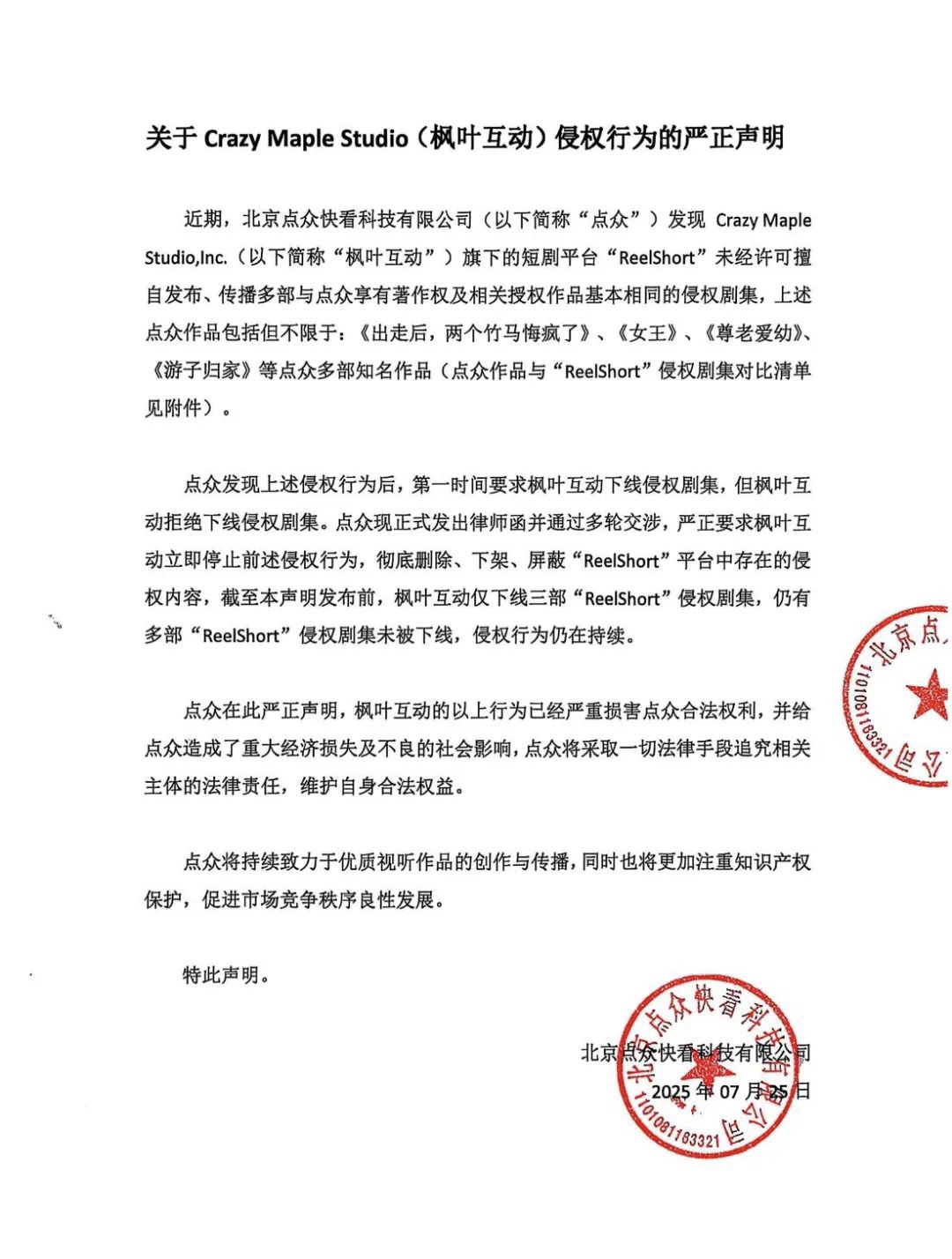
Core Viewpoint - The micro-drama platform ReelShort, known as the "leading micro-drama platform in North America," faces accusations of copyright infringement from two major domestic companies, Tinghua Island and Dianzong Technology, highlighting the challenges of copyright protection in the rapidly growing micro-drama industry [1][3][4]. Group 1: Copyright Infringement Accusations - Dianzong Technology claims that ReelShort, operated by Crazy Maple Studio, has unlawfully published and disseminated multiple works that are substantially similar to those they hold copyright for, including titles like "The Queen" and "The Prodigal Son Returns" [4][5]. - Tinghua Island asserts that their copyrighted micro-dramas "The Vegetable Seller is Actually the Empress" and "The Cold-Faced Uncle Spoils His Wife" were directly copied by ReelShort, leading to serious concerns about the infringement [5][9]. - Both companies have attempted to communicate with Crazy Maple Studio regarding the infringement, but have faced difficulties in achieving a resolution, prompting them to take public action [3][9]. Group 2: Industry Context and Growth - ReelShort, launched in August 2022, has seen significant growth, with its app ranking rising from 402 to 2 in the iOS free chart in the U.S. within a few months, indicating a strong market presence [7]. - The micro-drama industry is experiencing rapid expansion, with over 200 short drama applications emerging in overseas markets, generating approximately $713 million in in-app purchases, and projected to exceed $5 billion in revenue within three years [10][11]. - The report indicates that while domestic market growth is expected to slow from 35% to 26% in 2024, the overseas market is thriving, with a notable increase in the popularity of localized content [10][11]. Group 3: Legal and Operational Challenges - The complexities of international copyright disputes are highlighted, with significant challenges in legal jurisdiction and enforcement, particularly when dealing with platforms based outside of China [13][14]. - The high costs associated with pursuing legal action in foreign jurisdictions, including lengthy litigation processes and substantial attorney fees, deter many companies from seeking redress for copyright violations [14]. - Recommendations for improving copyright protection include strengthening copyright registration processes, fostering international cooperation, and enhancing monitoring of popular content to prevent infringement [14].