
轴承制造

Search documents
山东质量强链“组队”升级
Da Zhong Ri Bao· 2025-10-09 01:04
Core Insights - The article highlights the importance of quality management across the entire industrial chain, emphasizing the role of leading companies in setting standards and driving improvements in quality for their suppliers and partners [2][4]. Group 1: Quality Management Initiatives - Wanhua Chemical Group won the fifth China Quality Award, showcasing its leadership in promoting unified quality standards and advanced testing methods across over 100 upstream and downstream enterprises [2]. - Yujie Bearing Manufacturing Co. has established a comprehensive quality control system, ensuring high standards from raw material procurement to production, with real-time monitoring of manufacturing processes [2][3]. - The local market supervision department, in collaboration with research institutions, has successfully upgraded the production processes of Yujie Bearing, enabling it to meet P4-level precision standards and improve load capacity by 20% [3]. Group 2: Economic Impact and Growth - The bearing industry in Linqing has achieved annual revenues exceeding 50 billion, accounting for one-tenth of the national total, with over 5,100 related enterprises and several recognized as national-level specialized and innovative "little giant" companies [3]. - Shandong Meiguolai Food Co. has expanded its product line significantly, achieving annual sales exceeding 200 million, demonstrating the market's acceptance of high-quality products despite higher prices [3]. Group 3: Quality Traceability and Infrastructure - Zaozhuang's market supervision bureau has implemented a barcode traceability system, allowing consumers to access comprehensive quality information about products, achieving a compliance rate of over 99% [4]. - Shandong has completed the mapping of 4 national-level and 32 provincial-level quality strong chain key projects, establishing 136 one-stop quality infrastructure service platforms to support small and medium-sized enterprises [4]. - The province aims to further promote quality standards and practices across key industrial chains, making high quality a fundamental requirement for the entire industry [4].

奋勇争先,决战决胜“十四五”丨高质量发展不断取得新成效
Ren Min Ri Bao· 2025-10-09 00:59
Group 1: Company Developments - Shanghai Yiyu Intelligent Technology Co., Ltd. has rapidly developed its "Conch Video" product, expanding language support from 10 to over 40 languages within a year, with clients and developers in over 90 countries [1] - The "Mosu Space" innovation ecosystem has attracted over 100 large model enterprises in less than 20 months, expanding its area from 10,000 square meters to approximately 60,000 square meters in under two years [1] - The Henan Luoyang Bearing Group has launched the world's largest ring rolling machine series, with new product output increasing from 774 million to 1.605 billion yuan from 2021 to 2024, and high-end bearing output accounting for 70% of total output [4] Group 2: Industry Trends - China's economic growth has shown strong momentum, with major indicators exceeding expectations, contributing to high-quality development [2] - The "14th Five-Year Plan" emphasizes the importance of innovation, with R&D expenditure expected to grow nearly 50% compared to the end of the "13th Five-Year Plan," and China's global innovation index ranking rising to 10th place [5] - The "Deep Sea No. 1" gas field project has achieved full production, with an expected annual gas output of over 4.5 billion cubic meters, enhancing the supply of clean energy to the national natural gas grid [6]
高质量发展不断取得新成效(奋勇争先,决战决胜“十四五”)
Ren Min Ri Bao· 2025-10-09 00:46
Group 1: Company Developments - Shanghai Xiyu Intelligent Technology Co., Ltd. has rapidly developed its "Hailuo Video" product, which can automatically generate complex acrobatic videos from text and images, expanding language support from 10 to over 40 languages within a year and serving clients in over 90 countries [1] - The "Mosu Space" innovation ecosystem has attracted over 100 large model companies in less than 20 months, expanding its area from 10,000 square meters to approximately 60,000 square meters in under two years [1] - Luoyang Bearing Group has launched the world's largest ring rolling machine, with new product output increasing from 774 million yuan to 1.605 billion yuan from 2021 to 2024, and high-end bearing output accounting for 70% of total production [3] Group 2: Industry Trends - China's economy has maintained a strong momentum since the "14th Five-Year Plan," with major indicators exceeding expectations, contributing approximately 30% to global economic growth [3] - The country has solidified its position as the world's largest manufacturing power, goods trading nation, foreign exchange reserve holder, and human resource base, further enhancing its economic advantages [3] - The "14th Five-Year Plan" emphasizes the importance of innovation, with R&D investment expected to grow nearly 50% compared to the end of the "13th Five-Year Plan," and China's global innovation index ranking rising to 10th place [4] Group 3: Energy and Resource Management - The "Deep Sea No. 1" gas field project has achieved full production, with an expected annual gas output exceeding 4.5 billion cubic meters, contributing to clean energy supply across the national natural gas network [5] - China maintains the world's highest production levels for grains, meat, vegetables, and fruits, reinforcing its position in global manufacturing and ensuring a solid material and technological foundation for high-quality development [6]
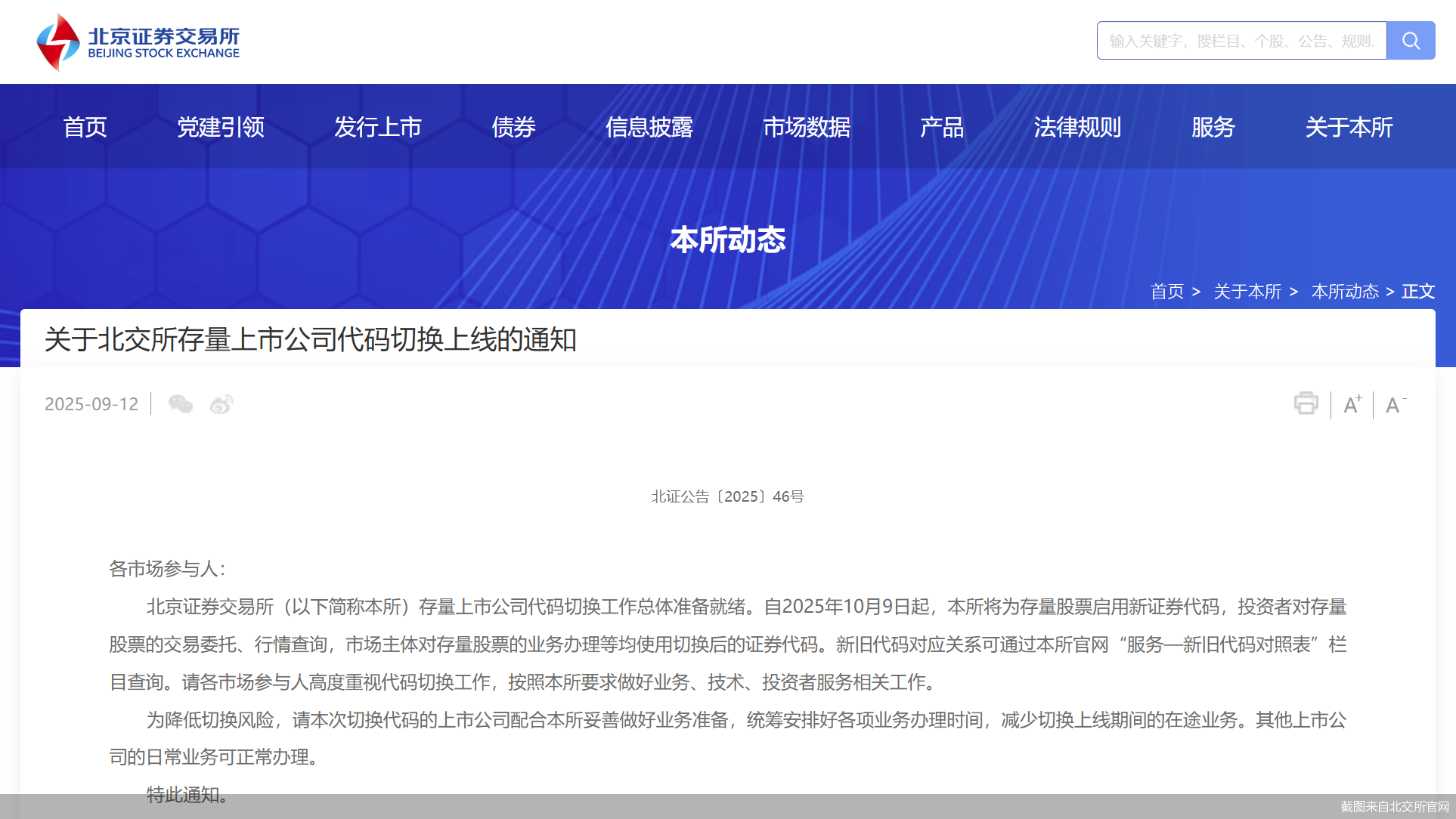
10月9日起,北交所全面进入“920代码”时代
Bei Jing Shang Bao· 2025-10-08 11:07
Core Viewpoint - The Beijing Stock Exchange (BSE) will switch to a new securities code system for existing stocks starting October 9, marking a transition to an independent code era aimed at enhancing its market positioning for innovative small and medium enterprises [1][4]. Group 1: Code Transition Details - The new securities code will be unified under the 920 code segment, which will help eliminate confusion caused by the previous codes used from the New Third Board [4][6]. - A total of 248 stocks will complete the transition to the new code, which can be checked on the BSE's official website [4]. - The transition process has been in preparation for over two years, with the China Securities Regulatory Commission (CSRC) previously advocating for the establishment of an independent code segment to improve stock identification [4][5]. Group 2: Implementation and Future Plans - The BSE plans to launch the 920 code functionality for new listings on April 22, 2024, while ensuring a smooth transition for existing companies [5][6]. - The first stock to adopt the new 920 code will be Wanda Bearing, listed on May 30, 2024, under the code "920002" [6]. - The transition for existing stocks will occur in batches, starting with a pilot program involving six selected stocks to ensure operational continuity and market stability [6][7]. Group 3: Market Impact - The unified code system is expected to facilitate easier information searches for investors, potentially attracting more investment and differentiating the BSE from other markets [7].

奋力谱写中国式现代化更加绚丽的篇章——习近平总书记在庆祝中华人民共和国成立76周年招待会上的重要讲话激扬奋斗豪情
Xin Hua She· 2025-09-30 16:45
Group 1 - The speech by General Secretary Xi Jinping at the 76th anniversary of the founding of the People's Republic of China emphasizes the importance of unity and collective effort in achieving national rejuvenation and high-quality development [3][4][8] - The achievements of the past 76 years under the leadership of the Communist Party of China are highlighted, showcasing self-reliance and continuous struggle as key factors in the nation's progress [4][5] - The focus on technological innovation and self-sufficiency in critical sectors is underscored, with examples of successful advancements in industries such as agriculture and heavy machinery [6][8] Group 2 - The development of the "Peach Blossom Economy" in Tibet is presented as a model of local economic growth, reflecting the positive impact of government support on rural communities [5] - The agricultural sector is encouraged to adopt high-quality development practices, with emphasis on technological support to enhance productivity and ensure food security [5][6] - The construction industry is actively engaged in high-quality urban development, aligning with national strategies for sustainable and innovative city planning [9][10]
临清市推动工业设计与“数智化”融合共生
Qi Lu Wan Bao Wang· 2025-09-30 01:19
Core Viewpoint - The news highlights the significant achievements of the Linqing City in industrial design, emphasizing the establishment of numerous industrial design centers and the promotion of digital transformation in the industry, which collectively contribute to the enhancement of industrial enterprises and the acceleration of industrial upgrading [1][3][4]. Group 1: Industrial Design Centers - Linqing City has established 26 municipal industrial design centers and 15 provincial industrial design centers, leading the city in terms of quantity [3]. - Notable industrial design centers include high-precision silent bearing design centers and silent deep groove ball bearing design centers, which support local industrial enterprises [3]. Group 2: Promotion of Industrial Design - The city has intensified efforts to promote industrial design policies, enhancing the development and innovation awareness among enterprises, leading to improvements in products, services, and branding for various local industries [3]. - Key industries such as textile, bearing, dairy, paper, and furniture have benefited from these initiatives, showcasing effective enhancements across multiple dimensions [3]. Group 3: Digital Transformation in Industrial Design - The integration of emerging technologies like 5G, artificial intelligence, and big data is being leveraged to promote the digital transformation of industrial design [3]. - Two enterprises, Yanzhou Cloud Technology and Yanzhou Bearing, have been selected for provincial digital transformation pilot projects, indicating a focus on digital solutions in the bearing industry [3]. Group 4: Future Initiatives - Future plans include leveraging the industrial design competition to further promote industrial design policies and organize various training programs for enterprises [4]. - The city aims to create a cluster of industrial design institutions and talent, focusing on key industries and exemplary enterprises to drive high-quality industrial economic development [4].
制造业加快数智化转型 我国超六成企业基本实现全业务流程数字化
Jing Ji Ri Bao· 2025-09-29 22:20
Core Insights - The 2025 World Manufacturing Conference released a report indicating that over 60% of enterprises have achieved digitalization across all business processes as of June 2023, marking a transition from medium to advanced levels of digital transformation in China's manufacturing sector [1][2] Digital Transformation Progress - Key business areas such as R&D design and production manufacturing have seen digitalization rates exceeding 60% [1] - 77.4% of industrial enterprises in China have implemented digital transformation, with some provinces like Jiangsu and Anhui exceeding 80% [3] - The overall level of integration of information technology and industrialization (两化融合) has reached 65% nationwide, with Jiangsu surpassing 70% [3] Industry Challenges - The global economic slowdown and increasing competition are pressuring China's manufacturing market, with rising production costs due to uncertainties in tariffs and trade policies [1] - The manufacturing sector faces dual pressures of green transformation and cost reduction under the "dual carbon" goals [1] Policy and Support Initiatives - Various policies, such as the "Digital Empowerment Action Plan for SMEs (2025-2027)" and "Guidelines for Digital Transformation of SMEs," have been introduced to accelerate digital transformation among small and medium-sized enterprises [2] - The establishment of a public service platform for the integration of information technology and industrialization has provided assessment and benchmarking services to over 360,000 enterprises [3] Future Directions - The integration of artificial intelligence with digital transformation is seen as a crucial step for the manufacturing industry, with a focus on high-end, intelligent, and green upgrades [4] - The development of high-quality data sets is essential for the digital transformation of the manufacturing sector, enabling the application of "Artificial Intelligence+" across various processes [6]
我国超六成企业基本实现全业务流程数字化——制造业加快数智化转型
Jing Ji Ri Bao· 2025-09-29 22:17
Core Insights - The 2025 World Manufacturing Conference released a report indicating that over 60% of enterprises have achieved digitalization across all business processes as of June 2023, marking a transition from medium to advanced levels of digital transformation in China's manufacturing sector [1][2]. Digital Transformation Progress - Key business areas such as R&D design and production manufacturing have seen digitalization rates exceeding 60% [1]. - 77.4% of industrial enterprises in China have implemented digital transformation, with some provinces like Jiangsu and Anhui exceeding 80% [3]. - The overall level of integration between information technology and industrial processes (referred to as "two-in-one integration") has reached 65% nationwide, with Jiangsu surpassing 70% [3]. Industry Challenges and Responses - The manufacturing sector faces pressures from global economic slowdown, rising production costs, and the need for green transformation under the "dual carbon" goals [1][2]. - Policies such as the "Digital Empowerment Action Plan for SMEs (2025-2027)" have been introduced to accelerate the digital transformation of small and medium-sized enterprises [2]. Role of Artificial Intelligence - The integration of artificial intelligence with digital transformation is becoming a focal point, with companies like China Telecom leading efforts to combine AI with manufacturing processes [4]. - The development of intelligent manufacturing is expected to evolve through two stages: achieving basic digitalization by 2030 and advancing to intelligent upgrades by 2035 [4]. Data Utilization - High-quality data sets are identified as essential for the digital transformation of manufacturing, necessitating the development and utilization of data resources across all processes [6]. - The need for professionals who understand both manufacturing processes and artificial intelligence is emphasized to facilitate deeper applications of AI in the industry [6].
制造业加快数智化转型
Jing Ji Ri Bao· 2025-09-29 22:02
Core Insights - The 2025 World Manufacturing Conference released a report indicating that over 60% of enterprises have achieved digitalization across all business processes as of June 2023, marking a transition from a medium to a higher level of digital transformation in China's manufacturing sector [1][3] - The report highlights the dual pressures of green transformation and cost reduction faced by the manufacturing industry under the "dual carbon" goals, emphasizing the necessity for improved production methods through digital transformation [1][4] Group 1: Digital Transformation Progress - As of June 2023, the digitalization penetration rate in key business areas such as R&D and production exceeds 60%, with 77.4% of industrial enterprises implementing digital transformation [1][3] - The integration of digital transformation is moving from isolated applications to systematic advancements, with 61.4% of enterprises utilizing industrial cloud platforms, enhancing cross-enterprise collaboration [3] Group 2: Policy and Support - The Chinese government has introduced several policies, including the "Digital Empowerment Action Plan for SMEs (2025-2027)" and "Guidelines for Digital Transformation of SMEs," to accelerate the digital transformation of small and medium-sized enterprises [2][3] - A public service platform for the integration of information technology and industrialization has been established, providing assessment and benchmarking services to over 360,000 enterprises across all provinces [3] Group 3: Future Directions - The manufacturing sector is transitioning from a focus on scale to strength, with digitalization becoming a foundational infrastructure for the entire industry [4] - The development of artificial intelligence is being integrated with digital transformation, pushing the manufacturing industry into a new phase characterized by model-driven approaches [4][6] - The goal is to achieve basic digital manufacturing by 2030 and intelligent manufacturing by 2035 across national industrial enterprises [4]
涉及至少720种产品,日企叫苦:“关税比想象中高”
Huan Qiu Shi Bao· 2025-09-28 22:45
Group 1 - Japanese companies are facing significant impacts from the U.S. government's steel and aluminum tariffs, which now include at least 720 products categorized as "derivative goods" [1] - The complex tariff structure imposes a 50% steel and aluminum tariff on the portion of products that use these materials, while a "countervailing duty" of 15% applies to Japan [1] - The expansion of the tariff list to include "derivative goods" has raised concerns among foreign companies and industry organizations, as it appears to be aimed at protecting U.S. domestic manufacturing [1] Group 2 - The Japan Construction Equipment Manufacturers Association has requested the Japanese government to negotiate with Washington to exclude construction machinery from the steel and aluminum tariffs [2] - Exports of construction and mining equipment from Japan to the U.S. were valued at over 800 billion yen in FY2024, but saw a 26% year-on-year decline in August [2] - The inclusion of cutlery products in the "derivative goods" category has negatively impacted manufacturers in Niigata Prefecture, with one company expressing concerns about potential price increases leading to reduced consumer demand [2] Group 3 - A recent agreement between Japan and the U.S. established a 15% tariff rate on Japanese exports, making it easier for companies to strategize around additional costs, but the steel and aluminum tariffs have complicated this [2] - The Japanese Minister of Economy, Trade and Industry has stated efforts will be made to assess the impact of the expanded tariffs and coordinate with relevant industries [2] - The U.S. Department of Commerce has initiated an investigation to determine if specific tariffs or import restrictions should be applied to machine tools, industrial robots, and medical devices, causing the Japanese machine tool industry to remain cautious [2]