家居零售

Search documents
专访宜家阮林娟:上海教会我们尊重需求,中国市场让我们实现进化
Guo Ji Jin Rong Bao· 2025-11-06 14:14
Core Insights - The eighth China International Import Expo (CIIE) is being held from November 5 to 10 at the National Exhibition and Convention Center in Shanghai [1] Company Highlights - IKEA's booth at the expo is designed as an immersive home aesthetic space, blending Nordic nature with Chinese home decor, featuring a 360 square meter layout [2] - The global debut of the F SSTA series, which includes 25 items that merge Chinese cultural elements with Nordic minimalist design, highlights IKEA's commitment to local innovation [3] - The F SSTA series achieved sales of over 400,000 units after its previous launch, and the upgraded electric sofa model has sold 78,000 units, showcasing strong market demand [3][4] Product Development - The electric sofa's development involved user co-creation, responding to consumer feedback for modularity and compatibility with smart home devices [4] - IKEA's approach to product development emphasizes local cultural integration, as seen in the inspiration gathering sessions held in Xi'an for the New Year series [3][4] Market Strategy - IKEA's online sales account for approximately 25% of total sales, indicating a shift towards an integrated online and offline retail strategy [5] - The transformation of physical stores into experience centers is exemplified by the renovation of the Shanghai Xuhui store, which aims to enhance community engagement and social interaction [6] Customization and Community Engagement - IKEA is launching design order centers in Shenzhen and Beijing, focusing on personalized design services tailored to local community needs [6][7] - The design order centers aim to provide customized solutions based on consumer lifestyles and preferences, enhancing accessibility to IKEA's services [7] Strategic Importance of Shanghai - Shanghai serves as a strategic hub for IKEA, reflecting the brand's evolution and deep integration with the Chinese market over 27 years [7][8] - The city's open-mindedness and rational consumer behavior have influenced IKEA's product optimization and innovation strategies [8]
外企高管热议进博:感受到中国开放共赢的强烈信号
Bei Jing Shang Bao· 2025-11-05 16:19
Core Insights - The China International Import Expo (CIIE) showcases China's commitment to high-level opening-up and presents significant opportunities for global businesses [1] - Foreign executives express confidence in China's market potential and the stable policy direction for foreign investment [1][3][4] Group 1: Company Perspectives - Qualcomm emphasizes the importance of CIIE as a platform for communication with China's industrial ecosystem and highlights the transition of technologies like 5G and AI from products to ecosystems [2] - IKEA reaffirms its commitment to investing in China, viewing it as a strategic market amid global uncertainties [3] - AstraZeneca expresses confidence in expanding investments in China, driven by the country's rapid innovation and commitment to high-quality development [4] - Panasonic sees CIIE as a vital platform for showcasing advanced technologies and aims to cultivate next-generation home appliances in China [5] - Schneider Electric highlights China's role as a strategic hub for global business expansion and innovation, reinforcing its long-term commitment to the Chinese market [6][7] - Tsingtao Group views CIIE as a key platform for fostering international cooperation and believes that investing in China equates to investing in long-term certainty [8]


红星美凯龙(01528)获股东杭州灏月减持1429.76万股A股
智通财经网· 2025-11-05 10:51
Core Viewpoint - Red Star Macalline (01528) announced that its major shareholder, Hangzhou Haoyue Enterprise Management Co., Ltd., has reduced its stake in the company by a total of 14.2976 million A-shares through both centralized bidding and block trading methods [1] Summary by Category Shareholder Activity - Hangzhou Haoyue reduced its holdings by 3.5716 million shares through centralized bidding, accounting for 0.08% of the company's total share capital [1] - Additionally, 10.726 million shares were sold through block trading, representing 0.25% of the total share capital [1] - Following this reduction, Hangzhou Haoyue and its concerted parties now hold a total of 391 million shares, down from 405 million shares, decreasing their ownership percentage from 9.31% to 8.98% [1]
红星美凯龙获股东杭州灏月减持1429.76万股A股
Zhi Tong Cai Jing· 2025-11-05 10:49
Core Viewpoint - Red Star Macalline (601828) announced that its major shareholder, Hangzhou Haoyue Enterprise Management Co., Ltd., has reduced its stake in the company by a total of 14.2976 million A-shares through various trading methods, impacting the overall shareholding structure of the company [1] Summary by Category Shareholding Changes - Hangzhou Haoyue reduced its holdings by 14.2976 million A-shares, with 3.5716 million shares sold through centralized bidding, accounting for 0.08% of the total share capital [1] - An additional 10.726 million shares were sold via block trading, representing 0.25% of the total share capital [1] - Following this reduction, Hangzhou Haoyue and its concerted parties now hold 391 million shares, down from 405 million shares, decreasing their ownership percentage from 9.31% to 8.98% [1]
广州市繁简家居有限公司成立 注册资本5万人民币
Sou Hu Cai Jing· 2025-11-05 09:30
Core Insights - Guangzhou Fan Jian Home Furnishing Co., Ltd. has been established with a registered capital of 50,000 RMB [1] - The company is engaged in a wide range of sales activities including lighting, toys, and various household products [1] Company Overview - The legal representative of the company is Yang Can [1] - The business scope includes sales of lighting products, toys, and gaming supplies, as well as consulting services [1] - The company also sells packaging materials, plastic products, food-grade plastic containers, paper products, and technical glass products [1] Product and Service Range - The company offers a diverse array of products including daily chemical products, kitchenware, and household items [1] - It engages in both retail and wholesale of daily necessities and home appliances [1] - Internet sales are also part of the business model, excluding items that require special licenses [1]
从又一个新高感受进博魅力
Ren Min Ri Bao Hai Wai Ban· 2025-11-05 01:56
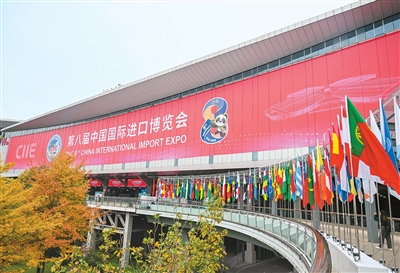
Core Insights - The eighth China International Import Expo (CIIE) has set a new record with over 4,100 foreign enterprises participating, showcasing more than 43 million square meters of exhibition space, highlighting the event's growing global significance [3][4][7] Group 1: Event Overview - The CIIE, initiated in 2018, is the world's first national-level expo focused on imports, attracting participants from 155 countries and regions this year [3] - The cumulative intended transaction amount from the first seven CIIEs exceeded $500 billion, with around 3,000 new products, technologies, and services displayed [4][5] Group 2: Company Participation and Achievements - New Zealand's Fonterra has seen its fresh milk sales in China grow over 20 times, from 3,000 bottles per week to a peak of 80,000 bottles, attributing this success to its participation in the CIIE [4] - Schneider Electric has showcased its innovations in digital technology and ecological cooperation, emphasizing its commitment to the Chinese market [5] - Bayer announced the establishment of its first global venture capital platform in China, with a planned investment of 750 million RMB in a new health consumer goods supply center [6] Group 3: Market Trends and Opportunities - The CIIE serves as a platform for international exchanges and trade cooperation, with Norway's seafood exports to China increasing significantly, exemplified by a 116% rise in salmon exports [9] - The event has attracted six guest countries this year, including Nigeria and Sweden, which are promoting their unique products to the Chinese market [10] Group 4: Innovation and Consumer Engagement - Estee Lauder introduced innovative skin detection technology at the CIIE, showcasing over 100 new products across various categories [8] - IKEA has redefined its brand positioning in China, aiming to co-create meaningful moments with consumers through its participation in the expo [8]

国际家居零售(01373)11月3日斥资11.85万港元回购15万股
智通财经网· 2025-11-03 09:03
智通财经APP讯,国际家居零售(01373)发布公告,于2025年11月3日斥资11.85万港元回购15万股股份。 ...
美凯龙主业“止血”:经营现金流净额回正毛利率大幅提升降本增效进入兑现期
Xin Lang Cai Jing· 2025-11-03 03:06
Core Viewpoint - Meikailong reported a significant net loss of 3.143 billion yuan in the first three quarters of 2025, attributed to the downturn in the real estate market and weakened demand in the home retail sector, despite positive cash flow and improved gross margins [1][2] Financial Performance - In the first three quarters of 2025, Meikailong achieved operating revenue of 4.969 billion yuan and a net loss of 3.143 billion yuan [1] - The company's operating cash flow was 643 million yuan, marking two consecutive quarters of positive cash flow [1][2] - Financial expenses decreased by 187 million yuan year-on-year, while credit impairment losses and asset impairment losses also saw reductions [2] - By the end of September, Meikailong's cash reserves reached 3.744 billion yuan, with short-term borrowings and current liabilities down by 3.277 billion yuan compared to the end of the previous year [2] Business Strategy and Transformation - Meikailong has initiated a transformation to become a comprehensive subsidy platform covering multiple categories, including home appliances, 3C products, smart home, and building materials [3] - The company has implemented a "3+Star Ecosystem" strategy, focusing on home-related sectors to create new growth opportunities [3] - The overall occupancy rate of Meikailong's self-operated malls reached 84.72% by the end of September, reflecting improvements in operational efficiency [4] Operational Improvements - The company has successfully reduced sales and management expenses, with sales expenses down by 18.05% and management expenses down by 19.92% year-on-year [2] - Meikailong's business segments, including high-end appliances and home design services, have shown significant growth, with high-end appliances becoming one of the fastest-growing segments [3][4] - The company has expanded its operational footprint in the automotive sector, covering 44 cities nationwide [4]
美凯龙主业“止血”:经营现金流净额回正 毛利率大幅提升降本增效进入兑现期
Xin Lang Cai Jing· 2025-11-03 02:51
Core Insights - The company reported a significant net loss of 3.143 billion yuan in the first three quarters of 2025, primarily due to short-term market fluctuations and value adjustments, but this does not affect cash flow and operational capabilities [1][2] - Despite the overall industry downturn, the company's main business has started to stabilize, with positive operating cash flow for two consecutive quarters and a substantial increase in gross profit margin [1][3] Financial Performance - The company's operating revenue for the first three quarters was 4.969 billion yuan, with a net loss of 3.143 billion yuan [1] - The net cash flow from operations was 643 million yuan, marking two consecutive quarters of positive cash flow [2] - The company experienced a fair value loss of approximately 3.33 billion yuan from investment properties and total impairment losses of about 170 million yuan [2] Cost Management and Efficiency - The company has implemented cost reduction and efficiency improvement measures, resulting in a significant increase in gross profit margin [3] - Sales expenses decreased by 18.05% to 618 million yuan, management expenses decreased by 19.92% to 600 million yuan, and financial expenses decreased by 10.23% to 1.642 billion yuan [3] Business Strategy and Transformation - The company is transitioning from a traditional home furnishing market to a comprehensive subsidy platform covering multiple categories, including home appliances and smart home products [5][6] - The "3+ Star Ecosystem" strategy focuses on expanding into home appliances, home decoration, and other lifestyle sectors, creating new growth opportunities [6] - The company has established a design service network with 73.1 million square meters of M+ design centers and partnerships with over 5,000 designers [6] Market Position and Future Outlook - The overall occupancy rate of the company's self-operated malls increased by 1.7 percentage points to 84.72% by the end of September [7] - The company has built unique operational efficiencies and consumer demand databases, positioning itself well for future recovery as consumer spending rebounds [7]
高盛:消费疲软蔓延至美国中产阶层 市场担忧加剧
Huan Qiu Wang Zi Xun· 2025-11-02 01:17
Group 1 - The market discussion regarding consumer health is shifting, with more companies reporting a slowdown in consumption that is now affecting middle-income groups, particularly consumers aged 25-35 [1][3] - Kraft Heinz has significantly lowered its full-year sales guidance, expecting a decline of 3% to 3.5%, citing one of the worst consumer confidence levels in decades [3] - Chipotle's stock plummeted by 17% as it noted a decrease in spending frequency among lower-middle-income customers, especially those earning under $100,000 and aged 25-34 [3] Group 2 - Goldman Sachs identified three alarming trends: an increase in the number of companies reporting consumption slowdowns, the spread of this weakness to middle-income groups, and a sharp decline in stock prices over the past two weeks [3] - Non-essential consumer goods sector has underperformed the market by 500 basis points, while essential goods sector lagged by 750 basis points in the last two weeks [3] - Companies that failed to meet earnings expectations faced severe market punishment, and even those that exceeded expectations did not receive positive reactions [3] Group 3 - In contrast, companies targeting the high-end market or those with scale advantages are performing steadily, with Visa reporting consistent growth across all spending categories [4] - Starbucks indicated a positive growth in transaction volume in September, while Brinker International's Chili's brand achieved sales growth across all income levels [4]