石油开采

Search documents
拉美,变天了!
Xin Lang Cai Jing· 2026-01-03 12:01
转自:刘晓博说财经 据央视新闻报道:当地时间1月3日,美国总统特朗普称,美方已成功对委内瑞拉实施打击,抓获委内瑞 拉总统马杜罗及其夫人,并带离委内瑞拉。 此次逮捕马杜罗的行动由美军三角洲特种部队执行。 除了石油之外,委内瑞拉还有丰富的天然气、铝土矿、铁矿和黄金等资源。地理位置也非常重要,这里 是美国后院,距离特朗普的家海湖庄园直线距离只有1800公里,中间隔着不服美国的古巴。 近年来,委内瑞拉和中国、俄罗斯的关系走得比较近。 美国和委内瑞拉已僵持了一段时间,对委内瑞拉进行了海上封锁,并逼迫委内瑞拉总统下台,但条件一 直没谈拢。近日启动了地面行动,没想到竟然戏剧性的轻而易举抓捕了委内瑞拉总统。 美国之所以对委内瑞拉动手,除了要控制其石油资源,还是基于其清理门户、控制整个美洲的战略需 求。 根据公开资料,委内瑞拉已探明石油储量约3030亿桶,中资参与区块(奥里诺科重油带、马拉开波湖 等)对应储量约200-300亿桶,占委总储量约6%-10%。 委内瑞拉是拉丁美洲国土面积和人口总量都排第六的国家,其国土面积约91万平方公里,人口大约2800 万。更重要的是,委内瑞拉是目前探明石油储量最多的国家,以微弱的优势超过了沙 ...
宁静于内,从容于外:25年投资总结及26年展望
雪球· 2026-01-03 03:46
Core Viewpoint - The article reflects on the investment strategies and market outlook for 2026, emphasizing a balanced approach between offense and defense, and the importance of fundamental analysis in stock selection [2][3][14]. Investment Performance - In 2025, the overall account achieved a 51% return, with A-shares contributing 55%-60% and Hong Kong stocks 40%-45% of total assets. The A-share portfolio rose by 72%, while the Hong Kong portfolio increased by 28% [2]. Market Outlook for 2026 - The market is expected to experience both opportunities and risks, with significant stock price volatility anticipated. Companies with sustained performance and validated growth logic may face less volatility, while those failing to meet expectations could see larger fluctuations [3]. - The article suggests that sectors like real estate and consumer goods, which underperformed in 2025, may not present significant opportunities in 2026 due to the slow nature of economic cycles [3]. Investment Strategy - The investment strategy should focus on fundamental analysis, considering long-term operational barriers, cash flow, growth potential, and dividend policies. Economic cycles will influence company performance and valuation [3]. - The article highlights the importance of asset allocation during economic cycles, recommending inflationary assets while avoiding deflationary ones during the current Kondratiev wave downturn [3]. Sector-Specific Insights - The article discusses successful investments in copper-related companies, with a focus on specific stocks like藏格矿业, which became a major profit source. The outlook for this sector remains positive, though growth may not match the previous year's performance [4]. - Alibaba is noted as a significant holding, with expectations for stable growth in its core business and potential in AI-related sectors. Tencent's position was reduced due to concerns over its growth potential [5]. - Long-term utility stocks like长江电力 and华能水电 are viewed as stabilizers in the portfolio, despite their limited short-term profitability [6]. - The article mentions the potential for recovery in companies like北京首都机场, with expectations for profitability in 2026 [9]. Cash Position and Risk Management - The article suggests increasing cash positions in 2026 to manage potential market volatility, contrasting with the full investment strategy of 2025 [15].


中国海油:巴西Buzios6项目投产
Zheng Quan Shi Bao Wang· 2026-01-03 03:24
Core Viewpoint - China National Offshore Oil Corporation (CNOOC) announced the successful production launch of the Buzios 6 project in Brazil, marking a significant milestone in the development of the world's largest deepwater saltwater oil field [1] Group 1: Project Details - The Buzios oil field is located in the Santos Basin in southeastern Brazil and is the seventh project to be launched in this field [1] - The Buzios 6 project utilizes a Floating Production Storage and Offloading (FPSO) unit combined with a subsea production system, deploying a total of 13 development wells, including 6 production wells and 7 injection wells [1] - Following the launch of the Buzios 6 project, the total production capacity of the Buzios oil field will reach 1.15 million barrels per day [1] Group 2: Technical Specifications - The FPSO used in the Buzios 6 project has a design capacity for processing 180,000 barrels of crude oil per day and 7.2 million cubic meters of natural gas per day, with a storage capacity of 2 million barrels [1] - To enhance environmental performance, the FPSO incorporates decarbonization technologies such as a closed flare system and heat recovery technology, which contribute to reducing greenhouse gas emissions and facility energy consumption [1] Group 3: Ownership Structure - CNOOC Petroleum Brasil Ltda., a wholly-owned subsidiary of CNOOC, holds a 7.34% stake in the integrated development project of the Buzios oil field [1] - The operator, Petrobras, holds an 88.99% stake, while CNODC Brasil Petróleo e Gás Ltda. holds a 3.67% stake in the project [1]

中企参建巴西布济乌斯油田六期项目投产
Xin Hua She· 2026-01-03 03:08
Core Viewpoint - The Buzios Phase VI project, co-developed by China National Offshore Oil Corporation (CNOOC) and Brazil's Petrobras, is set to commence production on December 31, 2025, significantly enhancing Brazil's oil and gas output [1] Group 1: Project Details - The Buzios Phase VI project is located in the Santos Basin, with operational water depths ranging from 1,900 to 2,200 meters [1] - The project utilizes a "floating production storage and offloading unit + subsea production system" for deepwater saltwater development [1] - The designed daily crude oil production capacity is approximately 25,000 tons, while the natural gas processing capacity is 7.2 million cubic meters per day [1] Group 2: Impact on Production Capacity - With the launch of Phase VI, the total daily production capacity of the Buzios oil field will exceed 1.15 million barrels [1] - The project is expected to significantly contribute to Brazil's overall oil and gas production capabilities [1] Group 3: Technological and Environmental Aspects - The floating production storage and offloading unit incorporates energy-efficient technologies such as heat recovery and closed flaring systems, enhancing energy utilization efficiency and reducing carbon emissions [1] - The project exemplifies successful collaboration between China and Brazil in the development of ultra-deepwater oil fields, aligning resource development with technological innovation and green low-carbon transformation [1]

一图详解|你不知道的石油特别收益金
蓝色柳林财税室· 2026-01-02 14:45
欢迎扫描下方二维码关注: 别收益金划转至税务部门征收。 @浙江脱贫 凡在中华人民共和国陆地领域和所辖海 域独立开采并销售原油的企业,以及在上述 领域以合资、合作等方式开采并销售原油的 其他企业(以下简称合资合作企业),均应当 按规定缴纳石油特别收益金。 中外合作油田按规定上缴国家的石油增 值税、矿区使用费、国家留成油不征收石油 特别收益金。 | 计征依据和标准 | 《《 石油特别收益金征收实行 5级超额累进 从价定率 量征。征收比率按石油开采企业 销售原油的月加权平均价格确定。 为便于参照国际市场油价水平,原油价 格按美元/桶计价,起征点为65美元/桶。具 体征收比例及速算扣除数如下: | 原油价格 (美元/糖) | 征收比率 | 速算扣除数 (美元/桶) | | --- | --- | --- | | 65-70(含) | 20% | 0 | | 70-75(含) | 25% | 0.25 | | 75-80(含) | 30% | 0.75 | | 80-85(含) | 35% | 1.5 | | 85以上 | 40% | 2.5 | 石油特别收益金= 158 117 计算石油特别收益金时, 原油吨桶比按石 ...

2025年度牛股出炉!沪指年度收盘创近18年新高
Zheng Quan Shi Bao Wang· 2026-01-02 00:43
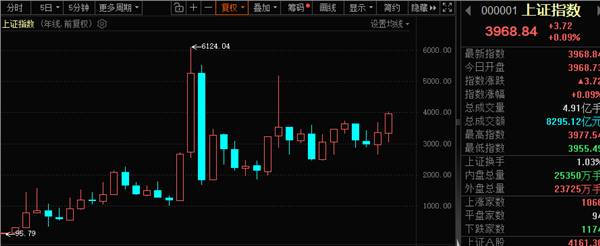
Group 1 - The Shanghai Composite Index closed at 3968.84 points, achieving an 11-day consecutive rise and marking the second highest annual closing in history, only behind 2007, and the highest in nearly 18 years [1] - Major A-share indices saw annual growth rates with the Shanghai Composite Index, Shenzhen Component Index, and CSI 300 Index increasing by 18.41%, 29.87%, and 17.66% respectively, while the ChiNext Index and Sci-Tech 50 Index rose by 49.57% and 35.92% respectively [3] - The total market capitalization of A-shares exceeded 108 trillion yuan, setting a new historical high, with seven stocks surpassing 1 trillion yuan in market value, led by Agricultural Bank of China at 2.45 trillion yuan [4] Group 2 - A total of 540 stocks in the A-share market have doubled in value this year, with Weiwei New Materials (688585) leading the gains with an increase of 1820.29%, driven by market enthusiasm following the acquisition by Zhiyuan Robotics [4] - Other notable gainers include *ST Yushun, *ST Yazhen, Shenghong Technology, Feiwo Technology, and Filinger [6] - Tianpu Co., Ltd. ranked second in annual growth with a cumulative increase of 1645.35% [7]






美国突然宣布:制裁!
Zheng Quan Shi Bao· 2026-01-01 07:14
Group 1 - The U.S. Treasury Department's Office of Foreign Assets Control (OFAC) announced sanctions against four companies operating in Venezuela's oil sector and froze four related oil tankers [1] - Since December 10, 2025, the U.S. has conducted at least three interception operations against oil tankers near Venezuela, claiming to seize crude oil onboard [1] - The U.S. State Department and Treasury announced sanctions against a total of 10 entities and individuals from Iran and Venezuela, citing Iran's ongoing provision of conventional weapons to Venezuela as a threat to U.S. interests [1] Group 2 - U.S. officials stated that Iran is actively proliferating its combat drones and violating UN restrictions while continuing to procure missile-related items [2] - The U.S. military conducted strikes against two so-called "drug boats," resulting in the deaths of five individuals onboard, as part of its ongoing military operations in the region [2] - The U.S. Southern Command has not disclosed the locations of these strikes or provided evidence of drug trafficking activities related to the targeted vessels [3]
孤岛化学驱连续25年保持年增油60万吨
Qi Lu Wan Bao· 2026-01-01 02:10
按照行业常规注入规律,区块注聚一年后见效,2—3年进入产量上升期,3—5年为稳定期,6—7年后便 需要转入后续水驱。但孤岛油田的化学驱区块却打破这一惯例,走出一条"突破常规"的道路。 其中,中二北项目堪称典范,从2005年实施注聚开发至今,已第13次延长注入方案,累计注入聚合物溶 液3009万立方米,增油210.8万吨。不仅如此,胜利油田孤岛采油厂15个注聚区块的平均黏度稳定在63.1 毫帕秒,100%符合方案设计指标。 成绩的背后,是孤岛采油厂始终坚持"注聚质量就是产量"目标,以"最少投入、最优质量换取最大驱油 效果"为导向,构建起全方位精准注聚管控体系,让多个注聚区块突破常规开发周期、延长寿命,连续 25年保持年增油60万吨以上,为油田高质量发展注入强劲动能。 在"标准引领、质量至上"理念引领下,注聚技术服务中心率先搭建"两条主线、一个小组、一套机制"的 指标管理体系:以配液指标和注入指标为核心管理主线,技术人员每日将注聚指标绘制成曲线,设定 ±3%的波动预警范围,一旦超出范围立即启动应急联动机制,确保指标管控"不脱轨"。 为将"质量至上"理念落到实处,孤岛采油厂从设备、药剂、跨单位协作、数智化赋能四个关 ...
海洋钻井公司平台拖航跑出“加速度”
Qi Lu Wan Bao· 2025-12-31 13:32
Core Viewpoint - The application of the self-developed "Drilling Platform Stability Calculation Intelligent System" by Victory Oil Engineering Company enhances operational efficiency and safety in high-risk drilling operations [1] Group 1: Technological Advancements - The drilling platform achieved significant operational milestones by completing the positioning of the North 6FB well group five hours ahead of schedule [1] - The intelligent system utilizes DeepSeek artificial intelligence programming to create a visualized stability calculation model based on the platform's structural layout [1] Group 2: Safety and Efficiency - The system establishes a dynamic load distribution framework across the entire platform, dividing it into multiple areas for precise load input [1] - It features robust analytical capabilities, allowing for the comprehensive calculation of operational loads and displaying critical stability parameters such as draft and coordinate positions [1] Group 3: Operational Management - The system enables clear information management for the crew, facilitating specialized and efficient management of platform stability [1] - Key data such as pile stress and ground pressure are calculated, providing essential insights for operational decision-making [1]
【连续报道·报效祖国 建功西部】青春为祖国而燃烧,才最闪亮——本报报道《只有荒凉的沙漠,没有荒凉的人生》引起强烈反响
Xin Lang Cai Jing· 2025-12-31 12:42
GUANGMING RIBAC 2025年12月31日 农历了,日年十 光明网网址:http://www.gmw.cn 国内统一连续出版物号 CN 11-0026 代号 1-16 新年戏曲晚会在京举行 习近平李强赵乐际王沪宁蔡奇丁薛祥李希韩正出席观看 新华社北京12月30日电 2026年 新年戏曲晚会30日晚在国家大剧院举 行。党和围家领导人习近平、李强、赵乐 际、干沪宁、蔡奇、丁薛祥、李希、韩正等 同首都各界群众一起观看演出,喜迎舞 年的到夹 夜色中的国家大剧院流光溢彩,剧 场内暖直融融。19时 45分许,习近平等 党和国家领导人来到晚会现场,全场响 起热刷营官 党和国家有关领导同志,有关部门 负责同志观看演出。 国家主席习近平将发表二〇二六年新年贺 中央广播电视总合所属中央电视台综合频道、新闻频道、中文国际频道、K 知道,中国国际电视合各外语频道,中央人民 播电台,中国国际广播电合,以及人民网、新华网、央视新闻客户端等中央主要新闻媒体所属网站、新媒体平台将准时播出 托 威恩奋进 ·说说我的2025 气更足了 本报记者 刚参加完一场关于工业AI产品开发 步实现研发设计软件国产化,这需要企业 的沙龙,李一帆意 ...