
量子计算

Search documents
中信建投:对AI带动算力需求及应用非常乐观 重点关注稀释制冷机、低温同轴线缆等环节
智通财经网· 2025-11-11 02:58
Group 1 - The AI industry revolution is ongoing, with strong demand for computing power and promising applications [1] - The "14th Five-Year Plan" emphasizes the acceleration of a new round of technological revolution and industrial transformation, implementing the "Artificial Intelligence +" initiative [1] - The telecommunications operators' capital expenditure is expected to decline, but the research on 6G technology has commenced, indicating potential recovery in the future [2] Group 2 - The focus on quantum technology is increasing in both China and the U.S., with significant developments such as NVIDIA's NVQLink for connecting GPUs to quantum processors [3] - The report highlights several companies with investment potential, including Zhongji Xuchuang, Xinyi Sheng, Yuanjie Technology, and others, as key recommendations for 2026 [4]

【科技日报】我国科研团队提出原子量子计算新架构
Ke Ji Ri Bao· 2025-11-11 01:36
Core Insights - The research team from the Chinese Academy of Sciences has made significant advancements in neutral atom quantum computing by proposing and experimentally validating a new architecture based on fiber arrays, addressing the challenges of achieving high parallelism, speed, and stability in atomic control [1][2]. Group 1: Research Achievements - The team successfully trapped 10 single atoms in a light trap formed by a fiber array, demonstrating high-fidelity "arbitrary single-qubit gate" parallel control in a two-dimensional atomic array for the first time [1]. - The observation of the Rydberg blockade effect between two atoms is a key physical foundation for achieving high-fidelity two-qubit gates [1]. Group 2: Technological Innovations - The proposed architecture allocates independent fiber control channels for each qubit, enabling synchronous, high-speed, and precise control of any atom, thus overcoming previous limitations in addressing technology [2]. - This innovation is crucial for advancing neutral atom quantum computing towards the next generation of scalable applications, providing essential technical support for practical quantum computing [2].
我科研团队提出原子量子计算新架构
Ke Ji Ri Bao· 2025-11-10 23:31
Core Insights - The research team from the Chinese Academy of Sciences has made significant advancements in neutral atom quantum computing by proposing and experimentally validating a new architecture based on fiber arrays, addressing the challenges of achieving high parallelism, high speed, and high stability in addressing control [1][2] Group 1: Research Achievements - The team successfully trapped 10 single atoms in optical traps formed by fiber arrays, demonstrating high-fidelity "arbitrary single-qubit gate" parallel control in a two-dimensional atomic array for the first time [1] - The observation of the Rydberg blockade effect between two atoms is a key physical foundation for achieving high-fidelity two-qubit gates [1] Group 2: Technological Innovations - The proposed architecture allocates independent fiber control channels for each qubit, enabling synchronous, high-speed, and precise control of any atom, marking a breakthrough in atomic addressing technology [2] - The architecture resolves the contradiction between high precision and high efficiency in single-atom control, providing critical technical support for the next generation of scalable applications in neutral atom quantum computing [2] Group 3: Industry Context - Neutral single-atom arrays are considered one of the most promising platforms for large-scale, fault-tolerant quantum computing due to their scalability, high-fidelity gate operations, long coherence times, and reconfigurable connectivity [1] - The efficiency and precision of single-atom control directly influence the practical advancement of quantum computing in the NISQ (Noisy Intermediate-Scale Quantum) era [2]
12个月涨超1900%,“量子妖股”远超“AI妖股”
美股IPO· 2025-11-10 07:05
量子计算概念股的市场狂热正在上演。以Rigetti和D-Wave为首的公司,在几乎没有收入和实际应用的情况下,股价于12个月内一度暴涨1900%,市值 突破百亿美元。这一现象引发了市场关于"下一个颠覆性技术"与"投机泡沫"的激烈辩论。 以Rigetti Computing Inc.和D-Wave Quantum Inc.为代表的量子计算公司,在过去12个月里股价一度飙升超过1900%,表现远超许多热门人工智能股 票,成为市场中最具争议的投机热点。 这一惊人涨幅使两家公司的市值双双突破100亿美元,甚至远超AI明星公司Palantir,也超过了金宝汤公司(Campbell's Co.)等老牌企业。然而,它们目 前几乎没有实际应用,且预计未来数年都无法产生可观收入,现金消耗巨大。 市场对此看法两极分化。多头认为,量子计算有望解决从疾病治疗到气候变化等重大问题,是不容错过的下一个颠覆性技术。而空头则警告称,这只是 一个由投机情绪驱动、缺乏基本面支撑的泡沫,注定将会破灭。 在人工智能热潮之后,资本市场正将目光投向量子计算这一更具想象空间的领域。 泡沫担忧并非空穴来风。据彭博汇编数据,Rigetti的估值超过其远期销售 ...


八方股份20251109
2025-11-10 03:34
Summary of Key Points from the Conference Call Company Overview - **Company**: 八方股份 (Bafang) - **Core Business**: The core business of Bafang is the mid-drive and hub motors for electric bicycles (eBikes) [4][2]. Industry Insights - **Market Demand**: Bafang benefits from the demand in the European market, despite experiencing a destocking cycle from 2023 to 2024. A new replenishment cycle is expected to begin in the second half of 2025 [2][6]. - **Global eBike Penetration**: The global eBike penetration rate is relatively low, with Europe at approximately 30%, while the US and Japan are below 10%. The overall global penetration rate is around 18% [7][2]. - **Market Concentration**: The eBike market is highly concentrated, with Bafang, Bosch, and Shimano holding over 50% of the European market share [8][2]. Company Performance - **Market Share**: Bafang's market share in Europe is approximately 25%, influenced by industry inventory fluctuations [9][2]. - **Financial Performance**: In Q3 2025, Bafang achieved a revenue of 391 million yuan, representing an 18% year-on-year growth. The net profit attributable to the parent company reached 35 million yuan, a 235% increase quarter-on-quarter, exceeding expectations and leading to a stock price increase of over 20% [3][2]. Future Outlook - **Growth Potential**: Bafang is expected to further increase its market share due to its brand strength, design customization, and maintenance capabilities. The rising proportion of mid-drive motors is anticipated to improve the overall gross margin of the company [10][2]. - **Profit Projections**: The company is projected to achieve a net profit of around 100 million yuan in 2025, with optimistic estimates reaching 200 million yuan in 2026, corresponding to a current valuation of approximately 35 times [10][2]. Quantum Computing Insights - **Industry Support**: Major economies are increasing policy support for the quantum computing industry. The US has raised its funding for quantum initiatives to $2.7 billion for the fiscal years 2025-2029, while China has prioritized quantum technology as a strategic frontier [15][2]. - **Market Size**: The upstream core device market for quantum computing is expected to reach $250 billion by 2035 [5][2]. - **Technological Development**: Various quantum technology routes are being explored, with superconducting technology slightly ahead in commercialization progress [13][2]. Additional Considerations - **Domestic Competition**: In the context of export controls from the US, China is accelerating domestic replacements for key quantum computing equipment, creating a competitive landscape [16][2]. - **Application Directions**: Downstream applications are transitioning from laboratory settings to industry practices, focusing on quantum simulation, optimization problems, and linear algebra applications [21][2].

全球第一!中国占比达60%
Xin Lang Cai Jing· 2025-11-09 23:24
Core Insights - The reports highlight the continuous optimization and upgrading of China's information infrastructure, with significant growth in the digital economy and expansion of the digital culture industry [1][2] Group 1: Internet Development - As of June 2025, the total number of fixed broadband access users in China reached 684 million, with 4.55 million 5G base stations built and 1.118 billion 5G mobile phone users [1] - The number of IPv6 internet active users reached 834 million, accounting for over 75% of total internet users [1] Group 2: Digital Economy Growth - China's digital economy is developing steadily and deeply, with highlights in digital industrialization and ongoing digital transformation [1] - The quantum computing industry is expected to exceed 11.56 billion yuan in 2025, with a year-on-year growth of over 30%, representing 41.2% of the overall quantum technology industry [1] - China holds 60% of global artificial intelligence patents, and 6G patent applications account for approximately 40.3% globally, ranking first [1] Group 3: E-commerce and Digital Culture - By December 2024, the number of online shopping users in China is projected to reach 974 million, making up 87.9% of the total internet users, with online retail sales growing by 7.2% [1] - China has maintained its position as the world's largest online retail market for 12 consecutive years [1] - The digital culture industry has entered the "trillion-level" scale, with revenue from large-scale cultural and related enterprises reaching 14.15 trillion yuan in 2024, a year-on-year increase of 6% [2] - The digital culture industry, including micro-short dramas, "guzi economy," cloud performances, digital games, and digital reading, continues to thrive and expand [2]
每一次突破,都在为未来铺路(院士新语)
Ren Min Ri Bao· 2025-11-09 22:20
Group 1 - The research and development of topological materials are driven by innovative thinking and rigorous empirical methods, emphasizing the importance of collaboration between theoretical research, material preparation, and experimental detection [1][2][3] - The theoretical prediction of Weyl semimetals by the Chinese Academy of Sciences in 2014 laid the groundwork for subsequent research, highlighting the critical challenge of high-quality material preparation for accurate experimental analysis [1][2] - The establishment of advanced experimental platforms, such as the Shanghai Synchrotron "Dream Line," has significantly enhanced the ability to analyze the properties of topological materials [1][3] Group 2 - The focus has shifted towards the promising field of topological quantum computing, particularly in developing topological qubits based on Majorana zero modes, with strong evidence found in iron-based superconductors [2][3] - The integration of multiple disciplines, including materials science and computer science, is becoming increasingly important in the research of topological quantum bits, facilitating advancements in purity, stability, and quantum control algorithms [2][3] - The collaborative approach in scientific research is emphasized, where data from experiments feed back into theoretical calculations, guiding further experimental and material preparation efforts [3] Group 3 - The ongoing development of topological materials and quantum computing aims to enhance China's international standing in the field and contribute to the advancement of related sectors [3] - Breakthroughs in the research of topological qubits are expected to usher in a new phase of quantum computing, with each scientific advancement paving the way for future developments [3]
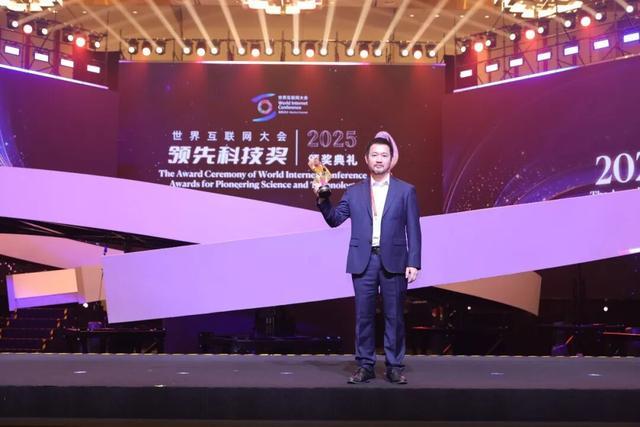
无锡“芯光”,拿下世界互联网大会最高奖!
Huan Qiu Wang Zi Xun· 2025-11-09 11:54
Core Viewpoint - The Shanghai Jiao Tong University Wuxi Photonic Chip Research Institute (CHIPX) and Turing Quantum have won the "Leading Technology Award" at the World Internet Conference for their project on "Key Technologies and Applications of Practical Large-Scale High-Speed Programmable Photonic Quantum Computing Chips," marking a significant international breakthrough in China's photonic quantum computing chip technology [3]. Group 1 - The award is the first in the quantum computing field since the establishment of the Leading Technology Award, highlighting the global recognition of China's advancements in photonic quantum computing [3]. - The award is considered a benchmark for global technological innovation, evaluated by a committee of top experts and academicians from multiple countries [3]. - CHIPX's achievement establishes its leading position in the global quantum technology industrialization process, having overcome key technical bottlenecks and built a fully controllable system [3]. Group 2 - Quantum computing is recognized for its exponential parallel processing capabilities, representing a disruptive technology that surpasses classical computing limits, with photonic quantum computing being the most promising route [5]. - CHIPX has established China's first pilot line for photonic chips, achieving a complete technical closed loop from chip design to system integration, making photonic quantum computers industrial-grade products [5]. - The development cycle for photonic quantum chips has been reduced from six months to two weeks, improving research efficiency by over ten times and addressing system stability issues [5]. Group 3 - The commercial photonic quantum computer developed by Turing Quantum and CHIPX features over 100 quantum bits and can enhance problem-solving efficiency in fields like chemistry, biology, and finance by over a thousand times [5]. - Their hybrid intelligent computing solution integrates quantum computing into classical computing processes, providing robust computational support across various industries, with successful applications demonstrated in aerospace, biomedicine, and fintech [5]. - Future plans include advancing photonic quantum chips to a universal quantum computing era with millions of quantum bits, aiming to make computational power as accessible as water and electricity [5].
大规模高精度量子化学模拟新范式:字节最新成果入选Nature子刊
机器之心· 2025-11-09 11:48
Core Insights - The article discusses the increasing reliance on computational methods in understanding material properties, particularly in fields like catalysis and clean energy [2] - A new quantum embedding framework, SIE+CCSD(T), has been developed to combine high-precision quantum chemistry with large-scale simulations, enabling accurate studies of complex materials [3][6] Group 1: SIE+CCSD(T) Framework - The SIE+CCSD(T) framework allows for the first time the application of "gold standard" CCSD(T) methods to real material systems containing thousands of electrons and hundreds of atoms [3][6] - This framework achieves linear computational scaling up to 392 atoms, demonstrating significant efficiency improvements through GPU optimization [4][6][15] - The SIE framework can combine different levels of high-precision algorithms, allowing researchers to adjust computational speed and accuracy as needed [6][12] Group 2: Performance and Accuracy - In a system with 392 carbon atoms and approximately 11,000 orbitals, SIE+CCSD(T) achieved "gold standard" accuracy while maintaining near-linear computational efficiency on GPUs [6][16] - The method consistently produced results within ±1 kcal/mol of experimental data across various real systems, indicating its reliability and potential as a universal tool [21][24] - The framework successfully reconciled results from different boundary conditions in large systems, showing convergence in adsorption energy for water on graphene [25] Group 3: Implications for Surface Chemistry - The study revealed that water molecules do not exhibit a preferred orientation when adsorbed on graphene, providing important insights for applications in blue energy and water desalination [24][26] - The SIE+CCSD(T) framework addresses the limitations of traditional quantum chemistry methods, enabling accurate simulations of surface chemistry at a larger scale [8][26] - The findings contribute to a better understanding of molecular adsorption on surfaces, which is critical for material design and surface mechanism exploration [26]

苏州市327个创新联合体激活产业升级新动能
Su Zhou Ri Bao· 2025-11-08 00:37
Core Insights - Suzhou's innovation consortiums have achieved significant breakthroughs in high-temperature superconducting materials and dual-target weight loss drugs, marking a strong step towards technological self-reliance and innovation [1][4] - The city has established 327 innovation consortiums, leading the province in quantity, which includes collaborations with 1,268 leading enterprises and 264 research institutions [2][3] Group 1: Innovation Achievements - The innovation consortiums have developed AI-driven mass production processes for high-temperature superconducting materials, achieving full-chain autonomy in nuclear magnetic resonance magnets [1] - The consortiums have also created the world's first dual-target weight loss drug, marking a significant milestone in the pharmaceutical industry [1] - Notable projects include the development of domestically produced high-temperature superconducting materials and the discovery of new treatment targets for colorectal cancer [4] Group 2: Collaborative Ecosystem - Suzhou's innovation consortiums operate under a "group army" model, integrating leading enterprises, research institutions, and universities to tackle key technological challenges [2] - The city has established a comprehensive internal circulation system that spans from technology research to project incubation and industrial cultivation [2] - Eight benchmark innovation consortiums have been recognized for their collaborative efforts, serving as models for industry-wide innovation [2] Group 3: Economic Impact - The innovation consortiums are expected to drive over 10 billion yuan in R&D investments and facilitate the application of over 1,000 core technologies [4] - Specific consortiums have reported significant economic benefits, such as a semiconductor laser consortium generating 2 billion yuan in R&D investments and a projected 50 billion yuan in revenue from a robotics consortium [5] Group 4: Future Development - Suzhou aims to deepen the development of innovation consortiums by enhancing collaboration, resource sharing, and establishing platforms for concept validation and pilot testing [6] - The city plans to support the consortiums in undertaking major national scientific tasks and promoting successful experiences to foster new productive forces [6]