
ETF

Search documents
科技龙头上调全年资本开支目标,人工智能需求持续强劲,恒生科技ETF(513130)深度布局AI产业链有望受益
Mei Ri Jing Ji Xin Wen· 2025-10-18 20:21
Group 1 - The Hong Kong stock market experienced a decline, particularly in the technology sector, with the Hang Seng Tech ETF (513130) recording a trading volume of 6.271 billion HKD and a turnover rate of 15.88% as of 14:21 on October 17, 2025 [1] - Despite the volatile international situation since October 2025, there has been a significant net inflow of southbound funds, amounting to 38.786 billion HKD for the week of October 13-16, 2025, with technology stocks being a key focus for investment [1] - Year-to-date, the net inflow of southbound funds has exceeded 1.2 trillion HKD, setting a new annual record and providing strong momentum for the Hong Kong stock market [1] Group 2 - A leading global semiconductor foundry reported better-than-expected revenue and net profit for Q3 2025, raising its full-year capital expenditure target, which has boosted market optimism regarding the surge in demand for AI chips [1] - Domestic technology companies are actively investing in hard technology and AI, with a reported 380 billion HKD investment in AI infrastructure and a deep collaboration with Nvidia in the Physical AI sector [2] - The Hang Seng Tech ETF (513130) closely tracks the Hang Seng Tech Index, which includes various sectors such as internet platforms, software development, and semiconductor design, positioning it well to capture opportunities in the AI industry [2] Group 3 - The Hang Seng Tech ETF (513130) is recognized as a preferred investment tool for the Hong Kong technology sector, with over 220,000 account holders as of the latest mid-year report [3] - The ETF offers advantages such as large scale, good liquidity, T+0 trading support, and low fees, making it a valuable instrument for investors looking to allocate to core technology assets in Hong Kong [3]
3 Reasons the Vanguard S&P 500 ETF Could Be Your Best Investment Right Now
The Motley Fool· 2025-10-18 07:55
Core Insights - The article emphasizes that investing in the Vanguard S&P 500 ETF (VOO) is a straightforward and effective way to gain exposure to the U.S. stock market, particularly for those who prefer a passive investment strategy [1][4]. Investment Performance - The S&P 500 has delivered an average annual return of approximately 10% since its inception in 1957, with a $10,000 investment in the original Vanguard S&P 500 Index Fund growing to $2.23 million today [2]. - The Vanguard S&P 500 ETF, launched in 2010, has seen a $10,000 investment grow to $79,400 with reinvested dividends [3]. Advantages of VOO - **Instant Diversification**: VOO provides exposure to the 500 largest U.S. companies, with top holdings including Nvidia (7.95%), Microsoft (6.73%), Apple (6.60%), and Amazon (3.72%). Information technology stocks represent 34.8% of the index [5][6]. - **Low Fees**: VOO has a low expense ratio of 0.03%, significantly lower than the average expense ratio of 0.74% for similar ETFs and 1.5% for hedge funds [7][8]. - **Dollar Cost Averaging**: The S&P 500 has historically rebounded from recessions, and dollar-cost averaging can help mitigate the impact of market volatility by spreading investments over time [9][10][11].
The Nasdaq Is Doing Something Seen 7 Times Since 1990. History Says the Stock Market Will Make a Big Move in 2026.
Yahoo Finance· 2025-10-18 07:45
Core Insights - The Nasdaq Composite has entered its seventh bull market since 1990, typically defined as a 20% increase from the previous bear market low, reaching a new record high [3][5] - Historically, the Nasdaq Composite has returned an average of 281% during bull markets, achieving these returns over an average of 1,817 days, or approximately five years, with an annual compounding rate of 33% [1][6] - The current bull market began on April 8, 2025, and the Nasdaq has gained 49% in the six months since then, with historical trends suggesting it could advance another 232% over the next four-and-a-half years [9] Nasdaq Composite Overview - The Nasdaq Composite is one of the three major U.S. stock market indexes, measuring the performance of about 3,300 companies, heavily weighted towards technology (64%) and consumer discretionary (17%) sectors [4] - The Invesco QQQ ETF provides exposure to the 100 largest nonfinancial companies in the Nasdaq Composite, returning 15.6% annually over the last two decades [6][11] Historical Context - The bull market that began in October 2002 lasted nearly 16 years, despite the index not reaching a new high until April 2015, following the dot-com bubble burst in 2000 [7][8] - The Nasdaq peaked in March 2000 and fell 78% by October 2002, marking the start of a new bull market, although it did not officially enter a bear market during the Great Recession [8] Future Projections - Based on historical averages, the Nasdaq is expected to advance 31% in 2026 if it aligns with past performance [9] - The Invesco QQQ ETF has returned 1,740% over the last two decades, compounding at 15.6% annually, with expectations for similar returns in the future, particularly due to the AI boom [11][12]
The Dip Investors Were Waiting for May Have Arrived
Etftrends· 2025-10-16 13:16
Core Viewpoint - The recent market downturn, particularly in the Nasdaq-100 and S&P 500, was driven by President Trump's threat of 100% tariffs on China, resulting in significant losses for major tech ETFs like QQQ and QQQM, which collectively lost $770 billion in market capitalization in one session [1]. Group 1: Market Reaction and Opportunities - Despite the sharp decline, experts suggest that this may not indicate a bear market or a full correction, and could present buying opportunities for investors [3]. - Investors who are under-allocated to equities are encouraged to phase in and utilize market dips to increase exposure to preferred sectors, particularly in structural growth themes like AI [4][7]. - The chief investment office of UBS highlights U.S. tech stocks as a preferred investment area, which is significant for QQQ and QQQM given their substantial exposure to the tech sector [5]. Group 2: Investment Strategies - A disciplined approach to gradually increasing stock exposure or balanced portfolios may help mitigate risks associated with poor timing and emotional decision-making, while also capitalizing on market dips and rebounds [6]. - UBS believes that lower interest rates, strong earnings growth, and AI trends will support further gains in global equities over the next year, reinforcing the case for investors to consider increasing their stock allocations [7].


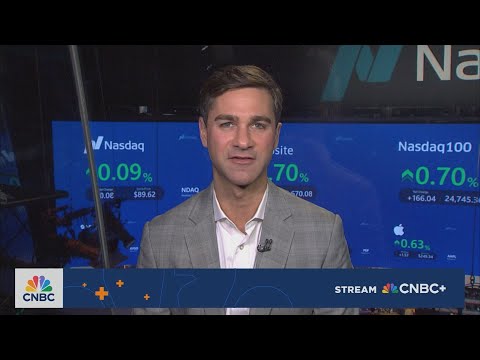
Jacobs: This is a global trend with tremendous momentum in the ETF industry
CNBC Television· 2025-10-16 12:04
ETF Market Trends - ETF flows are experiencing a global surge, with record-breaking performance in the first half and Q3 of the year [1][2] - The growth is broad-based, spanning across various asset classes, including digital assets, active strategies, and index funds [2] - Actively managed ETFs are gaining traction, accounting for approximately 37% of inflows this year, compared to just over 25% last year [3] Investor Preferences - Investors seek alpha, tax efficiency, and liquidity in actively managed ETFs [5][6][7] - Investors are looking for yield and moving into short-term government bond ETFs to capture higher returns compared to holding cash [12] - Investors are showing interest in growth and income strategies, including outcome ETFs that offer upside potential with income [9][10] Specific ETF Flows - Digital asset ETFs are experiencing significant momentum and increased accessibility [9] - Short-term treasury ETFs are attracting investors seeking yield [11][12] - Some investors are moving away from index funds, with the SPY S&P 500 ETF experiencing net outflows of over $6 billion this year [8] Future Outlook - The industry anticipates continued momentum in digital asset ETFs [9] - Expects growth in growth and income strategies [9] - A potential influx of funds from the $7 trillion sitting on the sidelines in money market funds into the ETF industry is anticipated [12][13]
ETF Prime: Rosenbluth Lifts the Hood on VettaFi's Indexing Engine
Etftrends· 2025-10-15 17:21
Group 1: VettaFi and Indexing Business - VettaFi, formed from the merger of multiple indexing businesses, was recently acquired by TMX Group and now manages over $75 billion in assets across various indices [2] - The company assists clients in product development, offering services such as formalizing rulebooks, conducting backtesting, and evaluating liquidity [2] - Ongoing management and education are essential for partners to differentiate themselves in the crowded ETF market, which has over 4,000 products [3] Group 2: Thematic ETFs and Portfolio Management - Thematic ETFs are becoming increasingly important, with a focus on analyzing portfolio overlap to enhance existing allocations [3] - Key thematic areas attracting investor demand include artificial intelligence and nuclear energy, with advisors typically allocating 5-10% of portfolios to these strategies [3] Group 3: Gold Market Dynamics - Gold prices are driven by strong physical demand from China and central banks, record ETF inflows, and macroeconomic factors such as a weaker U.S. dollar and inflation uncertainty [4] - Gold serves as a portfolio diversifier and can coexist with bitcoin, fulfilling different roles within an investment strategy [4] Group 4: Notable ETFs - Alerian MLP ETF (AMLP) has over $10 billion in assets and recently celebrated its 15-year anniversary [5] - VictoryShares Free Cash Flow ETF (VFLO) is approaching $5 billion in assets despite being less than three years old [5] - The ROBO Global ETF Suite focuses on robotics and artificial intelligence, while the Range Nuclear Renaissance Index (NUKZ) expands VettaFi's thematic indexing in nuclear energy [5]

每日机构分析:10月15日
Sou Hu Cai Jing· 2025-10-15 11:45
Group 1 - Japan's current political uncertainty is unlikely to significantly drag down its bond and stock markets, and may even boost market sentiment in the short term. The long-term impact will depend on the actual effects on economic fundamentals [1] - The U.S. consumer confidence has hit a 27-year low, with 57% of consumers expecting economic weakness in the coming year. This decline in confidence is leading to a 10% reduction in holiday spending plans, with the average budget dropping to $1,595 [2] - The U.S. debt has surpassed $37.8 trillion, with interest payments exceeding $1.2 trillion and a debt-to-GDP ratio of 99.9%. This fiscal vulnerability could worsen if political decisions change or if the economy slows down [3] Group 2 - Singapore's GDP preliminary data for Q3 indicates a slowdown in economic growth, primarily due to weak manufacturing performance, particularly in the electronics sector, which saw a contraction in August [2] - There has been a significant shift of funds from mutual funds to ETFs, with over $1 trillion flowing into U.S. ETFs in 2025 so far, driven by low fees and high liquidity [3] - The market is pricing in a potential interest rate cut to 3% by mid-next year, although further declines in U.S. Treasury yields may be limited without panic triggered by tariffs [3]
ERShares' XOVR ETF Opens the Door to Pre-IPO Stage Investing
Prnewswire· 2025-10-14 13:12
Core Viewpoint - ERShares' Private-Public Crossover ETF (XOVR) is the first ETF to provide investors with exposure at the IPO stage, traditionally reserved for venture capital and institutional investors, as demonstrated by Klarna's recent IPO [1][3][4]. Group 1: ETF Structure and Strategy - XOVR was relaunched on August 30, 2024, combining the Entrepreneur 30 Total Return Index (ER30TR) with selective private equity exposure to capture growth opportunities in both public and private markets [2]. - The ETF allows retail investors to access companies during their private-to-public transition, which was previously unavailable to them [3][4]. Group 2: Performance Metrics - Since its relaunch, XOVR has delivered a total return of +37.2% (with dividends reinvested) from August 30, 2024, to September 30, 2025 [6]. - Comparatively, the S&P 500, Russell 1000 Growth, Nasdaq 100, and Dow Jones have shown returns of +20.1%, +28.9%, +26.9%, and +13.7% respectively during the same period [9]. Group 3: Market Context and Future Outlook - The ETF aims to bridge the gap for retail investors who have been excluded from the wealth creation occurring in private markets before IPOs [7]. - Current holdings include both public and private companies such as SpaceX, Anduril, and Klarna, with expectations for more opportunities as additional private companies approach public markets in late 2025 [8]. Group 4: Management Insights - Eva Ados, COO and Chief Investment Strategist at ERShares, emphasizes the importance of providing retail investors access to the IPO stage, stating that the opportunity for private equity exposure has never been more compelling [4]. - Joel Shulman, Founder and CIO of ERShares, describes XOVR as a breakthrough ETF that allows everyday investors to participate in growth across both private and public markets [5].

Trade Tensions Threaten Market Stability: ETF Strategies to Follow
ZACKS· 2025-10-14 11:40
Core Viewpoint - U.S. stocks may decline by up to 11% if trade tensions between the U.S. and China remain unresolved before the November deadline, driven by high valuations and investor exposure [1][4]. Trade Tensions and Market Impact - U.S. stocks experienced a sharp decline on October 10, 2025, following President Trump's threat of increased tariffs on Chinese goods, citing China's hostility due to new restrictions on rare earth metals [2]. - Beijing has implemented new export restrictions requiring foreign companies to obtain a license for shipping products with over 0.1% rare earth content, effective from December 1 [3]. Market Predictions - Morgan Stanley's chief U.S. equity strategist predicts that continued trade uncertainty could lead the S&P 500 index to fall between 5,800 and 6,027 points, representing an 8-11% decline from the previous close [4]. Investment Strategies - Dividend-paying stocks are recommended as they provide a steady income stream and can mitigate losses during market downturns, with companies known as dividend aristocrats being quality picks [6]. - High-quality dividend stocks, such as those in the Vanguard Dividend Appreciation ETF (VIG), are highlighted for their potential for income and capital appreciation [7]. - Gold is identified as a safe-haven asset, with SPDR Gold Trust (GLD) suggested for investors seeking stability [8]. - Covered call ETFs, like TappAlpha SPY Growth & Daily Income ETF (TSPY) and Global X S&P 500 Covered Call ETF (XYLD), are recommended for generating higher income and reducing volatility, with annual yields of 13.94% and 13.09% respectively [10]. - Low-volatility ETFs, such as iShares MSCI USA Min Vol Factor ETF (USMV) and Invesco S&P 500 Low Volatility ETF (SPLV), are suggested for their potential to outperform the broader market in uncertain environments [11][12]. - Defensive sectors, including consumer staples, utilities, and healthcare, are noted for their resilience to market volatility, with ETFs like Consumer Staples Select Sector SPDR ETF (XLP) and Utilities Select Sector SPDR ETF (XLU) being recommended [13].


【真灼港股名家】担心贵金属纳入特关税名单,金银续创新高
Sou Hu Cai Jing· 2025-10-14 00:27
Group 1: Gold Market Insights - Recent surge in gold prices, reaching historical highs, with expectations for further increases, potentially hitting $5,000 per ounce by 2026 due to a projected 14% rise in investment demand [1] - If investor inflows into gold increase by 30%, prices could rise to $6,000 per ounce [1] - Significant growth in ETF inflows, with a record $14 billion in September, marking an 880% year-on-year increase [1] - Current economic conditions, including rising U.S. fiscal deficits and debt levels, continue to support bullish sentiment for gold as a hedge and diversification tool [1] Group 2: Silver Market Dynamics - Silver prices are benefiting from private investment inflows similar to gold, particularly in the context of Federal Reserve interest rate cuts [2] - Short-term volatility risks for silver are higher than for gold due to the smaller market size and lower liquidity [2] - Record premiums are being paid by investors to secure immediate access to silver, highlighting its scarcity in the London vaults driven by increased speculative demand [3] Group 3: Broader Market Trends - The overall commodity market has strengthened, with precious metals experiencing price increases between 50% to 80% this year [3] - Ongoing geopolitical tensions, such as U.S.-China trade issues and concerns over the independence of the Federal Reserve, are fueling safe-haven demand for precious metals [3] - Potential implications of the U.S. government's investigation into rare metals, including silver, could tighten market supply and provide upward momentum for prices [3]