
仓储和邮政业

Search documents
国家统计局:2025年全年服务业增加值比上年增长5.4%
Di Yi Cai Jing· 2026-01-19 02:10
Group 1 - The core viewpoint of the article indicates that the service industry in China is projected to grow by 5.4% in 2025 compared to the previous year, highlighting a positive trend in various sectors [1] - The information transmission, software, and IT services sector is expected to see the highest growth at 11.1%, followed by leasing and business services at 10.3%, and transportation, warehousing, and postal services at 5.2% [1] - In December, the service production index increased by 5.0% year-on-year, with notable growth in the information transmission, software, and IT services sector at 14.8% [1] Group 2 - The revenue of large-scale service enterprises increased by 7.8% year-on-year from January to November [1] - The service business activity index for December was reported at 49.7, showing a slight increase of 0.2 percentage points from the previous month, while the business activity expectation index rose to 56.4, up by 0.5 percentage points [1] - Specific sectors such as telecommunications, monetary financial services, and capital market services reported business activity indices above 60.0, indicating a high level of economic activity [1]
2025年全国固定资产投资基本情况
Guo Jia Tong Ji Ju· 2026-01-19 02:01
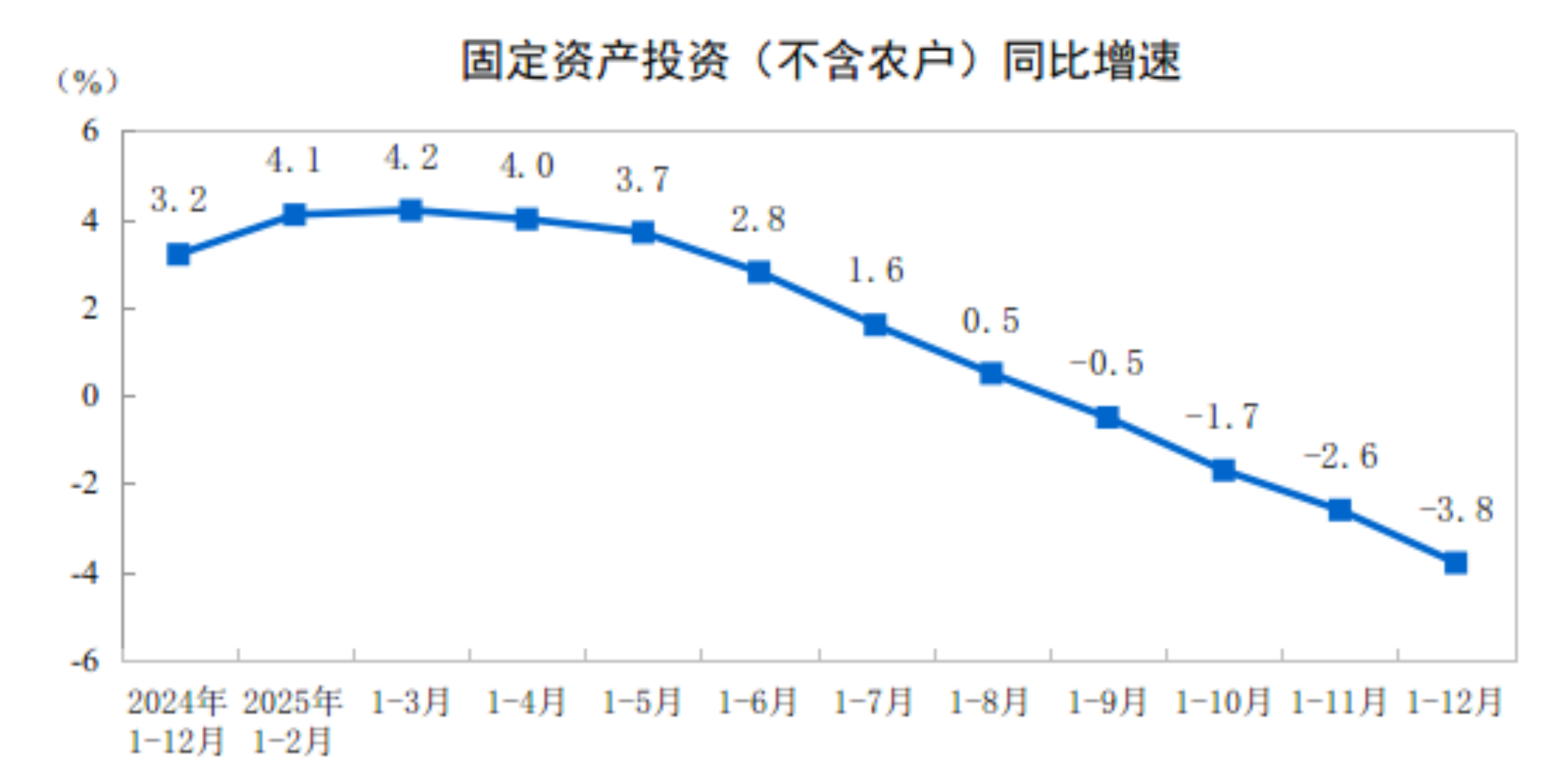
Core Insights - In 2025, China's fixed asset investment (excluding rural households) reached 48,518.6 billion yuan, a decrease of 3.8% compared to the previous year, with private fixed asset investment declining by 6.4% [1][6] Investment by Industry - Investment in the primary industry was 957 billion yuan, showing a growth of 2.3% year-on-year [3] - Investment in the secondary industry totaled 177,368 billion yuan, with a growth of 2.5% [3] - The tertiary industry saw a decline in investment, amounting to 298,248 billion yuan, down by 7.4% [3] Secondary Industry Breakdown - Within the secondary industry, industrial investment grew by 2.6% year-on-year [4] - Mining investment increased by 2.5%, while manufacturing investment grew by 0.6% [4] - Investment in the electricity, heat, gas, and water production and supply industry rose significantly by 9.1% [4] Infrastructure and Regional Investment - Infrastructure investment (excluding electricity, heat, gas, and water production and supply) decreased by 2.2% [4] - Investment in pipeline transportation surged by 36.0%, while multimodal transport and logistics saw a growth of 22.9% [4] - Investment trends varied by region, with the eastern region experiencing an 8.4% decline, the central region down by 2.7%, the western region down by 1.3%, and the northeastern region down by 15.5% [4] Investment by Registration Type - Domestic enterprises' fixed asset investment fell by 3.8%, while investment from Hong Kong, Macau, and Taiwan enterprises decreased by 2.2% [5] - Foreign enterprises saw a significant decline in fixed asset investment, down by 13.8% [5]

出口延续高增长,结构性降息政策出台
Hua Lian Qi Huo· 2026-01-18 13:32
1. Report's Investment Rating for the Industry - No investment rating for the industry is provided in the report. 2. Core Viewpoints of the Report - In December 2025, China's exports continued high - growth, imports rebounded significantly, and the trade surplus expanded. The Fed's January rate - cut probability decreased, and the RMB showed an appreciation trend. The central bank adjusted the structural monetary policy tool rate and commercial real - estate credit policies, aiming to improve capital activation and support the real economy [8][10]. 3. Summary According to Relevant Catalogs 3.1 National Economic Accounting - GDP quarterly data from 2023 to 2025 are presented, showing the performance of different industries, including agriculture, forestry, animal husbandry, fishery, industry, and services. The contribution rates and pulling effects of the three industries on GDP are also provided [13][18]. 3.2 Industry Analysis - **Industrial Sector**: The growth rate, added - value of major industries, and production of key products are analyzed. The profit situation of industrial enterprises shows mixed results, with some industries growing and some declining. The inventory of industrial enterprises is at a relatively high level, and enterprises still have the intention to reduce inventory [28][43][53]. - **Price Index**: In December 2025, the national consumer price index (CPI) increased year - on - year, and the industrial producer price index (PPI) decreased year - on - year but the decline narrowed. The prices of different categories in CPI and PPI showed different trends [60][68]. 3.3 Real Estate Market - In January - November 2025, real estate development investment, construction area, new - start area, completion area, sales area, and sales volume all declined year - on - year. The prices of new and second - hand residential properties in major cities also showed different degrees of decline [122][126][130]. 3.4 Foreign Trade and Investment - In December 2025, China's total import and export volume reached a record high. Exports to ASEAN and the EU increased, while exports to the US decreased. The export of key products and the import of key commodities are presented in detailed tables [93][100][101]. 3.5 Fixed - Asset Investment - From January - November 2025, national fixed - asset investment (excluding rural households) decreased year - on - year. Private fixed - asset investment also declined. Investment in different industries showed different trends, with the second - industry investment growing and the third - industry investment declining [114]. 3.6 Domestic Trade - The growth of service retail sales and social consumer goods retail sales is analyzed, and the year - on - year changes in retail sales of different industries above the quota are presented [158][165]. 3.7 Transportation - The transportation volume of goods and passengers by different means, the subway passenger flow in major cities, and the freight rates of shipping routes are analyzed [168][173][179]. 3.8 Banking and Currency - The new social financing scale, social financing scale stock, new RMB loans, and money liquidity are analyzed. The central bank emphasizes reasonable interest - rate control to promote the decline of the real - economy financing cost [183][194][200]. 3.9 Bond Market - The issuance of interest - bearing bonds and the yields of long - and short - term treasury bonds are analyzed [213][216]. 3.10 Foreign Exchange and Gold - The RMB exchange rate against the US dollar and the US dollar index are presented. China's gold reserves increased, and the foreign exchange reserves reached a new high [220][223]. 3.11 Fiscal and Employment - The central and local general public budget revenues and expenditures are analyzed, and the urban surveyed unemployment rate and new urban employment are presented [232][236][242]. 3.12 Business Climate Survey - The global and Chinese manufacturing and non - manufacturing PMI are analyzed. In December 2025, China's manufacturing PMI returned to the expansion range, and the non - manufacturing business activity index also rebounded [245][248][256]. 3.13 US Macroeconomy - The US real GDP growth rate, employment situation, treasury bond yields, retail sales, and the Fed's asset structure and federal funds rate are analyzed [263][266][274].
2025年1—11月份全国固定资产投资基本情况 - 国家统计局
Guo Jia Tong Ji Ju· 2025-12-29 09:36
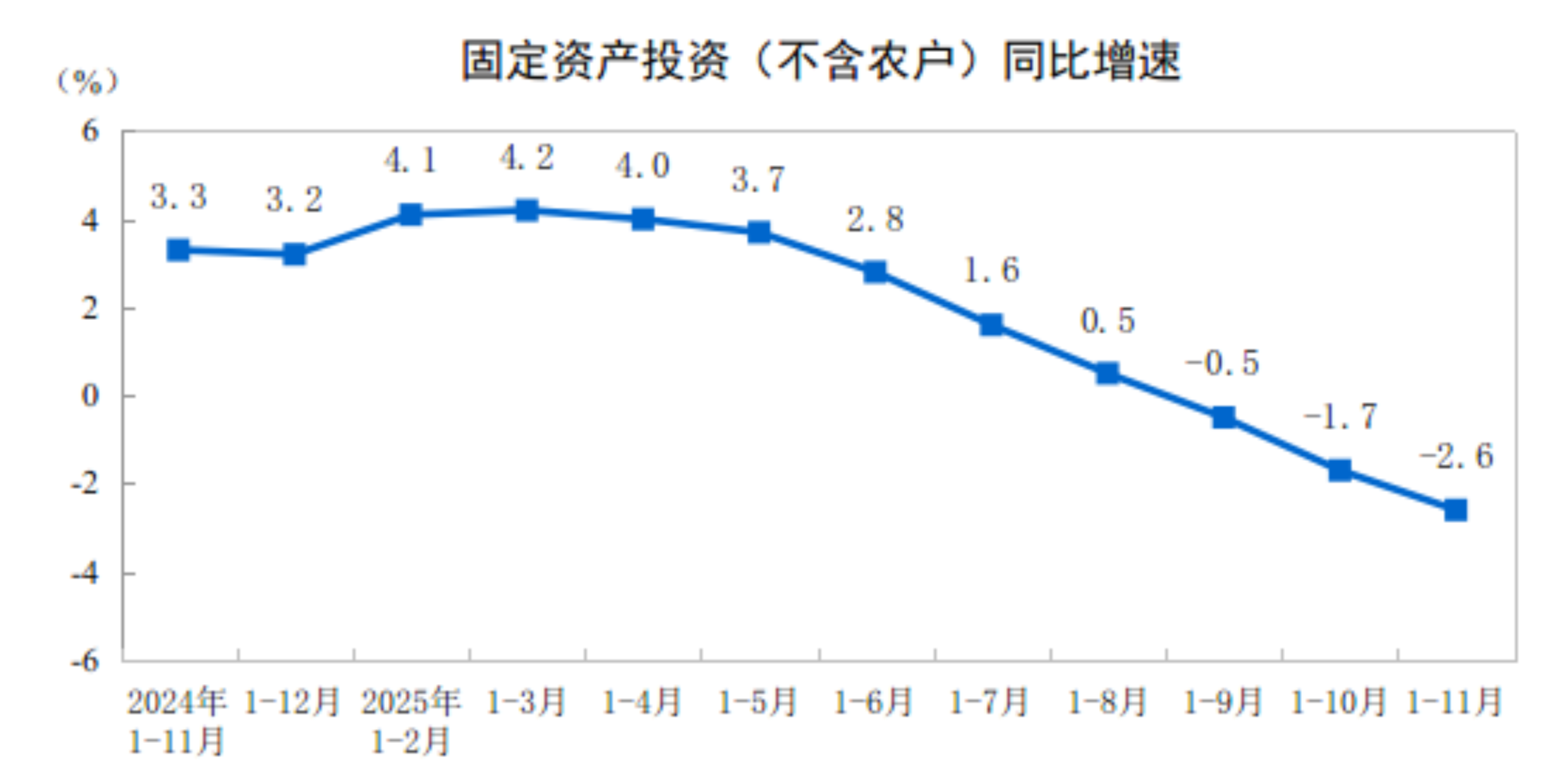
Core Viewpoint - In the first eleven months of 2025, China's fixed asset investment (excluding rural households) reached 444,035 billion yuan, showing a year-on-year decline of 2.6% [1][4]. Investment by Industry - Investment in the primary industry was 8,770 billion yuan, with a year-on-year growth of 2.7% [3][5]. - Investment in the secondary industry totaled 162,243 billion yuan, increasing by 3.9% [3][5]. - Investment in the tertiary industry was 273,022 billion yuan, reflecting a decline of 6.3% [3][5]. - Within the secondary industry, industrial investment grew by 4.0%, with mining investment also increasing by 4.0%, manufacturing investment rising by 1.9%, and investment in electricity, heat, gas, and water production and supply increasing by 10.7% [3][6]. Investment by Region - Eastern region investment decreased by 6.6%, central region investment fell by 1.7%, western region investment declined by 0.2%, and northeastern region investment saw a significant drop of 14.0% [3][6]. Investment by Registration Type - Domestic enterprises' fixed asset investment decreased by 2.6%, investment from Hong Kong, Macau, and Taiwan enterprises fell by 2.2%, while foreign enterprises' investment dropped sharply by 14.1% [3][6]. Detailed Investment Data - The overall fixed asset investment (excluding rural households) showed a decline of 2.6% year-on-year, with state-controlled investment down by 1.1% and private investment down by 5.3% [5][6]. - Specific categories such as construction and installation projects saw a decline of 6.4%, while equipment and tool purchases increased by 12.2% [5][6]. Industry-Specific Performance - In the manufacturing sector, notable growth was observed in the automotive manufacturing industry at 15.3% and in the railway, shipbuilding, aerospace, and other transportation equipment manufacturing at 22.4% [6][7]. - Conversely, the pharmaceutical manufacturing industry experienced a decline of 8.2%, and the chemical raw materials and chemical products manufacturing sector saw a drop of 13.1% [6][7]. Summary of Investment Trends - The overall trend indicates a contraction in fixed asset investment across various sectors, with significant regional disparities and varying performance across industries, highlighting potential areas for investment focus and concern [1][3][4].
国家统计局关于2024年国内生产总值最终核实的公告 - 国家统计局
Guo Jia Tong Ji Ju· 2025-12-29 09:36
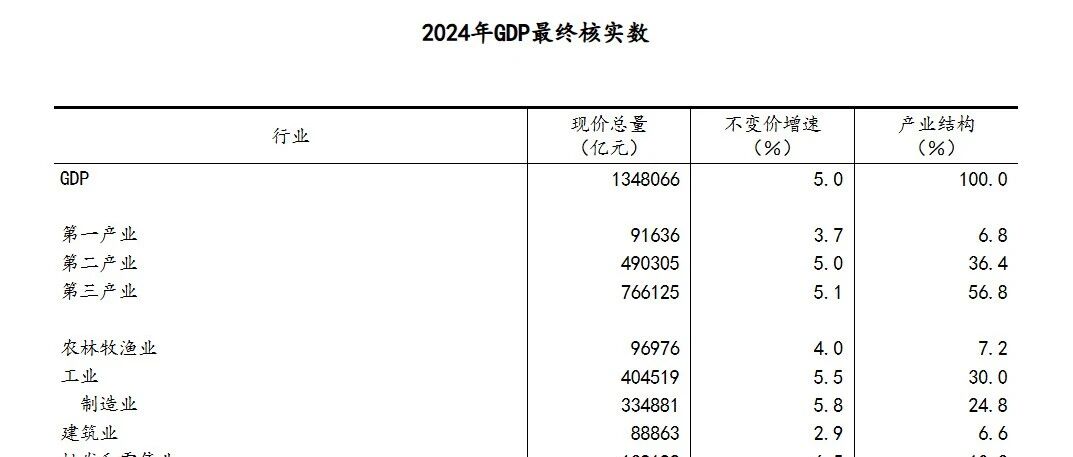
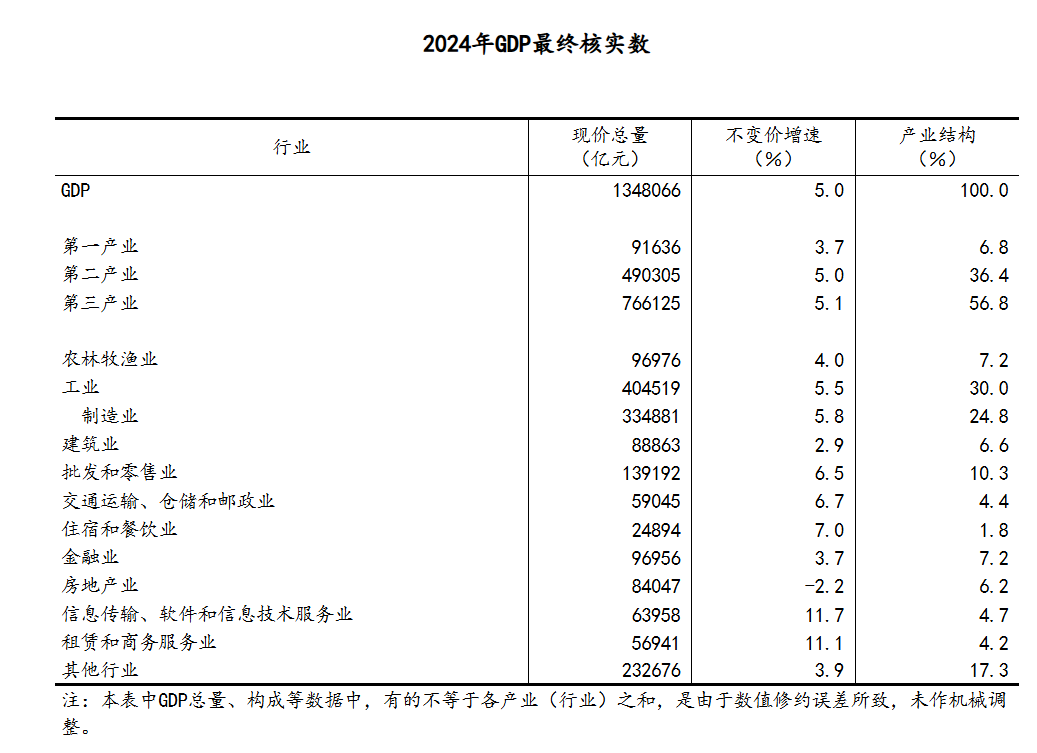
Group 1 - The core point of the article is the final verification of China's GDP data for 2024, which shows a total nominal GDP of 13,480.66 billion yuan, a decrease of 10.18 billion yuan from the preliminary estimate, with a year-on-year growth of 5.0% at constant prices, consistent with the preliminary estimate [1][2][4]. Group 2 - The primary industries contributed 91.64 billion yuan with a growth rate of 3.7% [5]. - The secondary industries accounted for 490.305 billion yuan, growing at 6.8% [5]. - The tertiary industries reached 766.125 billion yuan, with a growth rate of 5.1% [5]. - The agricultural sector, including forestry, animal husbandry, and fishery, grew by 4.0% [5]. - The industrial sector, which includes manufacturing, grew by 5.5% [6]. - The construction industry saw a growth of 2.9% [6]. - The wholesale and retail sector grew by 6.5% [6]. - The transportation, warehousing, and postal sector grew by 6.7% [6]. - The accommodation and catering sector grew by 7.0% [6]. - The financial sector grew by 3.7% [6]. - The real estate sector experienced a decline of 2.2% [6]. - The information transmission, software, and IT services sector grew by 11.7% [6]. - The leasing and business services sector grew by 11.1% [6]. - Other industries grew by 3.9% [6].
【数据发布】国家统计局关于2024年国内生产总值最终核实的公告
中汽协会数据· 2025-12-26 09:37
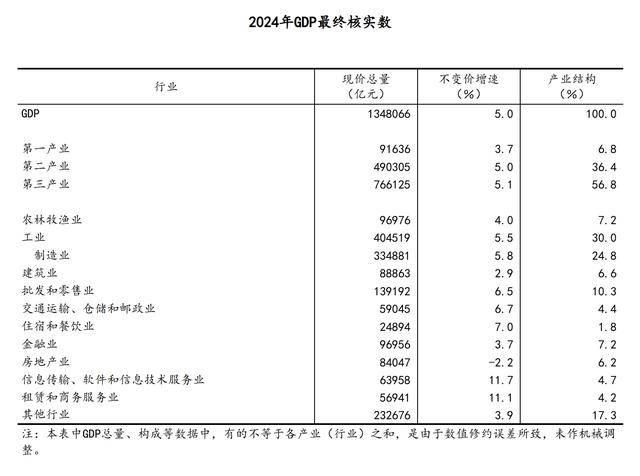
Core Viewpoint - The final verification of China's GDP for 2024 shows a total nominal GDP of 13,480.66 billion yuan, a decrease of 10.18 billion yuan from the preliminary estimate, with a year-on-year growth rate of 5.0% at constant prices, consistent with the preliminary estimate [1]. Summary by Categories GDP Overview - The final verified nominal GDP for 2024 is 13,480.66 billion yuan, reflecting a reduction of 10.18 billion yuan from the preliminary figure [1]. - The year-on-year growth rate at constant prices is 5.0%, unchanged from the preliminary estimate [1]. Industry Breakdown - **Primary Industry**: - Current value: 91,636 billion yuan - Growth rate: 3.7% - Contribution to GDP: 6.8% [4] - **Secondary Industry**: - Current value: 490,305 billion yuan - Growth rate: 5.0% - Contribution to GDP: 36.4% [4] - **Tertiary Industry**: - Current value: 766,125 billion yuan - Growth rate: 5.1% - Contribution to GDP: 56.8% [4] Specific Sector Performance - **Agriculture, Forestry, Animal Husbandry, and Fishery**: - Current value: 96,976 billion yuan - Growth rate: 4.0% - Contribution to GDP: 7.2% [4] - **Industrial Sector**: - Current value: 404,519 billion yuan - Growth rate: 5.5% - Contribution to GDP: 30.0% [4] - **Manufacturing**: - Current value: 334,881 billion yuan - Growth rate: 5.8% - Contribution to GDP: 24.8% [4] - **Construction**: - Current value: 88,863 billion yuan - Growth rate: 2.9% - Contribution to GDP: 6.6% [4] - **Wholesale and Retail Trade**: - Current value: 139,192 billion yuan - Growth rate: 6.5% - Contribution to GDP: 10.3% [4] - **Transportation, Storage, and Postal Services**: - Current value: 59,045 billion yuan - Growth rate: 6.7% - Contribution to GDP: 4.4% [4] - **Accommodation and Catering**: - Current value: 24,894 billion yuan - Growth rate: 7.0% - Contribution to GDP: 1.8% [4] - **Financial Sector**: - Current value: 96,956 billion yuan - Growth rate: 3.7% - Contribution to GDP: 7.2% [4] - **Real Estate**: - Current value: 84,047 billion yuan - Growth rate: -2.2% - Contribution to GDP: 6.2% [4] - **Information Transmission, Software, and IT Services**: - Current value: 63,958 billion yuan - Growth rate: 11.7% - Contribution to GDP: 4.7% [4] - **Leasing and Business Services**: - Current value: 56,941 billion yuan - Growth rate: 11.1% - Contribution to GDP: 4.2% [4] - **Other Industries**: - Current value: 232,676 billion yuan - Growth rate: 3.9% - Contribution to GDP: 17.3% [4]
国家统计局公布2024年GDP最终核实结果
Sou Hu Cai Jing· 2025-12-26 01:53
Core Insights - The National Bureau of Statistics of China has released the final verification of the GDP for 2024, showing a total nominal GDP of 13,480.66 billion yuan, which is a decrease of 10.18 billion yuan from the preliminary estimate. The GDP growth rate at constant prices is 5.0%, unchanged from the preliminary figure [1][4]. Group 1: Overall GDP Data - The final verified nominal GDP for 2024 is 13,480.66 billion yuan, a reduction of 10.18 billion yuan from the preliminary estimate [1]. - The GDP growth rate at constant prices is 5.0%, consistent with the preliminary calculation [1]. Group 2: Sectoral Breakdown - The primary industry contributed 91,636 billion yuan with a growth rate of 3.7%, accounting for 6.8% of the GDP [2]. - The secondary industry reached 490,305 billion yuan, growing at 5.0%, representing 36.4% of the GDP [2]. - The tertiary industry totaled 766,125 billion yuan, with a growth rate of 5.1%, making up 56.8% of the GDP [2]. - The agricultural sector (including forestry, animal husbandry, and fishery) generated 96,976 billion yuan, growing at 4.0% [2]. - The industrial sector produced 404,519 billion yuan, with a growth rate of 5.5% [2]. - The manufacturing sector accounted for 334,881 billion yuan, growing at 5.8% [2]. - The construction industry reached 88,863 billion yuan, with a growth rate of 2.9% [2]. - The wholesale and retail sector generated 139,192 billion yuan, growing at 6.5% [2]. - The transportation, warehousing, and postal sector produced 59,045 billion yuan, with a growth rate of 6.7% [2]. - The accommodation and catering sector reached 24,894 billion yuan, growing at 7.0% [2]. - The financial sector generated 96,956 billion yuan, with a growth rate of 3.7% [2]. - The real estate sector saw a decline, totaling 84,047 billion yuan with a negative growth rate of 2.2% [2]. - The information transmission, software, and IT services sector grew significantly at 11.7%, totaling 63,958 billion yuan [2]. - The leasing and business services sector reached 56,941 billion yuan, growing at 11.1% [2]. - Other industries contributed 232,676 billion yuan, with a growth rate of 3.9% [2].
国家统计局:经最终核实2024年GDP现价总量为1348066亿元
Guo Jia Tong Ji Ju· 2025-12-26 01:39
Core Insights - The National Bureau of Statistics of China announced the final verification of GDP data for 2024, revealing a total GDP at current prices of 13,480.66 billion yuan, which is a decrease of 10.18 billion yuan from the preliminary estimate [1] - The GDP growth rate at constant prices for 2024 is confirmed at 5.0%, consistent with the preliminary estimate [1] Industry Breakdown - The first industry (agriculture, forestry, animal husbandry, and fishery) contributed 91.636 billion yuan with a growth rate of 3.7%, accounting for 6.8% of GDP [3] - The second industry (including manufacturing and construction) totaled 490.305 billion yuan, growing at 5.0%, representing 36.4% of GDP [3] - The third industry (services) reached 766.125 billion yuan, with a growth rate of 5.1%, making up 56.8% of GDP [3] - Notable sectors include: - Manufacturing at 334.881 billion yuan with a growth rate of 5.8% [3] - Information transmission, software, and IT services at 63.958 billion yuan, growing at 11.7% [3] - Real estate sector showing a decline at -2.2% with a total of 84.047 billion yuan [3]
国家统计局关于2024年国内生产总值最终核实的公告
Guo Jia Tong Ji Ju· 2025-12-26 01:30
Core Points - The final verified GDP for 2024 is 13,480.66 billion yuan, which is a decrease of 10.18 billion yuan compared to the preliminary estimate, while the year-on-year growth rate at constant prices remains at 5.0% [1][4]. Group 1: GDP Overview - The GDP at current prices for 2024 is 1,348,066 million yuan, reflecting a reduction from the preliminary figure [1][4]. - The GDP growth rate at constant prices is confirmed at 5.0%, consistent with the preliminary estimate [1][4]. Group 2: Sector Contributions - The primary industry contributed 91,636 million yuan with a growth rate of 3.7%, accounting for 6.8% of GDP [4]. - The secondary industry, including manufacturing, contributed 490,305 million yuan with a growth rate of 5.0%, representing 36.4% of GDP [4]. - The tertiary industry showed the highest growth rate at 5.1%, contributing 766,125 million yuan, which is 56.8% of GDP [4]. Group 3: Industry-Specific Data - The manufacturing sector grew by 5.8%, contributing 334,881 million yuan [4]. - The construction industry experienced a slower growth rate of 2.9%, contributing 88,863 million yuan [4]. - The information transmission, software, and IT services sector had a significant growth rate of 11.7%, contributing 63,958 million yuan [4]. - The real estate sector faced a decline of 2.2%, contributing 84,047 million yuan [4].
1—11月杭州经济稳中向好态势延续
Mei Ri Shang Bao· 2025-12-22 06:32
Economic Overview - Hangzhou's economy shows a steady improvement from January to November 2025, with new productive forces being cultivated and structural optimization in various sectors including industry, consumption, investment, and foreign trade [1][6] Industrial Performance - The industrial added value for large-scale enterprises reached 418.9 billion yuan, growing by 6.1% year-on-year, indicating a solid industrial foundation [1] - Key industries such as automobile manufacturing and computer communication saw significant growth, with added values increasing by 35.5% and 13.0% respectively [1] - Emerging industries performed exceptionally well, with high-tech industries, strategic emerging industries, and equipment manufacturing increasing by 7.2%, 9.4%, and 9.1% respectively [1] - The digital economy's core manufacturing sector grew by 10.5%, with notable increases in industrial robots (38.5%), 3D printing equipment (44.5%), and new energy vehicles (350.1%) [1] Service Sector Growth - The service sector continued to lead economic growth, with revenue reaching 1,886.4 billion yuan from January to October, a year-on-year increase of 9.1% [2] - Information transmission, software, and IT services saw a revenue increase of 13.8%, becoming a key driver for service sector growth [2] - Emerging service industries, particularly in the digital economy and high-tech services, outpaced overall service sector growth, with revenues increasing by 13.5% and 12.7% respectively [2] Consumer Market Dynamics - The retail sales of social consumer goods totaled 863.6 billion yuan from January to November, growing by 4.3% year-on-year, reflecting a stable growth trend [3] - Significant growth was observed in household appliances (50.1%) and communication equipment (40.7%) [3] - Smart products emerged as new growth points, with retail sales of smart phones and wearable devices increasing by 45.6% and 88.1% respectively [3] Investment Trends - Fixed asset investment grew by 5.5% year-on-year, indicating a robust investment environment [4] - Industrial investment saw a notable increase of 7.5%, with automotive manufacturing and general equipment manufacturing investments rising by 39.6% and 14.1% respectively [4] - Infrastructure investment surged by 19.5%, accelerating by 3.3 percentage points compared to the previous period, supporting long-term economic development [4] Foreign Trade Performance - The total import and export value reached 823.7 billion yuan, with exports growing by 8.8% year-on-year, indicating resilience in foreign trade [5][6] - High-value-added products, particularly electromechanical products (281.7 billion yuan) and high-tech products (90.5 billion yuan), were significant contributors to export growth [6] - Private enterprises accounted for 76.8% of total exports, highlighting their vital role in the foreign trade sector [6] - Exports to emerging markets, particularly those involved in the Belt and Road Initiative, increased by 14.6%, outpacing overall export growth [6]