
体育等

Search documents
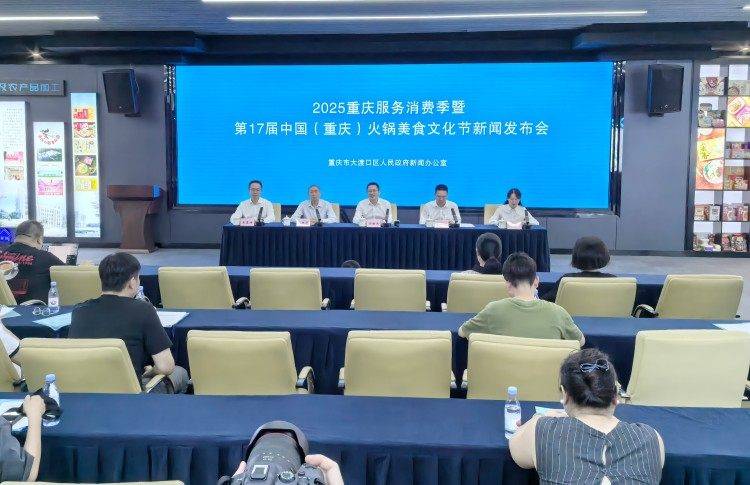
超500场主题惠民消费活动,“2025重庆服务消费季”来了!
Sou Hu Cai Jing· 2025-09-17 10:46
Core Viewpoint - The 2025 Chongqing Service Consumption Season and the 17th China (Chongqing) Hot Pot Food Culture Festival will be held from September 29 to December, aiming to boost local consumption by over 5 billion yuan through various service consumption activities [4][7]. Group 1: Event Overview - The event is organized by the Chongqing Municipal Commission of Commerce in collaboration with various departments and over 1,000 service consumption enterprises and financial institutions across 38 districts [3][6]. - The theme focuses on "service consumption," with over 500 themed activities planned across 11 key service consumption sectors, including dining, accommodation, and tourism [7][8]. Group 2: Key Highlights - The event will feature diverse consumption scenarios, integrating food, tourism, sports, and entertainment, with the Hot Pot Food Culture Festival being a major highlight [8][9]. - A rich array of cultural and entertainment activities will be offered, including over 200 artistic events and various tourism services to attract a wide audience [9]. - The initiative will leverage online and offline collaboration, utilizing internet platforms for convenient booking and payment, while also promoting on-site activities in commercial areas [9].

刚刚!重大利好!商务部等9部门对外发布《关于扩大服务消费的若干政策措施》
Zhong Guo Ji Jin Bao· 2025-09-16 14:35
Group 1 - The article emphasizes the importance of service consumption as a key support for improving people's livelihoods and a direction for consumption transformation and upgrading, playing a significant role in promoting high-quality economic development [10] - A series of promotional activities for service consumption will be launched, focusing on areas closely related to people's lives, with high demand potential and strong driving effects [11][12] - The establishment of pilot cities for new business formats, models, and scenarios in consumption will be promoted, encouraging innovation and the development of new consumption scenarios [11][12] Group 2 - High-level opening up of the service industry will be expanded, with orderly opening in fields such as the internet, culture, telecommunications, healthcare, and education [11][12] - Existing funding channels will be utilized to support the creation of high-quality cultural products and services, optimizing the supply of cultural products [11][12] - The introduction of foreign sports events and support for local mass sports events will be encouraged to create well-known sports brands [4][11] Group 3 - The article outlines measures to attract more foreign visitors for consumption, including optimizing visa policies and enhancing international promotion of cultural resources [12] - Digital service consumption will be expanded, encouraging e-commerce platforms to innovate in online and offline integration [12][13] - Financial support for service consumption will be strengthened, including the use of various funding channels and credit policies to stimulate market activity [13][14]
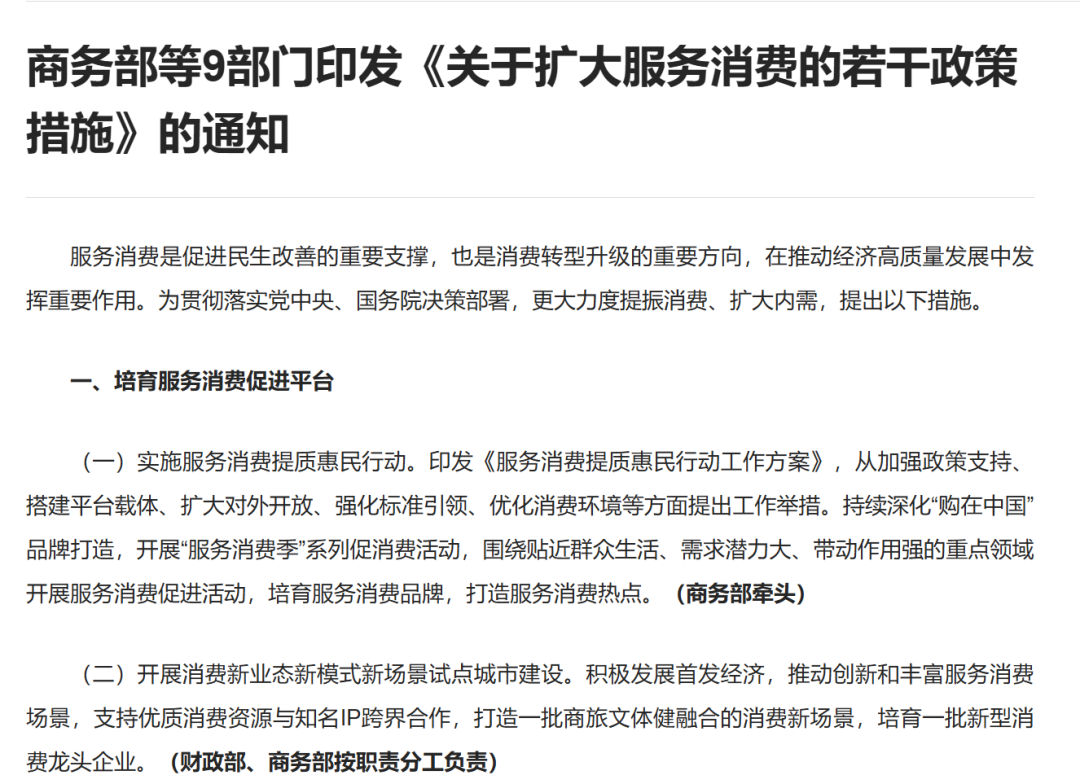
利好来了!9部门发文
Shang Hai Zheng Quan Bao· 2025-09-16 14:33
Core Viewpoint - The announcement by nine departments aims to expand service consumption as a crucial support for improving people's livelihoods and upgrading consumption, thereby playing a significant role in promoting high-quality economic development [7][4]. Group 1: Policy Measures - The document outlines five areas with 19 specific measures to stimulate service consumption, including the launch of "service consumption seasons" and support for high-quality consumption resources collaborating with well-known IPs [5][6]. - It emphasizes the need to extend operating hours for popular cultural and tourist venues, optimize reservation methods, and encourage no-reservation policies [5][8]. - The policy encourages the introduction of high-quality sports events and leagues, as well as the development of sports competition brands with independent intellectual property rights [5][9]. Group 2: Enhancing Service Supply - The initiative includes expanding high-level openness in the service industry, particularly in internet, culture, telecommunications, and healthcare sectors [8][10]. - It aims to utilize existing funding channels to support the creation of high-quality cultural products and services, enhancing the supply of cultural offerings [8][10]. - The policy encourages localities to innovate exhibition methods in cultural venues and collaborate with social forces to develop cultural and digital products [8][10]. Group 3: Stimulating New Consumption - The measures propose attracting more foreign visitors for consumption by optimizing visa policies and promoting China's cultural resources [9][10]. - It encourages the expansion of digital service consumption and supports e-commerce platforms in creating integrated online and offline service scenarios [9][10]. - The policy suggests optimizing school holiday arrangements to increase travel and service consumption opportunities [9][10]. Group 4: Financial Support - The plan includes utilizing various funding sources to support the construction of service facilities in culture, tourism, and healthcare [10][11]. - It aims to enhance financial support for service consumption sectors, encouraging financial institutions to develop tailored financial products [10][11]. - The initiative focuses on providing fiscal interest subsidies to stimulate service consumption and reduce financing costs for service providers [10][11]. Group 5: Monitoring and Implementation - The document calls for optimizing service consumption statistics and innovating monitoring methods to reflect regional service consumption development accurately [11][12]. - It emphasizes the need for all relevant departments to implement the policies effectively and coordinate efforts to enhance service consumption [11][12].
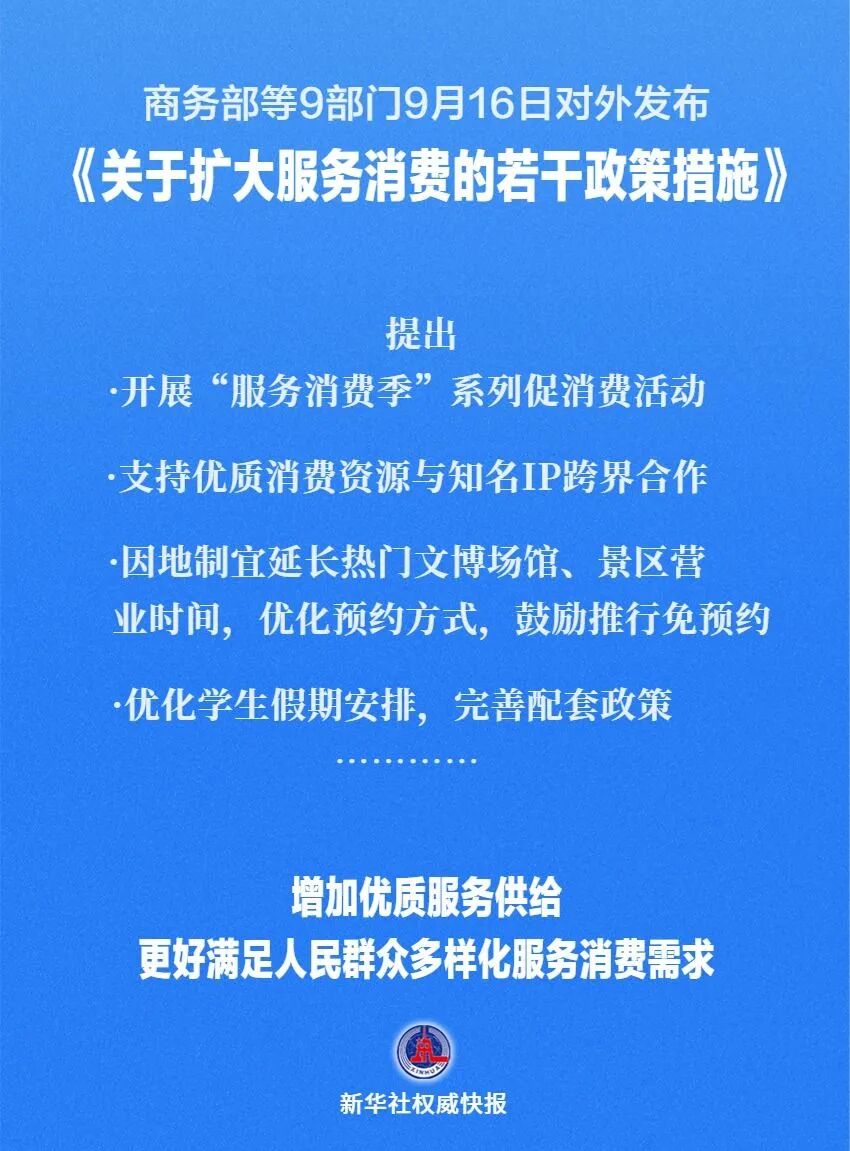
19条举措扩大服务消费,加强财政金融支持
Di Yi Cai Jing· 2025-09-16 11:17
Core Viewpoint - The Chinese government is implementing strong policy support to expand service consumption as a key strategy for boosting domestic demand, with specific measures outlined in the recent policy document [2][3]. Group 1: Policy Measures - The policy document includes 19 specific measures across five areas to enhance service consumption, focusing on financial support, quality service supply, and stimulating new consumption growth [2][3]. - Financial institutions are encouraged to increase credit allocation for service consumption, utilizing various funding channels such as central budget investments and local government bonds [2][6]. Group 2: Service Consumption Growth - Service consumption has become a significant aspect of domestic demand expansion, with service retail sales growing by 5.1% year-on-year from January to August, outpacing the growth of goods retail sales [3]. - The government aims to cultivate new consumption formats and scenarios, promoting innovative service consumption experiences and supporting the development of new consumption leaders [3][4]. Group 3: Supply Optimization - The policy emphasizes the need to open up sectors like telecommunications, healthcare, and education to enhance service supply, attracting foreign investment and private capital [4][8]. - Since 2015, China has expanded its pilot programs for service industry openness, with new cities added to the list of trial areas [4]. Group 4: Financial Support - The People's Bank of China has established a 500 billion yuan fund to support service consumption and elderly care, aiming to enhance the quality of service supply in sectors like hospitality, tourism, and education [7]. - The policy encourages financial institutions to develop tailored financial products for service consumption businesses, addressing their unique financing needs [6][7].
19条来了!事关扩大服务消费
Di Yi Cai Jing Zi Xun· 2025-09-16 09:45
Core Viewpoint - The Ministry of Commerce and nine other departments released policies to expand service consumption, emphasizing its role in improving livelihoods and driving economic growth [2][3]. Group 1: Measures to Promote Service Consumption - A series of promotional activities called "Service Consumption Season" will be launched to stimulate consumption [3]. - Support for high-quality consumption resources to collaborate with well-known IPs to create new consumption scenarios [3]. - Extension of operating hours for popular cultural and tourist venues, along with optimized reservation methods, to encourage more visits [3][4]. Group 2: Enhancing Service Supply - Expansion of high-level opening-up in the service industry, particularly in internet, culture, telecommunications, and healthcare sectors [3][4]. - Development of cultural and artistic projects to enhance the supply of quality cultural products and services [4]. - Encouragement of foreign sports events and local mass sports events to create well-known competitions and enhance tourism [4]. Group 3: Stimulating New Service Consumption - Measures to attract more foreign visitors for consumption, including optimizing visa policies and promoting cultural resources [5]. - Encouragement of digital service consumption through e-commerce platforms and support for the digital transformation of service enterprises [5]. - Adjustments to student holiday arrangements to increase opportunities for travel and service consumption [5]. Group 4: Financial Support for Service Consumption - Utilization of various funding channels to support the construction of service facilities in culture, tourism, and sports [6]. - Promotion of innovative financial products tailored to the needs of service consumption enterprises [6]. - Increased support for consumer credit, including risk-sharing mechanisms to encourage financial institutions to lend to service sectors [6]. Group 5: Statistical Monitoring - Optimization of service consumption statistics to reflect regional development accurately [6]. - Encouragement of the use of big data and information technology for monitoring and analysis of service consumption [6].
刚刚!重大利好!
中国基金报· 2025-09-16 09:29
Core Viewpoint - The article discusses the recent policy measures announced by the Chinese government aimed at expanding service consumption to boost economic growth and improve people's livelihoods [1][7]. Group 1: Service Consumption Promotion - A series of "Service Consumption Season" activities will be launched to promote consumption in key areas that are closely related to people's lives and have strong demand potential [3][8]. - New pilot cities will be established to develop innovative service consumption scenarios, encouraging collaboration between quality consumption resources and well-known IPs [3][8]. - The government aims to enhance the high-level opening of the service industry, particularly in sectors like internet, culture, telecommunications, healthcare, and education [4][8]. Group 2: Cultural and Sports Development - There will be efforts to extend operating hours for popular cultural and heritage venues and optimize reservation methods to encourage more visitors [4][9]. - The introduction of foreign sports events and support for local mass sports events will be encouraged to create well-known sports brands [4][9]. - The government will promote diverse education and training markets, particularly in non-academic fields like culture, arts, and technology [4][9]. Group 3: Financial and Policy Support - The government will utilize various funding channels to support the construction of cultural, tourism, elderly care, childcare, and sports facilities [10][10]. - Financial institutions will be encouraged to expand credit support for service consumption sectors, with a focus on innovative financial products tailored to service consumption characteristics [10][10]. - There will be an emphasis on providing fiscal interest subsidies to service industry operators to lower their financing costs and stimulate market activity [10][10]. Group 4: Digital and International Consumption - The article highlights the importance of expanding digital service consumption, encouraging e-commerce platforms to innovate in online and offline integration [5][9]. - Measures will be taken to attract more foreign visitors for consumption, including optimizing visa policies and promoting China's cultural resources [5][9]. - Adjustments to school holiday schedules will be explored to increase tourism and service consumption opportunities [5][9].

商务部等9部门:吸引更多境外人员入境消费 有序扩大单方面免签国家范围(金十数据APP)
Shang Wu Bu Wang Zhan· 2025-09-16 08:58
Core Viewpoint - The article emphasizes the importance of service consumption in improving people's livelihoods and driving economic transformation, proposing measures to boost consumption and expand domestic demand [1]. Group 1: Cultivating Service Consumption Promotion Platforms - Implementation of the "Service Consumption Quality Improvement and Benefit Action" to enhance policy support, build platforms, and optimize the consumption environment [2]. - Development of pilot cities for new service consumption formats and scenarios, promoting innovative service consumption landscapes [2]. Group 2: Enriching High-Quality Service Supply - Expansion of high-level opening up in the service industry, particularly in internet, culture, telecommunications, and healthcare sectors [3]. - Support for cultural and artistic sectors through funding and resource utilization to create impactful cultural events and exhibitions [3]. - Encouragement of foreign sports events and local mass sports events to enhance service consumption through sports tourism [3]. Group 3: Stimulating New Service Consumption Growth - Attraction of more foreign visitors through optimized visa policies and promotion of cultural resources [4]. - Expansion of digital service consumption by encouraging e-commerce platforms to innovate in online and offline integration [4]. - Adjustment of school holiday schedules to increase opportunities for tourism and service consumption [4]. Group 4: Strengthening Financial Support - Utilization of various funding channels to support the construction of service facilities in culture, tourism, and sports [5]. - Promotion of service trade innovation through market-oriented investment in service consumption enterprises [5]. - Enhancement of consumer credit support to stimulate service consumption through government and financial institution collaboration [5]. Group 5: Improving Statistical Monitoring Systems - Optimization of service consumption statistical methods to reflect regional development accurately [6]. - Encouragement of the use of big data for monitoring and analyzing service consumption trends [6].
贴息“红包”精准投向消费领域
Ren Min Ri Bao· 2025-08-13 23:15
Core Points - The Ministry of Finance, along with other departments, has introduced a subsidy policy for personal consumption loans and service industry loans, marking the first central-level implementation of such policies [1][2] - The subsidy for personal consumption loans targets the portion of loans actually used for consumption, with a subsidy rate of 1%, which is approximately one-third of the current commercial bank personal consumption loan interest rate [2][4] - The policy is set to last for one year, with specific examples illustrating potential savings for consumers and service industry operators [2][3] Subsidy Scope and Strength - The subsidy applies to personal consumption loans for various categories, including daily expenses under 50,000 yuan and larger purchases such as cars and home renovations [2] - For service industry loans, the subsidy focuses on eight key sectors, including dining, health, and tourism, with a maximum loan amount of 1 million yuan per entity and a subsidy cap of 10,000 yuan [2][4] Eligibility Criteria - To qualify for the subsidy, borrowers must demonstrate genuine consumption behavior, with specific conditions outlined for both personal and service industry loans [4][6] - The policy allows for multiple applications and cumulative benefits, with detailed calculations for subsidies based on loan amounts and usage [4][5] Implementation Process - The process for receiving subsidies involves the lending institution calculating the subsidy amount based on the established criteria and directly applying it to the borrower's interest payments [5][6] - Borrowers will be informed of their subsidy status through various communication methods, ensuring transparency in the process [5][6] Future Considerations - The policies are designed to be flexible, with potential evaluations for extending the duration or expanding the scope based on effectiveness [7][8] - Financial institutions are encouraged to enhance their services and streamline processes to better support the implementation of these policies [8]
贴息“红包”精准投向消费领域(权威发布)
Ren Min Ri Bao· 2025-08-13 21:50
Core Viewpoint - The Ministry of Finance, in collaboration with other departments, has introduced a subsidy policy for personal consumption loans and service industry loans, marking the first central-level implementation of such a policy aimed at boosting consumer spending and supporting service sector businesses [1][2]. Summary by Categories Subsidy Scope and Strength - The subsidy policy targets personal consumption loans used for specific consumer expenditures, including daily expenses under 50,000 yuan and larger purchases like cars and home renovations, with a subsidy rate of 1 percentage point, approximately one-third of current commercial bank loan rates [2]. - For example, a consumer taking a 200,000 yuan loan at a 3% interest rate could save up to 2,000 yuan in interest payments due to the subsidy [2]. - The service industry loan subsidy focuses on eight key sectors, including dining, health, and tourism, with a similar subsidy rate and a maximum loan amount of 1 million yuan per entity [2][3]. Eligibility Criteria for Subsidies - To qualify for the personal consumption loan subsidy, borrowers must demonstrate genuine consumption behavior, with the subsidy applicable to loans taken from September for one year [4]. - For service industry loans, businesses must utilize the funds for operational activities, with eligibility extending to loans signed from March 16 to the end of the year [4]. Operational Process - Borrowers must grant loan institutions permission to access transaction information, allowing for direct deduction of the subsidy from interest payments [5]. - The process is designed to minimize borrower burden, with most administrative tasks handled by lending institutions and local government departments [6]. Policy Implementation and Future Considerations - The policies are designed to be precise and impactful, with an expectation that 1 yuan of subsidy could stimulate 100 yuan in consumer loans [7]. - After the policy period, evaluations will be conducted to consider extending the policy or expanding its scope based on effectiveness [7]. - The People's Bank of China will facilitate information sharing and enhance credit support for the consumer sector, while regulatory bodies will ensure compliance and proper use of subsidy funds [8].
贷款贴息政策惠企利民,持续扩大内需
2 1 Shi Ji Jing Ji Bao Dao· 2025-08-12 22:44
Group 1 - The core viewpoint emphasizes the implementation of personal consumption loan interest subsidy policies to stimulate domestic demand and consumption [1][2] - The policy includes a 1% annual interest subsidy for loans used for consumption, covering various categories such as household appliances, automobiles, education, and healthcare [1] - The service industry is a primary focus of the subsidy policy, with a maximum loan amount of 1 million yuan for service providers in sectors like hospitality, healthcare, and entertainment [1] Group 2 - The recent Central Political Bureau meeting highlighted the need to effectively release domestic demand potential and cultivate new growth points in service consumption [2] - Structural monetary policy tools are being utilized to support consumption and reduce overall financing costs, indicating a reliance on fiscal and financial measures to stimulate spending [2] - The growth of disposable income is crucial for sustainable consumption growth, necessitating stronger economic performance to drive consumer spending [2] Group 3 - Industrial upgrading is often driven by technological advancements, which can enhance profit margins and increase purchasing power, thereby expanding consumption [3] - There is a need to address "involution" in competition, encouraging companies to focus on long-term brand building and high-quality supply to meet the demands of the middle-income group [3] - The goal is to create more middle-income individuals through technological and brand advancements, facilitating a cycle of consumption that supports economic growth [3]