新能源车整车制造

Search documents
国家统计局:12月锂离子电池制造价格上涨1.0%
Guo Jia Tong Ji Ju· 2026-01-09 02:55
Core Insights - The Producer Price Index (PPI) increased by 0.2% month-on-month, marking the third consecutive month of growth, with the growth rate expanding by 0.1 percentage points compared to the previous month [1] - Year-on-year, the PPI decreased by 1.9%, but the decline rate narrowed by 0.3 percentage points from the previous month, indicating positive changes in certain industries due to effective macro policies [1] Group 1: Price Changes in Key Industries - The improvement in supply and demand structure has led to price increases in several key industries, including a 1.3% rise in coal mining and washing, and a 0.8% increase in coal processing, both of which have risen for five consecutive months [1] - The price of lithium-ion battery manufacturing increased by 1.0%, and cement manufacturing prices rose by 0.5%, both showing growth for three consecutive months [1] - The price of complete electric vehicles shifted from a 0.2% decrease last month to a 0.1% increase this month [1] Group 2: Market Competition and Price Adjustments - The construction of a unified national market is progressing, leading to a continuous narrowing of year-on-year price declines in related industries [1] - The optimization of market competition order has resulted in a narrowing of price declines in coal mining and washing, lithium-ion battery manufacturing, and photovoltaic equipment and components manufacturing by 2.9, 1.2, and 0.4 percentage points respectively, with these industries experiencing narrowing declines for five, four, and nine consecutive months [1]
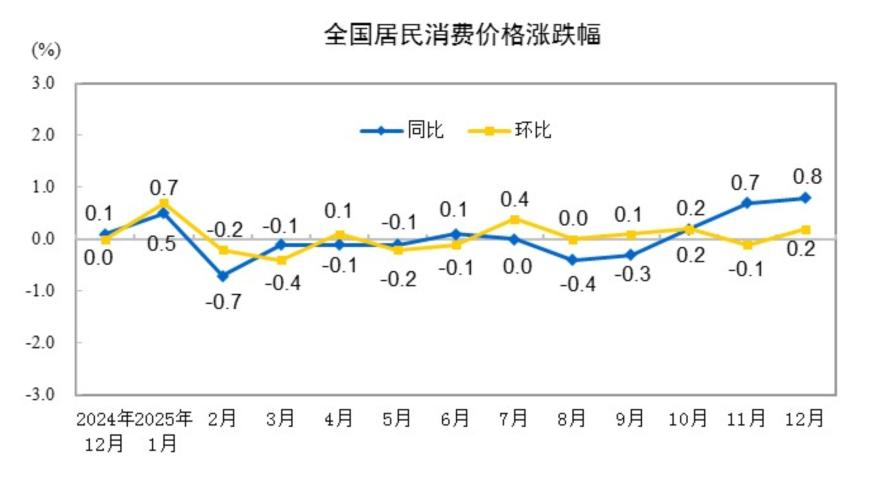
国家统计局:12月份CPI上涨0.8%,PPI环比上涨0.2%涨幅比上月扩大0.1个百分点
Jin Rong Jie· 2026-01-09 02:30
Core Insights - In December 2025, the national consumer price index (CPI) increased by 0.8% year-on-year, with urban areas rising by 0.9% and rural areas by 0.6% [3][20] - The producer price index (PPI) for industrial producers decreased by 1.9% year-on-year, with a narrowing decline compared to the previous month [12][25] CPI Analysis - The CPI rose by 0.2% month-on-month in December, driven by increased consumer demand ahead of the New Year [20][21] - Food prices increased by 1.1% year-on-year, significantly impacting the CPI, with fresh vegetable prices soaring by 18.2% [6][23] - Core CPI, excluding food and energy, rose by 1.2%, maintaining a growth rate above 1% for four consecutive months [20][23] PPI Analysis - The PPI saw a month-on-month increase of 0.2%, marking the third consecutive month of growth [24][25] - The decline in PPI year-on-year was less severe than in previous months, indicating a potential stabilization in industrial pricing [12][25] - Key industries such as coal mining and lithium-ion battery manufacturing experienced price increases, reflecting improved supply-demand dynamics [24][25] Price Movement by Category - In December, food and beverage prices rose by 0.8% year-on-year, contributing approximately 0.24 percentage points to the CPI [6][11] - The prices of production materials decreased by 2.1% year-on-year, with significant declines in mining and raw materials sectors [14][19] - The prices of durable consumer goods fell by 3.5%, while general daily necessities saw a price increase of 1.4% [14][19]

解读:12月份CPI同比涨幅继续扩大,PPI同比降幅收窄
Guo Jia Tong Ji Ju· 2026-01-09 01:57
Group 1: CPI Analysis - The Consumer Price Index (CPI) increased by 0.2% month-on-month and 0.8% year-on-year, with the core CPI rising by 1.2% year-on-year, indicating a recovery in consumer demand as the New Year approaches [1][2][3] - The month-on-month increase in CPI was primarily driven by rising prices of industrial consumer goods, excluding energy, which rose by 0.6%, contributing approximately 0.16 percentage points to the CPI increase [2] - Food prices rose by 1.1% year-on-year, with significant increases in fresh vegetables (18.2%) and fresh fruits (4.4%), contributing approximately 0.17 percentage points to the year-on-year CPI increase [3] Group 2: PPI Analysis - The Producer Price Index (PPI) rose by 0.2% month-on-month, marking the third consecutive month of increase, with the growth rate expanding by 0.1 percentage points compared to the previous month [4] - The month-on-month PPI increase was supported by improved supply-demand dynamics, with notable price increases in coal mining (1.3%) and lithium-ion battery manufacturing (1.0%) [4] - Year-on-year, the PPI decreased by 1.9%, but the decline rate narrowed by 0.3 percentage points, reflecting positive price changes in certain industries due to ongoing macroeconomic policies [5]
国家统计局解读2025年12月份CPI和PPI数据
Guo Jia Tong Ji Ju· 2026-01-09 01:49
2025年12月份CPI同比涨幅继续扩大 PPI同比降幅收窄 ——国家统计局城市司首席统计师董莉娟解读2025年12月份CPI和PPI数据 CPI同比上涨0.8%,涨幅比上月扩大0.1个百分点,回升至2023年3月份以来最高,同比涨幅扩大主要是 食品价格涨幅扩大拉动。食品价格上涨1.1%,涨幅比上月扩大0.9个百分点,对CPI同比的上拉影响比上 月增加约0.17个百分点。食品中,鲜菜和鲜果价格涨幅分别扩大至18.2%和4.4%,对CPI同比的上拉影响 比上月合计增加约0.16个百分点;牛肉、羊肉和水产品价格分别上涨6.9%、4.4%和1.6%,涨幅均有扩 大;猪肉价格下降14.6%,降幅略有收窄。能源价格下降3.8%,降幅比上月扩大0.4个百分点,其中汽油 价格降幅扩大至8.4%。扣除食品和能源价格的核心CPI同比上涨1.2%,涨幅连续4个月保持在1%以 上。服务价格上涨0.6%,影响CPI同比上涨约0.25个百分点。其中,家庭服务价格上涨1.2%;房租价格 下降0.3%。扣除能源的工业消费品价格上涨2.5%,影响CPI同比上涨约0.63个百分点。其中,金饰品价 格涨幅继续扩大至68.5%;家用器具和家庭日用 ...
国家统计局:2025年12月份CPI同比涨幅继续扩大 PPI同比降幅收窄
智通财经网· 2026-01-09 01:43
Group 1: CPI Analysis - The Consumer Price Index (CPI) increased by 0.2% month-on-month and 0.8% year-on-year in December 2025, with the core CPI (excluding food and energy) rising by 1.2% year-on-year [1][2][3] - The month-on-month increase in CPI was primarily driven by rising prices of industrial consumer goods, which increased by 0.6%, contributing approximately 0.16 percentage points to the CPI [2] - Food prices rose by 1.1% year-on-year, significantly impacting the CPI, with fresh vegetables and fruits seeing price increases of 18.2% and 4.4%, respectively [3] Group 2: PPI Analysis - The Producer Price Index (PPI) rose by 0.2% month-on-month, marking the third consecutive month of increases, with the year-on-year decline narrowing to 1.9% [1][4][5] - Key industries such as coal mining and lithium-ion battery manufacturing saw price increases, with coal mining prices rising by 1.3% and lithium-ion battery prices by 1.0% [4] - The year-on-year decline in PPI was mitigated by improved market conditions and the implementation of macroeconomic policies, with certain sectors like coal mining and battery manufacturing experiencing reduced price declines [5]
武汉2025年全社会用电量公布 新能源与数字经济成增长双引擎
Ren Min Wang· 2026-01-06 02:13
2026年1月1日,国网武汉供电公司发布2025年全社会用电数据,全年累计用电量达857.12亿千瓦时,同比2024年 增长4.76%,展现出稳健韧性。 这些高技术制造业与现代服务业的用电增长,背后折射了武汉电网与行业区域发展同频共振。2025年,国网武汉 供电公司聚焦全面打造现代化用电营商环境,建立重大项目报装"双长制",推动项目"拿地即开工""摘牌即通 电"。同时,大电网建设持续推进,500千伏东新变电站、金银湖变电站接连投产送电,一年投运2座500千伏变电 站,为区域经济发展注入坚强动力。大力实施网架优化补强工程,投运220千伏舵落口、西边湾等重点工程20项, 按期投产165项主配网度夏重点工程。这些举措助力东湖实验室、湖北瑞达智能装备产业园等省市重点项目"早接 快用",助力武汉市牵住高质量发展的"牛鼻子",以科技创新引领现代化产业体系建设。 在产业用电亮眼的同时,武汉市用电结构亦呈现积极变化。城乡居民生活用电量增速达3.84%,低于全社会用电 量增速,而充换电服务业用电量增长17.4%,既反映市民绿色出行意愿提升,也是武汉城乡协调发展和绿色转型 的缩影。 2025年9月25日,华中地区首个进入城市腹地 ...
武汉2025年全社会用电量同比增长4.76%
Chang Jiang Ri Bao· 2026-01-03 01:02
Core Insights - In 2025, the total electricity consumption in Wuhan reached 85.712 billion kilowatt-hours, reflecting a year-on-year growth of 4.76%, indicating robust resilience in the economy [1] - The electricity consumption data highlights a shift in Wuhan's economic landscape, with significant growth in sectors such as new energy vehicle manufacturing and internet data services, which saw year-on-year increases of 71.9% and 240.6% respectively [1] Group 1: Electricity Consumption Trends - The second industry saw a year-on-year electricity consumption increase of 5.53%, with manufacturing electricity consumption rising by 7.57%, significantly above the average growth rate [1] - New energy vehicle manufacturing electricity consumption grew by 71.9%, underscoring Wuhan's leading position in the electric vehicle transformation [1] - The computer, communication, and other electronic equipment manufacturing sectors experienced a 14.29% increase in electricity consumption [1] Group 2: Economic Growth Indicators - In the first three quarters of 2025, Wuhan's industrial added value above designated size grew by 5.4%, with the computer, communication, and other electronic equipment manufacturing sector growing by 18.0% [2] - The electrical machinery and equipment manufacturing sector saw an 11.7% growth, further supporting the trend of increased electricity consumption in high-tech manufacturing [2] - The production of automobiles in Wuhan showed steady growth, with new energy vehicle output expected to increase by 56.7%, raising its share of total vehicle production to 52.72% [2] Group 3: Changes in Electricity Structure - Urban and rural residential electricity consumption grew by 3.84%, which is lower than the overall electricity consumption growth rate, indicating a shift in consumption patterns [2] - The electricity consumption in the charging and swapping service industry increased by 17.4%, reflecting the rising willingness of citizens to adopt green transportation [2] - These changes in electricity consumption patterns illustrate the coordinated development and green transformation of urban and rural areas in Wuhan [2]
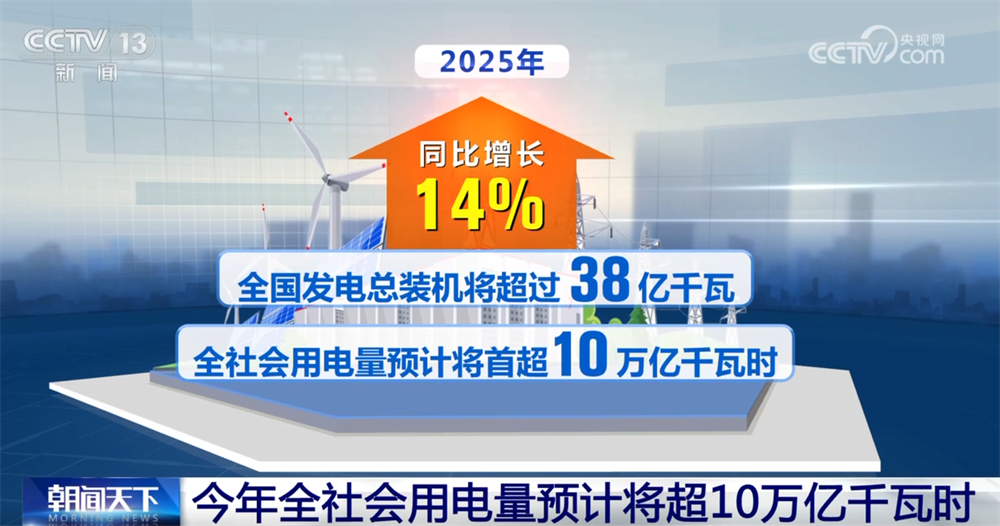
今年全社会用电量预计将超10万亿千瓦时
Sou Hu Cai Jing· 2025-12-16 09:45
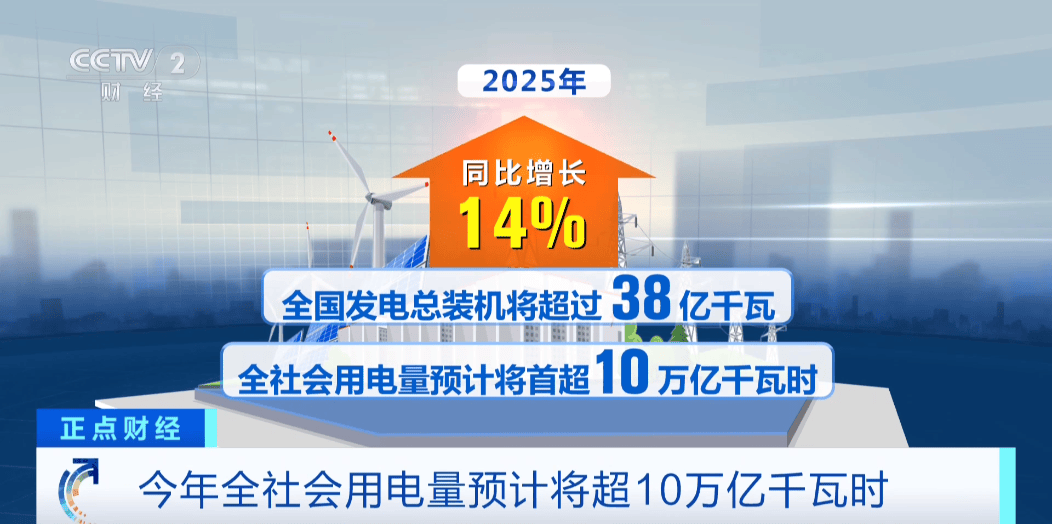
Core Insights - The national electricity supply in China remains safe and stable, with total electricity consumption expected to exceed 10 trillion kilowatt-hours this year [1][3] Group 1: Electricity Supply and Demand - The total installed power generation capacity in China is projected to exceed 3.8 billion kilowatts by 2025, representing a year-on-year growth of 14% [3] - The anticipated electricity consumption of over 10 trillion kilowatt-hours this year is approximately double the total electricity consumption in 2015 [3] Group 2: Sector Performance - High-tech and equipment manufacturing sectors are leading in electricity consumption growth, with predicted year-on-year increases of over 20% for new energy vehicle manufacturing and over 30% for wind energy equipment manufacturing from January to November [5] - The internet and related services sector is expected to see a year-on-year electricity consumption growth of over 30%, while the charging and swapping service sector is projected to grow nearly 50% [5]
从“10万亿千瓦时”透视中国经济澎湃活力 全国电力供应保持安全稳定
Yang Shi Wang· 2025-12-16 01:34
Core Insights - The national electricity supply in China remains safe and stable, with total electricity consumption expected to exceed 10 trillion kilowatt-hours this year [1][3] Group 1: Electricity Supply and Demand - The total installed power generation capacity in China is projected to exceed 3.8 billion kilowatts by 2025, representing a year-on-year growth of 14% [3] - The anticipated total electricity consumption of over 10 trillion kilowatt-hours will be approximately double the total consumption in 2015 [3] Group 2: Sector Performance - High-tech and equipment manufacturing sectors are leading in electricity consumption growth, with specific segments like new energy vehicle manufacturing and wind energy equipment manufacturing expected to see year-on-year growth rates exceeding 20% and 30%, respectively [6] - The internet and related services sector is also experiencing significant growth, with electricity consumption increasing by over 30% year-on-year, while the charging and swapping service sector is seeing nearly 50% growth [6]
新纪录!2025年全国全社会用电量预计首超10万亿千瓦时
Xin Hua Wang· 2025-12-15 21:28
Group 1 - The total electricity consumption in China is expected to exceed 10 trillion kilowatt-hours for the first time in 2025, marking a significant milestone in the country's economic and energy development [1][3] - This consumption level is approximately double that of 2015 and surpasses the combined electricity consumption of the EU, Russia, India, and Japan in the previous year [1][3] - The growth in electricity consumption reflects the robust vitality of the Chinese economy, driven by high-tech and equipment manufacturing sectors, with predictions indicating over 20% and 30% growth in specific areas like new energy vehicle manufacturing and wind energy equipment manufacturing [3][4] Group 2 - The total installed power generation capacity in China is expected to exceed 3.8 billion kilowatts, supported by a diverse range of energy sources including coal, hydro, wind, and solar [4] - China's power grid features the highest voltage levels and longest ultra-high voltage transmission lines globally, with a supply reliability rate of 99.924% [4] - The integration of new energy sources is increasing, with new energy storage installations surpassing 10 million kilowatts and wind and solar power expected to account for approximately 22% of total electricity consumption [4]