
私募证券投资

Search documents
A股大涨,私募净值却大回撤!紧急回应来了
Zhong Guo Ji Jin Bao· 2025-08-18 15:57
Core Viewpoint - The recent announcement from Qingdao Leang Asset Management indicates that market-neutral strategies experienced significant weekly drawdowns due to three main factors: poor Alpha environment, unfavorable style Beta, and substantial convergence of basis spreads [1][4][5]. Group 1: Reasons for Drawdown - The Alpha environment was unfavorable, with the average stock market increase of 2.0% and a median increase of only 0.36%, indicating insufficient market momentum and low inherent volatility, leading to fewer Alpha opportunities for quantitative strategies [4]. - There was a notable structural differentiation in the A-share market, with the CSI 300 index rising by 2.37%, the CSI 500 by 3.88%, and the CSI 1000 leading with a 4.09% increase, while micro-cap stocks fell by 0.65%. Only 23% of stocks outperformed the CSI 1000 index, posing challenges for market-neutral strategies [4][5]. - The basis spread for the main contract (IM2509) converged by over 1% within the week, resulting in an additional 1% drawdown in product net value. Overall, the market-neutral products experienced approximately a 3% drawdown [5]. Group 2: Company Overview - Qingdao Leang Asset Management was established in November 2018 and registered with the Asset Management Association of China in April 2019. The company has a registered capital of 10 million yuan and operates in Shanghai with a total of 14 full-time employees [6]. - The firm manages 32 private equity products with an asset management scale ranging from 2 billion to 5 billion yuan [6].

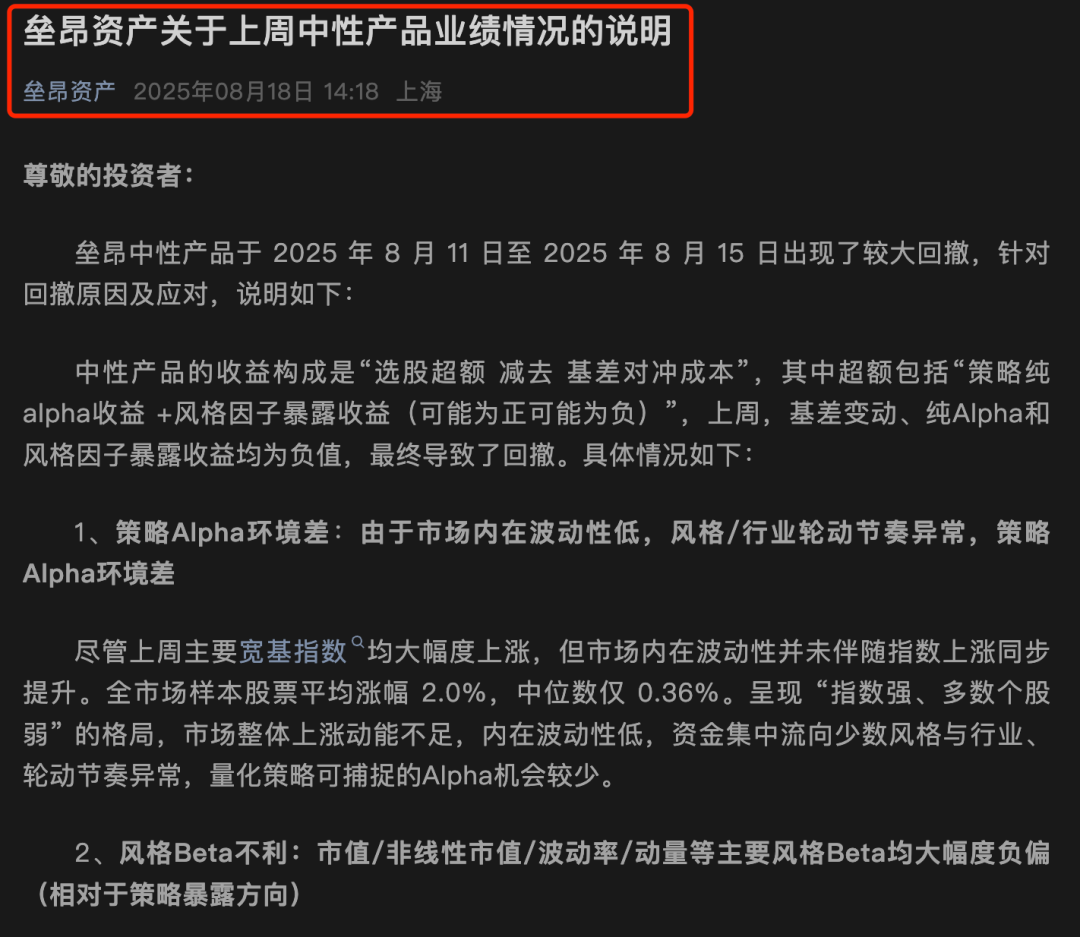
A股大涨,私募净值却大回撤!紧急回应来了
中国基金报· 2025-08-18 15:34
Core Viewpoint - The article discusses the significant weekly drawdown in market-neutral strategies by quantitative private equity firms, attributing it to three main reasons: poor Alpha environment, unfavorable style Beta, and substantial convergence of basis [2][3][6]. Group 1: Reasons for Drawdown - The Alpha environment was poor, with the average stock in the market only rising by 2.0% and the median increase being just 0.36%, indicating insufficient overall market momentum [6]. - There was a notable structural differentiation in the A-share market, with the CSI 1000 index leading with a 4.09% increase, while only 23% of stocks outperformed the CSI 1000 index, posing challenges for market-neutral strategies [6][10]. - The basis for the main futures contract used for hedging (IM2509) converged by over 1% within the week, leading to an additional 1% drawdown in product net value [6][7]. Group 2: Performance Summary - The market-neutral products experienced an approximate 3% drawdown due to the combined effects of a poor excess return environment, the strong performance of the CSI 1000 index, and the convergence of the basis [7]. - Despite the drawdown, firms believe that the overall basis environment will improve, allowing for recovery in market-neutral strategies [7][12]. Group 3: Company Profile - Qingdao Leang Asset Management Co., Ltd. was established in November 2018 and registered with the Asset Management Association of China in April 2019, with a registered capital of 10 million yuan [8]. - The company currently manages 32 private equity products with a management scale ranging from 2 billion to 5 billion yuan [7][8].

每日市场观察-20250808
Caida Securities· 2025-08-08 02:08
Market Overview - On August 7, the market experienced fluctuations, with the Shanghai Composite Index rising by 0.16% and the ChiNext Index falling by 0.68%[3] - The total trading volume reached 1.85 trillion CNY, an increase of approximately 90 billion CNY compared to the previous trading day[1] Sector Performance - More than half of the sectors saw gains, with notable increases in non-ferrous metals, real estate, beauty care, and textiles[1] - The semiconductor sector showed significant activity, indicating continued investment interest in technology[1] Capital Flow - On August 7, the net inflow for the Shanghai Stock Exchange was 4.396 billion CNY, while the Shenzhen Stock Exchange saw a net outflow of 7.555 billion CNY[4] - The top three sectors for capital inflow were semiconductors, consumer electronics, and new metal materials, while the sectors with the highest outflows included chemical pharmaceuticals, components, and batteries[4] Economic Indicators - As of the end of July, China's gold reserves stood at 73.96 million ounces (approximately 2,300.41 tons), marking an increase of 60,000 ounces (approximately 1.86 tons) for the ninth consecutive month[5] - In July, China's exports reached 2.31 trillion CNY, reflecting an 8% year-on-year growth, while imports totaled 1.6 trillion CNY, up 4.8%[6] Fund Dynamics - The first batch of 26 new floating-rate funds has begun to establish positions, with 22 of them achieving positive returns since inception, representing over 80% of the total[12] - The number of newly registered private equity securities investment funds in July increased by nearly 20% compared to June, reaching a two-year monthly high[13]
【私募调研记录】正圆投资调研维力医疗、晶科能源等3只个股(附名单)
Zheng Quan Zhi Xing· 2025-08-01 00:06
Group 1: Weili Medical - Weili Medical reported that its overseas production costs are slightly higher than domestic ones, but savings on shipping and storage are expected to keep gross margins stable [1] - The gross margin for urology products exceeds 70%, driven by domestic brand effects, import substitution, and overseas market expansion [1] - The company has increased its efforts to export urology products since 2023, resulting in significant growth in external sales revenue over the past two years [1] - Production capacity is concentrated in five cities, with new factories being built in Indonesia and Mexico to mitigate geopolitical risks and enhance automation levels [1] Group 2: JinkoSolar - JinkoSolar emphasized the need to control new capacity in the photovoltaic industry to address intense competition and guide prices back to rational levels [2] - The company is making progress in upgrading high-power products, with partial deliveries of products over 640W expected in Q3, and a majority of orders transitioning to these products next year [2] - JinkoSolar anticipates that its TOPCon capacity will reach 670W next year, with potential for 680-700W in the next 2-3 years, and aims to improve battery mass production efficiency to over 28% [2] - The global photovoltaic market demand remains stable, with a return to normal demand in China and rapid growth in emerging overseas markets, leading to stable component prices [2] Group 3: Yahua Group - Yahua Group is a leading producer of lithium salt products, particularly battery-grade lithium hydroxide, with industry-leading production technology and stable product quality [3] - The company serves major global automotive and battery manufacturers, with top clients like Tesla, LGES, and CATL accounting for 90% of revenue [3] - Yahua has established a diversified supply chain for lithium ore, including self-controlled mines in Zimbabwe and Sichuan, as well as long-term purchase agreements for external sources [3] - The company’s civil explosives business covers over 20 provinces in China and extends to countries like Australia, New Zealand, and Zimbabwe [3] - In 2024, Yahua plans to hedge against price fluctuations in lithium salt products through futures contracts for lithium carbonate [3] Group 4: Institutional Overview - Shenzhen Zhengyuan Investment was established in 2015 in the Qianhai Free Trade Zone and obtained a private securities investment fund license in the same year [4] - The firm has a professional research team, rich investment experience, and a comprehensive risk management system [4] - Zhengyuan focuses on the transformation and upgrading of the Chinese economy, aiming to connect social capital with quality industries to achieve asset preservation and appreciation for clients [4]



北证产品夺冠!一图揭秘量创投资“量化+多资产配置”策略
私募排排网· 2025-07-27 08:45
Core Viewpoint - The article highlights the impressive performance and growth of Liang Chuang Investment, a quantitative investment management firm, which has achieved top rankings in various categories of private equity funds as of mid-2025 [3][5]. Company Overview - Liang Chuang Investment was established in March 2016 and obtained its private fund manager license in July of the same year. The company focuses on quantitative investment strategies across multiple asset classes, including stocks, futures, options, and bonds [2]. - The firm has developed its own database, factor library, and trading systems, and has recently formed an AI team to enhance its investment strategies through artificial intelligence [2]. Performance Metrics - As of June 30, 2025, Liang Chuang Investment achieved an average return of ***% in the first half of the year, ranking first among quantitative private equity firms [3]. - The firm's product "Liang Chuang Quantitative North Stock Selection No. 1 A Class" also ranked first in the quantitative multi-strategy category with a return of ***% [3]. - The firm has consistently ranked at the top in various categories, including being the number one in the mid-generation quantitative private equity sector for firms established between 5 to 10 years [3]. Development History - Liang Chuang Investment has evolved its strategies over the years, starting with stock arbitrage in 2016, and has since introduced various quantitative strategies, including AI-driven models and all-weather strategies [5][6]. Team Structure - The company has a total of 22 employees, with 16 in the investment research team, ensuring a collaborative environment for strategy development and execution [7]. Core Advantages - **Data-Driven and Model-Oriented**: The firm utilizes its proprietary data platform and modeling systems to create systematic investment strategies, minimizing emotional biases [11]. - **Asset Diversification and Multi-Strategy Collaboration**: By combining different styles and asset classes, the firm aims to reduce risk and enhance portfolio stability [12]. - **Prudent Risk Management**: The company emphasizes strict risk controls, including position limits and volatility management [13]. - **Continuous Iteration and Dynamic Optimization**: Strategies are regularly assessed and adjusted based on real-time market feedback to maintain adaptability [14]. Product Lines - The firm offers a multi-strategy approach that balances various asset classes to achieve stable returns across different economic conditions, focusing on risk parity [15]. - Notable products include "Liang Chuang All-Weather Yuan Yu No. 1" and "Liang Chuang Quantitative North Stock Selection No. 1," both of which have shown significant returns since their inception [16][17].

量化私募业绩“吊打”主观私募?1000指增、选股策略集体爆发,有产品年内狂赚46%
Mei Ri Jing Ji Xin Wen· 2025-07-24 08:21
Core Viewpoint - The A-share market is experiencing a volatile upward trend, with small-cap growth style indices performing strongly, highlighting a structural market characteristic [1][2] Group 1: Performance of Quantitative and Subjective Strategies - Quantitative private equity funds have shown remarkable performance, with many strategies yielding over 30% returns year-to-date as of July 11 [1][2] - In contrast, subjective private equity funds, particularly those with over 100 billion in assets, have lagged behind due to strategy limitations, with an average return of 11.38% for their long-only equity products [3] Group 2: Quantitative Strategy Performance - The 1000 index growth strategy has outperformed, with top performers like Lingjun's 1000 index growth strategy achieving a return of 36.79% and an excess return of 17.4% [3] - The 500 index growth strategies also performed well, with top returns of 33.13% from Xinhong Tianhe and 30.63% from Abama [2][3] - The 300 index growth strategies have underperformed, with the highest return being 19.13% from Lingjun [2] Group 3: Quantitative Stock Selection Strategies - Quantitative stock selection strategies have emerged as the biggest winners, with the highest return reaching 46.26% from Xiaoyong's strategy [4] - Many quantitative private equity firms are promoting "full market stock selection" products, aiming to maximize absolute returns without additional risk [4][5] Group 4: Market Research and Trends - A total of 135 quantitative private equity firms have participated in A-share company research activities this year, covering 395 stocks across 29 industries [6] - The electronics, pharmaceuticals, and machinery sectors have been the most frequently researched, indicating a focus on these industries by quantitative firms [6]
徐翔旗下私募规模跃升3级!蒙玺、泓湖等16家私募荣升百亿!328家私募年内规模跃升!
私募排排网· 2025-07-19 10:04
Core Viewpoint - The A-share market maintained a sideways trend in the first half of 2025, with significant sector differentiation, while private equity securities investment funds in China saw an increase in total scale [2][3]. Group 1: Market Performance - In the first half of 2025, the A-share market showed a slight increase, with the Shanghai Composite Index rising by only 2.76% [2]. - The US stock market exhibited a V-shaped recovery, with both the Nasdaq and S&P 500 indices increasing by over 5% [2]. - The Hong Kong stock market performed relatively strongly, with the Hang Seng Index rising nearly 20% [2]. Group 2: Private Equity Fund Scale - As of June 2025, the total scale of private equity securities investment funds in China reached 5.56 trillion yuan, an increase of approximately 350 billion yuan compared to the end of 2024 [2][3]. - The number of private equity fund managers decreased to 7,761, down by 239 from the end of 2024, while the number of funds decreased to 83,356, down by 4,477 [2]. Group 3: Performance of Private Equity Firms - In the first half of 2025, 328 private equity firms achieved a management scale increase of at least one tier compared to the end of 2024 [3][4]. - Sixteen firms entered or re-entered the 100 billion yuan private equity club, with quantitative firms accounting for nine and subjective firms for six [4]. - Notable firms such as Fusheng Asset and Mengxi Investment reported average returns exceeding ***% in the first half of the year [4][8]. Group 4: Investment Strategies and Locations - By core strategy, 203 firms focused on stock strategies, 48 on multi-asset strategies, 33 on futures and derivatives, and 15 on bond strategies [4]. - Geographically, Shanghai had the highest concentration of firms with 127, followed by Beijing with 50 and Shenzhen with 41 [4]. Group 5: Top Performing Private Equity Firms - The top five private equity firms by performance in the first half of 2025 were Tongben Investment, Luyuan Private Equity, and Chengyao Private Equity, among others [15][20]. - Fusheng Asset, a subjective stock strategy firm, achieved the highest average return in the first half of 2025 [8][15].

中小市值策略持续火热!百亿量化业绩“炸裂”,警惕回撤风险
券商中国· 2025-07-10 06:28
Core Viewpoint - The small and mid-cap strategy has become a blue ocean for quantitative investment in 2023, particularly with the small-cap index enhancement strategy gaining significant attention in the market [1][4]. Group 1: Performance of Quantitative Private Equity - Several leading quantitative private equity products have achieved annual returns exceeding 20%, with some even reaching 30%, showcasing impressive excess returns [2][6]. - The average return for quantitative private equity firms with over 10 billion in assets reached 13.54% in the first half of the year, with all firms reporting positive returns [7][8]. Group 2: Market Dynamics and Strategy Shifts - The market has seen frequent style rotations since September 2024, with small and mid-cap stocks outperforming large-cap stocks, leading to a significant increase in the allocation of small-cap stocks by quantitative strategies [5][12]. - The CSI 2000 index has risen by 16.41% this year, significantly outperforming other indices, indicating a strong focus on small-cap stocks [5][6]. Group 3: Factors Driving Small-Cap Strategy Popularity - The small-cap strategy's success is attributed to a combination of market conditions, funding preferences, and technological advancements [10][11]. - The current market environment, characterized by wide fluctuations and increased stock volatility, provides ample trading opportunities for quantitative strategies [12]. - Supportive policies for "new productive forces" have made small-cap companies attractive for innovation, leading to a preference for high-tech, stable-return quantitative strategies [12][13]. Group 4: Risks and Adjustments - As small-cap stock valuations rise rapidly, the sustainability of the small-cap strategy faces challenges, with some quantitative firms tightening risk exposure and optimizing strategy models [3][15]. - The CSI 2000 index's price-to-earnings ratio stands at 135.1, indicating that current valuations are higher than 95% of historical levels, raising concerns about potential market corrections [16][18]. - Some quantitative firms have begun to diversify factors and reduce strategy homogeneity to maintain effective and stable returns amid increasing competition [18][19].

上半年新备案私募证券产品环比翻倍 量化指数增强策略最受市场青睐
Zheng Quan Shi Bao· 2025-07-07 17:55
Group 1 - The core viewpoint is that the sales of private securities investment products are gradually increasing due to the continuous decline in financial product yields and a recovery in the capital market [1] Group 2 - In the first half of the year, a total of 5,461 new private securities investment products were registered, representing a year-on-year increase of 53.61% and a month-on-month increase of 100.48% [2] - In June alone, 1,100 private securities investment fund products were registered, marking a monthly increase of 26.44% and the second-highest monthly figure of the year [2] - Stock strategies remain the dominant force in private fund registrations, with 3,458 new stock strategy private products accounting for 63.32% of the total [2] - Quantitative stock strategies are particularly popular, with 1,715 registered products, making up 70.06% of the quantitative strategy private products [2] Group 3 - The decline in deposit rates, with one-year fixed deposit rates falling below 1%, has contributed to the growth in private product issuance as they offer relatively higher returns [3] - The top three performing strategies in the first half of the year were the Tangpu 1000 Index Enhanced Private Index (+15.87%), Tangpu Subjective Growth Private Index (+12.80%), and Tangpu 500 Index Enhanced Private Index (+10.66%) [3] - Among the 33 private institutions with at least 20 registered products, 27 are quantitative private institutions, with 18 being large-scale institutions managing over 10 billion [3] - As of June, 2,010 private products reached historical net asset value highs, representing approximately 45.68% of those with nearly one year of performance data [3] Group 4 - Private institutions are generally optimistic about the second half of the year, focusing on sectors such as technology, consumption, innovative pharmaceuticals, and dividend assets [4] - The liquidity environment is expected to remain relatively loose, reducing the probability of systemic risks [4] - A total of 751 private securities managers participated in A-share listed company research, covering 387 stocks across 28 industries, with a total of 1,769 research instances [4] - The strategy for future market positioning includes a focus on high-quality companies that are undervalued, particularly in the internet, electronics, and automotive sectors [4]
【私募调研记录】大岩资本调研慈星股份
Zheng Quan Zhi Xing· 2025-07-04 00:13
Group 1: Company Insights - Daya Capital recently conducted research on Cixing Co., which is experiencing both resilience and pressure in the computer knitting machine industry, with a stable start in Q1 but a short-term slowdown in order volume and compressed profit margins [1] - Cixing Co. employs a buyer credit model where customers pay a down payment, and the remaining amount is financed by partner banks, with the company providing joint liability guarantees [1] - The overseas market accounts for 10%-15% of Cixing Co.'s business, primarily in emerging markets such as Southeast Asia, Mexico, Russia, and Egypt, with significant growth observed in Vietnam and Cambodia [1] Group 2: Strategic Developments - Cixing Co. has acquired Shunyi Technology, which focuses on health management and intelligent detection equipment, initially in the defense technology sector and gradually expanding into civilian applications [1] - The acquisition aims to facilitate transformation and upgrade, overcoming industry bottlenecks through collaborative innovation in technology, digitalization, special materials, and channels [1] - Shunyi Technology reported a loss in Q1 2025 due to the seasonal characteristics of the military industry, resulting in lower product deliveries and revenue [1] Group 3: Future Growth Prospects - Cixing Co. plans to continue focusing on its core business, developing niche models, and expanding into smart wearables and medical textiles within the non-apparel technology sector to identify new growth opportunities [1]
