软件和信息服务

Search documents
中国制造业全球位势明显提升(锐财经)
Ren Min Ri Bao Hai Wai Ban· 2025-12-10 23:20
Core Insights - The Chinese industrial and information technology sector has made significant progress in 2020 despite challenges posed by the COVID-19 pandemic and external environmental changes [1][2][4]. Group 1: Industrial Economic Performance - In 2020, the industrial added value of large-scale industries increased by 2.8% compared to the previous year, with a quarterly recovery in growth rates [2][4]. - The Ministry of Industry and Information Technology (MIIT) coordinated financial institutions to provide over 350 billion yuan in new funding to support enterprises [2]. - The manufacturing Purchasing Managers' Index (PMI) was 51.9% in December 2020, remaining above the threshold for ten consecutive months, indicating improving business conditions [5]. Group 2: Support for Pandemic Response - The industrial and information technology system established a comprehensive emergency production system for medical supplies, significantly enhancing supply capabilities [2][4]. - The "Communication Big Data Travel Card" service was launched, with over 5.1 billion queries throughout the year, aiding in precise pandemic prevention efforts [2]. Group 3: Manufacturing Transformation and Upgrading - The integration of industrialization and informatization has accelerated, with new industries and business models experiencing growth. The added value of equipment manufacturing increased by 6.6%, and high-tech manufacturing grew by 7.1% in 2020 [4][5]. - High-tech manufacturing investment rose by 11.5%, driven by the rapid development of new infrastructure such as 5G and industrial internet [5][6]. Group 4: Development of Small and Medium Enterprises - Since the pandemic, various supportive policies have been implemented, leading to a steady recovery in the economic performance of small and medium enterprises (SMEs). From January to November 2020, profits of large-scale SMEs increased by 6.9% year-on-year [7]. - The MIIT aims to enhance the innovation capabilities of SMEs, with plans to cultivate 100,000 "specialized, refined, distinctive, and innovative" enterprises over the next three to five years [7][8]. Group 5: 5G and Digital Transformation - Over 600,000 new 5G base stations were built in 2020, achieving full coverage in all cities above the prefecture level, with over 200 million 5G terminal connections [6]. - The implementation of over 1,100 5G and industrial internet projects has accelerated the digital transformation across various industries [6]. Group 6: Overall Industrial Positioning - The achievements in 2020 mark the successful conclusion of the 13th Five-Year Plan, with significant advancements in key technologies and equipment manufacturing, enhancing China's position in the global industrial value chain [4][10].

北京专精特新专板企业达千家
Ren Min Ri Bao· 2025-12-07 22:02
本报北京12月7日电 (记者王洲)截至11月30日,北京专精特新专板企业达1000家,提前完成专板培育 企业数量目标,专板企业高精尖产业集聚特征显著。其中,近九成归属新一代信息技术、软件和信息服 务、人工智能、生物医药、智能制造、新能源等前沿领域。此外,高研发也是专板企业呈现出的一大突 出特点,近七成企业在研发上的投入超过行业平均水平。 北京股权交易中心将专板建设与专精特新中小企业上市培育融合,通过上市政策宣讲、专板服务讲解、 上市路径选择、三四板协同发展等一系列主题培训活动,不断发挥专板作为专精特新企业挂牌上市"蓄 水池"的功能。专板面向北京市专精特新等优质中小企业提供股债融资、上市培育等综合金融服务,深 化多层次资本市场互联互通。 《 人民日报 》( 2025年12月08日 06 版) (责编:赵欣悦、袁勃) 关注公众号:人民网财经 ...
北京“专精特新”专板进入千家时代,企业融资规模全国领跑
Xin Jing Bao· 2025-12-01 09:29
Core Insights - As of November 30, 2023, the number of enterprises on Beijing's "Specialized, Refined, Characteristic, and Innovative" board has reached 1,000, achieving the target set in the construction plan ahead of schedule [1] - The board was launched on August 24, 2023, with an initial 50 enterprises, and aims to cultivate over 1,000 specialized enterprises by the end of December 2025 [1] - The board consists of three tiers: "Incubation Layer," "Standard Layer," and "Cultivation Layer," each with different entry standards [1] Enterprise Distribution - Among the 1,000 enterprises, there are 221 innovative SMEs, 541 specialized and refined SMEs, and 187 "little giant" enterprises [1] - The "Cultivation Layer" currently has nearly 200 enterprises, specifically 172 [2] - The enterprises on the board are primarily concentrated in high-tech industries, with nearly 90% belonging to cutting-edge fields such as new generation information technology, software and information services, artificial intelligence, biomedicine, intelligent manufacturing, new energy, and materials [2] Financial Performance - The total equity financing amount for the enterprises on the board has exceeded 40 billion yuan, leading the nation in terms of financing scale and policy support [2]
地方政府与城投企业债务风险研究报告:成都篇
Lian He Zi Xin· 2025-11-25 11:37
1. Report Industry Investment Rating No relevant information provided. 2. Core Viewpoints of the Report - Chengdu is a key city in the national regional development strategy, with significant economic scale and fiscal strength. In 2024, its economy steadily improved, and the general public budget revenue slightly increased, but the comprehensive fiscal resources declined due to the decrease in government - funded revenue. With favorable national policies, it aims to build into an influential regional economic and technological innovation center [4]. - Chengdu conducts industrial spatial layout around the principle of "Eastward Expansion, Southward Extension, Westward Control, Northward Reconstruction, and Central Optimization". The economic and fiscal strength shows a decreasing trend from the inner - circle to the outer - circle areas. The government debt level in the main urban area is much lower than that in other districts and counties, and the city is strengthening the resolution of existing debts [4]. - Affected by the implementation of a package of debt - resolution policies, the bond issuance scale in Chengdu decreased significantly in 2025, with net outflows in bond financing. The financing structure of bond - issuing城投 enterprises is mainly bank loans and bond financing. The short - term debt repayment pressure in the near - suburban and far - suburban areas is relatively large [4]. 3. Summary According to Relevant Catalogs 3.1 Chengdu's Economic and Fiscal Strength 3.1.1 Regional Characteristics and Economic Development - Chengdu is a provincial capital, sub - provincial city, and national central city, playing a prominent role in the national regional development strategy. It has obvious locational advantages, with developed aviation transportation and rich water, mineral, and tourism resources. The population shows a continuous net inflow, and the urbanization rate has room for further improvement. In 2024, its GDP exceeded 2.30 trillion yuan, ranking third among sub - provincial cities, with a growth rate of 5.7%. The tertiary industry contributes significantly to the economy, and the city is focusing on cultivating industrial clusters such as electronic information, equipment manufacturing, and aerospace [5][7][8]. - In the future, under the guidance of national policies, Chengdu will build a new urban development pattern of "One Mountain Connecting Two Wings" and adhere to the "One - Game - of - Chess" concept of Sichuan and Chongqing to enhance its international competitiveness and regional radiation ability [11]. 3.1.2 Fiscal Strength and Debt Situation - Chengdu's fiscal strength ranks high among national sub - provincial cities, with strong stability of general public budget revenue and fiscal self - sufficiency. In 2024, the comprehensive fiscal resources declined due to the decrease in government - funded revenue. The government debt level ranked in the upper - middle position among sub - provincial cities in 2024. With large - scale future project investments, the government debt ratio may continue to rise [12][13]. 3.2 Economic and Fiscal Conditions of Each District and County in Chengdu 3.2.1 Economic Strength of Each District and County - Chengdu conducts industrial spatial layout according to the principle of "Eastward Expansion, Southward Extension, Westward Control, Northward Reconstruction, and Central Optimization" to achieve industrial differentiation and clustering. The economic scale of Chengdu High - tech Zone is far ahead, and the economic scale and urbanization rate of other districts and counties decrease layer by layer from the inner - circle to the outer - circle areas. The main urban area has obvious advantages in per - capita GDP and urbanization rate, and the far - suburban areas are relatively weak [16][22]. 3.2.2 Fiscal Strength and Debt Situation of Each District and County - Fiscal Revenue: The fiscal strength of Chengdu High - tech Zone is the strongest, and the fiscal strength of other districts and counties decreases from the main urban area to the outside. The general public budget revenue of Chengdu High - tech Zone, Chengdu Tianfu New Area, and the main urban area is relatively stable, while the comprehensive fiscal resources of the far - suburban areas rely more on superior subsidies. In 2024, the comprehensive fiscal resources of most far - suburban areas increased due to the growth of superior subsidies, while those of other areas declined to varying degrees due to the decrease in government - funded revenue [25][29]. - Debt Situation: The government debt level in the main urban area is much lower than that in other districts and counties. The government debt distribution is related to the industrial layout and development principle. In 2024, the government debt scale of each district and county generally increased. The main urban area had a significant increase in government debt mainly due to the large - scale issuance of refinancing special bonds. The city is strengthening debt management and promoting debt resolution and replacement [32][34]. 3.3 Debt - Repayment Ability of Chengdu's城投 Enterprises 3.3.1 Overview of Chengdu's城投 Enterprises - As of the end of October 2025, there were 106城投 enterprises with outstanding bonds in Chengdu, a decrease of 5 compared with the previous year. Among them, there are 9 municipal - level, 3 park - level, and 94 district - and - county - level城投 enterprises. In terms of grade distribution, there are 10 AAA - rated, 34 AA + - rated, and 57 AA - rated enterprises. Jin tang County has the most bond - issuing城投 enterprises [36]. 3.3.2 Bond Issuance of城投 Enterprises - In 2024, the number and scale of bonds issued by Chengdu's城投 enterprises decreased compared with the previous year. In 2025, from January to October, the bond issuance scale continued to decline, with a year - on - year decrease of about 28%. Most of the bond financing is used for debt rollover, and the overall bond financing shows a net outflow [39][40]. 3.3.3 Debt - Repayment Ability Analysis of Chengdu's城投 Enterprises - The financing structure of Chengdu's城投 enterprises is mainly bank loans and bond financing. Some district - and - county - level城投 enterprises have heavy debt burdens. In the next two years, the bond maturity scale of some districts and counties is relatively large, and the short - term debt - repayment ability of some areas is weak. The refinancing ability of the main urban area and near - suburban areas is significantly stronger than that of the far - suburban areas [45][49][51]. 3.3.4 Support and Guarantee Ability of Fiscal Revenue of Each District and County in Chengdu for the Debt of Bond - Issuing城投 Enterprises - Overall, the debt scale of Chengdu's城投 enterprises is large, and the ratio of "total debt of bond - issuing城投 enterprises + local government debt" to comprehensive fiscal resources in most districts and counties exceeds 500% [53].
上海杨浦向新而行,全域创新活力奔涌 全力推进杨“数”浦新质秀带创新区建设
Ren Min Ri Bao· 2025-11-24 23:12
Core Insights - Yangpu District is transforming from an industrial area to an innovation hub, focusing on integrating various innovation resources and fostering a vibrant ecosystem for technological advancements [1][11]. Group 1: Innovation and Research - The "Yang's Digital Innovation Zone" plan outlines 23 key tasks aimed at enhancing innovation across the district, promoting a free flow of innovative elements [1]. - Yangpu District leverages its proximity to universities like Fudan University to foster collaboration between research teams and industry, resulting in 26 papers published in major international journals in the first half of the year [2]. - The district supports high-level innovation platforms, including the Shanghai Mathematics and Interdisciplinary Research Institute, to enhance research capabilities and entrepreneurial support [3]. Group 2: Economic Development - Yangpu District is home to over 8,300 digital economy enterprises, contributing more than 40% of the district's tax revenue and over 60% of its revenue, establishing itself as a key growth area for Shanghai's digital economy [4]. - The online new economy sector, particularly software and information services, reported revenues of 289.07 billion yuan in the first nine months of the year, marking a 27.4% year-on-year growth [7]. Group 3: Innovation Ecosystem - The district has established a comprehensive innovation and entrepreneurship system, exemplified by the growth of companies like Shangmi Technology, which has expanded from a small office to a global enterprise [4]. - Yangpu District promotes collaboration between universities and industries through initiatives like the "City's Immersive Scene Innovation Center" with Huawei, enhancing the integration of education and industry [5]. Group 4: Future Industry Development - Yangpu is actively developing new industries such as brain-like intelligence and embodied intelligence, with the establishment of the first future industry cluster in Shanghai focused on brain-like intelligence [8]. - The district aims to attract 100 AI companies to the AI Agent Industrial Park over the next three years, fostering a new ecosystem that integrates AI with various industries [8]. Group 5: Innovation Index and Support - The Yangpu Innovation Index has shown a stable growth rate of 12.9% annually over the past nine years, reflecting the district's increasing capacity for technological innovation [10]. - In 2024, the district's R&D investment intensity is projected to reach 4.83%, with a notable increase in the number of patents per capita, indicating a robust innovation environment [10].
着力提升超大城市发展、服务、治理能力—— 重庆推进市域数字化转型
Ren Min Ri Bao· 2025-11-19 22:47
Core Insights - The article emphasizes the integration of digital transformation in Chongqing, enhancing urban governance and service efficiency through advanced technologies and data management [1][2][4][6]. Group 1: Digital Transformation in Urban Governance - Chongqing is actively exploring digital transformation to improve urban governance, aiming for smarter, more efficient, and precise city management [1][6]. - The establishment of a unified intelligent public data platform allows for seamless data sharing among various departments, enhancing service delivery [4][5]. - A three-tiered digital city operation and governance center has been created, facilitating rapid information flow and coordination during emergencies [6][7]. Group 2: Industry and Technology Development - The integration of smart infrastructure in the automotive sector has led to significant advancements, such as vehicles autonomously responding to road conditions, enhancing safety [2]. - Chongqing's digital industry revenue reached 9910.2 billion yuan in 2024, reflecting a 6.1% year-on-year growth, driven by the development of software and information services [2]. - The implementation of over 6900 smart transformation projects has resulted in the establishment of 211 advanced intelligent factories, improving production efficiency and reducing operational costs [3]. Group 3: Enhanced Public Services - The "Yukuaiban" application streamlines administrative processes, allowing residents to complete multiple tasks in a single operation, significantly reducing the time required for services [4][5]. - The city has developed a one-stop service platform for enterprises, facilitating intelligent matching of service supply and demand, and proactively delivering policies to businesses [5]. - The establishment of a comprehensive risk monitoring system has improved emergency response times by threefold, enhancing public safety and urban resilience [7].

重庆推进市域数字化转型
Ren Min Ri Bao· 2025-11-19 22:20
Group 1: Digital Transformation in Chongqing - Chongqing is actively exploring digital transformation to enhance urban governance, aiming for smarter, more efficient, and precise city management [1][8] - The city has established an integrated intelligent public data platform to break down data barriers and manage digital resources effectively [1][4] - By 2024, Chongqing's digital industry revenue reached 9910.2 billion, with a year-on-year growth of 6.1% [2] Group 2: Smart Manufacturing and Industry Upgrades - Chongqing is implementing "AI + manufacturing" initiatives, resulting in a 30% increase in production efficiency and an 8% reduction in energy consumption for specific manufacturing processes [3] - The city has promoted over 6900 intelligent transformation projects and established 211 advanced intelligent factories, with a numerical control rate of key processes in large-scale industrial enterprises reaching 63.9% [3] Group 3: Enhanced Public Services - The "Yukuaiban" application allows residents to complete multiple administrative tasks in one go, significantly reducing the time needed for processes like obtaining a birth certificate [4][5] - Chongqing has created a one-stop service platform for enterprises, facilitating intelligent matching of business needs and service provisions, handling over ten thousand enterprise requests [6] Group 4: Efficient Urban Governance - The digital city operation and governance center in Chongqing enables real-time data monitoring and efficient emergency response, significantly improving governance efficiency [7] - The city has established a closed-loop mechanism for risk management, integrating 2200 million sensing devices to enhance emergency response speed by three times [8]
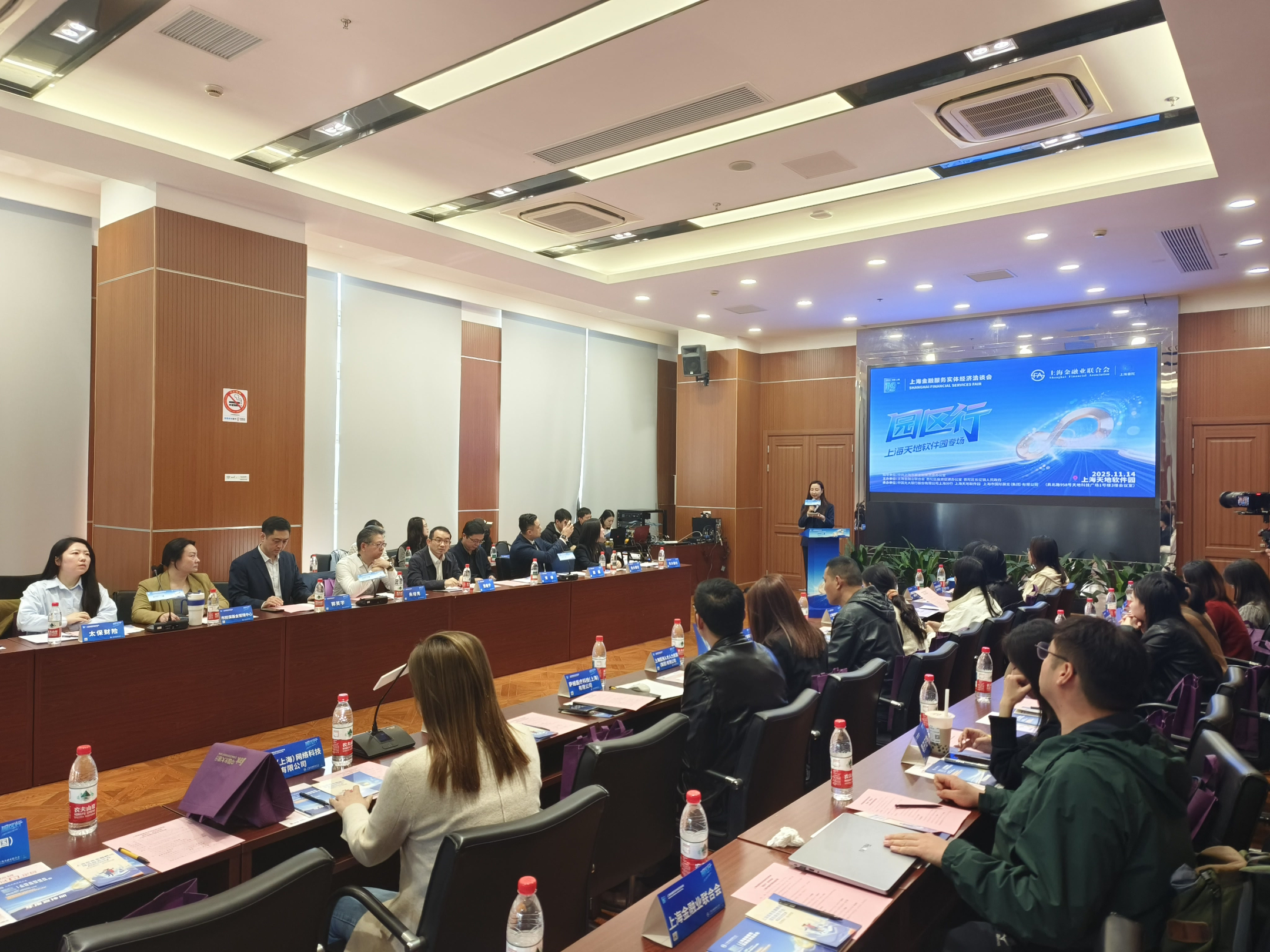
金洽会“园区行”走进普陀,金融“智囊团”精准赋能
Guo Ji Jin Rong Bao· 2025-11-15 12:56
Core Insights - The 19th Golden Fair's "Park Tour" event at the Putuo Shanghai Tiandi Software Park successfully showcased the integration of financial resources with emerging industries, emphasizing the importance of financial empowerment for the real economy [1][3]. Group 1: Event Overview - The event is part of the Golden Fair's initiative to connect financial resources with new industrial parks and enhance service linkages [1]. - The Tiandi Software Park, established in 2004 by the Putuo District government, focuses on high-tech industries such as cultural creativity, software, and information services [3]. Group 2: Financial Support for SMEs - Representatives from companies like Shanghai Xinbaishi Intelligent Technology Co., Ltd. and SAYA Medical Technology (Shanghai) Co., Ltd. engaged in discussions about financing and financial support [3]. - Financial advisors from institutions such as the Municipal Guarantee Fund Management Center and Everbright Bank provided targeted and actionable solutions to common concerns of SMEs regarding financial support [3][4]. Group 3: Diverse Financial Services - Non-bank financial institutions offer a range of support services, including comprehensive risk protection from insurance companies and full-cycle financial services from securities firms [4]. - For SMEs listed on the New Third Board, securities firms can provide guidance for listing on the Beijing Stock Exchange and facilitate industry mergers and acquisitions [4]. Group 4: Future Initiatives - The Golden Fair, which began on September 29, will host over ten specialized "Park Tour" events by the end of the year, with an online exhibition running until September 2026 [4]. - The fair aims to enhance the quality of service by facilitating connections between financial institutions and real enterprises, reinforcing the commitment of Shanghai's financial sector to support the real economy [4].
新能源汽车推广居全球城市首位,上海前三季度三大先导产业增长8.5%
Ke Ji Ri Bao· 2025-11-04 12:22
Core Insights - Shanghai's industrial economy shows a positive trend with steady growth in the first three quarters of the year, highlighted by significant achievements in various sectors [1][3] Industrial Performance - In September, the industrial added value of Shanghai grew by 8%, with a cumulative growth of 5.3%, contributing 1.1 percentage points to the city's GDP [3] - Among 35 industrial sectors, nine, including automotive manufacturing and electronic equipment manufacturing, outpaced the national average growth rate [3] - The three leading industries in Shanghai experienced an 8.5% growth, with their manufacturing output accounting for 12.3% of the city's industrial total, an increase of 0.6 percentage points compared to 2024 [3] Automotive Industry - The automotive industry in Shanghai achieved an output value of 522.5 billion yuan, a year-on-year increase of 11.8%, representing 17.7% of the city's total industrial output [4] - In the first nine months, the production of complete vehicles reached 1.236 million units, with new energy vehicles (NEVs) accounting for 64.5% of total production [4] - Cumulative promotion of NEVs exceeded 220,000 units, marking a 25.4% year-on-year increase, with a total of 1.87 million units promoted historically, leading globally [4] Major Equipment Industry - The major equipment industry in Shanghai continued to show robust growth, with key enterprises completing 3.555 million deadweight tons in the first three quarters [4] - The industry is undergoing a green transformation and digital enhancement, exemplified by the delivery of the world's first wind-assisted oil tanker and the use of RPA technology to streamline design processes [4] Software and Information Services - The software and information services sector contributed 527.743 billion yuan in added value, growing by 15.5%, surpassing the national growth rate of 11.2% [5] - This sector accounted for 13% of the city's GDP, contributing 1.7 percentage points to the overall GDP [5] - The sector's revenue reached 1.37081 trillion yuan, a 24.1% increase year-on-year, marking the fastest growth during the 14th Five-Year Plan period [5] Export Performance - Shanghai's industrial export delivery value grew by 7.1% in the first three quarters, outperforming the national average of 3.8% [5] - The three leading industries collectively exported 193.67 billion yuan, reflecting a growth of 10.3%, with significant increases in exports of industrial robots, aerospace equipment, and high-end machine tools [5]
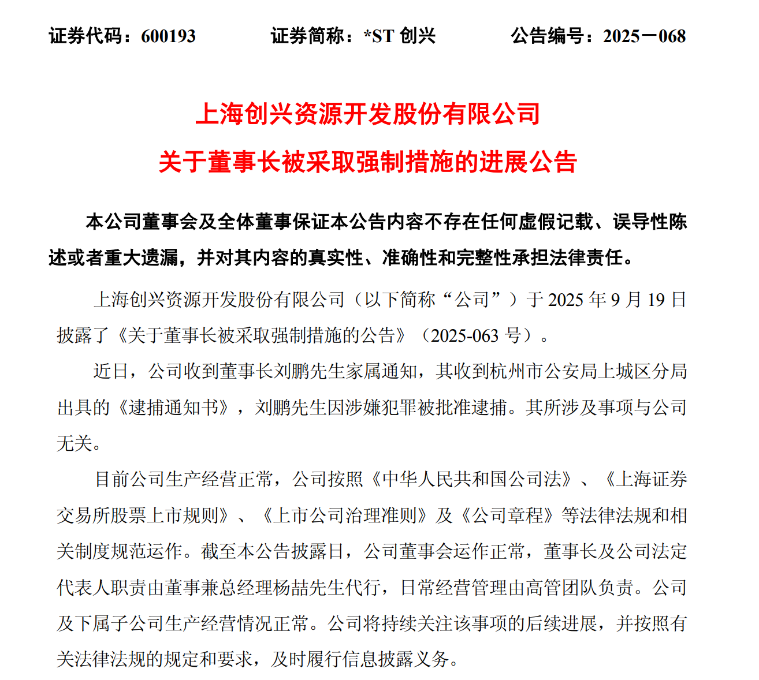
600193,董事长被批捕!业绩惨淡,退市风险高悬!
Shang Hai Zheng Quan Bao· 2025-10-30 11:20
Core Viewpoint - *ST Chuangxing (600193) is facing significant challenges due to the arrest of its chairman Liu Peng, which has raised concerns about the company's governance and operational stability, despite the company stating that its operations remain normal [1][3][4]. Group 1: Company Governance and Management - Liu Peng, the chairman of *ST Chuangxing, has been arrested on criminal charges, although the matters are unrelated to the company [1][4]. - The company's board of directors is functioning normally, with responsibilities being temporarily assumed by Yang Zhe, the general manager [3]. - The company is monitoring the situation closely and has stated that its production and operational activities are normal [3]. Group 2: Financial Performance - In the first half of the year, *ST Chuangxing reported a revenue of 374,000 yuan, a 99% decrease year-on-year, with a net loss of 13.71 million yuan [6]. - For 2024, the company achieved total revenue of 84.01 million yuan, a decline of 35.53% year-on-year, and a net loss of 193 million yuan, representing a staggering 814.99% decrease [7]. - The third quarter report for 2025 indicated a revenue of 18.73 million yuan, down 59.10% year-on-year, with a net loss of 14.49 million yuan [9]. Group 3: Operational Challenges - The company has faced significant operational challenges, particularly in its construction business, which did not generate new revenue during the reporting period [6]. - The company is focusing on improving its project acquisition capabilities and managing credit risks to enhance its operational sustainability [6]. Group 4: Shareholder Changes and Market Position - In July 2023, *ST Chuangxing underwent a change in control, with Liou Co. becoming the largest shareholder by acquiring 9.87% of the company [8]. - The new controlling shareholder, Wang Xiangrong, has raised questions about the motivations behind the investment, especially given the company's precarious financial situation [8][11].