
集成电路制造业

Search documents
31个省份经济“三季报”出炉 长三角表现突出
Zheng Quan Ri Bao· 2025-11-02 17:16
Economic Overview - Tibet achieved a GDP of 207.006 billion yuan in the first three quarters of 2025, with a year-on-year growth of 7.1% [1] - China's GDP for the same period reached 10,150.36 billion yuan, growing by 5.2% year-on-year [1] - Guangdong and Jiangsu provinces surpassed 10 trillion yuan in GDP, with figures of 10,517.698 billion yuan and 10,281.1 billion yuan respectively, leading the national rankings [1] Regional Economic Performance - The top ten provinces in GDP all exceeded 4 trillion yuan, indicating strong economic performance [1] - Tibet led the nation in economic growth rate at 7.1%, followed by Gansu at 6.1% and Hubei at 6% [1] - The economic performance of the Yangtze River Delta region was notable, with Jiangsu, Zhejiang, Anhui, and Shanghai showing GDP growth rates of 5.4%, 5.7%, 5.4%, and 5.5% respectively, all surpassing the national average [2] Sectoral Insights - High-tech manufacturing sectors, including artificial intelligence, integrated circuits, and biomedicine, are driving economic growth in the Yangtze River Delta [2][3] - In Shanghai, the manufacturing output of key industries grew by 8.5%, with artificial intelligence manufacturing increasing by 12.8% and integrated circuit manufacturing by 11.3% [2] Future Economic Strategies - Provinces are encouraged to boost consumption and release service consumption potential to stimulate economic growth [4] - There is a call for increased effective investment and support for private investment to stabilize growth and optimize supply [4] - Emphasis on technological innovation and the development of emerging industries such as artificial intelligence, big data, and renewable energy is crucial for future economic momentum [4]
国家发改委答证券时报记者提问时表示 将重点推进算力基础设施绿色发展
Zheng Quan Shi Bao· 2025-10-31 18:16
Economic Performance - The economic performance in the first three quarters of the year showed stability and progress, characterized by five key features: stable operation, strong momentum, improved quality and efficiency, significant resilience, and substantial potential [2] - The GDP grew by 5.2% year-on-year, maintaining a leading position among major global economies [2] - Retail sales of consumer goods increased by 4.5%, accelerating by 1.2 percentage points compared to the same period last year [2] - The industrial added value above designated size grew by 6.2%, marking the highest growth for the same period since 2022 [2] - The innovation-driven development momentum has strengthened, with China's innovation index entering the global top ten for the first time, supporting the development of emerging industries [2] Green Development Initiatives - The National Development and Reform Commission (NDRC) is focusing on promoting the green development of high-energy-consuming computing power industries [4] - The NDRC plans to optimize the construction layout of computing power infrastructure to enhance efficiency and promote resource conservation [5] - The NDRC will implement strict energy-saving reviews and carbon emission evaluations for new computing power projects, encouraging higher standards based on local conditions [5] Financial Tools and Investment - A total of 500 billion yuan in new policy-based financial tools has been fully allocated, supporting over 2,300 projects with a total investment of approximately 7 trillion yuan [7] - The funding primarily targets sectors such as digital economy, artificial intelligence, consumer infrastructure, and urban renewal projects including transportation and energy [7] - The NDRC will guide local governments in effectively utilizing the new funding and accelerating the issuance and use of special bonds [7]
经济运行态势怎么看?如何推进“双碳”工作?——国家发展改革委解读经济社会热点
Xin Hua Wang· 2025-10-31 12:24
Economic Performance Overview - The economic performance in the first three quarters has shown resilience and progress, with GDP growth of 5.2% year-on-year, maintaining a leading position among major global economies [2][3] - Key sectors such as equipment manufacturing and high-tech manufacturing have seen significant growth, with value-added increases of 9.7% and 9.6% respectively [3] - The export of goods has maintained a growth rate of 7.1%, with high-tech products and electromechanical products growing at 11.9% and 9.6% respectively [3] Financial Tools and Investment - A total of 500 billion yuan in new policy financial tools has been fully allocated, supporting over 2,300 projects with a total investment of approximately 7 trillion yuan, focusing on digital economy, AI, and urban infrastructure [4] - The initiative aims to enhance support for major economic provinces and important sectors, promoting effective investment and high-quality development [4] Carbon Neutrality Initiatives - The National Development and Reform Commission (NDRC) is accelerating the establishment of a dual control system for carbon emissions, including local carbon assessments and industry-specific management [5][6] - The NDRC is revising management methods for central budget investments to better support energy-saving and carbon reduction efforts [5] Planning for the 15th Five-Year Plan - The NDRC is actively working on the draft outline for the 15th Five-Year Plan, focusing on measurable indicators and actionable major tasks [7] - A public consultation is being conducted to gather opinions on over 20 key development areas, with a deadline for submissions set for November 14 [7] - The NDRC aims to create a unified planning system to ensure the effective implementation of national and regional strategies [7]
国家发改委:有信心有能力实现全年经济社会发展目标任务
Zhong Guo Xin Wen Wang· 2025-10-31 06:44
Core Viewpoint - The National Development and Reform Commission (NDRC) expresses confidence and capability to achieve the annual economic and social development goals, supported by solid performance in the first three quarters of the year [1][3]. Economic Performance - GDP growth for the first three quarters is reported at 5.2%, maintaining a leading position among major global economies [1]. - Social retail sales increased by 4.5%, accelerating by 1.2 percentage points compared to the same period last year [1]. - Industrial added value for large-scale enterprises grew by 6.2%, marking the highest growth for the same period since 2022 [1]. Innovation and Industry Growth - China's innovation index has entered the global top ten, bolstering the development of emerging industries [1]. - The added value of equipment manufacturing and high-tech manufacturing increased by 9.7% and 9.6%, respectively, with their shares in large-scale industrial output rising by 2.1 and 0.8 percentage points year-on-year [1]. - The semiconductor and smart device manufacturing sectors saw significant growth, with added values increasing by 22.4% and 12.2% [1]. Quality and Efficiency - Improvements in product prices and corporate profits are noted, with industrial enterprise profits rising by 3.2% year-on-year, and a notable 21.6% increase in September alone [2]. Resilience and Export Performance - Despite external pressures, merchandise exports maintained a growth rate of 7.1%, with high-tech and high-value-added products gaining wider recognition [2]. - Exports to countries involved in the Belt and Road Initiative grew by 12.4%, and exports to ASEAN countries have seen an increase for eight consecutive months [2]. Consumer Demand and Structural Upgrades - Consumer demand is highlighted by a 5.2% increase in service retail sales, driven by popular events such as sports and concerts [2]. - The number of inbound tourists surged by 17.8% in the first three quarters, reflecting the impact of visa-free policies [2]. - Strong trends towards high-end, green, and intelligent development are observed, with rapid growth in related product outputs [2]. Future Outlook - International economic organizations have raised their forecasts for China's economic growth, indicating a positive outlook for 2025 [3]. - The NDRC plans to enhance policy research and timely implementation to ensure the achievement of annual goals [3].
国家发展改革委答证券时报记者提问
Zheng Quan Shi Bao· 2025-10-31 04:44
Economic Performance - The economic performance in the first three quarters of the year shows stability and progress, with GDP growing by 5.2% year-on-year, maintaining a leading position among major global economies [2] - Social retail sales increased by 4.5%, accelerating by 1.2 percentage points compared to the same period last year, while industrial added value grew by 6.2%, marking the highest growth since 2022 [2] - The innovation-driven development momentum is highlighted, with China's innovation index entering the global top ten, supporting the development of emerging industries [2] Industrial Growth - The added value of equipment manufacturing and high-tech manufacturing industries grew by 9.7% and 9.6% respectively, significantly increasing their share in the industrial sector compared to last year [2] - The integrated circuit manufacturing and smart device manufacturing sectors saw added value growth of 22.4% and 12.2%, indicating accelerated industrial structure upgrades [2] Policy and Investment - A total of 500 billion yuan in new policy financial tools has been fully allocated, supporting over 2,300 projects with a total investment of approximately 7 trillion yuan, focusing on digital economy, artificial intelligence, and urban renewal [6] - The government plans to enhance the use of newly added special bond quotas to accelerate project construction and increase effective investment [6] Green Development - The government emphasizes the need for green and low-carbon development in the high-energy-consuming computing power industry, with plans to optimize construction layouts and promote resource-saving practices [4][5] - Future efforts will focus on promoting green technology innovations and improving energy efficiency in computing facilities [5]
增长4.1%!广州经济“三季报”出炉
证券时报· 2025-10-30 10:10
Economic Performance - Guangzhou's GDP for the first three quarters of 2025 reached 23,265.65 billion yuan, with a year-on-year growth of 4.1% at constant prices [2] - The primary industry added value was 197.94 billion yuan, growing by 4.2%; the secondary industry added value was 5,564.37 billion yuan, growing by 2.7%; and the tertiary industry added value was 17,503.34 billion yuan, growing by 4.6% [2] Industrial Growth - The city's industrial added value for large-scale enterprises grew by 1.4% year-on-year, an increase of 0.7 percentage points compared to the first half of the year [2] - The automotive manufacturing sector saw a narrowing decline, with a year-on-year decrease of 2.6%; however, the production of new energy vehicles surged by 20.6% [2] - The electronics manufacturing and petrochemical industries continued to grow, with added values increasing by 2.0% and 6.1%, respectively [2] - The new generation information technology industry showed significant growth, with display device manufacturing and integrated circuit manufacturing increasing by 19.4% and 37.4%, respectively [2] Consumer Market - Guangzhou's total retail sales of consumer goods reached 8,157.59 billion yuan in the first three quarters, with a year-on-year growth of 4.1% [3] - Retail sales in categories such as communication equipment (up 2.7%), new energy vehicles (up 3.5%), and home appliances (up 5.7%) continued to grow [3] - Online consumption maintained a strong upward trend, with online retail sales of physical goods increasing by 10.1% [3] Investment Trends - Fixed asset investment in Guangzhou grew by 1.3% year-on-year, with industrial investment increasing by 9.6% and infrastructure investment by 2.2% [3] - Investment in the automotive manufacturing sector increased by 15.8%, with rapid growth in automotive parts manufacturing investment at 38.6% [3] - High-tech industry investments focused on new and advanced sectors, with medical equipment manufacturing and aerospace equipment manufacturing investments growing by 38.0% and 55.2%, respectively [3] Transportation Development - Guangzhou aims to build a global comprehensive transportation hub by 2035, enhancing its role as a national central city [4] - In the first three quarters, the total passenger volume reached 254 million, with a year-on-year growth of 6.5% [4] - Baiyun Airport saw a significant increase in passenger throughput, reaching 61.1 million, a growth of 8.4%, with international passenger throughput increasing by 20.0% [4]

上海今年前三季度GDP增5.5% 新动能助推经济“稳”与“进”
Zhong Guo Xin Wen Wang· 2025-10-22 10:50
Economic Performance - Shanghai's GDP for the first three quarters of 2025 reached 40,721.17 billion RMB, with a year-on-year growth of 5.5%, surpassing the national average by 0.3 percentage points [1] - The industrial economy in Shanghai accelerated, with the added value of industrial enterprises above designated size increasing by 5.3%, a 0.2 percentage point increase from the first half of the year [1] New Growth Drivers - The three leading industries and high-tech manufacturing showed significant growth, with manufacturing output in these sectors increasing by 8.5%, outpacing the overall industrial output by 2.8 percentage points [1] - High-tech manufacturing output grew by 10.3%, exceeding the overall industrial output growth by 4.6 percentage points, with aerospace and electronic equipment manufacturing increasing by 20.6% and 13.4% respectively [2] Renewable Energy and Private Sector - Production of wind turbine generators and lithium batteries for energy storage saw remarkable increases, with output growing by 100% and 2,790% respectively [3] - The industrial output of private enterprises in Shanghai rose by 9.8%, outpacing the overall industrial output growth by 4.1 percentage points [4] Consumer and Trade Indicators - Shanghai's consumer price index remained stable compared to the previous year, while per capita disposable income increased by 4.3% [4] - The total value of goods imported and exported by Shanghai grew by 5.4%, with exports increasing by 11.3% [4]
透视8月经济“成绩单”
Shang Hai Zheng Quan Bao· 2025-09-15 23:30
Economic Growth and Stability - China's economy shows stable growth with industrial and service sectors maintaining rapid expansion, as indicated by the National Bureau of Statistics [1] - Key production demand indicators have shown consistent growth rates comparable to the first seven months of the year, reflecting a steady economic trend [1] Industrial Production and Investment - In August, industrial production increased significantly, with industrial added value growing by 5.2% year-on-year, driven by robust growth in equipment manufacturing and high-tech manufacturing, which rose by 8.1% and 9.3% respectively [2] - Fixed asset investment from January to August grew by 0.5%, with a notable decline in private investment by 2.3% [2] - Infrastructure investment increased by 2.0%, while manufacturing investment rose by 5.1%, and real estate development investment saw a decline of 12.9% [2] Consumer Market Trends - Social retail sales increased by 4.6% year-on-year from January to August, with August showing a 3.4% year-on-year increase [4] - The "old-for-new" policy has positively impacted retail sales in various categories, including furniture and home appliances, which saw increases of 18.6% and 14.3% respectively in August [4] - Service retail sales grew by 5.1% year-on-year, indicating a shift towards service-driven economic growth [4][5] Real Estate Market Developments - The real estate market has shown signs of recovery, with new housing sales declining by 4.7% year-on-year, a reduction in the decline compared to previous periods [6] - New home prices have also seen a narrowing decline, with first, second, and third-tier cities experiencing reduced year-on-year price drops [6] - The inventory of unsold properties has decreased for six consecutive months, indicating effective inventory reduction measures [6] Macroeconomic Policy Outlook - The macroeconomic policies are expected to strengthen, with potential new measures aimed at stabilizing employment, businesses, and market expectations [7] - Analysts anticipate that fiscal measures and interest rate cuts may be introduced in the fourth quarter to counter external demand slowdowns and support economic growth targets [7]
2025年上半年中国经济版图:31省区市与GDP前50城的增长密码
Mei Ri Jing Ji Xin Wen· 2025-08-13 12:36
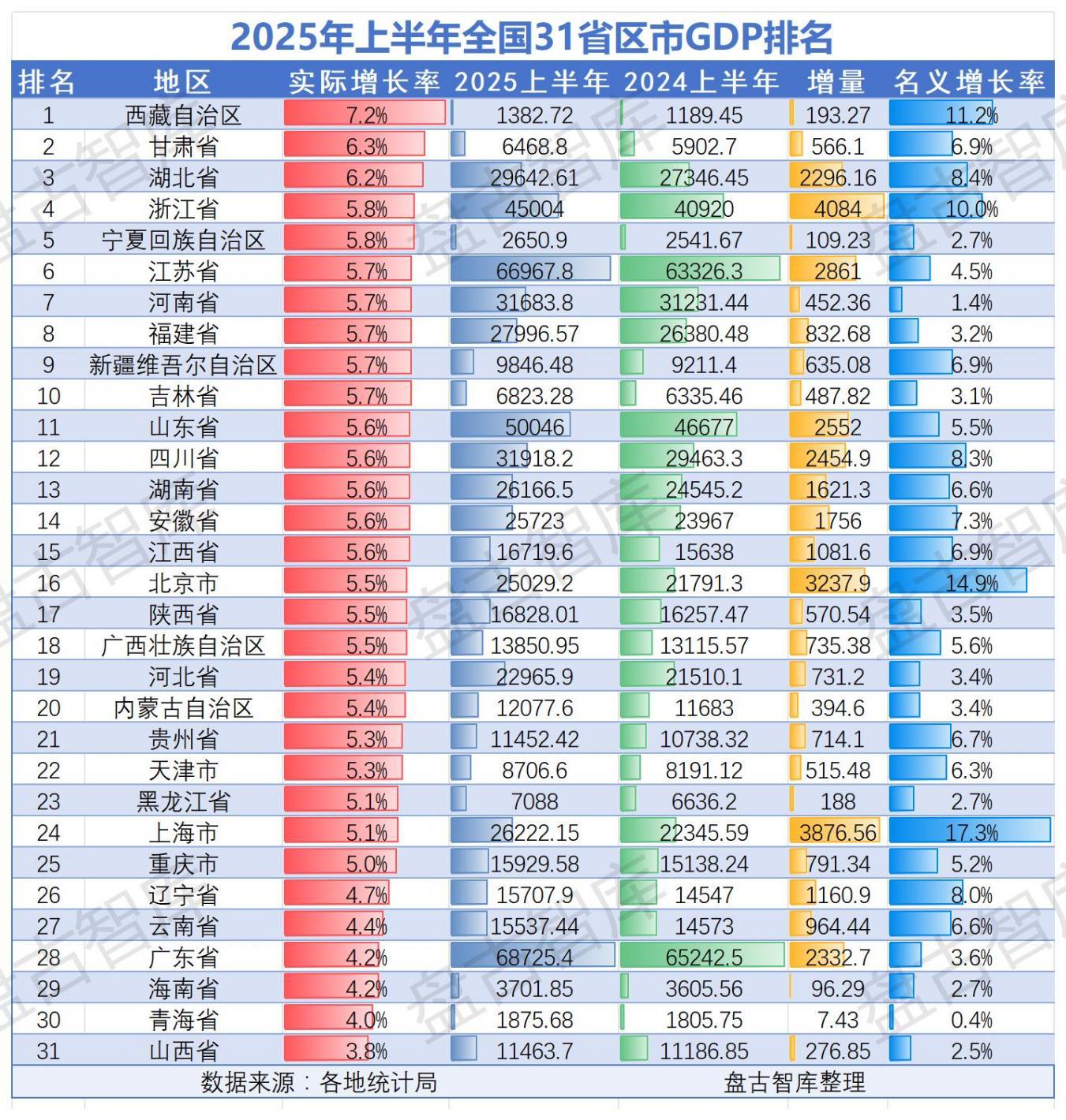
Core Viewpoint - The GDP rankings of 31 provinces and cities in China for the first half of 2025 reveal a unique economic landscape, with the top ten provinces contributing over 60% of the national GDP, highlighting their critical role in stabilizing the national economy [1] Group 1: GDP Rankings and Growth Rates - The top ten provinces by GDP in the first half of 2025 are Guangdong, Jiangsu, Shandong, Zhejiang, Sichuan, Henan, Hubei, Fujian, Shanghai, and Hunan, which are essential for driving China's economic growth [1] - Tibet leads the national GDP growth with a rate of 7.2%, followed by Gansu at 6.3% and Hubei at 6.2% [2][6] - The overall GDP growth rate for the first half of 2025 is 5.3%, with 20 provinces exceeding this rate [6] Group 2: Economic Performance of Major Cities - Shanghai maintains its position as the top city with a GDP of 26,222.15 billion yuan, growing by 5.1%, driven by the service sector and emerging industries [4][3] - Beijing follows with a GDP of 25,029 billion yuan and a growth rate of 5.5%, supported by technological innovation and service industry development [4][3] - Shenzhen ranks third with a GDP of 18,322.26 billion yuan, also growing by 5.1%, showcasing resilience in both industrial and service sectors [3][4] Group 3: Industrial Growth and Transformation - Emerging industries are crucial for economic growth, with Shanghai's strategic focus on artificial intelligence, integrated circuits, and biomedicine leading to significant manufacturing output increases [8][9] - Traditional industries are undergoing transformation, with provinces like Henan achieving substantial growth in automotive and electrical machinery sectors [8][9] - The industrial output in regions like Tibet and Gansu is significantly boosted by major projects and foreign trade, indicating a strong industrial base [6][7] Group 4: Policy and Strategic Initiatives - Local and national policies are driving economic growth, with initiatives in Shanghai promoting integrated circuit development and consumption stimulus measures in various provinces [9][10] - The "Belt and Road" initiative and regional development strategies are enhancing economic cooperation and infrastructure investment, particularly in central and western regions [10][11] - The focus on new infrastructure and technology investment is expected to support the growth of emerging industries and improve overall economic resilience [12][13]
广州市上半年规模以上工业增加值同比增长0.7%
Xin Lang Cai Jing· 2025-07-29 08:29
Core Insights - The industrial added value in Guangzhou increased by 0.7% year-on-year in the first half of the year [1] Group 1: Automotive Industry - The automotive manufacturing sector faced challenges during the transition period, with added value decreasing by 5.7% year-on-year, although the decline narrowed by 0.7 percentage points compared to the first quarter [1] - The production of new energy vehicles accelerated, with cumulative output increasing by 9.5%, an improvement of 8.8 percentage points from the first quarter [1] Group 2: Electronics and Petrochemicals - The electronics manufacturing industry and petrochemical manufacturing industry showed stable growth, with added value increasing by 1.6% and 6.3% respectively [1] - The "two new" policy effects continued to be released, driving the electrical machinery and equipment manufacturing industry and specialized equipment manufacturing industry to achieve added value growth of 11.3% and 7.5% respectively [1] Group 3: Home Appliances and New Generation Information Technology - Home appliances such as refrigerators, fans, and smartphones experienced rapid production with double-digit growth [1] - The new generation information technology industry is expanding, with the integrated circuit manufacturing industry seeing added value growth of 30.0%, and production of liquid crystal display modules, analog chips, and industrial robots increasing by 150%, 19.5%, and 19.0% respectively [1] Group 4: Low-altitude Economy - The low-altitude economy industry is growing rapidly, with the added value of the aerospace and equipment manufacturing industry increasing by 17.1%, and the production of civil drones growing by 37.7% [1]