
交通运输

Search documents
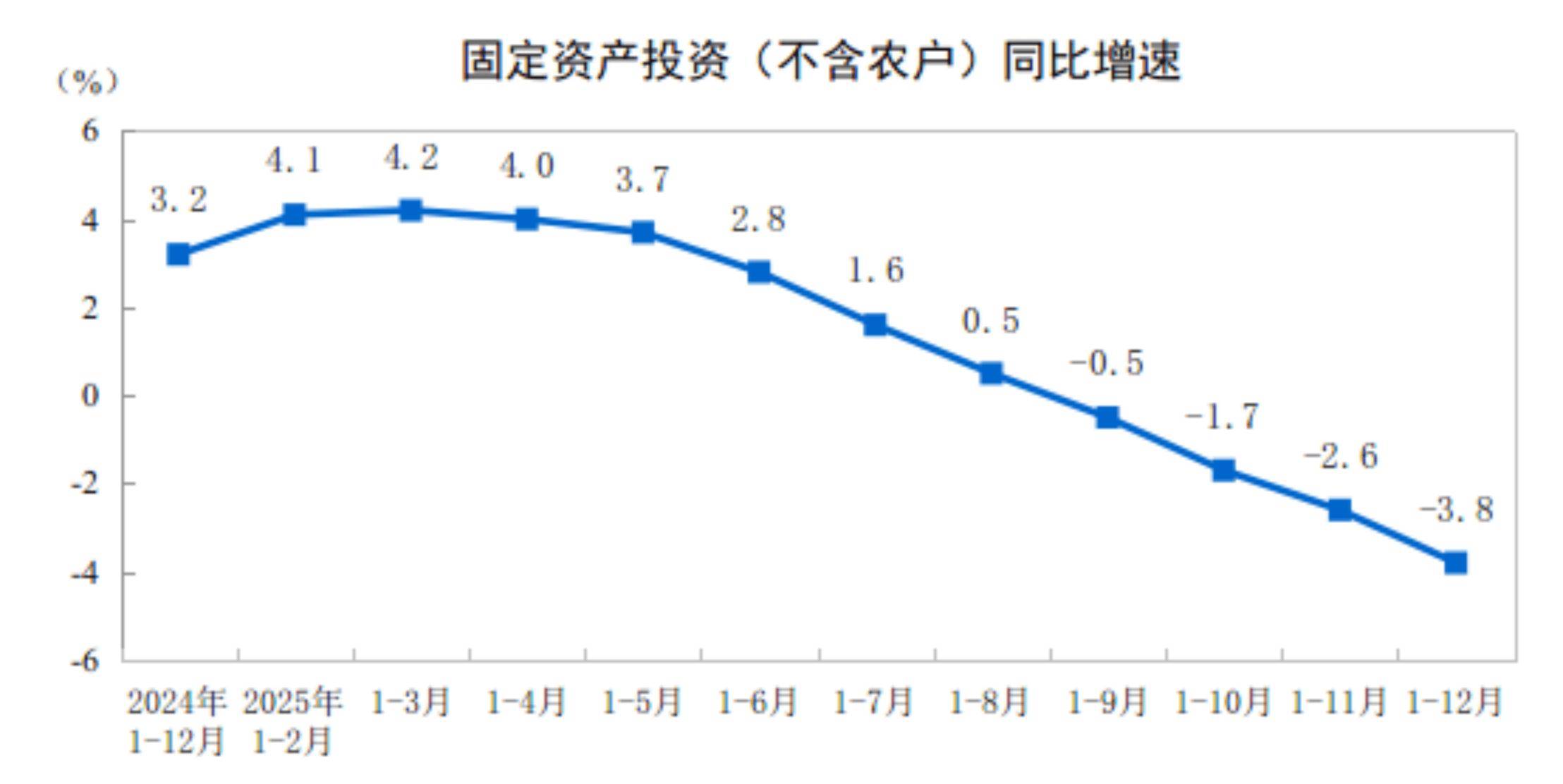
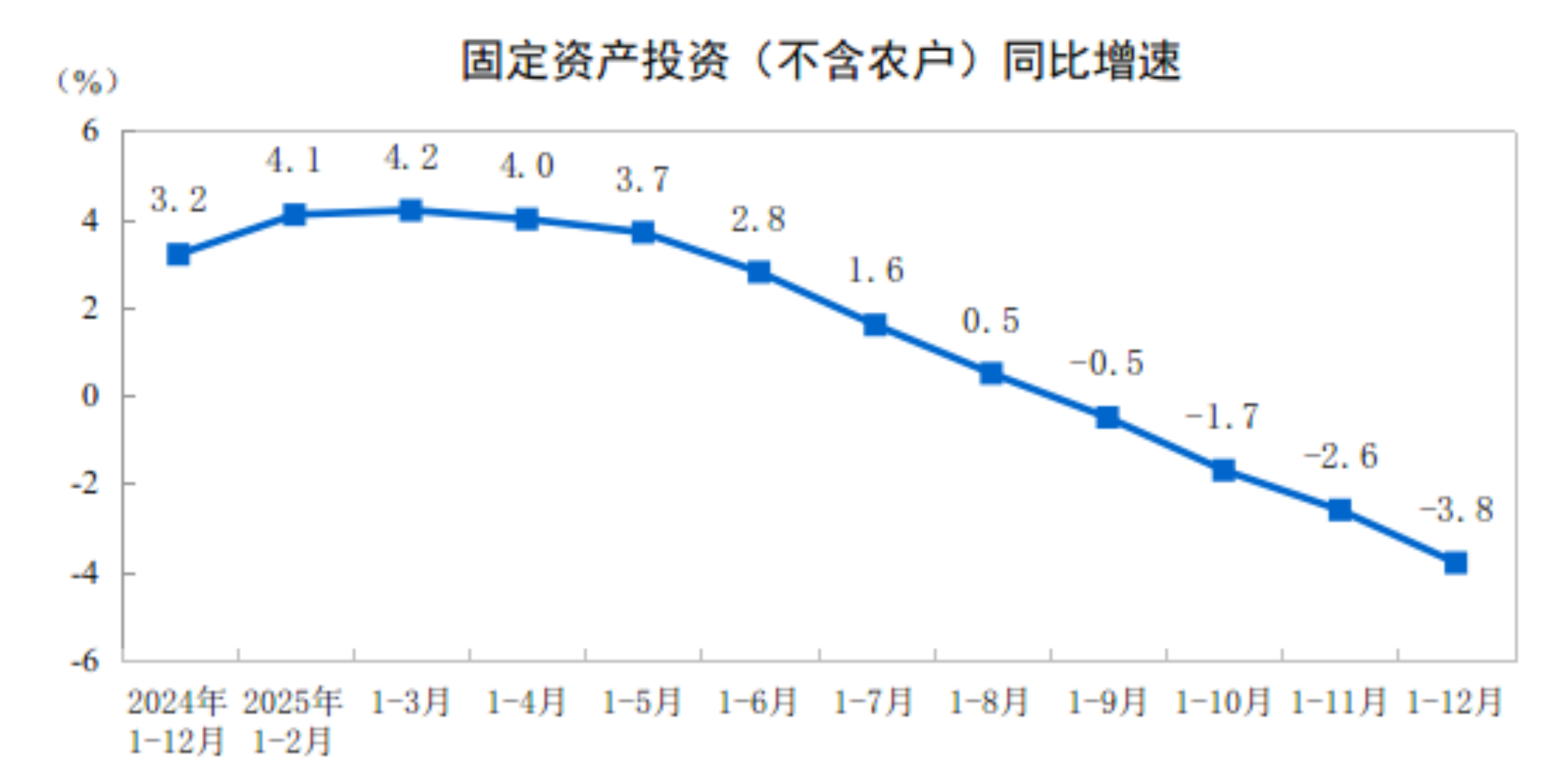
2025年全国固定资产投资485186亿元,比上年下降3.8%
Guo Jia Tong Ji Ju· 2026-01-19 02:19
Core Viewpoint - In 2025, China's fixed asset investment (excluding rural households) is projected to be 48,518.6 billion yuan, representing a decline of 3.8% compared to the previous year [1][4]. Investment by Sector - Investment in the primary industry reached 957 billion yuan, showing a growth of 2.3% year-on-year [3][4]. - Investment in the secondary industry totaled 177,368 billion yuan, with a growth of 2.5% [3][4]. - Investment in the tertiary industry was 298,248 billion yuan, reflecting a decline of 7.4% [3][4]. Secondary Industry Breakdown - Industrial investment in the secondary industry increased by 2.6% year-on-year [3]. - Mining investment grew by 2.5%, while manufacturing investment saw a modest increase of 0.6% [3]. - Investment in the electricity, heat, gas, and water production and supply industry surged by 9.1% [3]. Tertiary Industry Breakdown - Infrastructure investment (excluding electricity, heat, gas, and water production and supply) decreased by 2.2% [3]. - Notable growth was observed in pipeline transportation (36.0%), multimodal transport and agency services (22.9%), and water transportation (7.7%) [3]. Regional Investment Trends - Investment in the eastern region declined by 8.4% year-on-year [3]. - The central region experienced a decrease of 2.7%, while the western region saw a decline of 1.3% [3]. - The northeastern region faced the most significant drop at 15.5% [3]. Investment by Registration Type - Domestic enterprises' fixed asset investment fell by 3.8% [4]. - Investment from Hong Kong, Macau, and Taiwan enterprises decreased by 2.2% [4]. - Foreign enterprises experienced a substantial decline of 13.8% in fixed asset investment [4].

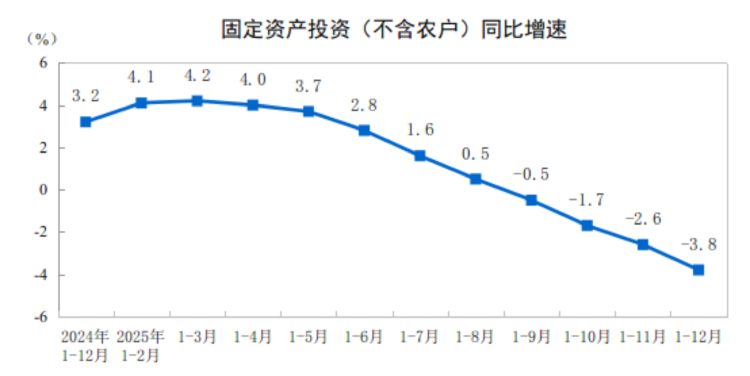
国家统计局:2025年全国固定资产投资485186亿元,比上年下降3.8%
Sou Hu Cai Jing· 2026-01-19 02:19
分产业看,第一产业投资9570亿元,比上年增长2.3%;第二产业投资177368亿元,增长2.5%;第三产业投资298248亿元,下降7.4%。 第二产业中,工业投资比上年增长2.6%。其中,采矿业投资增长2.5%,制造业投资增长0.6%,电力、热力、燃气及水生产和供应业投资增长9.1%。 第三产业中,基础设施投资(不含电力、热力、燃气及水生产和供应业)比上年下降2.2%。其中,管道运输业投资增长36.0%,多式联运和运输代理业投资 增长22.9%,水上运输业投资增长7.7%。 据国家统计局,2025年,全国固定资产投资(不含农户)485186亿元,比上年下降3.8%(按可比口径计算,详见附注7)。其中,民间固定资产投资比上年 下降6.4%。从环比看,12月份固定资产投资(不含农户)下降1.13%。 分地区看,东部地区投资比上年下降8.4%,中部地区投资下降2.7%,西部地区投资下降1.3%,东北地区投资下降15.5%。 -3.8 其中:国有控股 -2.5 其中:民间投资 -6.4 按构成分 建筑安装工程 -8.4 设备工器具购置 11.8 其他费用 -2.3 分产业 第一产业 2.3 第二产业 2.5 第三 ...
2025全年GDP增长5.0%!
清华金融评论· 2026-01-19 02:12
2025年,面对国内外经济环境的复杂变化,在以习近平同志为核心的党中央坚强领导下,各地区各部门深入贯彻落实党中央、国务院决策部署, 坚定不移贯彻新发展理念、推动高质量发展,统筹国内国际两个大局,统筹发展和安全,实施更加积极有为的宏观政策,纵深推进全国统一大市 场建设,国民经济运行顶压前行、向新向优,高质量发展取得新成效,经济社会发展主要目标任务圆满实现,"十四五"胜利收官。 三、服务业平稳增长,现代服务业发展良好 全年服务业增加值比上年增长5.4%。其中,信息传输、软件和信息技术服务业,租赁和商务服务业,交通运输、仓储和邮政业,批发和零售 业,住宿和餐饮业增加值分别增长11.1%、10.3%、5.2%、5.0%、4.9%。12月份,服务业生产指数同比增长5.0%。其中,信息传输、软件和信息 技术服务业,租赁和商务服务业,金融业生产指数分别增长14.8%、11.3%、6.5%。1—11月份,规模以上服务业企业营业收入同比增长7.8%。12 月份,服务业商务活动指数为49.7%,比上月上升0.2个百分点;服务业业务活动预期指数为56.4%,上升0.5个百分点。其中,电信广播电视及卫 星传输服务、货币金融服务、资本 ...

国家统计局:2025年全年服务业增加值比上年增长5.4%
Di Yi Cai Jing· 2026-01-19 02:10
Group 1 - The core viewpoint of the article indicates that the service industry in China is projected to grow by 5.4% in 2025 compared to the previous year, highlighting a positive trend in various sectors [1] - The information transmission, software, and IT services sector is expected to see the highest growth at 11.1%, followed by leasing and business services at 10.3%, and transportation, warehousing, and postal services at 5.2% [1] - In December, the service production index increased by 5.0% year-on-year, with notable growth in the information transmission, software, and IT services sector at 14.8% [1] Group 2 - The revenue of large-scale service enterprises increased by 7.8% year-on-year from January to November [1] - The service business activity index for December was reported at 49.7, showing a slight increase of 0.2 percentage points from the previous month, while the business activity expectation index rose to 56.4, up by 0.5 percentage points [1] - Specific sectors such as telecommunications, monetary financial services, and capital market services reported business activity indices above 60.0, indicating a high level of economic activity [1]
2025年全国固定资产投资基本情况
Guo Jia Tong Ji Ju· 2026-01-19 02:01
Core Insights - In 2025, China's fixed asset investment (excluding rural households) reached 48,518.6 billion yuan, a decrease of 3.8% compared to the previous year, with private fixed asset investment declining by 6.4% [1][6] Investment by Industry - Investment in the primary industry was 957 billion yuan, showing a growth of 2.3% year-on-year [3] - Investment in the secondary industry totaled 177,368 billion yuan, with a growth of 2.5% [3] - The tertiary industry saw a decline in investment, amounting to 298,248 billion yuan, down by 7.4% [3] Secondary Industry Breakdown - Within the secondary industry, industrial investment grew by 2.6% year-on-year [4] - Mining investment increased by 2.5%, while manufacturing investment grew by 0.6% [4] - Investment in the electricity, heat, gas, and water production and supply industry rose significantly by 9.1% [4] Infrastructure and Regional Investment - Infrastructure investment (excluding electricity, heat, gas, and water production and supply) decreased by 2.2% [4] - Investment in pipeline transportation surged by 36.0%, while multimodal transport and logistics saw a growth of 22.9% [4] - Investment trends varied by region, with the eastern region experiencing an 8.4% decline, the central region down by 2.7%, the western region down by 1.3%, and the northeastern region down by 15.5% [4] Investment by Registration Type - Domestic enterprises' fixed asset investment fell by 3.8%, while investment from Hong Kong, Macau, and Taiwan enterprises decreased by 2.2% [5] - Foreign enterprises saw a significant decline in fixed asset investment, down by 13.8% [5]
朝闻国盛:市场短期调整或已基本到位
GOLDEN SUN SECURITIES· 2026-01-19 00:03
Group 1 - The report indicates that the market's short-term adjustment may have reached its limit, with a potential new upward trend expected to begin soon, supported by healthy market dynamics and a majority of sectors showing signs of recovery [6][12][17] - The banking sector is undergoing a transformation, with policies encouraging increased equity asset allocation in bank wealth management, which is expected to drive long-term growth despite short-term challenges [17][18][21] - The geothermal energy sector in the U.S. is experiencing increased demand driven by data centers, with significant investment opportunities identified in companies like Kaishan [23][24] Group 2 - The coal industry is facing a mixed outlook, with global shipping volumes expected to decline, particularly in the EU, while some regions like South Africa and Southeast Asia show growth [26][27] - The pharmaceutical sector is witnessing advancements with the commercialization of innovative drugs like RAY1225, which is expected to enhance long-term competitiveness for companies like Zhongsheng Pharmaceutical [29] - The textile and apparel industry is projected to see a cautious recovery in orders, with recommendations for companies that demonstrate strong operational capabilities and market positioning [31][32]
出口延续高增长,结构性降息政策出台
Hua Lian Qi Huo· 2026-01-18 13:32
1. Report's Investment Rating for the Industry - No investment rating for the industry is provided in the report. 2. Core Viewpoints of the Report - In December 2025, China's exports continued high - growth, imports rebounded significantly, and the trade surplus expanded. The Fed's January rate - cut probability decreased, and the RMB showed an appreciation trend. The central bank adjusted the structural monetary policy tool rate and commercial real - estate credit policies, aiming to improve capital activation and support the real economy [8][10]. 3. Summary According to Relevant Catalogs 3.1 National Economic Accounting - GDP quarterly data from 2023 to 2025 are presented, showing the performance of different industries, including agriculture, forestry, animal husbandry, fishery, industry, and services. The contribution rates and pulling effects of the three industries on GDP are also provided [13][18]. 3.2 Industry Analysis - **Industrial Sector**: The growth rate, added - value of major industries, and production of key products are analyzed. The profit situation of industrial enterprises shows mixed results, with some industries growing and some declining. The inventory of industrial enterprises is at a relatively high level, and enterprises still have the intention to reduce inventory [28][43][53]. - **Price Index**: In December 2025, the national consumer price index (CPI) increased year - on - year, and the industrial producer price index (PPI) decreased year - on - year but the decline narrowed. The prices of different categories in CPI and PPI showed different trends [60][68]. 3.3 Real Estate Market - In January - November 2025, real estate development investment, construction area, new - start area, completion area, sales area, and sales volume all declined year - on - year. The prices of new and second - hand residential properties in major cities also showed different degrees of decline [122][126][130]. 3.4 Foreign Trade and Investment - In December 2025, China's total import and export volume reached a record high. Exports to ASEAN and the EU increased, while exports to the US decreased. The export of key products and the import of key commodities are presented in detailed tables [93][100][101]. 3.5 Fixed - Asset Investment - From January - November 2025, national fixed - asset investment (excluding rural households) decreased year - on - year. Private fixed - asset investment also declined. Investment in different industries showed different trends, with the second - industry investment growing and the third - industry investment declining [114]. 3.6 Domestic Trade - The growth of service retail sales and social consumer goods retail sales is analyzed, and the year - on - year changes in retail sales of different industries above the quota are presented [158][165]. 3.7 Transportation - The transportation volume of goods and passengers by different means, the subway passenger flow in major cities, and the freight rates of shipping routes are analyzed [168][173][179]. 3.8 Banking and Currency - The new social financing scale, social financing scale stock, new RMB loans, and money liquidity are analyzed. The central bank emphasizes reasonable interest - rate control to promote the decline of the real - economy financing cost [183][194][200]. 3.9 Bond Market - The issuance of interest - bearing bonds and the yields of long - and short - term treasury bonds are analyzed [213][216]. 3.10 Foreign Exchange and Gold - The RMB exchange rate against the US dollar and the US dollar index are presented. China's gold reserves increased, and the foreign exchange reserves reached a new high [220][223]. 3.11 Fiscal and Employment - The central and local general public budget revenues and expenditures are analyzed, and the urban surveyed unemployment rate and new urban employment are presented [232][236][242]. 3.12 Business Climate Survey - The global and Chinese manufacturing and non - manufacturing PMI are analyzed. In December 2025, China's manufacturing PMI returned to the expansion range, and the non - manufacturing business activity index also rebounded [245][248][256]. 3.13 US Macroeconomy - The US real GDP growth rate, employment situation, treasury bond yields, retail sales, and the Fed's asset structure and federal funds rate are analyzed [263][266][274].
养殖场防对手投毒 私装信号干扰器 威胁飞机安全被通报
Yang Shi Xin Wen· 2026-01-17 17:02
Group 1 - The article highlights the illegal installation of signal jammers by individuals and organizations near airports, high-speed rail, and subways, which disrupts wireless communication and poses a threat to public safety [1][4] - A specific case is mentioned where a breeding farm near an airport installed a signal jammer to prevent competitors from using drones, inadvertently affecting aviation safety by disrupting critical flight signals [1] - Another case involves a car pawn shop that installed jammers to block GPS signals of mortgaged vehicles, which also interfered with high-speed rail and subway communications [4] Group 2 - National security authorities have conducted investigations and confirmed that these jammers can significantly impact the transmission of communication signals for rail transport and mobile networks [4] - The authorities have taken action by confiscating the illegal devices and educating the responsible parties about the dangers of their actions [1][4] - A warning is issued that signal jammers are illegal and should not be purchased or installed without proper authorization, with a hotline provided for reporting suspicious activities [6]

新一轮寒潮暴雪将至 交通运输部部署低温雨雪冰冻天气防范应对工作
Xin Lang Cai Jing· 2026-01-17 05:22
Core Viewpoint - The Ministry of Transport emphasizes the importance of proactive measures to address the severe cold wave and snowstorm expected from January 17 to 21, which will impact central and eastern China, leading to the strongest winter weather conditions so far this season [1][2] Group 1: Weather Impact and Response - The cold wave is expected to bring heavy snow to regions including Shaanxi, Shanxi, Shandong, Henan, Hubei, Hunan, and Anhui, with freezing rain forecasted in parts of western Henan, western Hubei, Hunan, Guizhou, and eastern Chongqing from January 19 to 21 [1] - The Ministry of Transport is coordinating with meteorological departments to monitor road network operations and ensure safety during this weather event, deploying resources and personnel to manage the situation effectively [1][2] Group 2: Regional Preparedness - The Henan Provincial Department of Transportation has established 407 snow removal material storage points and mobilized 506 emergency teams, with a total of 13,400 personnel ready to respond [1] - The Hubei Provincial Department of Transportation has set up 545 emergency material storage points, stocked 46,900 tons of snow melting agents, and prepared 1,967 snow removal and ice clearing devices [2] - The Shaanxi Provincial Department of Transportation has increased patrols on critical road sections and assembled emergency teams of over 7,000 personnel for snow removal, with significant reserves of snow melting agents and equipment [2] Group 3: Overall Transportation Status - Currently, the national transportation system is operating smoothly without significant delays or congestion due to the cold wave and snowfall, indicating effective management and preparedness by the transportation authorities [2]
新一轮寒潮暴雪将至,交通运输部持续调度做好防范应对工作
Xin Lang Cai Jing· 2026-01-17 04:21
Core Viewpoint - The first cold wave of the year is expected to impact China from January 17 to 21, bringing the strongest rain, snow, and freezing weather since the start of winter, particularly affecting central and eastern regions [1] Group 1: Weather Impact and Response - The cold wave will result in heavy snowfall in parts of Shaanxi, Shanxi, Shandong, Henan, Hubei, Hunan, and Anhui, with freezing rain expected in western Henan, western Hubei, Hunan, Guizhou, and eastern Chongqing from January 19 to 21 [1] - The Ministry of Transport is prioritizing the response to this low-temperature weather, coordinating with meteorological departments to monitor road network operations and ensure safety [1][2] Group 2: Preparedness Measures - The Henan Provincial Department of Transportation is conducting road network inspections every two hours, maintaining a list of icy road sections and emergency resources, with 407 snow removal material storage points and 506 emergency teams ready [1] - Hubei's Department of Transportation has set up 545 emergency material points, stocked 46,900 tons of snow-melting agents, and prepared 5,510 tons of anti-skid materials [2] - Shaanxi's Department of Transportation is increasing patrols on critical road sections and has established emergency teams with over 3,400 personnel for national and provincial roads, along with 7,000 personnel for highways [2] Group 3: Overall Transportation Status - Currently, the national transportation system is operating smoothly without significant congestion or delays due to the cold wave and snowfall [2] - The Ministry of Transport will continue to monitor the weather conditions closely and guide the transportation industry in implementing preventive measures to ensure safe and orderly operations [2]