无人驾驶

Search documents
完成B4轮融资 九识智能预计年底启动海外千辆级布局
Zhong Guo Zheng Quan Bao· 2025-10-23 22:23
Core Insights - Jiushi Intelligent has completed a $100 million B4 round of financing led by Ant Group, with participation from other investors, to enhance its autonomous driving technology and expand its market presence [1][2] Financing and Market Position - The total amount raised in the B round has reached $400 million, with Jiushi Intelligent becoming a primary supplier for 4 out of 8 packages in a recent procurement project by China Post for 7,000 autonomous vehicles [2] - The company holds over 70% market share in the domestic logistics sector, particularly in express delivery and postal services, and has launched the Z5 model, a large autonomous delivery vehicle with a capacity of 5 cubic meters [2][3] Business Model and Cost Efficiency - Jiushi Intelligent focuses on a B2B model rather than a B2C Robotaxi market, achieving a viable economic model with the Z5 vehicle, which allows for higher cargo capacity and reduced costs through standard automotive supply chains [3] - The company has implemented a subscription model and offers various vehicle types tailored to specific customer needs, significantly lowering operational costs to approximately 3,000 yuan per month per vehicle [3][4] Technological Advancements - Jiushi Intelligent has developed proprietary technology that reduces operational costs by 50%-70% and increases delivery efficiency by 40% [4] - The company has upgraded its vehicles with advanced computing platforms and sensor systems, achieving significant improvements in data processing and energy efficiency [4][5] Global Expansion Strategy - The recent financing has heightened expectations for Jiushi Intelligent's ecosystem partnerships, with a shift in customer demographics indicating a diversification beyond the express delivery sector [6] - The company is actively pursuing international markets, having established operations in Singapore and Malaysia, and plans to deploy hundreds of autonomous vehicles abroad by the end of this year [7]
九识智能预计年底启动海外千辆级布局
Zhong Guo Zheng Quan Bao· 2025-10-23 20:12
Core Insights - Jiushi Intelligent has completed a $100 million B4 round of financing led by Ant Group, with participation from Blue Lake Capital and Baidu Ventures, bringing total B round financing to $400 million [1] - The funds will be used to enhance R&D in autonomous driving technology, product iteration, supply chain control, global market expansion, and customer service improvement [1] - Jiushi Intelligent has become a primary supplier for 4 out of 8 packages in a recent procurement project for 7,000 autonomous vehicles by China Post, securing over 50% of the orders [1] Business Model and Market Position - Jiushi Intelligent holds over 70% market share in the domestic logistics sector, having launched the Z5 model, a 5 cubic meter autonomous delivery vehicle, which has proven commercially viable [2] - The company has expanded its product line to include refrigerated and high-load vehicles, focusing on B2B applications rather than B2C [2] - The Z5 model's design allows for cost-effective production by utilizing existing automotive supply chains, significantly reducing costs compared to custom parts [2] Cost Efficiency and Technology Development - Jiushi Intelligent has implemented a subscription model and cost-effective vehicle designs, reducing the average monthly operating cost of a single autonomous vehicle to approximately 3,000 yuan [3] - The company claims its autonomous vehicles can reduce operational costs by 50%-70% and improve delivery efficiency by 40% [3] - The company has achieved full lifecycle profitability through a "turnkey sales + operation" model [3] Technological Advancements - Jiushi Intelligent has released L4+ level autonomous driving technology, which enhances the vehicle's ability to operate in various environments with reduced reliance on high-precision maps [4] - The company has achieved significant operational milestones, covering over 300 cities globally, with a cumulative delivery volume exceeding 1 billion packages and over 50 million kilometers driven [4] - Jiushi Intelligent holds a 76% market share in urban autonomous vehicle sales, with an 88% share in the RoboVan segment [4] Global Expansion and Ecosystem Collaboration - The involvement of Ant Group in the recent financing round has raised expectations for Jiushi Intelligent's ecosystem collaborations [5] - The company is actively pursuing international markets, with a focus on localizing technology and building standards in regions like Singapore and Malaysia [5] - Jiushi Intelligent has signed a commercial cooperation agreement with FairPrice Group in Singapore, becoming the first to operate autonomous vehicles on public roads in the region [5]
英伟达表示,正与优步开发无人驾驶汽车。 优步(Uber)涨幅迅速扩大至3.1%
Hua Er Jie Jian Wen· 2025-10-23 19:05
Core Viewpoint - Nvidia is collaborating with Uber to develop autonomous vehicles, leading to a significant increase in Uber's stock price by 3.1% [1] Group 1 - Nvidia is actively working on the development of self-driving cars in partnership with Uber [1] - Uber's stock experienced a notable rise, expanding its gains to 3.1% following the announcement [1]


新股消息 | 传新石器获腾讯等超5亿美元PreIPO融资 或将冲击港股上市
智通财经网· 2025-10-23 07:15
Group 1 - Neolix, a leading Chinese autonomous delivery company, has completed over $500 million in Pre-IPO financing and is initiating its IPO process in Hong Kong, with participation from notable investors including Tencent and Gaocheng Capital [1] - Founded in 2018, Neolix specializes in the research and manufacturing of L4 autonomous commercial vehicles, focusing on logistics applications and has launched models X3, X6, and X12 for urban delivery [1] - The company has achieved significant cost reductions for clients, exceeding 50%, and has developed a proprietary L4 autonomous driving system capable of operating at 50 kph on public roads [1] Group 2 - As of December 2024, Neolix has obtained public road rights in 93 regions and cities across 11 provinces in China, making it the largest autonomous delivery fleet globally with over 2,400 vehicles delivered [1] - Neolix has filed over 1,200 patents, positioning itself among the top in technological accumulation in the industry [1] - On October 14, Neolix entered a strategic partnership with K2 Group, a state-owned AI technology company in the UAE, to accelerate the application of autonomous driving technology in the Middle East [2] - Neolix celebrated the delivery of its 10,000th vehicle in September 2023, becoming the first company in the autonomous delivery sector to reach this milestone [2]
蚂蚁集团领投 九识智能完成1亿美元B4轮融资
Zhong Guo Jing Ying Bao· 2025-10-21 11:08
Core Insights - Jiushi Intelligent has completed a $100 million Series B4 financing round led by Ant Group, bringing the total financing in the B round to $400 million, marking it as one of the largest tech financing events in China this year and a significant milestone in the global L4 autonomous driving sector [2] - The company plans to enhance its investment in autonomous driving technology, focusing on product iteration, supply chain autonomy, global market expansion, and customer service improvement to build a smarter, more efficient, and greener autonomous freight network [2] Financing and Market Position - The B4 round financing is part of a larger trend in the autonomous driving industry, with Jiushi Intelligent being recognized for its innovative capabilities and engineering expertise [2] - Jiushi Intelligent's RoboVan series has achieved a market share of over 76% in the complete vehicle sales segment, solidifying its leading position in the industry [6] Product Development and Innovation - Jiushi Intelligent launched the world's first L4 RoboVan, a medium to large autonomous freight vehicle capable of operating on urban roads, and has since expanded its product lineup with various models tailored for different logistics scenarios [3][4] - The company has introduced the E series, designed for light cargo scenarios, which offers lower operational costs and higher loading capacity compared to previous models [3] - The L series, introduced in August 2025, features a payload capacity exceeding 1.8 tons, addressing the industry's challenges in heavy-duty logistics [4] Technological Advancements - Jiushi Intelligent has developed a comprehensive L4 autonomous driving technology, integrating hardware innovation and software optimization, which includes the industry's first application of automotive-grade solid-state LiDAR in L4 products [5] - The company has established a four-dimensional perception system combining LiDAR, cameras, millimeter-wave radar, and ultrasonic sensors, enhancing safety and operational efficiency [5] Operational Achievements - As of September 2025, Jiushi Intelligent has delivered over 10,000 autonomous vehicles, becoming the first company in the industry to achieve such a milestone [6] - The company has recorded over 50 million kilometers of safe driving and has completed over 1 billion deliveries, significantly reducing operational costs for clients by an average of 66% [6] - Jiushi Intelligent has expanded its distribution network to approximately 400 dealers and over 200 service providers, enhancing its market penetration and operational reach [6]

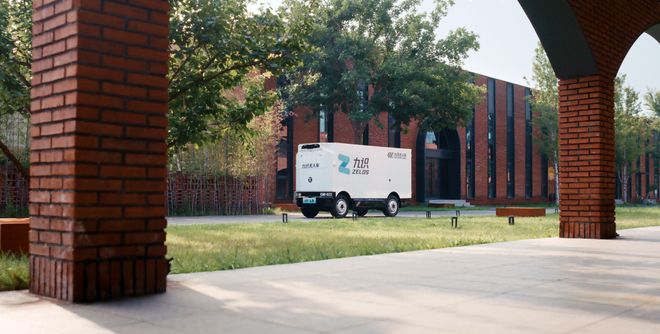
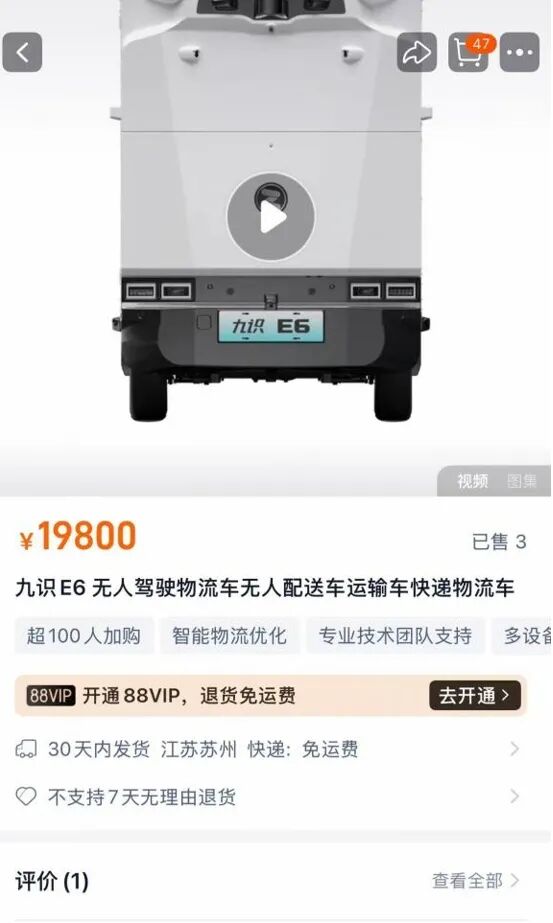
不到两万块,无人车“杀疯了”
3 6 Ke· 2025-10-21 11:02
Core Insights - The emergence of autonomous delivery vehicles is reshaping urban logistics, with significant growth projected in the sector [4][30] - Major players in the market, such as New Stone and Nine Knowledge, are adopting different business models to capture market share [19][24] Market Overview - The value of urban last-mile autonomous delivery is expected to reach 12.8 billion yuan by 2025 and surge to 97.7 billion yuan by 2030 [4] - As of September 2025, over half of China's 3,600 districts and counties support autonomous vehicles on the road [7] Business Model Analysis - Autonomous delivery primarily targets large logistics platforms and express delivery companies, focusing on cost-effective last-mile delivery solutions [8] - The operational cost of using autonomous vehicles can be nearly halved compared to traditional delivery methods [12] - The business model includes low-cost hardware sales or rentals, subscription-based software services, and additional value-added services [13][15] Competitive Landscape - New Stone and Nine Knowledge dominate the market, with a combined market share of approximately 80% by 2025 [16] - New Stone focuses on high barriers and deep partnerships with major logistics firms, while Nine Knowledge adopts a low-cost, broad coverage strategy [19][21] Challenges and Opportunities - The industry faces significant challenges, including the complexity of software algorithms, operational sustainability, and the need for a comprehensive ecosystem [25][29] - Both companies are exploring international markets, but face regulatory uncertainties and localization challenges [30]
无人驾驶双雄对决:小马智行毛利率仅16%遭做空机构指控 2025年财务预测被同行反超
Xin Lang Zheng Quan· 2025-10-21 10:55
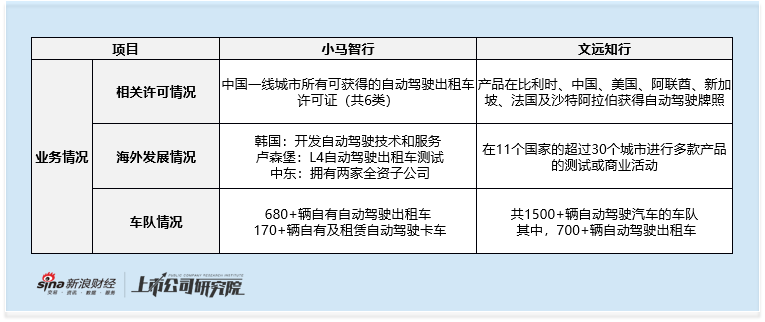
Core Viewpoint - The article discusses the recent listings of two major players in China's autonomous driving sector, Xiaoma Zhixing and Wenyuan Zhixing, on the Hong Kong stock market, highlighting their differing strategies and financial performances in a challenging industry environment [1] Business Strategy Differences - Xiaoma Zhixing focuses on deepening its presence in China's first-tier cities and has obtained all available autonomous taxi licenses, while also exploring overseas markets like Luxembourg and the UAE [2][3] - Wenyuan Zhixing adopts an "overseas first" strategy, concentrating on regions with clear economic advantages for autonomous vehicle operations, particularly in Europe and the Middle East, where it has established a leading position [3][4] Fleet Composition and Scale - Wenyuan Zhixing operates a fleet of over 1500 autonomous vehicles, primarily focusing on taxi services, while Xiaoma Zhixing has a dual fleet of over 680 autonomous taxis and 170 commercial vehicles, covering both urban mobility and logistics [4] Financial Performance - Both companies are experiencing significant losses, with Xiaoma Zhixing projected to generate $75.03 million in revenue and incur a net loss of $280 million in 2024, while Wenyuan Zhixing is expected to have $50.41 million in revenue and a net loss of $350 million [6][7] - Wenyuan Zhixing maintains a gross margin above 30%, significantly higher than Xiaoma Zhixing's margins, indicating potential for profitability despite high loss rates [6][7] Future Performance Predictions - Analysts predict that Wenyuan Zhixing may outperform Xiaoma Zhixing in 2025, with expected revenues of $89.6 million compared to Xiaoma's $82.1 million, and a narrower net loss for Wenyuan [7] Additional Challenges for Xiaoma Zhixing - Xiaoma Zhixing faces increased scrutiny following a short-selling report that raised concerns about its technology, operational efficiency, and financial health, adding uncertainty to its future performance in the market [8]
无人驾驶双雄港股对决:小马智行股价曾较美股IPO发行价跌68% 港股发行比例或高达22%引股权稀释
Xin Lang Zheng Quan· 2025-10-21 10:51
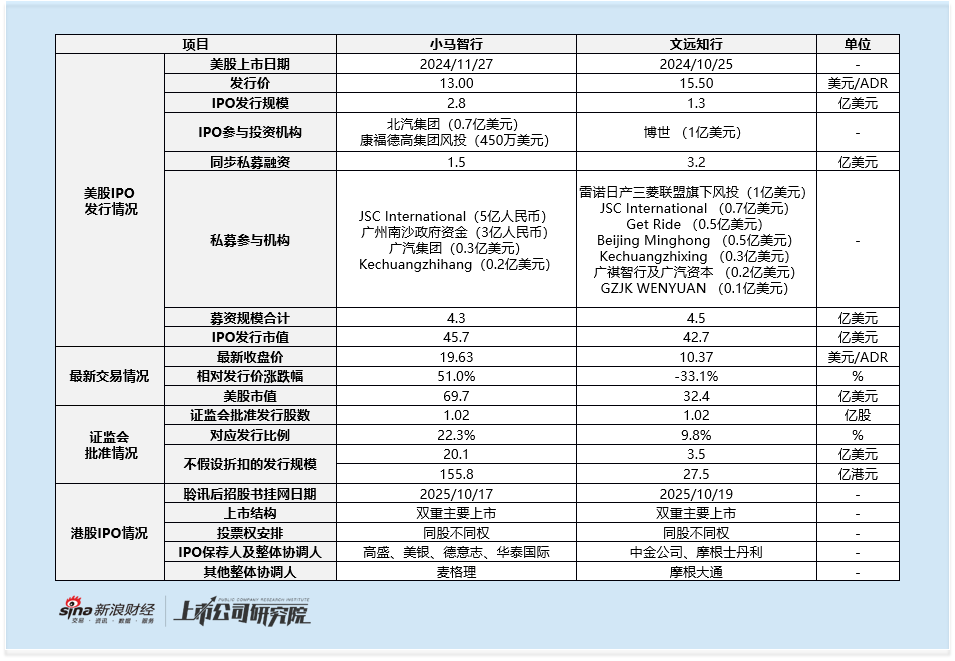
Core Viewpoint - The Chinese autonomous driving sector is witnessing a significant shift as two leading companies, Pony AI Inc. and We Ride Inc., prepare for their IPOs in Hong Kong, following the successful listing of Hesai Technology. This move reflects a competitive landscape in the capital markets, with contrasting post-IPO performances highlighting market sentiment and valuation disparities between the two firms [1][3]. Summary by Sections IPO Details - Pony AI plans to issue up to 102,146,500 shares, while We Ride aims to issue 102,428,200 shares [1]. - The IPO sizes are approximately $2.8 billion for Pony AI and $1.3 billion for We Ride [2]. - Both companies have engaged significant institutional investors, with notable participation from Baoneng Group and Bosch [2][3]. Post-IPO Performance - Pony AI's stock price has shown a strong recovery, rising 51% from its IPO price to $19.63 per ADR, with a market capitalization of $69.7 billion [4]. - In contrast, We Ride's stock has declined 33.1% from its IPO price, closing at $10.37 per ADR, resulting in a market cap of $32.4 billion [6][4]. - The valuation gap between the two companies has widened significantly, with a difference of $37.3 billion in market capitalization as of October 20 [6]. Institutional Investment Trends - Institutional interest in Pony AI has surged, with top investors increasing their holdings by $3.9 billion, indicating strong confidence in its long-term potential [8][9]. - Conversely, We Ride's institutional support has been weaker, with only $1 billion in increased holdings, and the quality of its investors is less favorable [9][10]. Regulatory and Market Considerations - The Chinese Securities Regulatory Commission's approval of share issuance suggests a favorable regulatory stance towards Pony AI, which has a higher issuance ratio compared to We Ride [11]. - Both companies have adopted dual-class share structures, which may limit their access to southbound capital for at least seven months post-listing, potentially affecting liquidity [12].
无人驾驶双雄港股对决:文远知行较美股上市时跌超30%并遭凯雷集团清仓 港股仅至多募资28亿港元
Xin Lang Zheng Quan· 2025-10-21 10:48
Core Viewpoint - The Chinese autonomous driving sector is witnessing a significant shift as two leading companies, Pony AI Inc. and We Ride Inc., prepare for their listings in Hong Kong, following the successful IPO of Hesai Technology. This move reflects a competitive landscape in the capital markets, with contrasting post-IPO performances highlighting market sentiment and valuation disparities between the two firms [1][3]. Summary by Sections IPO Details - Pony AI plans to issue up to 102,146,500 shares, while We Ride aims to issue 102,428,200 shares [1]. - The IPO scale for Pony AI is estimated at $2.8 billion, and for We Ride, it is $1.3 billion [2]. - Both companies have attracted strategic investments from major players, including GAC Group and Guangzhou Nansha Government Fund [3]. Post-IPO Performance - Pony AI's stock price has shown a strong rebound, rising 51% from its IPO price to $19.63 per ADR, with a market capitalization of $69.7 billion [4]. - In contrast, We Ride's stock has declined by 33.1% to $10.37 per ADR, resulting in a market cap of $32.4 billion, widening the valuation gap to $37.3 billion [6]. Institutional Investment Trends - Institutional interest has sharply diverged, with Pony AI receiving significant backing from top global funds, totaling $3.9 billion in increased holdings [8]. - We Ride's institutional support is notably lower, with only $1 billion in increased holdings, and the quality of its investors is less favorable [9]. Regulatory and Market Considerations - The China Securities Regulatory Commission's approval of share issuance suggests a favorable regulatory stance towards Pony AI, which has a higher issuance ratio and potential fundraising compared to We Ride [11]. - Both companies will face challenges in market liquidity due to their dual-class share structures, which may limit access to southbound capital for at least seven months post-listing [12].

万马科技全资子公司优咔科技与九识智能达成合作
Xin Lang Cai Jing· 2025-10-21 07:37
Core Viewpoint - Wanma Technology's subsidiary, Youka Technology, has officially partnered with Jiushi Intelligent to leverage their strengths in vehicle networking technology and logistics autonomous driving to explore innovative applications of RoboVan projects [1] Group 1 - Youka Technology is a wholly-owned subsidiary of Wanma Technology [1] - Jiushi Intelligent is a company specializing in intelligent technology [1] - The collaboration aims to enhance the development of autonomous logistics vehicles [1]