
汽车制造业

Search documents
吉利取得增程器控制方法专利
Sou Hu Cai Jing· 2026-01-31 03:54
浙江远程商用车研发有限公司,成立于2021年,位于杭州市,是一家以从事汽车制造业为主的企业。企 业注册资本100000万人民币。通过天眼查大数据分析,浙江远程商用车研发有限公司共对外投资了1家 企业,参与招投标项目29次,专利信息2177条,此外企业还拥有行政许可3个。 国家知识产权局信息显示,浙江吉利控股集团有限公司、浙江远程新能源商用车集团有限公司、浙江远 程商用车研发有限公司取得一项名为"一种增程器的控制方法、装置、设备及存储介质"的专利,授权公 告号CN115416502B,申请日期为2022年9月。 天眼查资料显示,浙江吉利控股集团有限公司,成立于2003年,位于杭州市,是一家以从事汽车制造业 为主的企业。企业注册资本103000万人民币。通过天眼查大数据分析,浙江吉利控股集团有限公司共对 外投资了39家企业,参与招投标项目524次,财产线索方面有商标信息5000条,专利信息5000条,此外 企业还拥有行政许可275个。 浙江远程新能源商用车集团有限公司,成立于2016年,位于杭州市,是一家以从事汽车制造业为主的企 业。企业注册资本50000万人民币。通过天眼查大数据分析,浙江远程新能源商用车集团有 ...

江淮汽车申请新能源汽车车载低压发电效率试验测试系统专利,能够准确获取DC/DC变换器在整车上的实际效率
Jin Rong Jie· 2026-01-31 03:09
声明:市场有风险,投资需谨慎。本文为AI基于第三方数据生成,仅供参考,不构成个人投资建议。 财经频道更多独家策划、专家专栏,免费查阅>> 专利摘要显示,本发明公开了一种新能源汽车车载低压发电效率试验测试系统,基于直流电子负载、电 流传感器、电压传感器、电器功耗测试系统、CAN信号采集系统构建的试验台架,采集至少包含低压 端电流实测值、低压端电压实测值、高压端电流信号、高压端电压信号的数据;低压端电流和电压由相 应传感器将信号传导至电器功耗测试系统进行存储、计算、输出;高压端电流和电压信通过CAN_H和 CAN_L传导至CAN信号采集系统进行存储、计算、输出。本发明提供的测试方案安全高效、准确方 便,能够准确获取DC/DC变换器在整车上的实际效率,从而可以全面完成DC/DC变换器效率测试任 务,且适用于所有具备CAN信号新能源汽车车载低压发电效率的验证。 天眼查资料显示,安徽江淮汽车集团股份有限公司,成立于1999年,位于合肥市,是一家以从事汽车制 造业为主的企业。企业注册资本218400.9791万人民币。通过天眼查大数据分析,安徽江淮汽车集团股 份有限公司共对外投资了48家企业,参与招投标项目5000次,财 ...

极氪取得车辆阻尼控制方法专利
Sou Hu Cai Jing· 2026-01-31 02:46
声明:市场有风险,投资需谨慎。本文为AI基于第三方数据生成,仅供参考,不构成个人投资建议。 来源:市场资讯 国家知识产权局信息显示,浙江极氪智能科技有限公司、浙江吉利控股集团有限公司取得一项名为"车 辆控制方法、阻尼工作模式确定方法及装置"的专利,授权公告号CN115817090B,申请日期为2022年12 月。 天眼查资料显示,浙江极氪智能科技有限公司,成立于2021年,位于宁波市,是一家以从事研究和试验 发展为主的企业。企业注册资本1300000万人民币。通过天眼查大数据分析,浙江极氪智能科技有限公 司共对外投资了10家企业,参与招投标项目195次,专利信息5000条,此外企业还拥有行政许可4个。 浙江吉利控股集团有限公司,成立于2003年,位于杭州市,是一家以从事汽车制造业为主的企业。企业 注册资本103000万人民币。通过天眼查大数据分析,浙江吉利控股集团有限公司共对外投资了39家企 业,参与招投标项目524次,财产线索方面有商标信息5000条,专利信息5000条,此外企业还拥有行政 许可275个。 ...
2025年广东经济运行数据出炉:经济总量14.58万亿元 常住人口超1.28亿
Xin Lang Cai Jing· 2026-01-31 00:57
Economic Performance - In 2025, Guangdong achieved a GDP of 145,846.76 billion yuan, growing by 3.9% year-on-year at constant prices [1] - The primary industry added value was 5,891.80 billion yuan, increasing by 4.5%; the secondary industry added value was 54,993.50 billion yuan, growing by 2.4%; and the tertiary industry added value was 84,961.46 billion yuan, rising by 4.7% [1] Population and Urbanization - By the end of 2025, the province's permanent population reached 128.59 million, an increase of 790,000 from the previous year, with an urbanization rate of 76.58% [2][5] Industrial Production - Industrial production showed steady recovery, with the added value of above-scale industries growing by 3.0% year-on-year in 2025 [3] - Key industries such as computer, communication, and other electronic equipment manufacturing saw a 7.1% increase, while automotive manufacturing grew by 10.1% [3] New Growth Drivers - Advanced manufacturing and high-tech manufacturing industries reported added value growth of 5.1% and 6.2%, respectively, outpacing the overall industrial growth [3] - Production of high-tech products like industrial robots and civilian drones surged, with increases of 31.2% and 39.0%, respectively [3] Consumption Trends - The total retail sales of consumer goods in the province grew by 2.8%, with significant increases in categories such as sports and entertainment goods, which rose by 28.6% [4] - Investment in internet and related services surged by 115.6%, indicating a shift towards new productive forces [4] Transportation and Logistics - The freight market remained active, with a total freight volume of 3.855 billion tons, a slight increase of 0.2% [5] - Passenger transport volume reached 946 million person-times, growing by 3.5% [5] Income and Price Levels - The per capita disposable income in the province was 53,669 yuan, nominally increasing by 4.3% year-on-year [7] - The consumer price index (CPI) decreased by 0.2%, while the core CPI rose by 0.4%, indicating overall price stability [7]
渤海汽车系统股份有限公司第九届董事会第十八次会议决议公告
Shang Hai Zheng Quan Bao· 2026-01-30 23:17
Group 1 - The company held its 18th meeting of the 9th Board of Directors on January 30, 2026, with all 8 directors present, complying with relevant regulations [2][3] - The board approved the election of Ms. Lan Shihong as a non-independent director, pending approval from the shareholders' meeting [2][4][36] - The board also approved the convening of the second extraordinary shareholders' meeting on February 27, 2026 [5][6] Group 2 - The second extraordinary shareholders' meeting will be held on February 27, 2026, at 14:00, with both on-site and online voting options available [9][10] - Shareholders can vote through the Shanghai Stock Exchange's online voting system during specified time slots on the meeting day [10][12] - The meeting will allow shareholders registered by the close of trading on the registration date to attend and vote [14] Group 3 - The company announced a performance forecast for 2025, expecting a net profit attributable to shareholders of between 155 million and 188 million yuan, indicating a turnaround from previous losses [22][24] - The forecasted net profit excluding non-recurring gains and losses is expected to be between -105 million and -88 million yuan [25][30] - The significant change in profit is attributed to the exclusion of certain subsidiaries from the consolidated financial statements, resulting in investment income from previously recognized excess losses [29] Group 4 - The company reported that the previous year's net profit was -1.26373 billion yuan, with a loss per share of -1.3295 yuan [27][28] - The anticipated losses for 2025 are influenced by increased depreciation from new equipment, reduced orders due to market conditions, and higher intermediary costs from major asset restructuring [30]

【每周经济观察】民间投资向新向优势不可挡
Sou Hu Cai Jing· 2026-01-30 23:06
Group 1 - The core focus of the recent policy package is to stimulate private investment, particularly through measures such as loan interest subsidies for small and micro enterprises, special guarantee plans for private investment, and risk-sharing mechanisms for private enterprise bonds [2] - The overall trend of private investment in China has shown a decline in growth and low performance since 2025, largely influenced by macroeconomic factors like the deep adjustment of the real estate market [2] - Despite the pressure on total private investment, there is a significant structural optimization, with a shift from traditional investment in real estate and general manufacturing to new technologies, new infrastructure, new services, and new livelihoods [2] Group 2 - Private investment is increasingly embracing new productive forces and modern industrial systems, with a 0.6% growth in manufacturing investment despite a 3.8% decline in overall fixed asset investment in 2025 [3] - Key sectors such as railway, shipbuilding, aerospace, and other transportation equipment manufacturing saw substantial investment growth, with increases of 17.5%, 12.3%, 11.7%, and 9.1% respectively [3] - The participation of private capital in infrastructure projects has deepened, with significant projects in transportation and energy being promoted to private investors, indicating that private capital is becoming a crucial force in construction [3] Group 3 - High-tech services and consumer sectors are emerging as new hotspots for private investment, with notable growth in information transmission and water management sectors, achieving increases of 28.4% and 16.9% respectively [4] - The structural transition in private investment is a result of precise macro policies and market opportunities, with various measures aimed at reducing barriers and enhancing the investment environment [4] - Recent policies, including the implementation of the Private Economy Promotion Law and measures to further promote private investment, have provided unprecedented support for private investment [4] Group 4 - To achieve high-quality development of private investment, deeper structural reforms are necessary, focusing on ensuring fair competition and innovative financial supply models [5] - The current market has seen a reduction in explicit barriers to entry, but hidden requirements and regulatory challenges still exist, necessitating a shift in policy focus to guarantee fair competition [5] - Innovations in financial supply and the establishment of profitable models are essential for overcoming obstacles faced by private capital, particularly in long-term investment projects [5]

长城汽车2025年营收增长超10%
Xin Jing Bao· 2026-01-30 15:51
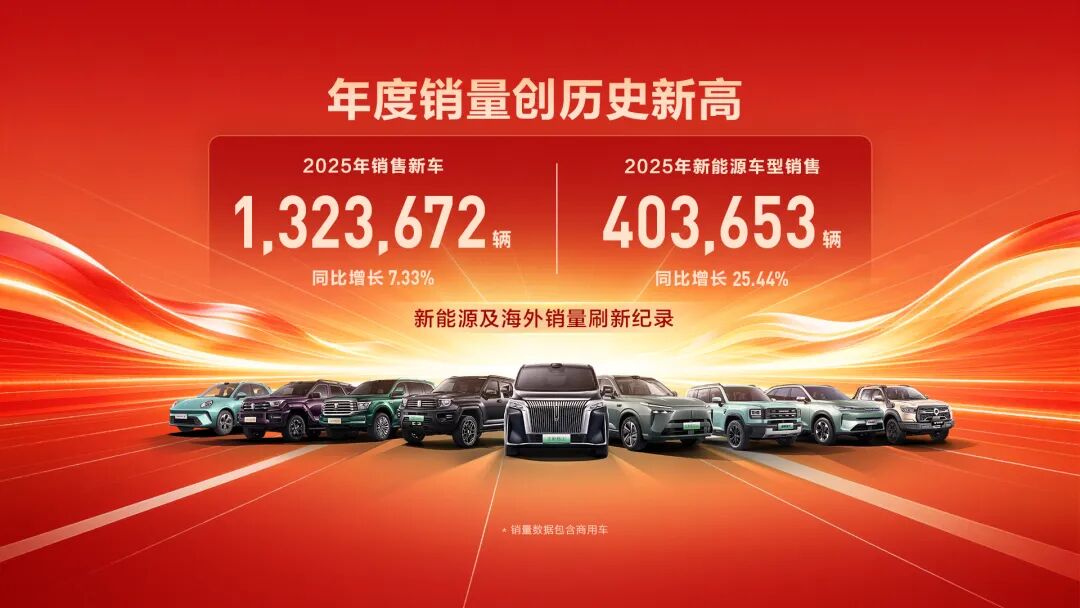
新京报贝壳财经讯(记者白昊天)1月30日,长城汽车(601633)发布2025年年度业绩快报,2025年企业 营业收入2227.9亿元,同比增长10.19%;净利润99.12亿元,基本每股收益1.16元。 销量方面,长城汽车2025年销售新车132.37万辆,同比增长7.33%。其中新能源车型销量40.37万辆,同 比增长25.44%;海外销量50.61万辆,同比增长11.68%。 ...

技术筑基,长期主义护航!长城汽车新能源与海外业务双线爆发
Guo Ji Jin Rong Bao· 2026-01-30 14:33
Core Insights - Long-termism is emphasized as a proactive approach, focusing on technology and value rather than short-term market fluctuations and profits [1] - Great Wall Motors (GWM) showcases strong resilience in a competitive environment with impressive financial results for 2025, including record revenue and sales figures [1][3] Financial Performance - GWM reported total revenue of 222.79 billion yuan in 2025, a year-on-year increase of 10.19%, marking a historical high [1] - The company sold over 1.32 million new vehicles in 2025, reflecting a 7.33% increase year-on-year, with over 403,000 of these being new energy vehicles, which surged by 25.44% [1][4] - Overseas sales exceeded 506,000 units, showing an 11.68% growth compared to the previous year [1][5] Technological Advancements - GWM's strategy of "technology-driven, long-termism" is evident in its development of the Hi4 intelligent four-wheel drive hybrid technology and the VLA advanced driving model [3][10] - The Hi4 technology, which was optimized in 2025, enhances vehicle performance and efficiency, catering to diverse consumer needs [4][11] - The launch of the "Guiyuan" platform in January 2026 represents a significant step towards future-proofing GWM's product lineup, allowing for compatibility across various powertrain types [10][11] Market Positioning - GWM's focus on high-end models is reflected in an average vehicle price of 201,300 yuan in 2025, an increase of 11,700 yuan from 2024 [8] - The Tank brand solidified its leadership in the high-end off-road market, with sales reaching 232,713 units in 2025 [9] - The VLA model enhances user experience by integrating advanced AI capabilities, setting a new standard in intelligent driving [10][13] Strategic Vision - GWM's commitment to high-quality development is seen as essential for transitioning from an automotive power to a strong automotive nation, emphasizing continuous quality improvement over blind expansion [16][17] - The company is well-prepared for upcoming industry changes, including adjustments in tax incentives for electric vehicles, through ongoing technological upgrades and product optimization [18] - GWM's integrated "research, production, supply, sales, and service" model has been successfully validated in markets like Thailand and Brazil, with plans for further expansion [18]
广汽集团:销量未达预期,预计去年净亏损至少80亿元
Xin Lang Cai Jing· 2026-01-30 14:29
Group 1 - GAC Group expects a net profit of -8 billion to -9 billion yuan for the current period, marking a shift from profit to loss year-on-year [1] - The company's revenue for 2024 is projected at 106.798 billion yuan, a decrease of 17.05% year-on-year, with a net profit decline of 81.4% [1] - GAC Group's total vehicle sales for 2025 are estimated at 1.7215 million units, down 14.06% year-on-year, with new energy vehicle sales at 433,600 units, a decline of 4.64% [1][2] Group 2 - GAC Toyota is the only brand within GAC Group to show sales growth in 2025, with a total of 756,000 units sold, up 2.44% year-on-year [2] - GAC Honda, GAC Trumpchi, and GAC Aion experienced significant sales declines of 25.22%, 23.02%, and 22.62% respectively in 2025 [2] Group 3 - GAC Group has initiated a Business Unit reform at the end of 2025, integrating its two self-owned brands, Haobo and Aion, into a single unit [3] - The establishment of the Trumpchi Business Unit was announced on January 16, indicating ongoing internal restructuring efforts [3] Group 4 - GAC Group's stock price fell by 1.86% to 7.92 yuan per share on the closing day [4]

法巴天星保险正式开业 又一车企系财险公司杀入新能源车险市场
Zhong Guo Jing Ying Bao· 2026-01-30 13:40
Core Viewpoint - A new player, 法巴天星保险, has entered the new energy vehicle insurance market, backed by major stakeholders including the French insurance group and automotive financial services [1][2]. Group 1: Company Overview - 法巴天星保险 has a registered capital of 1 billion yuan, with ownership distributed among three shareholders: 49% by the French insurance group, 33% by 四川银米科技, and 18% by 大众汽车金服 [1]. - 四川银米科技 is a subsidiary of 北京小米电子软件技术有限公司, which is primarily owned by 雷军 of 小米集团 [1]. - 大众汽车金服 is a member of the German automotive giant Volkswagen Group [1]. Group 2: Market Strategy - 法巴天星保险 aims to focus on the new energy vehicle insurance sector, developing specialized insurance products and enhancing claims processes to improve service for electric vehicle owners [1][2]. - The company plans to expand its business matrix and strengthen its competitive advantages in the market [1]. Group 3: Industry Trends - The traditional auto insurance market is highly concentrated, with a growing focus on new energy vehicles as a key area for insurance companies [2]. - Other automotive companies, such as Toyota, are also entering the new energy vehicle insurance market, indicating a trend among car manufacturers to integrate insurance services [2]. Group 4: Challenges and Opportunities - The entry of automotive companies into the insurance sector is seen as a response to the unique characteristics of new energy vehicles, which require tailored insurance products and services [3]. - The motivation for car manufacturers to seek insurance licenses includes extending their industry chain, internalizing costs, and enhancing brand and customer lifecycle management [4]. - However, challenges such as market concentration, regulatory scrutiny, and high capital requirements present significant barriers to entry for new insurance players [4].
