
生物制造

Search documents
焦点访谈丨向着新目标前进:未来五年 打好关键核心技术攻坚战
Yang Shi Xin Wen Ke Hu Duan· 2025-12-02 06:40
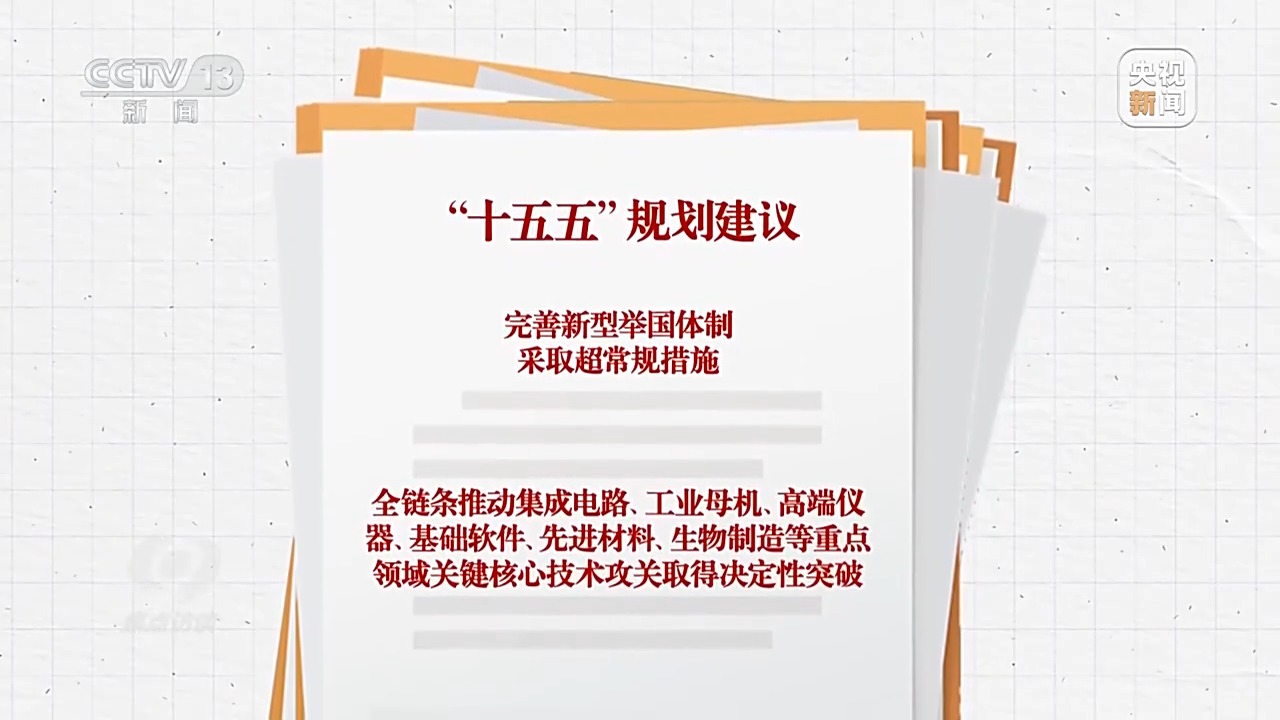
Core Viewpoint - The article emphasizes the importance of key core technology breakthroughs in China's "14th Five-Year Plan" and outlines a strategic approach to achieve these breakthroughs through focused efforts in six critical areas [1][3][9]. Group 1: Strategic Focus Areas - The "14th Five-Year Plan" identifies six key areas for technology breakthroughs: integrated circuits, industrial mother machines, high-end instruments, basic software, advanced materials, and biomanufacturing [3][9][21]. - These areas are strategically chosen to address urgent technological challenges and leverage new opportunities in the context of global technological competition [9][11][19]. Group 2: New Approaches and Measures - The plan proposes a "new type of national system" to enhance coordination and resource allocation for technology innovation, ensuring a unified effort across government and market sectors [23][25]. - "Extraordinary measures" will be implemented to overcome existing institutional barriers, focusing on urgent issues and mobilizing all available resources to achieve targeted breakthroughs [25][27]. Group 3: Comprehensive Chain Integration - A "full-chain approach" is advocated, integrating research, technology development, and industrial cultivation to ensure a seamless transition from innovation to market application [27][29]. - The integration of various chains, including industry, innovation, funding, and talent, is crucial for addressing past disconnects and ensuring effective collaboration [29]. Group 4: Investment and Progress - China's R&D investment is projected to exceed 3.6 trillion yuan in 2024, reflecting a 48% increase from 2020, with a focus on strengthening foundational research and innovation capabilities [19][21]. - The country has achieved significant milestones in key technology areas, moving from a position of following to leading in certain sectors, such as the production of ultra-thin steel materials [17][19].

厚实家底支撑核心技术攻关底气 “新提法”“新目标”新在何处?解读↓
Yang Shi Wang· 2025-12-02 04:32
Core Insights - The "14th Five-Year Plan" emphasizes the importance of key core technology breakthroughs, highlighting it as a crucial element for achieving high-quality development in China [1][3][12] - The plan outlines a shift from a broad approach to a more targeted strategy, focusing on six key areas for technological advancement [6][8][19] Summary by Categories Key Areas of Focus - The six major fields identified for concentrated efforts are integrated circuits, industrial mother machines, high-end instruments, basic software, advanced materials, and biomanufacturing [8][9][12] - These areas are critical for overcoming existing technological bottlenecks and seizing new opportunities presented by technological revolutions [9][12] Strategic Approach - The plan introduces a "new proposal" and "new goals" for tackling key core technologies, emphasizing a comprehensive and integrated approach [3][5] - The strategy involves a "new type of national system" that promotes collaboration and resource allocation across various sectors to enhance innovation [19][20] Investment and Resources - By 2024, China's total R&D investment is projected to exceed 3.6 trillion yuan, a 48% increase from 2020, with a research intensity of 2.68%, surpassing the EU average [18] - The plan aims to strengthen both foundational research and the mechanisms that facilitate rapid technological advancement [18][20] Implementation Mechanisms - The strategy calls for "super-normal measures" to break existing constraints and accelerate reforms in technology development [20][21] - A full-chain approach is emphasized, ensuring that every link from research and development to industrial application is effectively integrated [21]
【关注“十五五”规划】前瞻布局未来产业 中国具备禀赋优势
Zheng Quan Shi Bao· 2025-12-01 18:12
Core Viewpoint - The Chinese government has outlined a strategic initiative to proactively layout future industries, focusing on six key areas: quantum technology, biomanufacturing, hydrogen energy and nuclear fusion, brain-computer interfaces, embodied intelligence, and sixth-generation mobile communication. This initiative aims to enhance the country's industrial structure and drive economic growth [1]. Group 1: Future Industry Layout - The strategic layout of future industries is expected to clarify the direction of China's industrial structure and serve as a new pillar for economic growth [1]. - The six core areas identified for future industry development are characterized by their strategic, leading, and disruptive features [1]. Group 2: Advantages of Development - China possesses three unique advantages for developing future industries: a new type of national system for resource concentration, a complete industrial system for technology commercialization, and a vast market for rapid application and iteration of new technologies [1]. - The country is also expected to leverage its technological innovation advantages to support these developments [1]. Group 3: Technological Advancements - In embodied intelligence, China is achieving breakthroughs in both "smart brains" and "strong bodies," with increasing levels of model generalization [2]. - The country has developed leading brain-computer interface technologies, including ultra-flexible, minimally invasive electrodes and dynamic electrodes that can navigate within animal brains [2]. - In biomanufacturing, China leads globally in CAR-T cell therapy and original drug production [2]. - Quantum technology advancements include the "Zuchongzhi No. 3" supercomputer, which is significantly faster than the world's fastest supercomputer, and the "Wukong" quantum computer, which has completed over 710,000 calculations globally [2]. Group 4: Innovation Rankings - According to the Global Innovation Index 2025, China has entered the top ten for the first time, achieving its highest ranking at fourth place [3]. - The Global Key and Emerging Technologies Index 2025 indicates that while the U.S. remains the leading technology power, China ranks second in key technology fields such as semiconductors and artificial intelligence [3]. - China has 24 of the world's top 100 innovation clusters, maintaining its position as the global leader for three consecutive years [3]. Group 5: Policy Initiatives - The National Development and Reform Commission and the Ministry of Industry and Information Technology have issued implementation opinions to promote innovation in future industries, including specific policies for brain-computer interfaces and biomanufacturing [4]. - The State Council has introduced measures to accelerate the cultivation of application scenarios across various fields, establishing a comprehensive ecosystem for future industries [4]. Group 6: Industry Growth - Approximately 350 companies related to brain-computer interfaces have emerged in China, creating a complete industrial chain from core components to end applications [5]. - China has established the largest solar panel and flat screen film production bases globally, along with 23 biomanufacturing bases [5]. - With over 300 billion yuan allocated to quantum technology and substantial local funding, major provinces are developing numerous quantum technology application scenarios [5]. - The country has built 4.55 million 5G base stations, indicating a strong push towards future industries characterized by national strategic guidance and large-scale market applications [5].
焦点访谈|未来五年,打好关键核心技术攻坚战
Yang Shi Wang· 2025-12-01 13:23
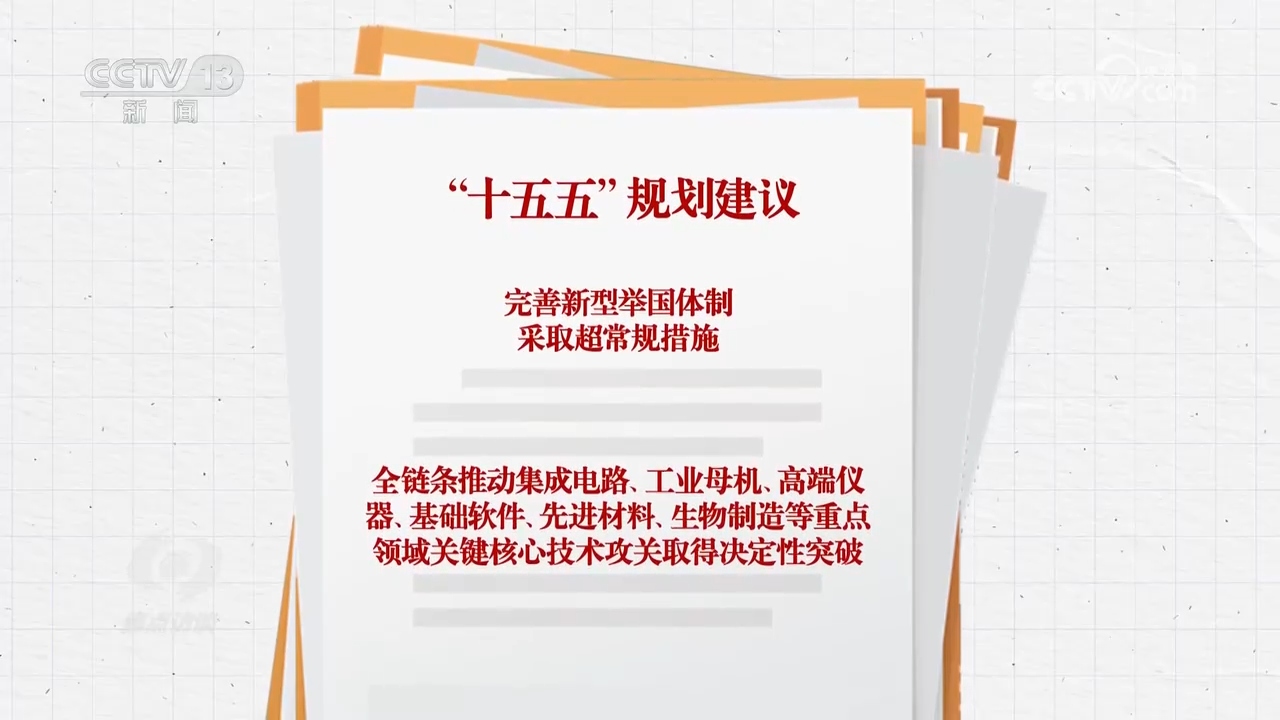
Core Insights - The article emphasizes the importance of tackling key core technologies as a strategic priority for China's high-quality development, particularly highlighted in the "14th Five-Year Plan" [1][4][10] - The focus will be on six critical areas: integrated circuits, industrial mother machines, high-end instruments, basic software, advanced materials, and biomanufacturing, which are deemed essential for overcoming technological bottlenecks and seizing new opportunities [6][8][14] Group 1: Strategic Framework - The "14th Five-Year Plan" proposes a new approach to technology development, emphasizing a comprehensive and targeted strategy rather than a broad, unfocused one [4][6] - The plan aims to establish a "new type of national system" that coordinates resources across government and market sectors to enhance innovation capabilities [16][18] - The strategy includes "extraordinary measures" to break existing barriers and accelerate reforms necessary for technological breakthroughs [18][20] Group 2: Implementation Tactics - The focus on "full-chain promotion" ensures that every aspect of the technology development process, from research to industrialization, is integrated and efficient [20] - The article highlights the need for a robust support system that combines funding, talent, and industry collaboration to facilitate rapid advancements in technology [12][14] - The commitment to investing in foundational research and creating a conducive environment for innovation is underscored, with projected R&D spending exceeding 3.6 trillion yuan by 2024, a 48% increase from 2020 [14] Group 3: Future Vision - The envisioned future includes advanced materials and technologies that enhance everyday life, such as smart buildings and sustainable food production methods [22] - The successful execution of the outlined strategies is expected to lead to significant advancements in various sectors, ultimately transforming the technological landscape of China [10][22]
海南布局现代化产业体系 谋划五条新质生产力赛道
Zhong Guo Xin Wen Wang· 2025-12-01 13:22
Core Viewpoint - Hainan Province is planning to establish a modern industrial system with a "45432" framework, focusing on optimizing existing industries and fostering new productive forces to enhance economic development [1][2]. Group 1: Industrial Optimization - The four leading industries in Hainan, namely tourism, modern services, high-tech industries, and tropical efficient agriculture, currently account for over 67% of the province's GDP. The province aims to enhance these sectors through chain supplementation and optimization during the 14th Five-Year Plan period [2]. Group 2: New Productive Forces - Hainan will leverage its unique resources to develop five new productive force tracks, including creating a "Southern Seed Silicon Valley," establishing a core hub for deep-sea technology innovation, expanding aerospace-related industries, developing a low-altitude economy, and building a green and low-carbon industrial supply chain [2]. Group 3: Future Industries - The province will focus on four cutting-edge fields: biomanufacturing, hydrogen energy, brain-computer interfaces, and embodied intelligence, to cultivate new hotspots for future industries [2]. Group 4: Consumer Development - Hainan plans to enhance its duty-free shopping reputation, develop the Boao Lecheng Medical Special Zone, and strengthen the "Study in Hainan" brand to boost consumption [2]. Group 5: Talent and Innovation - The province will implement the "Million Talents to Prosper Hainan" initiative to create a hub for technological innovation, reform, and open cooperation [3].
读懂中国“十五五”规划,中国式现代化彰显共享发展机遇承诺
2 1 Shi Ji Jing Ji Bao Dao· 2025-12-01 12:00
Core Insights - The "Understanding China" International Conference is being held for the 12th year, focusing on the theme of "New Layout, New Development, New Choices - Chinese-style Modernization and the New Global Governance Pattern" [1] - The conference aims to discuss the significance of the 14th Five-Year Plan and its implications for global governance, emphasizing China's role in providing new opportunities for developing countries [2][3] Group 1: Conference Themes and Objectives - The conference introduces two new topics: understanding the 14th Five-Year Plan and the four global initiatives, including the Global Governance Initiative [2] - The 14th Five-Year Plan is seen as a departure from the notion that modernization equals Westernization, offering new choices for developing countries [2][6] - The conference serves as a platform for global South countries to learn from China's modernization experience and to promote the concept of a community with a shared future for mankind [3][7] Group 2: International Cooperation and China's Role - Former Italian Prime Minister Romano Prodi highlights China's increasing importance in international cooperation, contrasting it with the past U.S.-led initiatives [2] - The conference emphasizes the need for collaboration among nations, particularly in the context of global challenges [2][4] - The participation of representatives from 72 countries, with a significant portion from the global South, indicates the growing influence of the conference [3] Group 3: Economic Strategies and Development Plans - The 14th Five-Year Plan focuses on domestic demand and international cooperation as core components of China's modernization strategy [3][6] - The plan aims to integrate economic growth with global cooperation, emphasizing shared opportunities and mutual development [6][7] - The plan includes innovative strategies for technology and industry, aiming to establish new economic growth points [8][9] Group 4: Regional Development and Innovation - The conference discusses the development experiences of the Guangdong-Hong Kong-Macao Greater Bay Area and Hainan Free Trade Port, highlighting their roles in China's modernization [12][13] - The Greater Bay Area is viewed as a vibrant region with significant potential for economic development and innovation [12] - The Hainan Free Trade Port is set to enhance international trade and cooperation, marking a new phase of China's high-level opening up [13]
溢多利:金大地投资累计质押股数为3750万股
Mei Ri Jing Ji Xin Wen· 2025-12-01 08:44
Group 1 - The core point of the article is that Yiduoli (SZ 300381) announced that as of the announcement date, Jindadi Investment has pledged a total of 37.5 million shares, accounting for 26.32% of its holdings [1] - For the year 2024, Yiduoli's revenue composition is as follows: 83.57% from the biomanufacturing industry, 15.71% from the bio-agriculture and animal husbandry industry, and 0.72% from other industries [1] - The current market capitalization of Yiduoli is 3.4 billion yuan [2]

院士领衔丨第六届生物制造产业大会,共话生物制造新未来
生物世界· 2025-12-01 08:30
Group 1 - The 6th Bio-Manufacturing Industrial Conference will take place on December 2, 2025, at the Guangming Cultural and Art Center in Shenzhen, focusing on synthetic biological manufacturing [2][4][40] - The conference is organized by several prominent institutions, including the Chinese Society of Biotechnology and the Shenzhen Institutes of Advanced Technology [2][39] - The event aims to gather key players from industry, academia, research, and investment sectors to discuss trends and insights in bio-manufacturing [3][45] Group 2 - A second batch of distinguished guests has been announced, featuring experts from various fields who will engage in deep discussions and share valuable insights [3][45] - The conference will include multiple forums and sessions, covering topics such as bio-manufacturing in the Guangdong-Hong Kong-Macao Greater Bay Area, pharmaceuticals, agriculture, and automation [49][50] - Evening sessions will feature project roadshows highlighting emerging forces in the bio-manufacturing industry [50]

多地力推工业领域设备更新
Jing Ji Ri Bao· 2025-11-30 03:12
Core Insights - The Chinese government has launched a large-scale equipment update and consumer goods replacement initiative, focusing on key industries such as steel, non-ferrous metals, petrochemicals, chemicals, building materials, electricity, machinery, aviation, shipping, textiles, and electronics [1] - Various provinces, including Inner Mongolia and Hunan, have developed specific implementation plans to promote industrial equipment updates and technological transformations [2][3] Group 1: Implementation Plans - Inner Mongolia has established a plan to enhance industrial equipment updates, with a focus on advanced equipment, digital transformation, and green upgrades, aiming for a 50% increase in equipment investment by 2027 compared to 2023 [7] - Hunan's plan targets over 2,000 industrial enterprises annually for technology upgrades, with a goal of achieving over 50% of large-scale industrial enterprises undergoing high-end, intelligent, and green transformations by 2027 [4][5] Group 2: Financial and Policy Support - Financial and tax policies are crucial for supporting equipment updates, with local governments optimizing tax processes and providing financial assistance to mining and manufacturing sectors [8][9] - In Inner Mongolia, a demand list for re-loans related to equipment updates has been created, involving 140 projects with a total investment of 634.6 billion yuan and a loan demand of 30.5 billion yuan [8] Group 3: Industry Focus and Goals - The focus on green and intelligent upgrades is emphasized, with Hunan aiming for a digital design tool usage rate of over 90% and a CNC rate of over 75% in key industrial sectors by 2027 [4][7] - Yunnan province is also pushing for digital equipment updates in the industrial sector to enhance production efficiency and promote advanced capacity [6]
2025生物制造前沿科技论坛举行 汇聚智慧厚植产业发展优势
Zhong Guo Xin Wen Wang· 2025-11-29 11:26
Core Insights - The 2025 Biomanufacturing Frontier Technology Forum commenced in Harbin, focusing on "Synthetic Biology to Create the Future" as its core theme, aiming to establish a high-end platform for academic discussions, technical exchanges, and industry connections to boost the high-quality development of the biological economy in Heilongjiang [1][2] Group 1: Industry Development - Heilongjiang Province has significant advantages in biomanufacturing, being the largest producer of amino acids and fuel ethanol in China, supported by robust research platforms and industrial clusters [1] - The province is at a critical juncture of "qualitative change" in biomanufacturing, with plans to leverage ecological resource advantages into industrial strengths [1][2] Group 2: Collaboration and Innovation - The forum facilitated knowledge sharing among domestic experts in biomanufacturing, biomedicine, bio-agriculture, and bio-based materials, showcasing the development advantages and innovative outcomes of Heilongjiang's biomanufacturing industry [2] - The event aims to enhance the collaborative development of the biological industry cluster, efficient transformation of scientific achievements, and quality improvement in agriculture, contributing positively to the high-quality development of Heilongjiang's biological economy [2] Group 3: Organizers - The conference was organized by the Heilongjiang Provincial Association for Science and Technology, Heilongjiang Academy of Sciences, and the Microbiology Research Institute of Heilongjiang Academy of Sciences [3]