科技行业

Search documents
12月降息概率骤变,美联储大消息,黄金异动
Zheng Quan Shi Bao· 2025-10-30 00:30
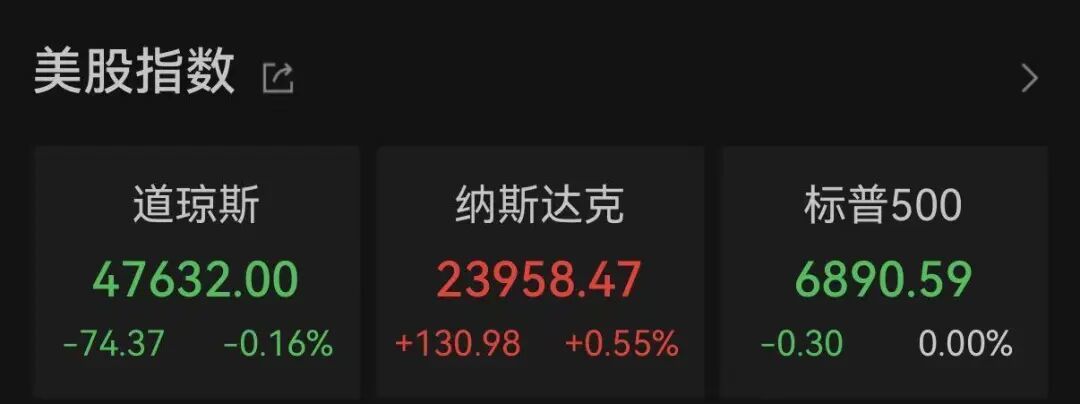
Group 1 - The Federal Reserve has lowered interest rates by 25 basis points, bringing the federal funds rate to 3.75% - 4.00%, marking the second rate cut of the year [5] - There is increasing internal division within the Federal Reserve regarding future rate cuts, with some members advocating for a pause and others pushing for a 50 basis point cut [5][6] - The probability of a 25 basis point cut in December is now at 67.8%, down from a previous 95.3% for a 50 basis point cut before Powell's statements [6][7] Group 2 - The U.S. stock market showed mixed results, with the Dow Jones down 0.16% at 47,632 points, the S&P 500 unchanged at 6,890.59 points, and the Nasdaq up 0.55% at 23,958.47 points, achieving a new high for the fourth consecutive day [1] - In the Chinese concept stock market, the Nasdaq China Golden Dragon Index fell by 0.03%, while the Wind China Concept Technology Leaders Index rose by 0.65% [3] - Individual stocks such as Canadian Solar, EHang, and CenturyLink saw significant gains, with increases of nearly 16%, 9%, and 8% respectively [3]

长川科技(300604.SZ):前三季净利润8.65亿元 同比增长142.14%
Ge Long Hui A P P· 2025-10-29 15:31
Core Viewpoint - Changchuan Technology (300604.SZ) reported significant growth in its third-quarter results, indicating strong operational performance and profitability [1] Financial Performance - The company's revenue for the first three quarters reached 3.779 billion yuan, representing a year-on-year increase of 49.05% [1] - Net profit attributable to shareholders was 865 million yuan, showing a year-on-year growth of 142.14% [1] - The net profit after deducting non-recurring gains and losses was 789 million yuan, reflecting a year-on-year increase of 128.89% [1]

汉王科技:2025年前三季度净利润约-9118万元
Mei Ri Jing Ji Xin Wen· 2025-10-29 12:48
Group 1 - The core viewpoint of the article highlights Hanwang Technology's financial performance in Q3 2025, showing a revenue increase but a net loss [1] - Hanwang Technology reported revenue of approximately 1.26 billion yuan for the first three quarters of 2025, representing a year-on-year increase of 9.85% [1] - The company experienced a net loss attributable to shareholders of approximately 91.18 million yuan, with a basic earnings per share loss of 0.373 yuan [1] Group 2 - As of the report, Hanwang Technology's market capitalization stands at 5.6 billion yuan [1] - The article also notes a significant market trend, indicating that the A-share market has surpassed 4,000 points, marking a resurgence in the technology sector and the beginning of a "slow bull" market pattern [1]

微软冲上4万亿市值苹果仅差一步,AI狂欢下的泡沫隐忧
Di Yi Cai Jing· 2025-10-29 09:55
Core Insights - The article highlights a historic moment in the U.S. stock market where Microsoft, Nvidia, and Apple briefly entered the "4 trillion club" in market capitalization, driven by the ongoing AI wave [1] - Nvidia leads with a market cap of $4.89 trillion, while Apple is at $3.99 trillion, and Microsoft has surpassed the $4 trillion mark, closing at $4.03 trillion [1] - The surge in valuations is attributed to breakthroughs in AI technology, which are reshaping industry dynamics and fueling high market expectations for growth potential among tech giants [1] Group 1: Market Performance - Nvidia's market cap is $4.89 trillion, just shy of the $5 trillion milestone [1] - Apple's market cap stands at $3.99 trillion, close to the $4 trillion threshold [1] - Microsoft has successfully crossed the $4 trillion market cap barrier, closing at $4.03 trillion [1] Group 2: AI Influence - The ongoing AI revolution is a key driver behind the soaring valuations of these tech giants, impacting everything from computational infrastructure to end-user applications [1] - There are concerns regarding whether the growth momentum can be sustained after a rapid increase in valuations [1] Group 3: Upcoming Earnings Reports - The upcoming earnings reports from major tech companies, including Microsoft, Google, Amazon, Meta, and Apple, are seen as critical indicators for the market [1] - These companies will need to address three key questions: the diminishing marginal returns of AI investments, the ability of cloud business growth to offset high capital expenditures, and the commercial performance of AI products [1] - The answers to these questions will significantly influence the valuation logic of tech giants and the future trajectory of the U.S. tech sector and the broader market [1]



华自科技:公司目前生产经营正常,行业前景广阔
Zheng Quan Ri Bao Zhi Sheng· 2025-10-29 09:12
Core Viewpoint - The company, Huazi Technology, is currently operating normally and is optimistic about the industry's future, taking various measures to enhance its operational performance [1] Group 1 - The company responded to investor inquiries on October 29, indicating that assessing potential risks requires a comprehensive evaluation of factors such as ongoing operational capability and financial indicators [1] - The company emphasizes that it is actively working to improve its business performance amidst a promising industry outlook [1]

美股集中度的抬升是否值得担忧?
Dong Zheng Qi Huo· 2025-10-29 08:50
Group 1: Report Industry Investment Rating - The investment rating for US stocks is bullish [1] Group 2: Core Viewpoints of the Report - The current increase in US stock concentration is mainly due to investors' funds flowing towards leading technology companies. The root cause of the risk is not the concentration increase caused by industry structure changes, but the excessive concentration of funds and the over - payment of value premiums for leading companies [1] - The high - concentration stage of US stocks is still fundamentally driven. The market capitalization expansion of leading technology companies is supported by profit growth and capital returns. In the short term, this structural feature will continue to support market returns [5] Group 3: Summaries based on the Table of Contents 1. Historical Lessons of the Increase in US Stock Concentration: Nifty Fifty and the Dot - Com Bubble - Market concentration significantly increased during the "Nifty Fifty" in the 1970s and the dot - com bubble in 2000. In the 1970s, the valuation premiums paid for the stability of leading enterprises returned to the mean in a high - interest - rate environment. The dot - com bubble burst because the cyclical demand in the technology industry was difficult to sustain, and the tightening of the interest - rate environment accelerated the decline of the capital expenditure cycle [2] - During the "Nifty Fifty" in 1970, investors over - paid for the certainty of leading enterprises. In the 1973 - 1974 Fed rate - hiking process, the valuation bubble burst, and most leading stocks fell by more than 50%. The decline was mainly due to the correction of leading enterprises' valuations rather than profit pressure [26][29] - In the 2000 dot - com bubble, the demand for computer hardware and network equipment was over - drawn in the short term, and many Internet companies had no stable profits. After the interest - rate environment tightened, profits declined rapidly, and high valuations could not be supported [39] 2. The US Stock Market Structure Further Increases Market Concentration - Institutional investors in the US stock market have more pricing power. Constrained by capital volume and performance evaluation systems, funds prefer large - market - capitalization momentum stocks. The rise of ETFs also causes funds to flow passively to leading enterprises, further increasing market concentration [3] - The trading structure of the US stock market is conducive to large - market - capitalization companies attracting funds. The trading volume of institutional investors accounts for about 80%, and they have stronger pricing power. Retail investors prefer small - market - capitalization and high - turnover companies [59][60] 3. Is the Current Concentration Reasonable? - The increase in concentration is greater than the increase in index valuation, indicating that leading technology companies are not the main source of valuation pressure. Current profit growth is gradually digesting valuations. There is no significant risk of a bubble in the current AI market [4] - In a high - interest - rate environment, the US economy is slowing down, but the AI industry has high certainty and growth potential. The profit margins of leading technology companies are increasing, and the value premium brought by fundamentals may continue to exist [70] - Although the current interest - rate environment weakens the support for valuations, it does not pose a significant risk. If leading technology companies maintain their valuation premiums, the proportion of Mag7 in the index may further rise to 41% [4][73] 4. Investment Recommendations - The high - concentration stage of US stocks is still fundamentally driven. Leading technology companies in the AI industry chain still have allocation value, and the Nasdaq 100 is expected to outperform. However, attention should be paid to the increased sensitivity to industry risks and systemic fluctuations after the increase in index concentration. It is recommended to avoid chasing high prices blindly, buy on dips, and hedge potential risks when volatility is low [5]
独家洞察 | 贸易回暖?中美马这波谈判释放重磅信号!
慧甚FactSet· 2025-10-29 02:14
Core Viewpoint - The article highlights the significant easing of global trade tensions following U.S. President Trump's trade agreements during his Asia trip, leading to a positive market sentiment and record highs in U.S. stock indices [2][4]. Group 1: Trade Agreements - Trump signed formal trade agreements with Malaysia and Cambodia, and reached a framework agreement with Thailand and Vietnam, which includes tariff reductions on U.S. automobiles and agricultural products [4]. - Malaysia committed to investing approximately $70 billion in the U.S. over the next decade, while the U.S. will exempt some tariffs, maintaining an overall tax rate between 19% and 20% [4]. Group 2: U.S.-China Trade Talks - A new round of U.S.-China trade negotiations took place in Kuala Lumpur, resulting in a "framework agreement" for further cooperation, with plans for a meeting between the two countries' leaders at the APEC summit [4][5]. - Key discussion topics included bilateral trade, export controls, and the potential for a resolution regarding tariffs on soybeans and rare earth exports [5]. Group 3: Market Reactions - Following the trade agreements, U.S. stock indices reached new closing highs, with the S&P 500 rising by 1.23% to 6875.16 points, the Dow Jones increasing by 0.71% to 47544.59 points, and the Nasdaq soaring by 1.86% to 23637.46 points [2][4]. Group 4: Future Trade Relations - Analysts suggest that the recent talks signal a stable framework for U.S.-China relations, reducing the likelihood of sudden risks in the short term, despite unresolved issues regarding tariffs and trade [6]. - The establishment of a "framework agreement" is seen as a constructive outcome, potentially paving the way for future negotiations and trade agreements [6][7].

帮主郑重:美股三连创新高,6900点为啥站不稳?
Sou Hu Cai Jing· 2025-10-29 00:25
先说说昨天夜里的盘面,挺有意思的——道指、纳指、标普500仨指数,连着第三天创历史新高,标普盘中一度冲到6911点,眼看就要站稳6900关口,结果 收盘又缩回去了,报在6890点。就跟爬山似的,费劲爬到山顶,没站稳又退了半步。那边英伟达倒是猛,大涨近5个点,股价破200美元,市值都快摸到4.9 万亿美元了,科技股的劲头还是足。 为啥能连涨三天?背后不是没原因的。上周末中美在吉隆坡磋商,说是形成了初步共识,贝森特也说为领导人会谈准备了框架,特朗普更是直接放话"要达 成协议"——国际贸易这块的紧张感一降,市场就松了口气。还有ADP就业数据,10月私营部门岗位从9月的负增长转成正的,每周增14000多,虽说不算特 别亮眼,但好歹是止跌回升,给劳动力市场添了点信心。更关键的是,美联储今天开始开两天议息会,市场都等着今年第二次降息,甚至盼着鲍威尔放话12 月再降——钱要变松,资金自然愿意往股市里跑。但热闹背后也有凉风吹,亚马逊昨天宣布要搞史上最大规模裁员,科技行业裁员潮还没停,这也是个隐 忧。 早上一睁眼,手机推送就炸了——美股又双叒创新高了,标普500都摸到6900点了!估计不少朋友盯着屏幕嘀咕:这行情到底是真强,还 ...


交大思诺:本次计提资产减值准备,将减少公司2025年1-9月营业利润约785万元
Mei Ri Jing Ji Xin Wen· 2025-10-28 17:38
Group 1 - Company Jiao Da Si Nuo (SZ 300851) announced on October 29 that it will recognize an asset impairment provision, which will reduce the company's operating profit for the period from January to September 2025 by approximately 7.85 million yuan [1] - The asset impairment provision will also decrease the company's equity as of September 30, 2025, by approximately 7.85 million yuan [1] - The asset impairment provision has not been audited by an accounting firm [1] Group 2 - The A-share market has surpassed 4000 points, marking a significant resurgence after a decade of stagnation [1] - The technology sector is leading the market's transformation, indicating the onset of a "slow bull" market pattern [1]

突发!深夜大利好,直线暴涨!
中国基金报· 2025-10-28 16:06
Market Overview - The US stock market continued to rise on October 28, with the Dow and Nasdaq slightly up, while the S&P 500 approached breakeven as investors awaited earnings reports from major tech companies and the Federal Reserve's two-day meeting [2][4] - Major tech companies including Microsoft, Alphabet, Meta, Amazon, and Apple, which account for about a quarter of the S&P 500's weight, are set to report earnings this week, with a focus on capital expenditure expectations [3] Capital Expenditure Insights - Analysts predict that combined capital expenditures for Microsoft, Alphabet, Amazon, and Meta will reach $360 billion in the current fiscal year, with a significant portion related to artificial intelligence [3] - This figure is expected to rise to nearly $420 billion next year, indicating a strong investment trend in AI technologies [3] Nvidia's Investment in Nokia - Nvidia announced a $1 billion equity investment in Nokia, marking a significant endorsement of Nokia's shift from mobile network equipment to an AI-focused strategy [6] - Nokia will issue approximately 166 million new shares at $6.01 each, resulting in Nvidia holding a 2.9% stake in the company [6] - Nvidia's chips will be utilized to enhance Nokia's software for 5G and 6G networks, while Nvidia will explore integrating Nokia's data center technology into its AI infrastructure [6] Nokia's Stock Performance - Following the announcement of Nvidia's investment, Nokia's stock surged nearly 20% [7]