
资产管理

Search documents
贵金属崩盘、美元走高!华尔街想搞明白:沃什“是敌是友”?
华尔街见闻· 2026-01-31 03:46
Core Viewpoint - The article discusses the significant market volatility triggered by the potential appointment of Kevin Warsh as the new Federal Reserve Chair, highlighting investor uncertainty regarding his policies and their implications for asset pricing [3][5]. Market Reactions - On Friday, silver experienced a drop of over 30%, marking its largest single-day decline since March 1980, while gold fell by 11%, the worst day since January 1980. The dollar index rose by 0.9%, and the 10-year Treasury yield increased to 4.24%. The S&P 500 index dipped by 0.4%, and the Russell 2000 index, sensitive to liquidity, fell by 1.5% [3][6]. Warsh's Policy Contradictions - Warsh's seemingly contradictory stance of advocating for quicker interest rate cuts while also pushing for a reduction of the Fed's balance sheet has raised concerns among investors. This dual approach could significantly impact risk assets, as a rapid balance sheet reduction may counteract the benefits of lower interest rates [5][6]. Concerns Over Balance Sheet Reduction - The primary worry on Wall Street revolves around Warsh's attitude towards the Fed's balance sheet. His past as a "hawk" on inflation and recent calls for faster rate cuts, combined with his insistence on balance sheet reduction, lead some investors to believe that this could undermine the stimulative effects of rate cuts [7][8]. Support from Investment Leaders - Despite market concerns, some top investors view Warsh positively, emphasizing his independence and ability to withstand political pressure. They believe he could provide a rational voice in the Fed, which may help stabilize market sentiments [9][10]. Shift in Market Sentiment - The recent market movements indicate a reversal in the "currency devaluation trade," where the strong rebound of the dollar and the collapse of precious metals suggest that investors are regaining confidence in U.S. assets. This shift reflects the complex emotions surrounding Warsh's potential policies [10]. Internal Fed Dynamics - The Federal Reserve's decision-making process is influenced by committee voting, and recent dissent among members regarding interest rate decisions could signal significant changes ahead. This internal division may increase uncertainty in future market decisions [11]. Need for Time to Digest Signals - The market requires additional time to fully understand and react to the complex signals presented by Warsh's potential leadership, indicating ongoing volatility as investors assess his policy implications [12].


贵金属崩盘、美元走高!华尔街想搞明白:沃什“是敌是友”?
Hua Er Jie Jian Wen· 2026-01-31 01:43
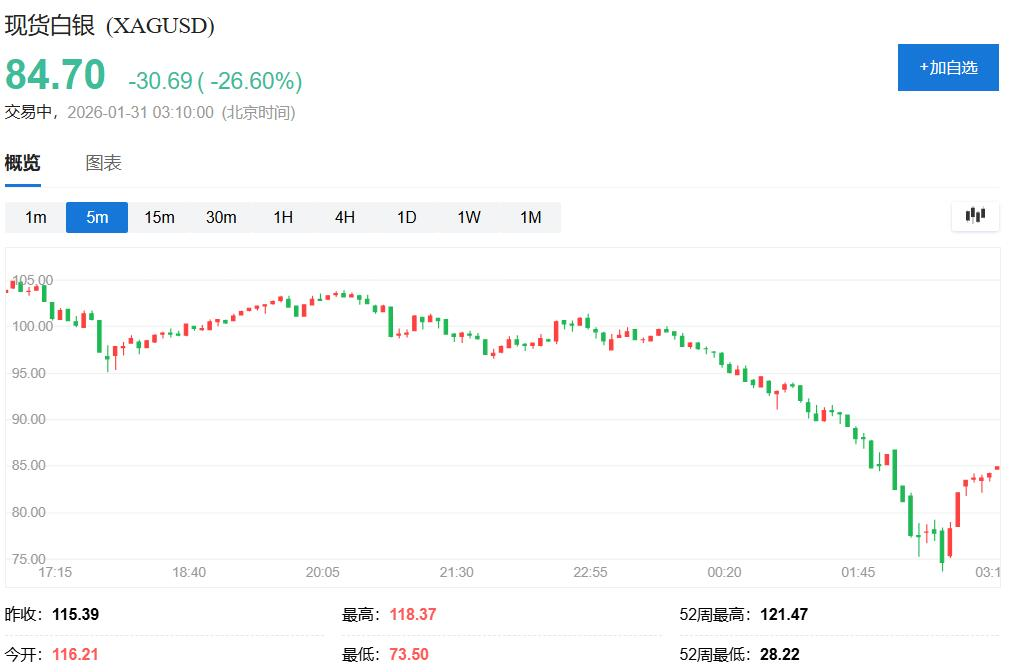
Core Viewpoint - The market is experiencing significant volatility due to the potential appointment of former Federal Reserve Governor Kevin Warsh as the new Fed Chair, leading to uncertainty about his policies and their impact on the economy [1][4]. Group 1: Market Reactions - On Friday, silver dropped over 30%, marking its largest single-day decline since March 1980, while gold fell 11%, the worst day since January 1980 [1]. - The U.S. dollar index surged by 0.9%, and the 10-year Treasury yield rose to 4.24%. The S&P 500 index slightly decreased by 0.4%, and the Russell 2000 index, sensitive to liquidity, fell by 1.5% [1]. Group 2: Warsh's Policy Stance - Warsh's contradictory policy stance is at the center of market concerns; he advocates for faster interest rate cuts while also insisting on reducing the Fed's balance sheet, which could negatively impact risk assets [4][5]. - His previous tenure at the Fed from 2006 to 2011 as an "inflation hawk" raises questions about the effectiveness of potential rate cuts if accompanied by aggressive balance sheet reduction [5]. Group 3: Investor Sentiment - Despite market fears, some top investors view Warsh as a pragmatic choice who can maintain the Fed's independence amid political pressures, with notable figures praising his market understanding [6]. - Investors are currently uncertain about Warsh's true policy intentions, as his past as an inflation hawk contrasts with his recent calls for rate cuts, complicating his categorization as either dovish or hawkish [7]. Group 4: Internal Fed Dynamics - The Fed Chair's influence is significant but still subject to the committee's voting mechanism, which has shown internal divisions, particularly with dissenting votes on interest rate decisions [8]. - The potential for increased uncertainty in future decisions could pressure the market, especially if the Fed leadership mirrors the divisions seen in the UK [8].
日本财务省:1月份未进行日元干预操作
Hua Er Jie Jian Wen· 2026-01-30 17:08
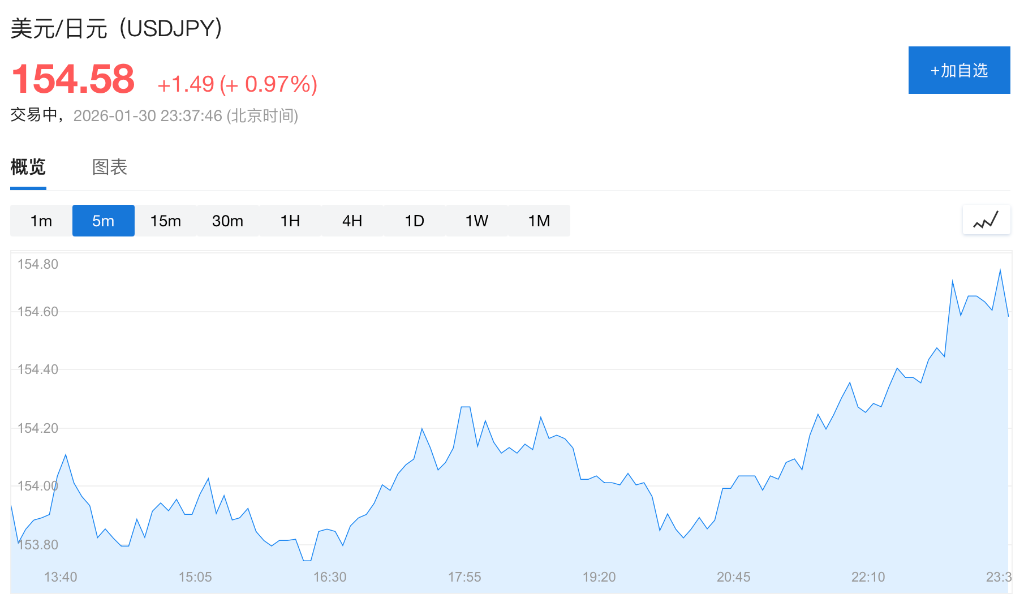
日本财务省周五公布的数据证实,在1月大部分时间里,当局并未直接干预汇市。尽管日元在此期间从接近160关口显著升值至154区间,但其反弹 主要源自市场对美日可能采取联合行动的担忧,而非实际干预操作。 交易员报告显示,纽约联邦储备银行的询价操作实际推动了日元走强。相比日本单独行动,美日联合干预的潜在威胁具有更强的市场影响力,能 更有效地引导汇率方向并对投机交易形成压制。 日本财务大臣片山皋月近期多次援引去年9月的日美货币协议,强调可能与美国协调行动。她在周二日元进一步升值后对记者表示: 数据显示,从去年12月29日至今年1月28日,日本并未动用任何资金进行外汇干预。这与2024年春季的情况形成鲜明对比,当时为达成类似幅度调 整,日本曾投入近10万亿日元(约650亿美元)进行干预。 这一策略为即将于2月8日面临大选考验的高市早苗政府赢得了宝贵的缓和空间,因为日元贬值推升的通胀一直是选民不满的主要焦点。然而分析 师警告,此种依赖美国政策配合的策略存在显著脆弱性,难以持续复制;一旦日元再度逼近160,日本或将不得不启动规模更大的实际干预。 值得注意的是,美国财政部长贝森特周三已明确表态,美国"绝对没有"在货币市场中抛售 ...
中基协:12月私募资管产品设立规模819.32亿元,环比减少3.86%
Sou Hu Cai Jing· 2026-01-30 12:05
钛媒体App 1月30日消息,中基协发布数据,2025年12月,证券期货经营机构共备案私募资管产品2,307 只,环比增加8.11%,同比增加90.82%;设立规模819.32亿元,环比减少3.86%,同比增加60.16%。截 至2025年12月底,证券期货经营机构私募资管产品规模合计12.30万亿元(不含社保基金、企业年 金),较上月底减少2,062.41亿元,环比下降1.65%。(中基协) ...
Nomura (NMR) - 2026 Q3 - Earnings Call Transcript
2026-01-30 10:32
Financial Data and Key Metrics Changes - Return on equity was 10.3%, meeting the 2030 target of 8%-10% for the seventh consecutive quarter [3] - Group-wide net revenue reached JPY 551.8 billion, a 7% increase from the previous quarter [3] - Income before income taxes decreased by 1% to JPY 135.2 billion, while net income also fell by 1% to JPY 91.6 billion [3] - Earnings per share for the quarter were JPY 30.19 [3] Business Line Data and Key Metrics Changes - Wealth Management saw a growth of approximately 30% compared to the previous quarter, with net revenue increasing by 14% to JPY 132.5 billion [4][8] - Investment Management's business revenue reached an all-time high, but profits fell due to weaker investment gains and one-time expenses related to the Macquarie acquisition [4][12] - Wholesale net revenue rose by 12% to JPY 313.9 billion, with investment banking net revenue increasing by 31% to JPY 57.1 billion [15][17] Market Data and Key Metrics Changes - Recurring revenue assets saw a net inflow of JPY 503.9 billion, reaching an all-time high of JPY 28.1 trillion by the end of December [10][11] - The number of flow business clients increased by around 270,000 to 1.53 million, driven by buoyant market conditions [11] Company Strategy and Development Direction - The company announced a share buyback program with a limit of 100 million shares and JPY 60 billion in amount, aimed at enhancing shareholder return and capital efficiency [5] - The company is focused on maximizing synergies between existing and newly acquired businesses, particularly in the Investment Management division [26] Management's Comments on Operating Environment and Future Outlook - Management noted that client sentiment remains favorable despite some selling pressures in the market, with a shift from savings to investment being a sustainable trend [21][22] - The company expects a solid pipeline in investment banking, despite a slower start in Q4 due to seasonal factors [22] Other Important Information - Group-wide expenses increased by 10% to JPY 416.5 billion, driven by one-time costs associated with acquisitions and strategic investments [19] - The common equity Tier 1 ratio at the end of December was 12.8%, with a slight decrease attributed to changes in regulatory capital calculations following the Macquarie acquisition [20] Q&A Session Summary Question: Regarding Laser Digital's losses and position management - Management acknowledged the losses due to market fluctuations and emphasized the importance of precise position management to control volatility [31] Question: Sustainability of Wealth Management's net inflow - Management refrained from making definitive comments on sustainability but noted a significant shift in retail investor behavior towards investment [32] Question: Wealth Management pricing strategy - Management declined to comment on internal discussions regarding commission rate increases, focusing instead on value provision to customers [38] Question: Timing and scale of buyback - Management explained that the timing was influenced by the recent acquisition and the need to meet investor expectations [39] Question: Impact of personnel costs and deferred compensation - Management provided details on the expected impact of accounting changes on personnel costs, estimating around JPY 8 billion for Q4 [52] Question: Long-term strategy for Laser Digital - Management discussed the need for a thorough strategy to manage the growth and volatility of the digital asset business while ensuring diverse activities [54]

Nomura (NMR) - 2026 Q3 - Earnings Call Transcript
2026-01-30 10:30
Financial Data and Key Metrics Changes - Return on equity was 10.3%, meeting the 2030 target of 8%-10% for the seventh consecutive quarter [3] - Group-wide net revenue reached JPY 551.8 billion, a 7% increase from the previous quarter [3] - Income before income taxes decreased by 1% to JPY 135.2 billion, while net income also fell by 1% to JPY 91.6 billion [3] - Earnings per share for the quarter were JPY 30.19 [3] - Pre-tax income for all four divisions rose 8% to JPY 142.9 billion, the highest level in 18.5 years [4] Business Line Data and Key Metrics Changes - Wealth Management saw a growth of around 30% compared to the previous quarter, with net revenue increasing 14% to JPY 132.5 billion [4][7] - Investment Management's business revenue reached an all-time high, but profits fell due to weaker investment gains and one-time expenses from the Macquarie acquisition [4][12] - Wholesale net revenue rose 12% to JPY 313.9 billion, with Investment Banking net revenue increasing by 31% to JPY 57.1 billion [15][17] - Banking net revenue increased by 7% to JPY 13.7 billion, with income before income taxes rising 31% to JPY 4.2 billion [18] Market Data and Key Metrics Changes - Recurring revenue assets saw a net inflow of JPY 503.9 billion, reaching an all-time high of JPY 28.1 trillion [11] - Total sales rose to JPY 6.6 trillion, with equities growing by 4% and bonds declining by 25% [9][10] - The number of flow business clients increased by approximately 270,000 to 1.53 million, driven by buoyant market conditions [11] Company Strategy and Development Direction - The company announced a share buyback program to enhance shareholder return and capital efficiency, with a limit of 100 million shares and JPY 60 billion [5] - The focus remains on maximizing synergies between existing and newly acquired businesses, particularly in the Investment Management division [25][26] - The company aims to continue capturing growth in crypto markets while managing volatility through tighter control over positions and risk exposure [23] Management's Comments on Operating Environment and Future Outlook - Management expressed confidence in the strong performance across all segments, with stable revenue growth and positive client flows [21] - The outlook for January indicated that Wealth Management's net revenue was on par with Q3 levels, despite some market selling pressures [21] - Management acknowledged the challenges posed by market volatility but emphasized a solid pipeline in Investment Banking [22] Other Important Information - Group-wide expenses increased by 10% to JPY 416.5 billion, driven by one-off costs and strategic investments [19] - The common equity Tier 1 ratio at the end of December was 12.8%, with Tier 1 capital rising to JPY 3.6 trillion [20] Q&A Session Summary Question: Regarding Laser Digital's losses and position management - Management confirmed that there were long positions taken and emphasized the importance of a robust risk management framework to control volatility [30][31] Question: Sustainability of Wealth Management's net inflow - Management refrained from making definitive comments on sustainability but noted a significant shift from savings to investment among retail investors [32] Question: Wealth Management pricing strategy - Management focused on value provision to customers and did not provide specific details on potential pricing changes [36] Question: Timing and scale of buyback - The buyback was timed to align with the completion of the Macquarie acquisition, and the size was determined based on investment strategy and shareholder return considerations [37] Question: Impact of personnel costs and deferred compensation - Management indicated an expected impact of about JPY 8 billion in Q4, with a gradual normalization of costs in subsequent years [41] Question: Long-term strategy for Laser Digital - Management acknowledged the need for a thorough discussion on growing the business while managing risk exposure [42]
最懂炒股的医疗公司?九安医疗:主业躺平,投资躺赢,市值躺枪
市值风云· 2026-01-30 10:09
Core Viewpoint - The performance of asset management is impressive, while the core business is experiencing losses [1][19]. Financial Performance - Jiuan Medical (002432.SZ) forecasts a net profit attributable to shareholders of 2.02 billion to 2.35 billion yuan for 2025, representing a year-on-year growth of 21.05% to 40.83% [4][5]. - For the first three quarters of 2025, Jiuan Medical reported revenue of 1.069 billion yuan, but net profit reached 1.589 billion yuan, indicating that total operating costs of 1.276 billion yuan exceeded revenue [7][13]. - Investment income for the first three quarters was 562 million yuan, with fair value changes contributing 1.251 billion yuan, totaling over 1.8 billion yuan in investment-related income [7]. Asset Management - As of the end of Q3 2025, Jiuan Medical held trading financial assets worth 10.362 billion yuan, primarily in wealth management products, and other investments totaling 13.877 billion yuan, leading to a total asset management portfolio of 24.122 billion yuan [8][10]. - The contribution of asset management to Jiuan Medical's profits is increasing, allowing the company to achieve significant profitability despite a decline in core business revenue [13]. Core Business Challenges - The iHealth product line, which includes smart medical devices, has seen a significant revenue decline, with a 50% drop in revenue to 601 million yuan in the first half of 2025, and a 49% decline in total revenue for the first three quarters [15][16]. - The overall revenue from the iHealth series has decreased from 1.859 billion yuan in 2021 to 601 million yuan in 2025 [17]. Market Reaction - Following the earnings forecast, Jiuan Medical's stock price remained relatively stable, with a price-to-book ratio of 0.89, indicating it is trading below its book value [18].


国联民生资管携手青岛银行,渠道版图再下一城
Jing Ji Guan Cha Wang· 2026-01-30 09:31
2026年伊始,国联民生(601456)资管子公司与青岛银行(002948)达成深度合作,正式成为青岛银行 在零售私募代销业务的首家合作伙伴。双方强强联合落地的首期私募资管新产品,在首发销售中表现亮 眼。数据显示,该产品首期募集规模超1亿元,不仅圆满完成了既定目标,更为公司的新年征程带来了 第一声捷报。 展望2026,国联民生资管将继续秉承"专业创造价值,陪伴铸就成长"的理念,依托不断扩大的客户基 础,力争通过精细化管理与多元策略工具选择,为更广泛的客户提供可持续的业绩回报。 截至目前,国联民生资管已积淀出强大的渠道网络与机构客户资源禀赋。公司积极扩容朋友圈,构建了 多元化的代销客户资源:涵盖国有大行、券商财富管理部、以及大型城农商行等。目前核心合作渠道已 达10余家,实现了渠道广度与深度的双双跃升。 此次与青岛银行的成功牵手,标志着国联民生资管在渠道开拓战略上再下一城。作为青岛银行引入的首 家合作伙伴,这不仅是国联民生资管子一直以来坚定执行"渠道深耕"战略的硕果,也是双方团队精诚协 作、不懈努力的结晶。展望未来,我们将以此为契机,进一步挖掘合作潜力,为公司拓展了北方地区更 广阔的市场空间。 ...

“新债王”冈拉克看空美国,最新投资策略聚焦三大方向!
Jin Shi Shu Ju· 2026-01-30 09:20
Core Viewpoint - Jeff Gundlach, known as the "new bond king," emphasizes avoiding the U.S. market as a key investment strategy due to two main risks: high inflation and a weakening dollar [1] Group 1: Inflation Concerns - Current U.S. annual inflation rate is around 3%, exceeding the Federal Reserve's 2% target, which could lead to a cumulative price increase of 56% over 15 years if maintained [1] - Concerns exist that the Federal Reserve may lower interest rates prematurely due to political pressure, potentially exacerbating inflation [1] Group 2: Dollar Weakness - The dollar index has declined approximately 10% over the past year, indicating a loss of investor confidence in dollar-denominated assets [1] - Gundlach believes that a significant rate cut by the Federal Reserve would not only indicate a weak dollar policy but also an inflationary policy [1] Group 3: Investment Directions - **Direction One: Non-U.S. Currency Denominated Overseas Stocks** - Gundlach recommends allocating 30% to 40% of investment portfolios to overseas stocks, particularly in emerging markets, while completely avoiding U.S. stocks [2] - Emerging market stocks have outperformed U.S. stocks, with the iShares MSCI Emerging Markets ETF rising 42% over the past year compared to a 15% increase in the S&P 500 [2] - **Direction Two: Short-Term Bonds** - Gundlach maintains a positive outlook on short-term bonds, believing that most risks in the public bond market have been absorbed by the private credit market [3] - He holds a bearish view on long-term bonds due to rising yields driven by high inflation and expanding U.S. fiscal deficits [3] - **Direction Three: Precious Metals and Commodities** - With the dollar losing its safe-haven status, Gundlach identifies gold, silver, and other precious metals as quality investment options, along with commodities [4] - Precious metals have seen significant price increases, with gold rising nearly 65% and silver soaring about 150% over the past year [5]
香港财库局许正宇:《稳定币条例》已于去年8月正式实施 香港金管局正处理相关牌照申请
智通财经网· 2026-01-30 09:05
Group 1: Strengthening Hong Kong's Position as an International Financial Center - The Hong Kong Financial Secretary aims to enhance the stock market by implementing measures such as assisting mainland tech companies in financing, optimizing listing mechanisms, and exploring a reduction in the stock settlement cycle from T+2 to T+1 [2] - The Financial Secretary plans to submit legislative proposals to optimize tax incentives for funds and family offices, and to introduce statutory regulations for real estate investment trusts (REITs) [2] - The government will revise regulations to lower capital requirements for insurance funds participating in infrastructure financing and support local projects [3] - The Securities and Futures Commission and the Monetary Authority have announced a roadmap to position Hong Kong as a global fixed income and currency center [3] - The Financial Secretary will continue discussions with mainland institutions to enhance offshore bond futures and expand interest rate derivatives [3] Group 2: Accelerating New Growth Areas - The Financial Secretary aims to establish an international gold trading market and promote commodity trading, targeting over 2,000 tons of gold storage in three years [4] - The government will support the establishment of more recognized warehouses for commodity trading and enhance collaboration with mainland commodity markets [5] - The implementation of the Stablecoin Ordinance has begun, allowing for the licensing of fiat stablecoin issuers [5] - Legislative proposals will be submitted to implement a framework for reporting crypto assets, aiming for automatic exchange of tax information by 2028 [5] - The government is working on a regulatory framework for sustainable finance and carbon market development [6] Group 3: Enhancing International Engagement and Cooperation - The Financial Secretary is promoting the company migration mechanism, which has seen positive responses with 14 applications approved [7] - A committee has been established to study incentive policies to attract high-value industries and potential enterprises to Hong Kong [7] - The government is preparing to host the APEC Finance Ministers' Meeting in October, showcasing Hong Kong's financial development [7] - The Asian Infrastructure Investment Bank plans to establish an office in Hong Kong, with the government providing necessary support [8] Group 4: Improving Public Welfare - The government is reforming the Mandatory Provident Fund (MPF) system to ensure a smooth transition to the new platform [9] - Legislative work for the first phase of the MPF "full portability" scheme has been completed, with plans to consult on the second phase [10] - The government is drafting a bill to extend the tax exemption period for newborns from one year to two years [10]