
城市轨道交通

Search documents
年内迎客!大鹏首条地铁开始“试跑”
Shen Zhen Shang Bao· 2025-11-06 06:48
Core Points - The opening of the first subway line in Dapeng New District is approaching, with the Line 8 Phase III project entering the "test run" phase, indicating progress towards its official opening by the end of the year [1][2] - The Line 8 Phase III extends approximately 3.69 kilometers from the existing Line 2/8 Xiaomeisha Station to Xichong Station, filling a transportation gap in Dapeng New District and connecting to the existing subway network [2] Summary by Sections Project Overview - Line 8 Phase III is a significant addition to Dapeng's transportation infrastructure, connecting to the existing Line 2/8 and creating a "mountain-sea commuting line" that facilitates travel across multiple districts in Shenzhen [2] - The line is expected to greatly improve commuting times for residents, reducing travel from Dapeng to the city center from at least 1.5 hours to a direct route [2] Operational Details - During the test run, the existing Line 2/8 will maintain normal passenger service, while the new section will not carry passengers, focusing on system stability and coordination [1] - The test run schedule will slightly adjust the first and last train times, with updates to signage and train displays to prepare for the new line's initial operations [1]
上海申通地铁股份有限公司关于参加2025年上海辖区上市公司三季报集体业绩说明会的公告
Shang Hai Zheng Quan Bao· 2025-11-05 18:58
Core Points - The company will hold an investor briefing on November 13, 2025, from 15:00 to 16:30, at the Shanghai Stock Exchange Roadshow Center [2][4] - The purpose of the briefing is to provide insights into the company's Q3 2025 operational results and financial status, allowing for interactive communication with investors [3][5] - Investors can submit questions from November 6 to November 12, 2025, through the Roadshow Center website or via the company's email [2][5] Meeting Details - The investor briefing will be conducted in an online interactive format [3][4] - Key personnel attending the meeting include the Chairman, General Manager, and the Financial Director [4] - After the meeting, investors can access the main content and details of the briefing on the Roadshow Center website [5]

深圳地铁AI智能体“深铁宝”上线
Sou Hu Cai Jing· 2025-11-05 00:17
Core Insights - Shenzhen Metro Group and its subsidiary Shenzhen Tong have launched the AI Deep Rail Treasure intelligent assistant, marking the first "public transport + city service" AI assistant in the country [1][3] Group 1: AI Deep Rail Treasure Features - The AI Deep Rail Treasure utilizes a model with hundreds of billions of parameters for semantic understanding, enabling "one-sentence direct access and second-level response" for intelligent interaction [3] - It offers comprehensive travel services throughout the journey, including pre-trip route planning, schedule inquiries, transportation card recharges, in-journey QR code scanning, and post-trip invoice issuance, creating a closed-loop smart travel service [3][11] - As a city guide, it provides travel tips, shopping district guidance, food and hotel recommendations, and insights into local culture and events, making it a knowledgeable assistant for both travel and local exploration [3][11] Group 2: User Engagement and Benefits - The AI Deep Rail Treasure features a "Shenzhen Travel Benefits Zone," aggregating various travel discounts, allowing users to send "Shenzhen travel discounts" via mobile to win ride coupons [6] - The integration of AI and big data connects core resources from metro operations, commercial management, and hotels, forming a unique "rail + city" knowledge system that links urban transport hubs with diverse local services [11]

上海地铁改了:活大闸蟹可带进站,包装须符合要求,细则公布
Huan Qiu Wang· 2025-11-04 07:10
Core Points - The recent discussion regarding the transportation of live crabs and other fresh food items on the subway has garnered significant public attention [1] - Starting from November 4, specific guidelines have been established for passengers wishing to carry such items on the subway [1] Summary by Categories - **Guidelines for Carrying Fresh Food Items** - Passengers carrying live crabs, fish, shellfish, and other fresh food must use sturdy containers such as foam boxes or hard plastic boxes, ensuring they are sealed tightly to prevent odors and liquid leakage [1] - The containers must be lined with absorbent materials and pass security checks before entering the station [1] - **Passenger Conduct and Regulations** - Passengers must ensure that carrying fresh food does not disturb others, and the packaged items should be stored properly without occupying seats or blocking aisles [1] - The weight limit for items is set at 30 kilograms, with a volume limit of 0.2 cubic meters, and the total dimensions (length, width, height) must not exceed 1.8 meters [1] - Passengers are encouraged to contact station staff for inquiries or assistance if needed [1]
新华网视评|公共服务怎能给商业广告“让路”
Xin Hua She· 2025-11-04 06:20
Core Viewpoint - The introduction of intrusive pop-up ads in the Guangzhou Metro app has sparked controversy, particularly the "shake to activate" feature that disrupts user experience and public transport efficiency [1] Group 1: Impact on Public Transport - The "shake to activate" ads significantly affect the efficiency of passenger flow during peak hours, leading to potential congestion at turnstiles [1] - The design of the ad's close button is misleading, resulting in a high misclick rate that exacerbates delays [1] Group 2: Response from Authorities - In response to public outcry, the Guangzhou Metro has removed this type of advertisement and improved the ad interaction format [1] - The authorities' willingness to listen to public feedback and make changes is commendable [1] Group 3: Commercialization vs. Public Service - While the introduction of commercial content in public service platforms is acceptable, it should not compromise public service efficiency [1] - The balance between profit-seeking and maintaining public order is crucial, emphasizing that commercial interests should not obstruct public access [1]

深圳地铁的“智变”密码
Ke Ji Ri Bao· 2025-11-03 23:57
Core Insights - Shenzhen Metro Group has showcased innovative technologies such as muon imaging and intelligent repair robots, enhancing safety and efficiency in tunnel construction [1][2] - As of the end of 2024, there are 58 cities in mainland China with urban rail transit, totaling over 12,000 kilometers of operational track, with Shenzhen ranking fifth in operational mileage [1] - Shenzhen's metro network has been built and operated at a high level over the past 20 years, driven by innovation and the adoption of smart technologies [1] Technological Innovations - The muon imaging device developed by Shenzhen Metro Group and universities can detect geological features and provide critical decision support for safe construction [2] - The world's largest rectangular shield tunneling machine, "Dayu Juejin," has been deployed in Shenzhen, utilizing multiple smart technologies to enhance urban construction solutions [2] - The first automatic driving system detection vehicle in China has been fully applied in Shenzhen's metro lines, significantly improving construction efficiency and safety [2] Smart Operations and Maintenance - The Gangxia North Station, the largest single rail transit project in China, features advanced smart technologies such as real-time crowd monitoring and facial recognition for ticketing [3] - At the Science Museum Station, drones and high-precision cameras are used for automated inspections, achieving a fault detection rate of over 93% for rail vehicle components [3] - The Ministry of Transport and other departments have issued guidelines for the widespread application of artificial intelligence in the transportation sector by 2027, aiming to establish a comprehensive AI model system [3] Future Opportunities - The introduction of a mobile intelligent heavy-load repair robot system in Shenzhen Metro represents a transformative opportunity for high-density rail transit cities [4] - Shenzhen Metro is expected to become a source of new scenarios and demands for smart operations and maintenance, driving the development and application of artificial intelligence technologies [4]
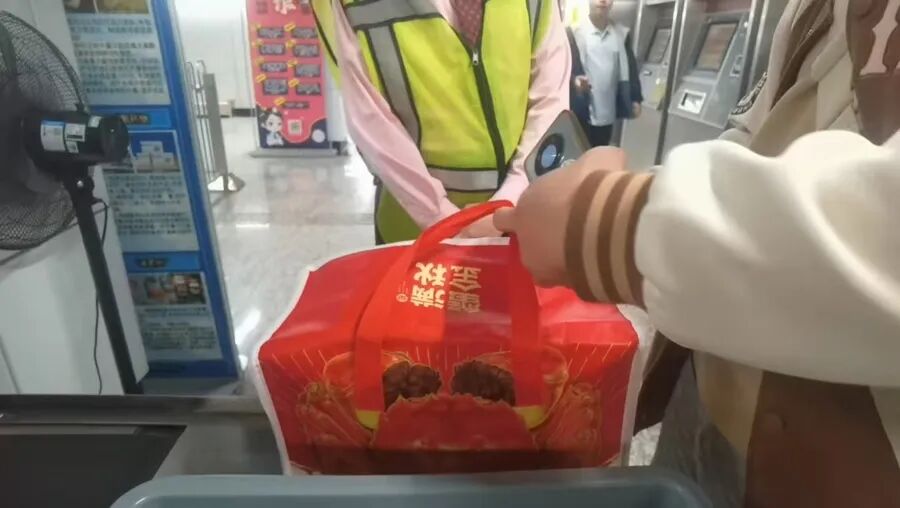
活的大闸蟹不能“坐”上海地铁?一天十几人被拦下,“建议另寻出行方式”
Huan Qiu Wang· 2025-11-02 13:42
Core Viewpoint - The article discusses the prohibition of bringing live hairy crabs onto the Shanghai subway, highlighting a recent incident where passengers were stopped from entering the station with crabs due to safety regulations [1][3][10]. Summary by Sections Incident Description - A couple was stopped at the Minsheng Road subway station while attempting to enter with live hairy crabs, which were clearly marked on their bag [3]. - The security staff reported that several passengers had been prevented from entering with crabs that day [3]. Regulations and Justifications - The staff cited regulations from the Shanghai Urban Public Transport Ordinance and the Shanghai Rail Transit Management Regulations, which explicitly prohibit carrying live animals, including crabs, onto the subway [7]. - The rationale provided was that even if the crabs were secured, their sharp claws could pose a risk to other passengers [7]. Passenger Reactions - The couple expressed frustration, noting that while live crabs are animals, they felt the regulations did not clearly specify crabs in the same way as other animals like poultry or pets [9]. - They also mentioned the inconvenience of having to travel over ten kilometers home without the subway [9]. Exceptions and Variations - Some security personnel reportedly allow exceptions, advising passengers to secure their crabs properly instead of outright denying entry [10]. - In particular, it was noted that passengers often bring crabs back from Suzhou to Shanghai without issue, provided the crabs are well-contained [10]. Guidelines for Transporting Crabs - Passengers are advised to use sturdy containers, such as foam boxes or hard plastic, and ensure that the crabs are sealed to prevent leakage [12]. - The guidelines emphasize that the crabs should not obstruct seating or passageways and must comply with size and weight regulations for luggage on the subway [12].
智领深蓝 电驱未来——中船七一二所,科技引领绿色智能
Xin Lang Cai Jing· 2025-10-31 21:16
Core Insights - The event "China Shipbuilding Group Intelligent Leading Deep Blue" showcased the innovative capabilities of the China Shipbuilding Group's 712 Research Institute, emphasizing its advancements in green intelligent ships, urban rail transit, and hydrogen energy applications [4][5]. Group 1: Green Intelligent Ships - The 712 Research Institute is a leader in green intelligent ship technology, having pioneered the all-electric ship concept and developed a comprehensive technical system for power system research, core component production, and system integration [6]. - The institute's delivered new energy power systems account for over 50% of the national market, maintaining a leading position [6]. - Notable projects include the Wuhan "Junlv No. 1," the first pure electric passenger ship certified by CCS, and the "Three Gorges Hydrogen Ship No. 1," which has replaced 108 tons of fuel and reduced CO2 emissions by 360 tons [7]. Group 2: Hydrogen Energy Applications - Hydrogen energy is a key focus area, with the institute achieving significant advancements in fuel cell technology, including a domestic production line for membrane electrodes and bipolar plates [8]. - The hydrogen fuel cell system developed for ships has a power output efficiency of 50%-60% and features a multi-level safety protection system certified by CCS [8][9]. - The "Hydrogen Electric Tug No. 1" is the first zero-emission hydrogen tugboat in China, capable of reducing CO2 emissions by approximately 1,500 tons annually [9]. Group 3: Urban Rail Transit - The 712 Research Institute is the only domestic entity with complete proprietary intellectual property for direct current traction power supply systems, covering 20 cities and 52 rail transit lines [11]. - The institute's products dominate the market in metro power supply systems, with a market share of over 95% in the non-ferrous metal smelting sector [11]. - The institute has developed a comprehensive research and production capacity, with an annual output value of 500 million yuan, supporting the high-quality development of urban rail transit [11]. Group 4: Innovative Application Scenarios - The event featured innovative applications such as the smart ship cockpit, which integrates AI and human-centered design to enhance navigation safety and efficiency [12]. - The smart kitchen research platform utilizes automated cooking and food preparation systems, allowing real-time feedback from employees to improve product development [13].

北京地铁站内首家咖啡店开业,线上点单、出站即取
Xin Jing Bao· 2025-10-31 03:19
Core Insights - Beijing Subway has launched its first coffee shop at Guomao Station on Line 1 and Batong Line to enhance passenger experience and support the "15-minute convenient living circle" initiative [1][2] - The project focuses on activating and innovatively utilizing fragmented spaces within the subway station, transforming it into a "city vitality micro-center" that meets diverse passenger needs [1] Summary by Sections Service Innovation - Passengers can pre-order coffee via a mobile app before entering the subway station, allowing for a seamless experience and reducing wait times [2] - This "online ordering and in-store pickup" method enhances the commuting process while catering to daily life needs [2] Expansion of Convenience Services - Beijing Subway has implemented various convenience services, including 134 retail outlets and 2,634 self-service machines, such as food vending machines and shared charging stations [2] - In the first three quarters of 2025, these services have served 17.471 million passengers, marking a 24.4% year-on-year increase [2] - The company plans to continue innovating services based on passenger feedback to further facilitate travel [2]
拟121.67亿元投建云南省泸西抽水蓄能电站项目 中国电建持续加码核心主业
Zheng Quan Shi Bao Wang· 2025-10-30 14:30
Core Viewpoint - China Power Construction Corporation (中国电建) is actively investing in new projects and has reported mixed financial results for the third quarter, with a focus on expanding its energy and power business while facing challenges in other sectors [1][2][3] Financial Performance - In the first three quarters, the company achieved revenue of 439.11 billion yuan, a year-on-year increase of 3.05%, while net profit was 7.47 billion yuan, a decline of 14.86% [1] - The energy and power business signed 4,013 new projects with a contract value of 585.23 billion yuan, reflecting a year-on-year growth of 12.89% [1] Project Developments - The company has approved an investment of approximately 12.17 billion yuan for the construction of the Yunnan Luxi Pumped Storage Power Station [1] - In October, the company secured several significant contracts, including a 6.57 billion yuan project for a complex hospital in Peru and two solar power projects in Saudi Arabia worth approximately 5.84 billion yuan and 5.88 billion yuan respectively [2] Business Segments - The energy and power sector showed strong growth, particularly in hydropower and wind power, with contract values increasing by 68.82% and 54.67% respectively [1] - However, the water resources and environment segment saw a decline in new contracts by 24.86%, and the urban construction and infrastructure segment also experienced a decrease of 5.07% [2] International Expansion - The company continues to play a significant role in the "Belt and Road" initiative, with domestic new contract amounts reaching 690.77 billion yuan (up 0.83%) and international contracts totaling 213.75 billion yuan (up 21.45%) [2] Capital Operations - The company is in the process of spinning off its subsidiary, China Power Construction New Energy Group, for a listing on the Shanghai Stock Exchange, which is expected to enhance the clarity of its business structure and improve capital market valuations [3]
