
科技股

Search documents
连续被血洗!今年前十个月的涨幅,币圈一个月跌完了
Hua Er Jie Jian Wen· 2025-11-08 01:53
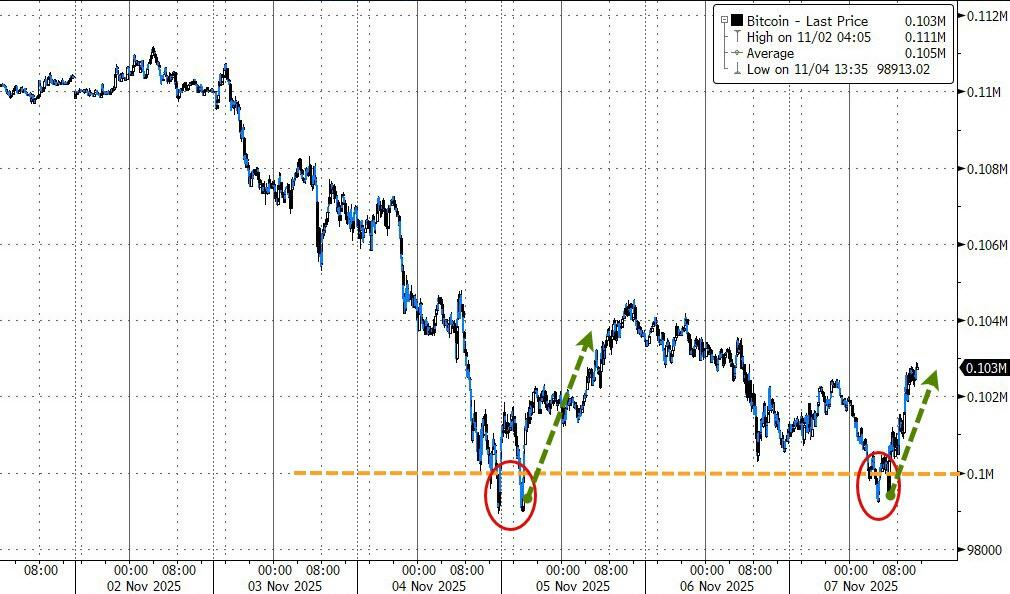
Core Insights - Bitcoin experienced a significant drop, falling below $100,000 twice this week before rebounding to above $103,000, but it remains approximately 18% lower than its record high of $120,000 set on October 6 [2][3] - The total market capitalization of cryptocurrencies reached nearly $4.4 trillion on October 6 but has since fallen about 20%, leaving a year-to-date increase of only 2.5% for the entire asset class [3] - The decline in cryptocurrency prices is causing concern on Wall Street, as Bitcoin is viewed as a leading indicator for high-volatility stocks in the U.S. market [3][12] Market Trends - The recent cryptocurrency downturn coincides with a decline in AI tech stocks, indicating a cooling of risk appetite in high-risk asset classes [4] - Meme stocks and recently IPO'd companies, which have been popular among retail investors, have also seen declines of over 10% from recent highs [4][5] - Concerns over the high valuations of AI stocks are partially attributed to the drop in digital assets, with warnings that if tech stocks continue to sell off, Bitcoin could fall below the $100,000 mark [6][12] Investor Behavior - The previously strong "buy the dip" mentality among investors is being tested, with a noticeable shift in market sentiment [7][8] - Data indicates a cautious sentiment among investors, with over $700 million withdrawn from digital asset ETFs in the past week, including nearly $600 million from BlackRock's Bitcoin fund [9] - The lack of new capital inflow into alternative tokens and DeFi projects suggests a stagnant market, with many areas of the crypto market remaining defensive [9][10] Market Dynamics - Analysts note that there is insufficient new capital to offset the exits of local investors, and a recovery in upward trends may require "whales" to stop selling [10] - A significant liquidation of approximately $19 billion in leveraged positions occurred weeks ago, and the market has yet to recover from that shock [11] - Bitcoin is increasingly seen as a "canary in the coal mine," with its price fluctuations serving as an early warning signal for high-volatility tech stocks and retail liquidity [12][13] Whale Activity - The number of "whale" investors holding large positions has been declining, which raises concerns about tightening liquidity in the market [13][14] - The potential for Bitcoin to fall below the critical support level of $100,000 could indicate that further sell-offs are imminent, with predictions of a possible drop to $70,000 in the near future [14]

港股低开低走 恒指午间收跌1.14% 科技股、半导体股集体弱势
Ge Long Hui· 2025-11-07 04:08
Core Viewpoint - The technology sector in the US stock market faced significant sell-offs, leading to a decline in the Asia-Pacific stock markets, particularly in Hong Kong where major indices fell sharply [1] Group 1: Market Performance - The Hang Seng Index dropped by 1.14%, the Hang Seng China Enterprises Index fell by 1.12%, and the Hang Seng Technology Index decreased by 2% [1] - Major technology stocks such as Xiaomi, JD.com, Tencent, Meituan, and Alibaba all experienced declines of over 2%, with Xiaomi falling more than 3% [1] Group 2: Sector Trends - Semiconductor stocks, which had rebounded previously, also faced weakness again [1] - Other sectors including Chinese brokerage stocks, automotive stocks, heavy machinery stocks, and Apple-related stocks all saw declines [1] Group 3: Commodity and Alternative Sectors - Gold prices returned to $4,000, leading to a continued rise in gold stocks [1] - The solar energy sector made significant progress against internal competition, with solar stocks showing strong performance [1] - The three major oil companies continued their upward trend [1]
视频|杨德龙:美股科技股再次暴跌 是否有泡沫破裂风险?
Xin Lang Ji Jin· 2025-11-07 02:05
Core Insights - The article highlights the formation of a MACD golden cross signal, indicating a bullish trend for certain stocks [1] Group 1 - The MACD golden cross signal is a technical indicator that suggests potential upward momentum in stock prices [1] - Several stocks have shown significant price increases following the formation of this signal, reflecting positive market sentiment [1]
降息罕见分歧,美股全线大跌
Zheng Quan Shi Bao· 2025-11-07 00:12
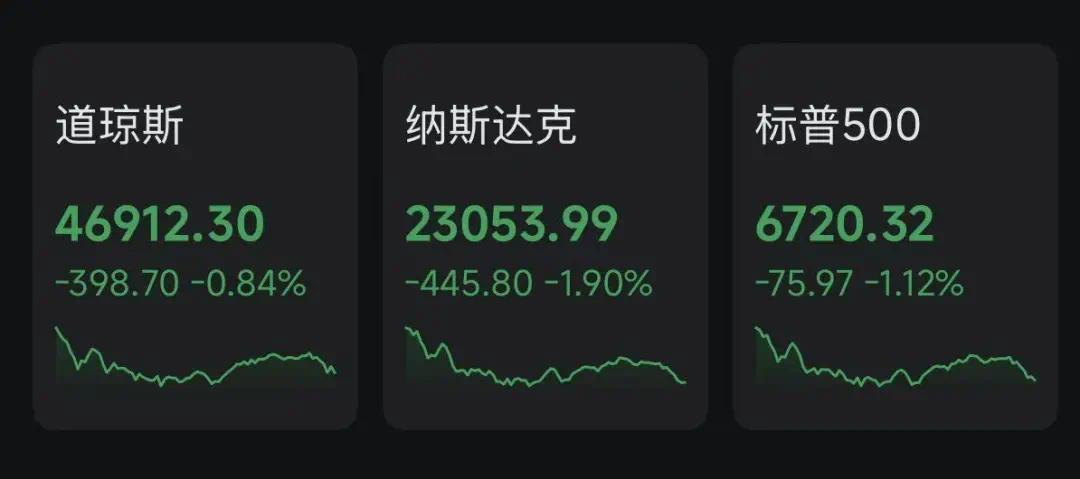
Market Performance - The Dow Jones Industrial Average fell by 0.84% to 46,912.3 points, the S&P 500 index decreased by 1.12% to 6,720.32 points, and the Nasdaq dropped by 1.9% to 23,053.99 points [1] Individual Stocks - Technology stocks experienced a broad decline, with Nvidia down over 3%, Tesla down more than 3%, Amazon down nearly 3%, Facebook down over 2%, Microsoft down nearly 2%, and Apple down 0.14%. In contrast, Google saw a slight increase of 0.15% [3] - Chinese concept stocks showed relatively strong performance, with the Nasdaq China Golden Dragon Index down 0.03% and the Wind Chinese Technology Leaders Index up 0.93%. Notable individual stock movements included Xiaopeng Motors up nearly 10%, Canadian Solar up nearly 7%, Baidu up over 3%, and Xinyi Technology up over 2% [3] Gold Market - As risk aversion increased, gold prices rose in early trading, with London gold opening higher [4] Federal Reserve Commentary - Multiple Federal Reserve officials expressed opposition to interest rate cuts, with Harker stating that inflation levels remain high, which is not conducive to further rate cuts. She expressed concerns that monetary policy may not be adequately prepared to address current inflation [5] - Musalem indicated that monetary policy is in a moderately tight to neutral range and suggested that further rate decreases could benefit the real estate market. He noted that the Fed has moderately eased policy to support the job market and that long-term inflation expectations have stabilized [6] - According to CME's FedWatch, the probability of a 25 basis point rate cut in December is 70.6%, while the probability of maintaining the current rate is 29.4%. The cumulative probability of a 25 basis point cut by January is 54.2%, with a 17.7% chance of no change and a 28.2% chance of a cumulative 50 basis point cut [6]
加密货币超43万人爆仓,比特币一个月内蒸发约600亿美元市值
21世纪经济报道· 2025-11-05 15:41
记者丨赖镇桃 编辑丨和佳 经历了"红色十月"后,比特币价格再次跌破关键支撑位。 11月5日周三凌晨,比特币价格直线下行,一度下探至99008美元/枚,是6月末以来首次跌破10万美元大关。截至23时左右,比特币跌幅收窄。 | BTC | 103263 | -1.01% | | --- | --- | --- | | $701.8亿 +2.9% | | | | ETH | 3350 | -5.6% | | $392.1亿 -8.6% | | | | SOL | 158.9 | -3.34% | | $74.7亿 -10.2% | | | | XRP | 2.267 | -1.62% | | $33.8亿 -4.9% | | | | HYPE | 41.21 | +5.97% | | $17.5亿 +3.8% | | | | BNB | 958.2 | -0.38% | | $15.1亿 -0.0% | | | 短短一个月内,比特币的价格已经重挫超18%,单枚比特币的价格跌超22400美元。 抛售的压力依然高企。Coinbase数据显示,比特币的总市值月内已经缩水超2.62%,相当于一个月内蒸发了约600亿美元的市 ...

比特币“血崩” 全球加密货币市场超43.8万人爆仓
2 1 Shi Ji Jing Ji Bao Dao· 2025-11-05 13:03
经历了"红色十月"后,比特币价格再次跌破关键支撑位。 11月5日,周三凌晨,比特币价格直线下行,一度下探至99008美元/枚,是6月末以来首次跌破10万美元 大关。短短一个月内,比特币的价格已经重挫超18%,单枚比特币的价格跌超22400美元。 抛售的压力依然高企。Coinbase数据显示,比特币的总市值月内已经缩水超2.62%,相当于一个月内蒸 发了约600亿美元的市值。 比特币以外,其他加密货币则以更快的速度下泄。最近一个月,以太坊作为总市值排名仅次于比特币的 第二大加密货币,月跌超29%,XRP下挫超25%。 刚过去的10月,币圈还意外终结了七年连涨神话。从2018年开始,比特币在每年10月都会出现必涨行 情,但几周前一波大清算危机后,10月从"Uptober"变成了"Downtober",现在比特币已经基本抹除夏季 的全部涨幅。 一般而言,加密货币还会在四季度迎来一年来的最佳行情。市场能在年底找回看涨的信心吗? 逃离风险资产 当地时间11月4日,美国三大股指全线收跌,"恐慌指数"VIX波动率指数大幅上涨,风险资产出现剧烈 抛售,万得美国科技七巨头指数跌1.93%,高盛和摩根士丹利的分析师双双警告未来两 ...
杨德龙:美国政府“停摆”时间将破纪录加大美国经济陷入衰退的风险
Xin Lang Ji Jin· 2025-11-05 09:50
Group 1 - The U.S. stock market experienced a significant decline, with major indices falling sharply, particularly the Nasdaq, which dropped over 2% [1] - Notable investors, including Michael Burry, have taken large short positions against leading tech stocks, indicating a bearish sentiment in the market [1] - Concerns about high valuation levels in the U.S. stock market have been raised by several Wall Street leaders, predicting potential corrections of 10% to 20% in the next 12 to 24 months [1][2] Group 2 - The ongoing U.S. government shutdown, which is expected to exceed previous records, has heightened fears of an economic recession, impacting investor sentiment [2] - The Federal Reserve has lowered interest rates in response to recession risks, which has contributed to the decline in major stock indices and affected Chinese concept stocks [3] - The technology sector has been a strong performer this year, but profit-taking pressures are increasing as the market adjusts [3] Group 3 - The current market adjustment is viewed as a necessary correction within an ongoing upward trend, rather than an end to the bull market [5] - Investors are encouraged to maintain confidence and patience, focusing on sectors and companies that will benefit from economic transformation [6] - The upcoming closure of Hainan's free trade zone is anticipated to positively impact local economic growth and related listed companies, making it a hot sector in the market [4]
美股泡沫有多大?瑞银给出七个观测指标
Hua Er Jie Jian Wen· 2025-11-05 09:41
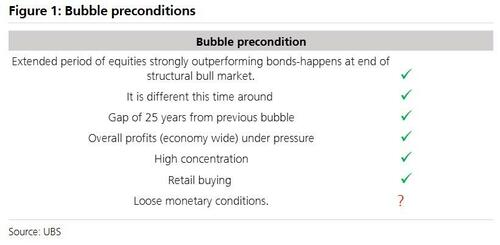
Core Viewpoint - The discussion around whether the U.S. stock market has entered a bubble phase is intensifying, despite strong corporate earnings. UBS's latest report indicates that the market is in the early stages of a potential bubble, but has not yet reached a dangerous peak [1]. Group 1: Indicators of Potential Bubble - UBS identified seven conditions that typically precede the formation of a market bubble. If the Federal Reserve's interest rate cuts align with UBS's predictions, all seven conditions could be triggered [2]. Group 2: Signals of Market Peak - The report outlines three key signals indicating a market peak: 1. Clear overvaluation: Historical bubbles often feature extreme valuations, with at least 30% of companies having P/E ratios between 45x and 73x. Currently, the dynamic P/E ratio of the "Magnificent Seven" tech stocks is 35x, and equity risk premium (ERP) has not dropped to the extreme low levels seen in 2000 or 1929 [4][5]. 2. Long-term catalysts: Various long-term indicators do not show signs of a peak, such as ICT investment as a percentage of GDP being significantly lower than in 2000, and tech giants' leverage being better than during the dot-com bubble [12][14]. 3. Short-term catalysts: There are no immediate peak signals, such as extreme mergers like those seen in 2000, and the Federal Reserve's policy stance is not tight enough to trigger a market collapse [14]. Group 3: Market Dynamics and Investor Behavior - The report highlights several market dynamics: - A strong buy-the-dip mentality exists, with stocks outperforming bonds by an annualized rate of 14% over the past decade, exceeding the 5% threshold needed to foster such sentiment [5]. - The narrative of "this time is different" is prevalent, particularly with the rise of generative AI [5]. - There is a generational memory gap, as it has been about 25 years since the last tech bubble, making new investors more susceptible to believing in a unique situation [5]. - Profit pressure is evident, as excluding the top 10 companies by market cap, the forward EPS growth for other firms is nearly zero, reminiscent of the dot-com bubble [5]. - Market concentration is at historical highs, with significant increases in retail trading activity across various regions [5]. Group 4: Lessons from the TMT Bubble - UBS reflects on the aftermath of the 2000 TMT bubble, suggesting that value may shift to non-bubble sectors during initial sell-offs, and that a "echo effect" or double-top pattern may occur. Notably, companies like Microsoft, Amazon, and Apple saw stock price declines of 65% to 94%, taking 5 to 17 years to recover [18][20].
3.2万亿一夜蒸发!美股六大巨头遭遇“市值风暴”
Sou Hu Cai Jing· 2025-11-05 08:10
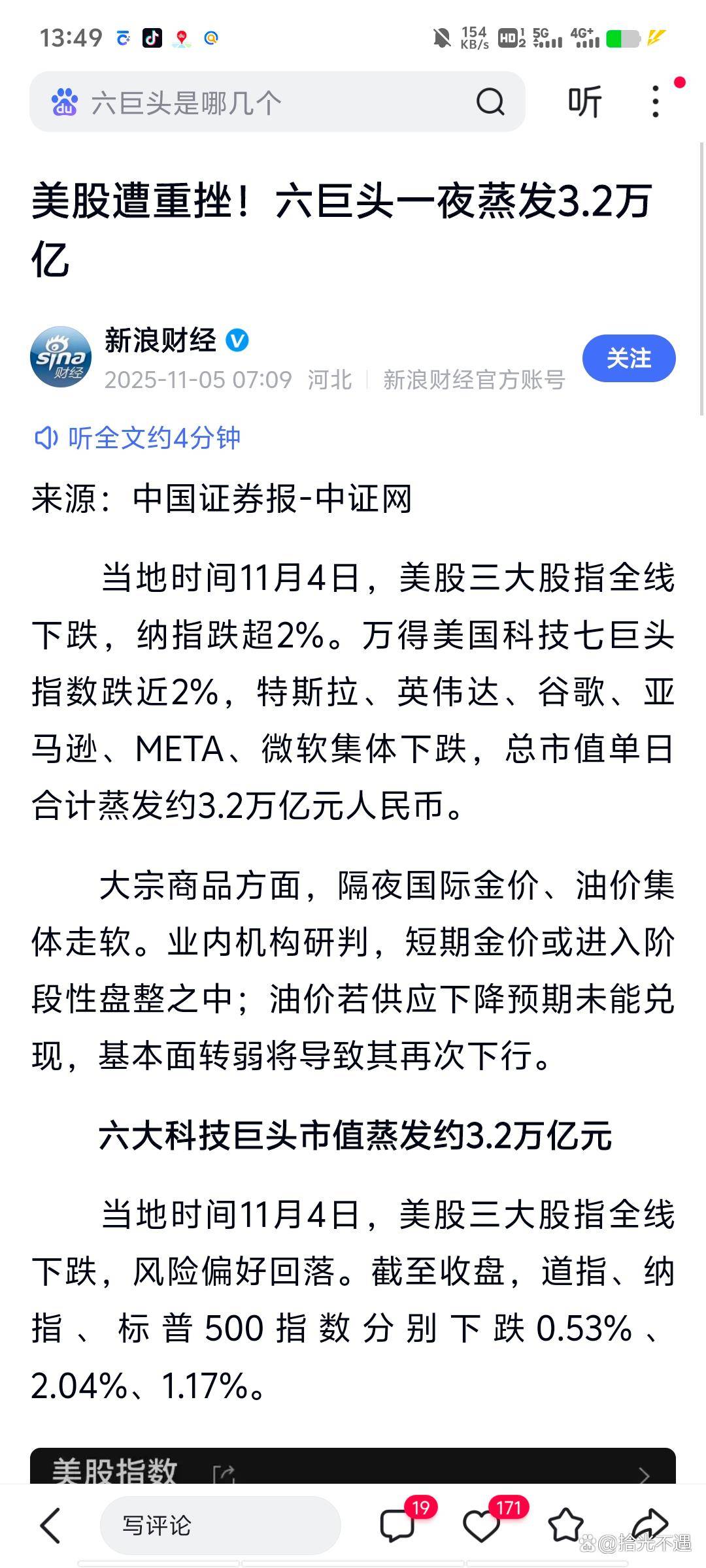
Core Viewpoint - The recent significant decline in major tech stocks, including Tesla and Nvidia, has been attributed to a combination of factors including a prominent investor's short-selling strategy, tightening monetary policy from the Federal Reserve, high valuation concerns, and macroeconomic instability. Group 1: Market Reaction - On November 4, 2025, the U.S. stock market experienced a sharp decline, with the Nasdaq index dropping by 2.04% and major tech companies losing nearly $450 billion in market value, equivalent to approximately 3.2 trillion yuan [1][6][8]. Group 2: Short-Selling Influence - Legendary investor Michael Burry, known for his role in the film "The Big Short," has heavily shorted tech stocks, with put options on Nvidia valued at $186 million and Palantir at $912 million, prompting a wave of selling among investors concerned about high valuations [6][7]. Group 3: Federal Reserve Policy - The Federal Reserve's recent hawkish signals have dampened expectations for further interest rate cuts, leading to increased volatility in the 10-year U.S. Treasury yield and a stronger dollar, which negatively impacted tech stocks [7][8]. Group 4: Valuation Concerns - As of early November 2025, Nvidia's market capitalization exceeded $5 trillion, while Apple and Microsoft reached $4 trillion and $3.9 trillion, respectively, indicating that these companies' valuations are comparable to major economies, raising concerns about sustainability [7][8]. Group 5: Macroeconomic Factors - The U.S. government is facing a prolonged shutdown due to the failure to pass a temporary funding bill, which has led to significant concerns about the economic outlook and investor confidence, exacerbating the market's decline [8][9].





凯投宏观:亚洲股市回调是对美股下跌的直接反映 对后续抛售加剧存疑
Ge Long Hui A P P· 2025-11-05 03:31
Core Viewpoint - The recent pullback in Asian stock markets appears to be a direct reaction to the decline in U.S. technology stocks, particularly affecting tech-heavy indices in Asia like the South Korean market [1] Group 1: Market Reaction - Asian markets, especially those dominated by technology, have shown strong performance recently, leading to larger losses when market sentiment shifts [1] - The potential for continued declines in Asian markets is questioned, particularly if U.S. tech stock sell-offs intensify [1] Group 2: Valuation Comparison - Despite the recent pullback, Asian valuations remain relatively low compared to the U.S., which may limit the downside potential for a global market downturn [1]