
互联网平台

Search documents
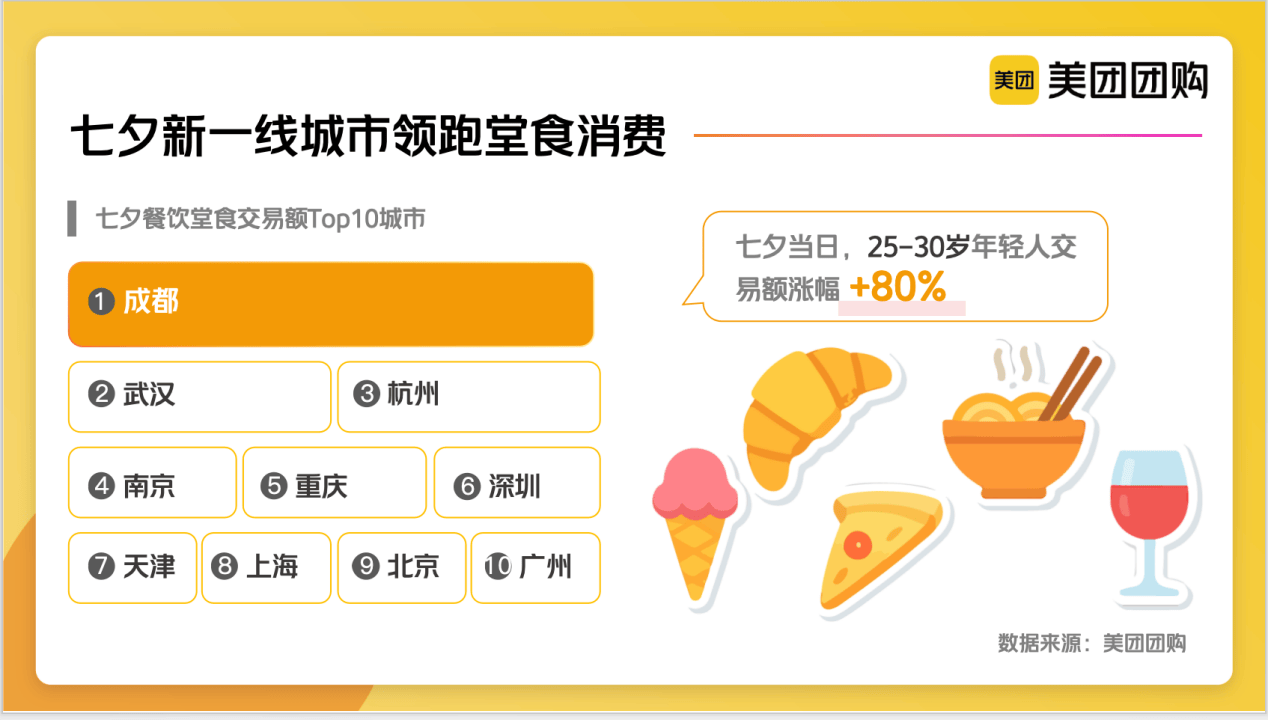
七夕餐饮堂食活跃用户数同比增长30%,广深交易额位居前十
Sou Hu Cai Jing· 2025-09-01 12:07
Group 1 - New first-tier cities lead in dining consumption during the Qixi Festival, with top cities including Chengdu, Wuhan, Hangzhou, Nanjing, Chongqing, Shenzhen, Tianjin, Shanghai, Beijing, and Guangzhou [1] - Young people are the main force in dining during Qixi, with a significant increase in transaction volume: 25-30 age group saw an 80% increase, while the 20-25 age group experienced a 72% increase compared to regular days [1] - Over 10,000 date restaurants provided advance booking services through Meituan in the two weeks leading up to Qixi, with a dynamic tracking system for restaurant reputation and booking status [1] Group 2 - On Qixi, restaurants listed on the hot booking list saw a 40% year-on-year increase in reservation orders, and the list's traffic increased fivefold compared to normal days [1] - Western cuisine restaurants experienced a 110% increase in transaction volume, Japanese cuisine saw a 94% increase, buffet restaurants had an 87% increase, and bakery and cake categories saw a 90% increase in dining transactions [1] - Meituan's representatives stated that the platform will leverage its strengths in restaurant infrastructure and digital operations to support small and medium-sized restaurants, enhancing their operational efficiency and boosting dining consumption [2]

百亿基金经理隐形重仓股曝光!张坤、葛兰、傅鹏博这样操作
证券时报· 2025-09-01 11:40
Group 1: Core Views - The article highlights the recent movements of prominent fund managers in the public fund sector, focusing on their investment strategies and stock adjustments in response to market conditions [1][4][5]. Group 2: Zhang Kun's Strategy - Zhang Kun has reduced his holdings in Meituan by 46.43% while increasing his position in Beike, indicating a shift towards domestic demand logic [1][3]. - The E Fund Blue Chip Select Fund, managed by Zhang Kun, has a current size of 34.943 billion and a year-to-date return of 12.85% [3]. - The fund's hidden heavyweights include Focus Media and Meituan, with Focus Media's holdings increasing by 13.76% [3]. - Zhang Kun believes that the current pessimism regarding domestic demand is unfounded and anticipates a positive feedback loop in domestic consumption [4]. Group 3: Ge Lan's Focus - Ge Lan's China Europe Medical Health Fund has achieved a year-to-date return of 28.82%, with significant investments in the innovative drug sector [5][6]. - The fund's hidden heavyweights include Huadong Medicine and Zai Lab, with a notable increase of 2627.32% in holdings of Ailis [6]. - Ge Lan emphasizes that innovation, consumption recovery, and domestic substitution will drive the pharmaceutical industry in the second half of 2025 [6]. Group 4: Fu Pengbo's Approach - Fu Pengbo's Ruiyuan Growth Value Fund has a year-to-date return of 48.50%, focusing on high-growth companies [7][8]. - The fund has significantly increased its holdings in Alibaba and BYD by 161.10% and 184.78%, respectively [8][9]. - Fu Pengbo plans to continue focusing on sectors such as electronics, internet technology, and precision manufacturing, while also adapting to market volatility [9].

互联网龙头中报业绩超预期提振市场信心,恒生科技ETF(513130)连续5周实现周度资金净流入
Xin Lang Ji Jin· 2025-09-01 06:33
Core Insights - The leading internet platform reported its mid-year results for 2025 on August 29, significantly exceeding market expectations with strong revenue and net profit growth, particularly a 26% year-on-year increase in cloud intelligence business revenue, validating the AI-driven profit growth logic in the industry [1] - A strategic cooperation agreement was signed on August 31, 2025, between the internet leader and a telecom giant, focusing on deep collaboration in cloud and AI infrastructure, further empowering the "AI+" development theme [1] Market Performance - The strong financial performance of the leading company positively impacted market sentiment, leading to active trading in the Hong Kong tech sector [1] - The Hang Seng Tech ETF (513130) has seen continuous net inflows for five weeks since July 28, totaling 7.885 billion yuan, making it one of the few products tracking the Hang Seng Tech Index with net inflows exceeding 6.5 billion yuan [1] - The ETF's scale has grown to 36.092 billion yuan, reaching a new historical high, with an average daily trading volume of 5.194 billion yuan in August, up from 3.922 billion yuan in July [1] Investor Interest - The number of holders of the Hang Seng Tech ETF (513130) reached 224,100, an increase of over 61,000 since the end of 2024, highlighting strong market interest [1] - The Hang Seng Tech Index, closely tracked by the ETF, includes a diverse range of sectors, including internet platforms, software development, telecommunications, and chip design, capturing multiple areas of the AI industry chain [1] Valuation Metrics - As of August 29, 2025, the Hang Seng Tech Index's price-to-earnings ratio stood at 21.23, which is relatively low at 19.23% compared to the past five years, suggesting potential for valuation uplift in the context of improving earnings and expectations of interest rate cuts by the Federal Reserve [1] - The Hang Seng Tech ETF (513130) is characterized by large scale, good liquidity, and low fees, making it a suitable tool for investors looking to capture opportunities in the Hong Kong tech sector [1]

“小空间”传递“大温暖”,城市驿站为新就业群体筑“避风港”
Xin Hua Wang· 2025-08-31 01:42
Group 1 - The article highlights the challenges faced by new employment groups, such as delivery riders, due to unpredictable weather conditions in Beijing [1] - A 24-hour service station for new employment groups was established in January, providing rest areas and addressing their needs through grassroots governance [1][2] - The city has over 330,000 new employment group members, with initiatives aimed at integrating service management into their daily lives [2] Group 2 - Beijing has opened 14,200 urban service stations for new employment groups, with over 800 24-hour service stations providing various support services [2] - The service stations are equipped with essential facilities and emergency supplies, and they host activities that allow workers to earn rewards [2] - The local government is extending educational and legal support services to enhance the well-being of new employment groups [3]
超10亿资金逢跌布局!恒生科技ETF(513130)成交持续放量,最新规模超358亿元,创历史新高
Xin Lang Ji Jin· 2025-08-29 03:18
Group 1 - The core viewpoint of the articles highlights the significant underperformance of major companies in the takeaway industry, leading to pressure on the Hong Kong tech sector, despite increased market investment activity [1][2] - The Hang Seng Tech ETF (513130) experienced a net inflow of 1.028 billion yuan on August 28, 2025, with a total of 1.794 billion yuan accumulated over three days, pushing its scale to a historical high of 35.887 billion yuan [1] - The average daily trading volume of the Hang Seng Tech ETF over the last five trading days reached 7.670 billion yuan, significantly higher than the average of 3.9 billion yuan in July, indicating strong market interest [1][2] Group 2 - The overall adjustment in the Hong Kong tech sector is primarily driven by the performance disruptions in the takeaway business, with current stock prices likely reflecting this negative factor [2] - The Hang Seng Tech Index, closely tracked by the Hang Seng Tech ETF, is diversified with a weight of only 39.67% in its top five constituent stocks, which may help mitigate individual stock volatility risks [2] - As of August 28, 2025, the price-to-earnings ratio of the Hang Seng Tech Index stands at 21.89, which is at a relatively low percentile of 23.77% over the past five years, suggesting potential for valuation recovery [2]
规范平台价格行为
Jing Ji Ri Bao· 2025-08-28 22:15
Core Viewpoint - The National Development and Reform Commission and other departments have drafted the "Rules for Price Behavior of Internet Platforms (Draft for Comments)" to solicit public opinions, aiming to regulate pricing behaviors in the rapidly growing platform economy [1] Group 1: Regulatory Framework - The draft includes four main aspects: operators' right to set prices independently, standardization of price labeling, constraints on price competition behaviors, and the establishment of a collaborative governance mechanism [1] - The document emphasizes the need for a transparent and predictable regulatory mechanism to guide operators towards lawful and compliant business practices [1] Group 2: Current Issues in Platform Economy - Despite the rapid development of the platform economy in China, issues such as "big data killing familiarity," forced merchant choices, and interference in pricing autonomy through traffic restrictions and store blocking persist [1] - These practices highlight the challenges faced by consumers and operators, necessitating regulatory intervention to protect their legitimate rights and interests [1] Group 3: Future Steps - The relevant departments are expected to refine the draft based on public feedback, further detailing regulatory requirements to promote orderly and healthy development of the platform economy [1]
恒生科技ETF(513130)两个交易日累计“吸金”超7.6亿元!政策与资金面共振助推港股科技板块回暖
Mei Ri Jing Ji Xin Wen· 2025-08-28 06:22
Core Viewpoint - The Hong Kong stock market, particularly the technology sector, has shown flat performance due to rising Hibor rates, but recent dovish signals from the Federal Reserve and stabilizing Hibor rates may lead to a marginal improvement in liquidity, supporting a potential rebound in the market [1] Group 1: Market Conditions - The Hong Kong stock market has been affected by tightening liquidity due to rapidly rising Hibor rates, but recent developments suggest a possible easing of this narrative [1] - The release of the "Artificial Intelligence +" action plan by the State Council on August 26, 2025, is expected to create more opportunities for the AI industry [1] Group 2: ETF Performance - The Hang Seng Technology ETF (513130) has seen significant volume growth, with a recent scale of 35.189 billion, supporting T+0 trading [1] - As of August 27, 2025, the average daily trading volume of the Hang Seng Technology ETF reached 4.957 billion, a notable increase from 3.922 billion in July [1] - The ETF's year-to-date scale and share growth have exceeded 10 billion [1] Group 3: Index Composition - The Hang Seng Technology Index, closely tracked by the ETF, includes a diverse range of sectors, mitigating individual stock volatility risks while capturing broad opportunities in the AI industry [1] - The top five constituent stocks of the Hang Seng Technology Index account for only 38.90% of its weight, indicating a relatively diversified index [1] Group 4: Valuation and Fund Flows - As of August 27, 2025, the price-to-earnings ratio of the Hang Seng Technology Index is 22.30, which is at a mid-low percentile level compared to the past five years [1] - Southbound capital has maintained a net inflow exceeding 10 billion HKD in the last two trading days, providing solid support for the Hong Kong stock market [1] - The combination of easing liquidity expectations in both the Hong Kong and overseas markets, along with accelerated commercialization of the AI industry, is likely to improve the fundamentals of the index [1]
国家发改委等三部门:规范互联网平台价格行为|营商环境周报
2 1 Shi Ji Jing Ji Bao Dao· 2025-08-26 07:02
Group 1: Internet Platform Pricing Regulations - The National Development and Reform Commission, along with other departments, has drafted rules to guide internet platform pricing behavior, emphasizing the importance of lawful and independent pricing by operators [2][3] - The rules specify requirements for price marking and transparency, mandating that platform operators disclose pricing strategies such as promotions and dynamic pricing to ensure public oversight [2] - The guidelines aim to foster fair competition among operators by establishing standards for price competition and integrity [2][3] Group 2: PPP Project Management - The State Council has issued guidelines to regulate the construction and operation of existing Public-Private Partnership (PPP) projects, focusing on problem-solving and efficiency [4][5] - Local governments are instructed to prioritize projects based on their economic viability and to ensure timely completion and operational readiness [4] - The guidelines encourage collaboration among social capital, financial institutions, and government entities to optimize project costs and enhance public service delivery [5] Group 3: Antitrust Guidelines in Public Utilities - The State Administration for Market Regulation has proposed antitrust guidelines for the public utility sector to prevent monopolistic practices and protect consumer interests [6][7] - The guidelines detail specific behaviors that constitute abuse of market dominance, such as unfair pricing and restrictive trading practices [6][7] - The initiative aims to clarify enforcement principles and provide a framework for compliance in the public utility sector, promoting healthy market competition [7] Group 4: Financial Support in Chongqing - Chongqing aims to increase its technology loan balance to approximately 1 trillion yuan by 2027, alongside significant targets for green loans and microfinance [9][10] - The plan includes 17 specific measures to enhance financial services across various sectors, including technology, green initiatives, and elderly care [9][10] - The city will also focus on digital finance transformation and support for small and micro enterprises through targeted financial actions [10] Group 5: Business Deregistration Guidelines in Xiamen - Xiamen has introduced guidelines for "substitute deregistration" to facilitate the exit of business entities facing challenges due to investor death or other issues [11][12] - The guidelines provide a structured approach for various types of investors to navigate the deregistration process, ensuring legal compliance and efficiency [11][12] - Measures are in place to protect the rights of creditors and shareholders, including avenues for preemptive relief and post-deregistration corrections [12] Group 6: Innovation and Entrepreneurship in Shanghai - Shanghai's Lingang Group has launched the "Super Individual 288 Action" plan to create a supportive environment for youth entrepreneurship, offering free office space and housing [14][15] - The initiative targets eight innovative sectors and aims to establish a significant number of high-level laboratories and industry clusters by 2030 [14][15] - Financial support mechanisms, including dedicated loans and funds, will be implemented to assist startups and enhance market access [15]
21社论丨规范价格行为,促进平台经济健康发展
21世纪经济报道· 2025-08-26 00:14
Core Viewpoint - The article discusses the newly drafted "Internet Platform Pricing Behavior Rules" aimed at regulating pricing practices among internet platforms to ensure fair competition and protect consumer rights in a mature platform economy [1][2]. Summary by Sections Introduction to the Rules - The "Behavior Rules" provide clear guidelines for operators on lawful pricing, price marking, and competitive behavior to foster a fair market environment and promote healthy development of the platform economy [1]. Current State of the Internet Economy - The internet economy has matured over nearly 30 years, with a stable competitive landscape among large platforms. Daily consumer activities are highly internet-based, leveraging scale and network effects, particularly in data, traffic, and algorithms [1]. Issues with Pricing Practices - Unregulated competition, including algorithmic pricing and price wars, can harm consumers and businesses. The phenomenon of "price discrimination" based on user data is a significant concern, prompting the need for regulatory measures [2]. Specific Provisions in the Rules - Article 15 prohibits differential pricing based on consumer data without their knowledge, while Article 16 forbids collusion among platform operators to manipulate market prices. The revised pricing law draft emphasizes that operators cannot engage in unfair pricing practices using data and algorithms [2]. Legal Responsibilities and Clarifications - There is a call for clearer regulations regarding the legal responsibilities of platform operators and pricing algorithm service providers in cases of disputes, ensuring accountability in algorithmic pricing practices [2]. Competition and Pricing Strategies - The rules discourage low-price competition tactics that disrupt market order, such as restricting traffic or forcing operators into price wars. Compliance with price marking standards and transparency in promotional pricing is mandated [3][4]. Legal Framework and Market Governance - Similar provisions across various laws, including the pricing law and anti-monopoly law, highlight the prohibition of selling below cost to maintain market order. Clarifying these overlapping regulations can enhance market governance efficiency [4].

规范定价、补贴及促销等行为 三部门就《互联网平台价格行为规则》公开征求意见
Sou Hu Cai Jing· 2025-08-25 08:18
明确平台经营者、平台内经营者依法自主定价的基本要求。规范平台经营者收费行为。提出保护平台内 经营者自主定价权的细化规定,特别是要求平台经营者不得采取限制流量、屏蔽店铺、下架商品或者服 务等措施,对平台内经营者的价格行为进行不合理限制。 近年来,我国平台经济快速发展,在赋能实体经济、发展新质生产力、满足人民生活需要等方面发挥了 积极作用。平台经济领域涉及的经营者众多,其价格行为关系消费者切身利益,特别是价格标示、大数 据定价等受到广泛关注。为营造有序竞争、公平竞争的市场环境,保护经营者和消费者合法权益,现行 法律法规对经营者价格行为作出一般性规定,但在平台经济领域如何更好落实,还需要进一步细化实化 监管要求,引导经营者依法合规经营。为此,国家发展改革委、市场监管总局、国家网信办在征求有关 部门、地方、平台经营者和平台内经营者、经济和法律领域专家、消费者、社会团体意见基础上,研究 起草了《互联网平台价格行为规则(征求意见稿)》(以下简称《行为规则》)。 《行为规则》主要包括四方面内容: 1.引导经营者依法自主定价。 2.明确经营者价格标示要求。 细化平台经营者、平台内经营者明码标价的规定,明确销售商品、提供服务需 ...