
粮食种植

Search documents
饭碗端得更牢 乡村更加和美——国新办发布会聚焦“十四五”时期农业农村发展成就
Xin Hua She· 2025-09-16 17:13
Core Viewpoint - The press conference highlighted the achievements in agricultural and rural development during the "14th Five-Year Plan" period, emphasizing the goal of building a strong agricultural nation and the steady progress in rural revitalization, which supports high-quality economic and social development [1] Group 1: Agricultural Production and Food Security - China's grain production is set to exceed 1.4 trillion jin (approximately 933 million tons) in 2024, an increase of 74 billion jin (approximately 49.3 million tons) compared to 2020, with per capita grain availability reaching 500 kg [2] - The grain sowing area has increased by over 3.8 million acres compared to 2020, and the average grain yield per acre has improved by 12.5 kg, contributing over 60% to the increase in grain production [2] - The government has implemented comprehensive support policies for grain production, including cost insurance and income insurance for major grain crops, ensuring stable income for farmers [2] Group 2: Poverty Alleviation and Rural Income Growth - The transition period following the poverty alleviation campaign has seen continued policy support, with over 6 million individuals at risk of returning to poverty receiving targeted assistance [4] - The labor force from poverty-stricken areas has maintained a working scale of over 30 million annually, supported by various collaborative efforts [4] - Rural residents' per capita disposable income is projected to reach 23,119 yuan in 2024, reflecting a rapid growth in income [5] Group 3: Rural Environment and Infrastructure Improvement - The rural sanitation toilet coverage rate has reached approximately 76%, with over 90% of villages managing household waste effectively [6] - Rural infrastructure, including roads, water, electricity, and gas, has been steadily improved, with rural road mileage exceeding 4.64 million kilometers [6] - Public services in rural areas have been enhanced, with improved access to education and healthcare, including the establishment of over 14,000 mutual aid elderly care facilities [7]
“十四五”农业答卷:粮食产量创新高,多元化食物供给提速
2 1 Shi Ji Jing Ji Bao Dao· 2025-09-16 13:01
Core Insights - The article highlights the achievements in agricultural development during the "14th Five-Year Plan" period, emphasizing food security and the diversification of food supply in China [1][3]. Agricultural Production and Food Security - China's grain production reached a new high of 1.4 trillion jin (approximately 700 million tons) last year, an increase of 74 billion jin (approximately 37 million tons) compared to 2020 [1][3]. - The per capita grain availability in China has reached 500 kg, ensuring basic self-sufficiency in grains and absolute safety in staple food [3]. - The Ministry of Agriculture and Rural Affairs has implemented a national food security strategy focusing on domestic production, moderate imports, and technological support [3]. Crop and Livestock Production - The production capacity of cotton, oil, and sugar has been continuously improved, with sufficient and diverse supply of fruits, vegetables, meat, eggs, milk, and aquatic products [1][6]. - The total output of livestock products reached 175 million tons by the end of last year, an increase of 27.78 million tons (18.8%) since 2020 [6][7]. - The soybean production reached 20.65 million tons, with a self-sufficiency rate increase of 4 percentage points compared to 2020 [4][6]. Agricultural Reform and Modernization - The Ministry of Agriculture and Rural Affairs is deepening rural reforms, including extending land contracts and managing rural housing land [2]. - Over 2 million farmer cooperatives and nearly 4 million family farms have been cultivated, promoting the integration of smallholders with modern agriculture [2]. Food Supply Diversification - The central government has emphasized the establishment of a diversified food supply system, focusing on various food sources including forests, grasslands, and aquatic resources [6][7]. - The area of facility agriculture has reached 40 million mu (approximately 2.67 million hectares), with annual vegetable production exceeding 20 million tons [7]. Consumer Engagement and Market Stability - The Ministry of Agriculture and Rural Affairs has launched a plan to boost agricultural product consumption, emphasizing brand development and marketing strategies [8][9]. - The plan aims to enhance consumer engagement through various channels, including festivals and exhibitions, to stabilize the agricultural product market [9].
“十四五”农业农村发展“成绩单”:稳粮增收创佳绩 科创水平跻身第一方阵
Zheng Quan Shi Bao Wang· 2025-09-16 09:51
Core Insights - The "14th Five-Year Plan" period has seen steady progress in agricultural and rural development in China, with significant improvements in grain production, income growth for farmers, and advancements in agricultural technology innovation [1][2][4]. Agricultural Production - In 2024, China's grain production is projected to reach 1.4 trillion jin, supported by stable planting areas and increased yields, with the national grain sowing area reaching 1.79 billion mu, an increase of over 3.8 million mu since 2020 [2][3]. - The average grain yield per mu is expected to be 394.7 kg in 2024, an increase of 12.5 kg compared to the end of the "13th Five-Year Plan," with yield growth contributing over 60% to total grain production [2][3]. Income Growth - Rural residents' per capita disposable income reached 23,119 yuan in 2023, with the urban-rural income ratio decreasing from 2.56:1 in 2020 to 2.34:1 in 2024, indicating a significant narrowing of the income gap [4][5]. Technological Innovation - China's agricultural technology innovation has entered the world's top tier, with breakthroughs in key technologies and a focus on integrating industry, academia, and research [6][7]. - The country has established 50 modern agricultural industry technology systems, providing comprehensive technological services across the entire agricultural production chain [7]. Food Supply and Nutritional Quality - The total output of livestock products and aquatic products has increased by 18.8% and 12.3%, respectively, compared to 2020, contributing to a diversified food supply system [3][4]. - The nutritional intake of urban and rural residents is approaching that of developed countries, with improvements in the quality of food available [3][4]. Rural Development Initiatives - The government has supported the establishment of 210 characteristic industrial clusters and 250 modern agricultural parks during the "14th Five-Year Plan" period, promoting rural e-commerce and tourism [5][6].
新华社权威速览·非凡“十四五”丨把饭碗牢牢端在自己手中,农业农村部门这么干!
Xin Hua Wang· 2025-09-16 09:27
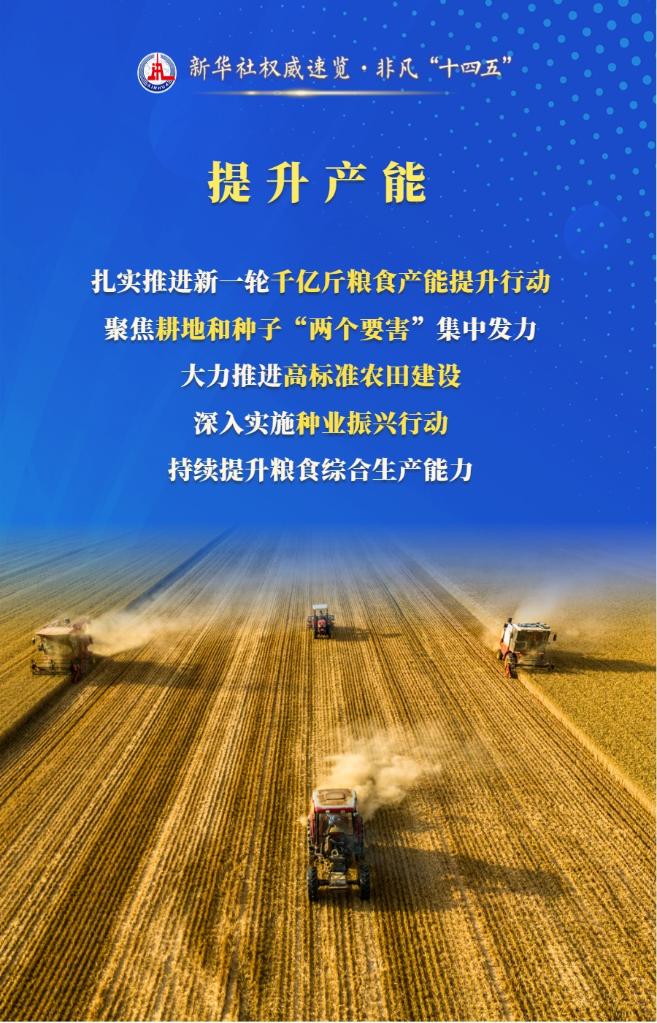
Core Viewpoint - Ensuring national food security is a perpetual issue, emphasizing the importance of self-sufficiency in food production in China [1] Group 1: Enhancing Production Capacity - A new round of actions to increase grain production capacity by 100 billion jin is being implemented, focusing on key areas such as arable land and seeds [2] - High-standard farmland construction is being promoted, along with the implementation of seed industry revitalization actions to continuously enhance comprehensive grain production capacity [2] Group 2: Structural Optimization - Agricultural production structures are being proactively optimized to adapt to changing market demands [3] - There is an emphasis on improving product quality to meet the diverse and high-quality needs of the population [3] Group 3: Resilience Enhancement - Disaster warning and forecasting systems are being strengthened, alongside significant investments in agricultural water conservancy and farmland drainage improvements [6] - A number of regional agricultural machinery social service centers and agricultural emergency disaster relief systems have been established to enhance agricultural disaster prevention and mitigation capabilities [6] Group 4: Ensuring Income - Measures for grain storage and procurement are being improved to stabilize the prices of important agricultural products, ensuring reasonable price levels [7] - Efforts are being made to ensure that farmers can earn a profit from grain production, thereby encouraging more farmers to engage in grain cultivation [7] Group 5: Accountability - The Grain Security Guarantee Law has clarified the responsibilities of various levels of government and departments in ensuring food security [9] - There is a strict implementation of responsibilities related to arable land protection and food security, emphasizing the accountability of local governments in agricultural production [9]

今年中国秋粮长势正常偏好
Zhong Guo Xin Wen Wang· 2025-09-16 09:15
Core Insights - The Chinese Ministry of Agriculture and Rural Affairs reported that the autumn grain growth is normal and favorable, with an aim to achieve a total grain production of approximately 1.4 trillion jin in 2024, marking an increase of 74 billion jin compared to 2020 [1][2] - The per capita grain availability in China has reached 500 kg, ensuring basic self-sufficiency in grains and absolute safety in staple food [1] - The implementation of high-density planting and integrated water and fertilizer management has led to significant improvements in crop yields, with some areas achieving over 7,000 corn plants per mu [1] Production and Yield - The national grain yield per mu is projected to be 394.7 kg in 2024, an increase of 12.5 kg compared to the end of the 13th Five-Year Plan, with yield contributing over 60% to the growth in grain production [1] - The summer grain production has stabilized, early rice has increased, and the area for autumn grain has shown steady growth, indicating a solid foundation for a successful autumn harvest [1][2] Management and Strategy - The Ministry emphasizes the importance of effective field management and disaster prevention measures in the final weeks leading up to the autumn harvest to ensure successful grain collection [2]
“十四五”农业农村发展“成绩单”:稳粮增收创佳绩,科创水平跻身第一方阵
Zheng Quan Shi Bao Wang· 2025-09-16 09:13
Core Insights - The "14th Five-Year Plan" has led to steady progress in agricultural and rural development in China, with significant improvements in grain production, income growth, and technological innovation [1][2][4] Agricultural Production - China's grain production is projected to reach 1.4 trillion jin in 2024, supported by stable planting areas and increased yields [2][3] - The national grain planting area reached 1.79 billion mu in 2024, an increase of over 3.8 million mu since 2020, laying a solid foundation for food security [2] - Grain yield per mu increased to 394.7 kg in 2024, up by 12.5 kg from the end of the "13th Five-Year Plan," with single yield contributing over 60% to grain production growth [2][3] Income Growth - Rural residents' per capita disposable income reached 23,119 yuan in 2023, with the urban-rural income ratio decreasing from 2.56:1 in 2020 to 2.34:1 in 2024 [4][5] - The government has enhanced support policies for grain production, including comprehensive cost and income insurance for major grain crops [4][5] Technological Innovation - China's agricultural technology innovation has entered the world's top tier, with significant breakthroughs in key technologies and a focus on integrating industry, academia, and research [6][7] - The country has developed over 50 modern agricultural industry technology systems, providing comprehensive technological services across the entire industry chain [7] Food Supply and Nutritional Quality - The total output of livestock products and aquatic products increased by 18.8% and 12.3%, respectively, compared to 2020, contributing to a diversified food supply system [3] - The nutritional intake of urban and rural residents is approaching that of developed countries, indicating improved food quality and health [3]
秋粮丰收在望 全力以赴确保1.4万亿斤粮食颗粒归仓
Yang Shi Wang· 2025-09-16 08:38
农业农村部部长 韩俊:现在北方再有不到20天,秋粮进入大面积收获的季节了,我们要利用最后这个时间窗口,把田间管理 工作抓好,把农业防灾减灾工作抓到位,做好秋粮收获工作,确保颗粒归仓。总之,要奋力夺取全年粮食丰收,确保实现今年全 国粮食产量1.4万亿斤左右的目标。 韩俊介绍,今年全国702个县实施粮油作物大面积单产提升行动,集成推广合理密植、一喷多促、水肥一体化等增产的技术模 式,整县整建制地推进大面积均衡增产。 央视网消息:国务院新闻办公室9月16日举行新闻发布会,农业农村部部长韩俊表示,今年秋粮长势正常偏好,夺取秋粮丰收 有很好的基础和条件。 农业农村部部长 韩俊:最近,农业农村部派出18个调研组到全国各地去现场看,秋粮面积稳中有增,从我们调研的情况看, 秋粮长势正常偏好,可以肯定地说夺取秋粮丰收有很好的基础和条件。 ...
高质量完成“十四五”规划丨“十四五”时期我国加快构建多元化食物供给体系
Xin Hua Wang· 2025-09-16 08:09
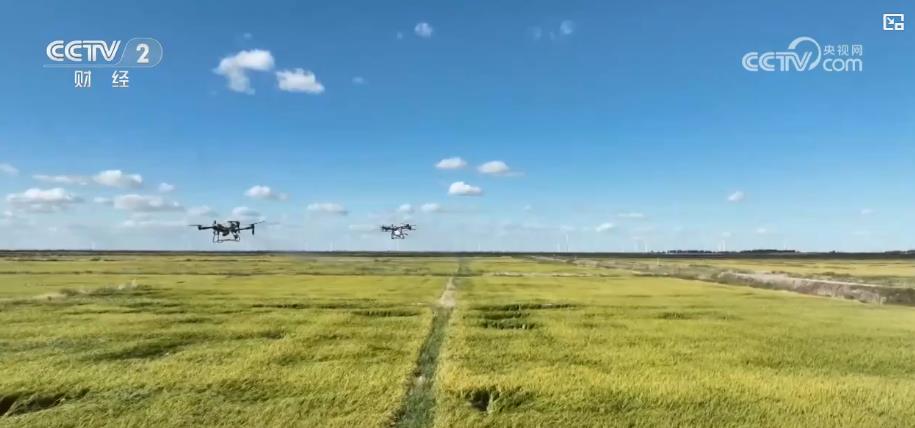
Group 1 - The core viewpoint of the articles emphasizes China's commitment to ensuring food security and enhancing the diversity of food supply during the "14th Five-Year Plan" period [1][2] Group 2 - The Ministry of Agriculture and Rural Affairs has introduced measures to strengthen food security, including increasing grain yield and implementing a large-scale production enhancement initiative [1] - By 2024, China's grain yield per mu is expected to reach 394.7 kg, an increase of 12.5 kg compared to the end of the "13th Five-Year Plan," with single yield contributing over 60% to the growth of grain production [1] - The total grain production in China is projected to exceed 1.4 trillion jin by 2024, an increase of 74 billion jin from 2020, ensuring basic self-sufficiency in grains and absolute safety in staple food [1] Group 3 - By the end of 2024, the total output of meat, eggs, and dairy products in China is expected to reach 175 million tons, an increase of 18.8% from 2020 [2] - The per capita annual consumption of meat and poultry eggs in China is projected to reach 72 kg and 25 kg, respectively, both exceeding the global average [2] - The total output of aquatic products in China is expected to reach 73.58 million tons by 2024, marking a 12.3% increase from 2020, maintaining the country's position as the world's largest producer for 36 consecutive years [2] Group 4 - The area of facility agriculture in China is expected to reach 40 million mu, with the annual output of facility vegetables exceeding 20 million tons [2] - The nutritional intake of urban and rural residents in China is approaching that of developed countries, indicating improved dietary quality and health [2] - The overall message conveys that the Chinese population is not only able to eat enough but also enjoys better and more nutritious food [2]
农业农村部:目前三大粮食作物完全成本保险和种植收入保险政策已实现全国全面覆盖
Qi Huo Ri Bao Wang· 2025-09-16 07:46
Group 1 - The core viewpoint of the news is the emphasis on achieving food security and agricultural development during the "14th Five-Year Plan" period, highlighting the importance of stabilizing production and ensuring supply to secure China's food resources [1][2] - The Ministry of Agriculture and Rural Affairs has implemented comprehensive support policies for grain production, including full cost insurance and income insurance for major grain crops, which are now fully covered nationwide [1] - The government aims to maintain reasonable prices for important agricultural products and ensure farmers can earn a profit from grain production, thereby stabilizing their income [1] Group 2 - The current grain production situation is positive, with stable summer grain production and increased early rice output; the Ministry has deployed 18 research teams nationwide to assess the conditions for autumn grain [2] - The area for autumn grain is expected to increase, and the growth conditions are favorable, providing a solid foundation for achieving a bountiful harvest [2] - The target for total grain production for the year is approximately 1.4 trillion jin, and efforts are being made to ensure effective management and disaster prevention in the fields to secure the harvest [2]
2024年我国粮食产量首次突破1.4万亿斤 目前已累计建成高标准农田超过10亿亩
Xin Hua She· 2025-09-16 05:28
(文章来源:新华社) 新华财经北京9月16日电农业农村部部长韩俊9月16日在国新办举行的"高质量完成'十四五'规划"系列主 题新闻发布会上介绍,"十四五"时期我国粮食产量迈上新台阶,2024年首次突破1.4万亿斤,比2020年 增产740亿斤。"十四五"时期农业现代化取得重要进展。目前我国已累计建成高标准农田超过10亿亩, 农业科技进步贡献率达到63.2%。"十四五"期间我国农民收入保持较快增长,2024年农村居民人均可支 配收入达到23119元。 ...