
科技创新

Search documents
“十四五”时期建设西部地区创新高地主要成就公布 从三个数字看硬核“成绩单”
Si Chuan Ri Bao· 2025-09-26 00:28
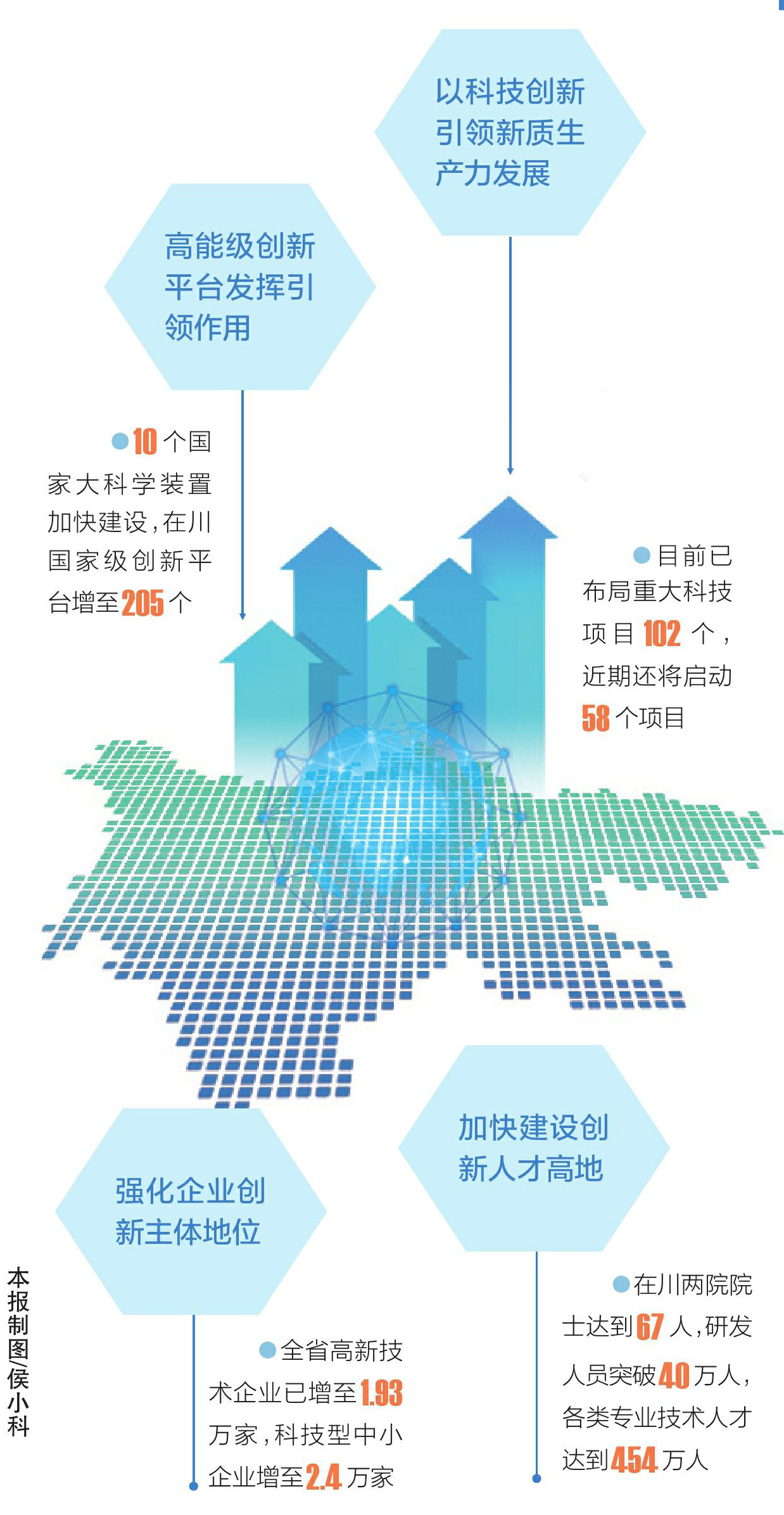
Core Viewpoint - Sichuan is advancing its position as an innovation hub in Western China by focusing on technological innovation and the transformation of scientific achievements, aiming to enhance its status as a high-level technology province during the "14th Five-Year Plan" period [4]. Group 1: Innovation Platforms and Achievements - The number of national-level innovation platforms in Sichuan has increased to 205, with 10 major national scientific facilities under accelerated construction [5][6]. - Sichuan has achieved significant breakthroughs in advanced magnetic field structures and fusion device operations, showcasing the leading role of its high-energy innovation platforms [5][6]. - The province has established a comprehensive innovation platform system covering basic research, applied research, and technology development [6]. Group 2: Major Technology Projects - Sichuan has laid out 102 major technology projects, with an additional 58 projects set to launch soon, focusing on areas such as artificial intelligence, aerospace, and clean energy [8]. - Notable advancements include the development of the first domestic F-class 50 MW heavy-duty gas turbine and the approval of the first TROP2 antibody-drug conjugate [8]. Group 3: Integration of Technology and Industry - The province is promoting deep integration between technological innovation and industry, encouraging collaborative efforts among enterprises, universities, and research institutions to expedite the transformation of laboratory results into market-ready products [9]. - Initiatives include a dual approach where enterprises seek technology and research outcomes find markets, addressing critical issues in the industrial chain [9]. Group 4: Growth of High-tech Enterprises - The number of high-tech enterprises in Sichuan has surged to 19,300, representing a 2.4-fold increase since 2020, with technology-based SMEs also experiencing significant growth [10]. - The proportion of enterprises leading major technology projects has risen to 60%, and R&D expenditure by these enterprises has increased by 58.4% compared to 2020 [10]. Group 5: Talent Development - Sichuan has accelerated the construction of an innovation talent hub, with 67 academicians and over 400,000 R&D personnel in the province [11]. - The province has implemented various measures to enhance the evaluation and support of scientific talent, benefiting over 30,000 individuals [11].

今日视点:“解锁”瞪羚企业的成长“密码”
Zheng Quan Ri Bao· 2025-09-24 23:16
Core Viewpoint - The article emphasizes the importance of nurturing "gazelle" enterprises, which are high-growth technology companies with significant innovation capabilities, as a means to drive economic transformation and industrial upgrading [1][6]. Group 1: Policy and Framework - The Ministry of Industry and Information Technology and the National Development and Reform Commission have issued guidelines to foster high-quality development of industrial parks, focusing on cultivating various types of innovative enterprises, including gazelle and unicorn companies [1]. - A unified management system for identifying and nurturing gazelle enterprises is currently lacking, leading to gaps in subsequent support policies [3]. Group 2: Financial Support - Gazelle enterprises often require additional financial support to transition into unicorns, necessitating innovative financial empowerment methods and a diversified financial service system tailored to different stages of enterprise development [4]. - Financial institutions are encouraged to create customized financial service plans for gazelle enterprises, promoting early, small, long-term investments in hard technology [4]. Group 3: Innovation and Growth - Gazelle enterprises must enhance their innovation leadership, continuously seeking new growth points and breakthroughs while avoiding growth risks [5]. - There is a call for entrepreneurs to focus on technological innovation and make significant breakthroughs in key areas to seize new opportunities presented by emerging technologies [5].
经济日报评论员:促进科技创新和产业创新融合发展
Jing Ji Ri Bao· 2025-09-24 00:06
Group 1 - The core viewpoint emphasizes the importance of integrating technological innovation and industrial innovation to seize competitive advantages and foster new development momentum [1] - Jiangsu Province's Yancheng City is leveraging the rapid growth of green energy to enhance traditional industries, support emerging industries, and guide future industrial layouts, providing a practical example of deep integration between technological and industrial innovation [1] - Yancheng has initiated a series of activities such as "Breakthrough Year," "Promotion Year," and "Enhancement Year" to implement innovation, reflecting decision-makers' understanding of the critical role of technological innovation in shaping the city's future [1] Group 2 - Companies are identified as the main drivers of integrating technological and industrial innovation, and there is a need to address the lack of collaboration between industry, academia, and research institutions [2] - The article highlights the necessity for continuous reform to support companies in collaborating with universities and research institutions to tackle industry-specific technological challenges and cultivate talent [2] - Building infrastructure for the conversion of technological achievements into practical productivity is crucial, including establishing platforms for concept validation and reducing the costs associated with technology transfer [2] Group 3 - The establishment of cross-departmental and cross-regional coordination mechanisms is essential to break down information silos and resource barriers, thereby enhancing the innovation ecosystem [3] - Optimizing resource allocation and strengthening service guarantees are necessary to unlock the potential of technological innovation and industrial upgrading [3]
湖北26条措施破解产学研协同不足 力争2027年重大科技成果转化达2000项
Chang Jiang Shang Bao· 2025-09-23 23:58
Core Viewpoint - The Hubei Provincial Science and Technology Committee has issued the "Implementation Opinions on Promoting Collaborative Innovation in Production, Learning, and Research with Enterprises as the Main Body," aiming to address the innovation dilemma of "producers unable to find research, researchers unable to find learning, and scholars unable to find production" [1] Group 1: Objectives and Measures - The "Implementation Opinions" set a goal to establish a collaborative innovation system led by enterprises by 2027, including training over 20,000 technical managers, implementing 200 key technology projects annually, and facilitating 2,000 significant technology achievement transformations with transaction amounts exceeding 1 million yuan [1][2] - Eight specific measures are proposed to enhance collaborative innovation, including restructuring innovation platforms, strengthening collaborative innovation alliances, exploring industrial ecological cooperation mechanisms, and promoting resource sharing in technological innovation [2][3] Group 2: Platform and Alliance Development - Hubei plans to optimize innovation platform functions, coordinate platform layouts, and enhance the operational mechanisms of innovation platforms to elevate their capabilities [2] - The province aims to establish industry-oriented production, learning, and research alliances, support collaborative innovation projects, and promote information sharing to improve service quality and efficiency [2] Group 3: Financial and Talent Support - Hubei will create a fund matrix focused on early-stage and small-scale investments in hard technology, expand light asset credit financing, and develop a three-tiered technology financial service system to support technological innovation [3] - The "Implementation Opinions" propose a talent-sharing mechanism through deepening industry-education integration, accelerating talent flow between schools and enterprises, and exploring dual employment and shared positions to enhance talent support for innovation [3]
两份清单精准发力“双高协同”
Xin Hua Ri Bao· 2025-09-23 22:03
Core Viewpoint - Jiangsu High-tech Zone and higher education institutions are advancing "dual high collaboration" development through the introduction of a "policy guideline list" and a "reform guideline list," which include 24 specific policies and 15 reform measures aimed at addressing innovation integration challenges and deepening collaboration [1][2] Group 1: Policy Guidelines - The "policy guideline list" focuses on a five-part integration development system: cutting-edge tracks, sci-tech platforms, leading talents, transformation funds, and benchmark projects, detailing 24 specific policies [1] - Several newly added or refined policies target key bottlenecks in "dual high collaboration," such as enhancing the participation of university faculty in enterprise horizontal projects through support for industry-university-research cooperation projects [1] - Eligible projects will be included in provincial science and technology program management, with provincial special funds providing support through post-subsidies and interest subsidies [1] Group 2: Reform Guidelines - The "reform guideline list" consists of 15 reform measures that focus on four areas: park management mechanisms, collaborative education in science and technology, transformation of scientific and technological achievements, and evaluation of scientific and technological talents [2] - These two lists create a dual-track advancement model of "current policy implementation + future reform exploration" to encourage proactive and innovative reforms in high-tech zones and universities [2]
资本市场将以更大力度支持科技创新
Zhong Guo Zheng Quan Bao· 2025-09-23 20:16
Group 1 - The core viewpoint of the articles highlights the increasing role of the capital market in supporting technological innovation and high-quality economic development, with a significant rise in the market capitalization of technology companies in the A-share market [1][2][3] - As of the end of the "Thirteenth Five-Year Plan," the number of technology companies among the top 50 by market capitalization in A-shares increased from 18 to 24, indicating a growing emphasis on technology within the market [1] - The proportion of high-tech enterprises among newly listed companies during the "Fourteenth Five-Year Plan" period exceeds 90%, showcasing a strong focus on innovation [1][2] Group 2 - The private equity and venture capital fund management scale reached 14.4 trillion yuan, with 15,000 projects under investment, reflecting a robust investment environment for small and medium-sized enterprises and high-tech companies [2] - The issuance of technology innovation corporate bonds has reached 1.77 trillion yuan since their introduction in March 2021, providing diversified financing channels for technology innovation enterprises [2][3] - The implementation of new policies, such as the "New National Nine Articles" and the "1+N" policy framework, has enhanced the stability and adaptability of the capital market, promoting a more inclusive investment ecosystem [3][4] Group 3 - The regulatory policies are continuously evolving to support the entire lifecycle of technology enterprises, with a focus on enhancing the adaptability and inclusiveness of the capital market [4][5] - The capital market is encouraged to innovate financial products tailored to the characteristics of technology companies, such as long cycles, high risks, and light assets [5] - Suggestions include creating hybrid products like "convertible bonds + technology options" to align investment returns with technological milestones, thereby balancing risk and reward [5]
多层次资本市场筑牢枢纽功能 科创成色越擦越亮
Zheng Quan Shi Bao· 2025-09-23 18:07
Group 1: Capital Market Development - The capital market in China has achieved steady growth in quantity and effective improvement in quality during the "14th Five-Year Plan" period, with a more complete multi-level and widely covered market system [1] - The total financing through stock and bond markets reached 57.5 trillion yuan over the past five years, an increase of 2.8 percentage points compared to the end of the "13th Five-Year Plan" [2] - The market share of technology companies in A-shares has exceeded 25%, significantly higher than the combined market share of banking, non-banking financial, and real estate sectors [2] Group 2: Support for Technology Innovation - The establishment of the Beijing Stock Exchange has created a tailored system for small and medium-sized enterprises, with nearly 80% of listed companies in strategic emerging industries and advanced manufacturing [3] - Private equity and venture capital funds have invested in 90% of companies listed on the Sci-Tech Innovation Board, the Growth Enterprise Market, and the Beijing Stock Exchange, highlighting their role in supporting technology innovation [5] - The total management scale of private equity and venture capital funds reached 14.4 trillion yuan, with 15,000 projects under investment [5] Group 3: Bond Market and Financial Products - The bond market has seen a diversification of products, with the issuance of Sci-Tech bonds exceeding 57 billion yuan this year, driven by policy guidance and market demand [4] - The number of futures and options products has reached 157, covering major sectors of the national economy, enhancing price discovery and risk management capabilities [7] - The total funds in the futures market have surpassed 1.9 trillion yuan, marking a historical high [7] Group 4: Policy Support and Market Accessibility - The government has introduced policies to promote the development of equity and venture capital investments, with the "17 Measures for Venture Capital" set to enhance the investment environment [6] - The proportion of institutional clients in the futures market has reached 65.34%, an increase of 7.94 percentage points since 2020, indicating the growing importance of futures in business operations [8] - The number of futures products available for foreign investment has expanded, with 24 specific products and 95 options for qualified foreign investors [8]

越南科技部:越创新指数积极向好
Shang Wu Bu Wang Zhan· 2025-09-23 04:12
Group 1 - The core viewpoint of the article highlights Vietnam's positive performance in the 2025 Global Innovation Index, particularly in the "creative goods export" category, where it ranked first globally, indicating a shift towards high-tech and creative products in exports [1][2] - Vietnam ranks 44th among 139 economies in the Global Innovation Index, and second among lower-middle-income countries, showcasing its superior innovation performance compared to many peers at similar income levels [1][2] - The report reflects Vietnam's efforts in improving institutional mechanisms, attracting R&D investment, and supporting innovation activities, although it still lags behind higher-income economies in areas like research infrastructure and R&D investment as a percentage of GDP [2] Group 2 - In the ASEAN region, Vietnam has surpassed Thailand to rank third, following Singapore and Malaysia, indicating significant progress in innovation compared to traditional regional leaders [2] - The positive impact of national management policies on innovation, particularly in areas such as patents, technology, and brand development, has contributed to Vietnam's notable achievements in innovation conversion results [2]
中国科学技术发展战略研究院:6省市综合科技创新水平领先全国
Huan Qiu Wang· 2025-09-23 00:58
Core Insights - China's comprehensive technology innovation level score reached 80.20, an increase of 1.77 points from the previous year, indicating ongoing growth in technology innovation input, output, and high-tech industries [1] - Six provinces and cities, including Shanghai, Beijing, Jiangsu, Guangdong, Zhejiang, and Tianjin, lead the nation in comprehensive technology innovation levels [1] - The second half of the year is crucial for ensuring the successful completion of the "14th Five-Year Plan" and laying a solid foundation for the "15th Five-Year Plan," emphasizing the deep integration of technology and industrial innovation [1] Group 1 - The report highlights the importance of technology innovation as a new driving force for productivity development and the cultivation of internationally competitive emerging pillar industries [1] - The Central Political Bureau of the Communist Party of China has called for a focus on technology innovation to promote the deep integration of technology and industrial innovation [1] Group 2 - Recommendations include encouraging local governments to promote advanced technologies in fields such as artificial intelligence, blockchain, low-altitude economy, future networks, and low-carbon energy [2] - The establishment of demonstrative and experiential technology application scenarios is encouraged to create replicable and promotable models and experiences [2] - Support for market-tested solutions through government procurement, pilot demonstrations, and priority issuance of relevant licenses is advised [2]
深交所:大力推动优质科技创新企业上市发展 支持适用创业板第二套、第三套标准申报发行
Zheng Quan Ri Bao Wang· 2025-09-22 12:45
Core Viewpoint - The Shenzhen Stock Exchange is committed to implementing the rectification tasks outlined by the China Securities Regulatory Commission, aiming to enhance the quality of its operations and contribute to China's modernization efforts [1] Group 1: Capital Market Reforms - The exchange will deepen comprehensive reforms in capital market financing and investment, using the ChiNext reform as a driving force to enhance the inclusiveness and adaptability of its systems [1] - There will be a strong push for the listing and development of high-quality technology innovation enterprises, supporting the application of the second and third sets of standards for ChiNext [1] Group 2: Company Growth and Quality - The focus will be on promoting the continuous growth of listed companies and efficiently supporting industry chain integration [1] - The exchange plans to conduct extensive visits to listed companies to enhance their quality and investment value [1] Group 3: Investment Structure Optimization - Efforts will be made to optimize the investment structure by implementing guidelines and plans to encourage long-term capital to enter the market [1] - There will be a significant development of equity funds to facilitate the smooth entry of long-term capital into the market [1]
