智能穿戴设备

Search documents
“百镜大战”雷声大、雨点小
第一财经· 2025-08-08 13:37
Core Viewpoint - AI glasses are seen as a new carrier for the application of AI large models, but the industry is facing significant challenges in supply chain maturity and consumer acceptance [3][6][8]. Supply Chain Challenges - The AI glasses industry is struggling with supply chain issues, including a lack of dedicated chips and core components, which hampers production and integration [4][6]. - The current demand for AI glasses is high, with consumers expecting multifunctionality, but the technology and supply chain are not yet ready to meet these expectations [5][6][8]. Market Performance - Despite the hype around AI glasses at major tech events, actual sales and consumer adoption remain low, with a reported 40% return rate for Xiaomi's AI glasses shortly after launch [5][6]. - The forecast for AI glasses shipments in China is expected to grow over 200% by 2025, reaching approximately 270 million units, but this is still small compared to the smartphone market [7][8]. Integration Difficulties - There is currently no single manufacturer capable of integrating all components of AI glasses, including materials, optics, hardware, software, and algorithms, which complicates the production process [8][9]. - The lack of specialized AI algorithms for glasses means that manufacturers are forced to use smaller models from smartphones, leading to integration challenges [8][9]. Cost and Pricing Issues - The cost of components, such as Micro LED displays, is high, making it difficult to produce affordable AI glasses for the mass market [9]. - Companies are exploring various strategies to reduce costs, such as selling AI glasses without lenses initially and focusing on online sales [11][12]. Consumer Acceptance and Retail Challenges - Traditional eyewear retailers face challenges in promoting AI glasses due to consumer perceptions, inventory management, and after-sales service requirements [12][13]. - The introduction of platforms to assist traditional retailers in selling smart eyewear is underway, aiming to simplify the sales process and improve consumer education [13][14].


“百镜大战”雷声大、雨点小,AI眼镜供应链痛点待解
Di Yi Cai Jing· 2025-08-08 12:12
Core Insights - AI glasses are seen as a new carrier for the application of AI large models, generating significant interest from brands, capital, and tech enthusiasts, yet the actual production remains limited [2][3] - The industry faces challenges in supply chain maturity, with companies struggling to meet consumer demands and integrate upstream components effectively [2][4] Industry Challenges - The lack of dedicated chips and core components hampers the development of AI glasses, with high return rates observed, such as a 40% return rate for Xiaomi's AI glasses [3][4] - Consumer expectations for multifunctionality in AI glasses create high demands on manufacturers, leading to difficulties in product development [4][5] - The supply chain for AI glasses is not yet fully developed, with issues in chip availability, AI algorithms, and production processes [4][6] Market Potential - Predictions indicate that the shipment of AI glasses in China could exceed 2.7 million units by 2025, representing a growth of over 200% from previous years [5] - Despite the anticipated growth, the AI glasses market remains small compared to the global smartphone market, which exceeds 1 billion units [5][6] Integration Difficulties - The AI glasses industry encompasses multiple components, including chips, sensors, and algorithms, but no single manufacturer has successfully integrated all aspects [6][7] - The complexity of integrating various technologies leads to challenges in achieving a cohesive product offering [6][7] Cost and Accessibility - The cost of components, such as Micro LED displays, significantly impacts the retail price of AI glasses, making them less accessible to consumers [7] - Companies are exploring cost-effective solutions and partnerships to enhance production capabilities and reduce prices [8][9] Distribution and Consumer Awareness - Traditional eyewear retailers face challenges in promoting AI glasses due to consumer awareness and the need for extensive product education [9][10] - Initiatives are being developed to assist traditional retailers in selling smart eyewear more effectively, including the introduction of specialized sales platforms [10]



一块智能手表折射消费新变化
Ren Min Ri Bao· 2025-08-05 00:28
Economic Overview - China's GDP grew by 5.3% year-on-year in the first half of the year, an increase of 0.3 percentage points compared to the same period last year, indicating a stable economic foundation and strong resilience [1] Consumer Behavior - The introduction of a trade-in policy has stimulated a trend towards health-focused consumption, with consumers increasingly inquiring about health monitoring features in smart devices [2][6] - Sales staff are now required to be well-versed in health monitoring functions and subsidy policies to effectively assist customers [6] Product Demand - There is a notable increase in demand for smart wearables, particularly those with health monitoring capabilities, as evidenced by a 70% inquiry rate for blood pressure monitoring features among customers [2][6] - The store sold over 400 smart devices in June alone, reflecting a growing consumer interest in health management through technology [5][6] Market Dynamics - The policy to encourage trade-ins has expanded to include various digital products, leading to over 69 million consumers purchasing more than 74 million digital items this year [6] - The market is witnessing a shift where consumers prioritize health monitoring features over traditional concerns like battery life and price [6][7] Sales Strategy - Retailers are adapting their sales strategies by increasing training sessions for staff to focus on health data interpretation and ensuring customers are aware of available subsidies [6][7] - The collaboration between manufacturers and healthcare institutions is enhancing the accuracy of health monitoring features in smart devices [6]
一块智能手表折射消费新变化(年中经济微观察)
Ren Min Ri Bao· 2025-08-04 22:01
Economic Overview - China's GDP grew by 5.3% year-on-year in the first half of the year, an increase of 0.3 percentage points compared to the same period last year, indicating a stable economic foundation and strong resilience [1] Consumer Behavior - The introduction of a trade-in policy for consumer goods has stimulated a trend towards health-focused consumption, particularly in the smart wearable device market [2][6] - Consumers are increasingly interested in health monitoring features, such as blood pressure and oxygen saturation, alongside traditional concerns like battery life and price [6][7] Sales Performance - In June alone, a store sold over 400 smart watches and bands, highlighting the effectiveness of the subsidy policies in driving sales [5][6] - More than 69 million consumers purchased over 74 million digital products this year, reflecting a significant uptick in demand [6] Product and Service Upgrades - Retailers are enhancing their training programs to ensure staff are knowledgeable about health monitoring features and subsidy details, shifting from basic product knowledge to health data interpretation [6][7] - Smart wearable devices are evolving, with lower-priced models meeting basic needs and higher-end models focusing on health management, often in collaboration with medical institutions to improve monitoring accuracy [6]
百镜大战:智能眼镜市场的商业逻辑与未来形态
混沌学园· 2025-08-04 10:54
Core Viewpoint - The smart glasses market is experiencing a significant surge, with global shipments expected to increase by 210% in 2024, surpassing 2 million units for the first time, driven by successful collaborations like Meta's with Ray-Ban [2][3]. Market Dynamics - The Chinese market is entering a competitive phase referred to as the "Hundred Glasses War," with major players like Xiaomi, Alibaba, Baidu, Tencent, and ByteDance making strategic moves [3]. - The competition is not merely about hardware specifications but involves deeper business models, ecosystem strategies, and future computing paradigms [5]. Technology Pathways - The smart glasses market is fragmented due to the lack of unified underlying technology, leading to three distinct technological pathways: - **AI-Enhanced Audio/Camera Glasses**: These resemble regular glasses and focus on hands-free AI interaction without a display [7][8]. - **Wearable AR Display Devices**: This pathway emphasizes screen projection for a personal virtual experience, with varying optical solutions [9][10]. - **Industrial/Enterprise AR Headsets**: Targeting the enterprise market with advanced features and high performance [11][12]. Strategic Players - **Meta**: Holds a dominant position with a 50.8% market share in AR/VR, leveraging partnerships to integrate technology with fashion brands [14]. - **XREAL**: Focuses on providing superior wearable display experiences, emphasizing core technology over market hype [15]. - **Thunderbird Innovation and Rokid**: Aim to balance technological ideals with market realities, targeting younger demographics [16][17]. - **Xiaomi and Huawei**: Xiaomi positions its AI glasses as a strategic entry point into a broader ecosystem, while Huawei adopts a more cautious approach [18][19]. Underlying Logic - The shift from "independent device" to "distributed AI" is crucial for understanding the strategies of Xiaomi and other players [20]. - Xiaomi's approach involves creating new dimensions of value through distributed computing and predictive services, moving beyond traditional smartphone models [24][26]. Business Model Innovations - Xiaomi's model emphasizes value creation from the entire ecosystem rather than just the hardware, with a focus on ongoing intelligent services [28]. - The potential for user lifetime value is significantly enhanced through this ecosystem approach, allowing for hardware to be sold at low margins to attract users [28]. Insights for Innovators - The article suggests that startups should avoid direct competition with giants on visible features and instead focus on unique dimension innovations [36][37]. - Identifying overlooked elements and creating new value dimensions can provide significant opportunities in the competitive landscape [39][40]. Future Outlook - The outcome of the "Hundred Glasses War" is likely to be a gradual evolution of multiple successful models rather than a single dominant product [41]. - The market for smart glasses is projected to grow from $878.8 million in 2024 to $4.1293 billion by 2030, with a compound annual growth rate of 29.4% [48].
从小米新品看AI眼镜发展及轻工标的布局
Guolian Minsheng Securities· 2025-08-04 08:23
Investment Rating - The report maintains an investment rating of "Outperform the Market" [6][11]. Core Insights - The release of Xiaomi's new AI smart glasses on June 26, 2025, showcases advancements in battery life, weight, and functionality compared to competitors like Meta Ray-Ban. The potential replacement demand for AI glasses in the domestic market is significant, with retail sales of glasses priced above 2000 yuan reaching a million units [3][8][14]. Summary by Sections 1. Event: Xiaomi Launches New AI Smart Glasses - Xiaomi officially launched its new AI smart glasses, featuring a dual-chip architecture with Snapdragon AR1 and Hengxuan BES2700, which enhances battery life and reduces weight to 40g without lenses. The glasses have a typical battery life of 8.6 hours and can last up to 45 minutes during continuous shooting, outperforming Meta's 33 minutes [3][16][18]. 2. Analysis of AI Glasses Market Size and Potential - The AI glasses market is expected to grow significantly, with the potential to replace traditional glasses for myopic individuals and smart devices like TWS earphones and smartwatches. The domestic market for glasses priced above 2000 yuan has reached a retail volume of over 10 million units, indicating substantial replacement demand [8][31][34]. 3. Current Technology Pathways for AI/AR Smart Glasses - To address the challenges of weight, computing power, and battery life, manufacturers are exploring various solutions, including dual-chip designs and external battery packs. Xiaomi's glasses utilize a dual-chip structure to balance performance and power management [9][39]. 4. Layout of Light Industry Related Companies in the AI Glasses Field - Domestic manufacturers are forming strategic partnerships with optical lens manufacturers and channel partners to enhance their presence in the AI glasses market. Companies like Mingyue Optical and Doctor Glasses are actively collaborating with tech firms to leverage their distribution channels [10][11][22]. 5. Investment Recommendations: Maintain "Outperform the Market" Rating - In a structurally differentiated market environment, the report suggests focusing on high-growth sectors, particularly in new consumer areas driven by emotional value and technological empowerment. The light industry optical lens manufacturing and channel companies involved in AI glasses are highlighted as key areas for investment [11][34].

五大明星智能眼镜横评:Rokid表现最均衡,Meta水土不服
3 6 Ke· 2025-08-04 05:46
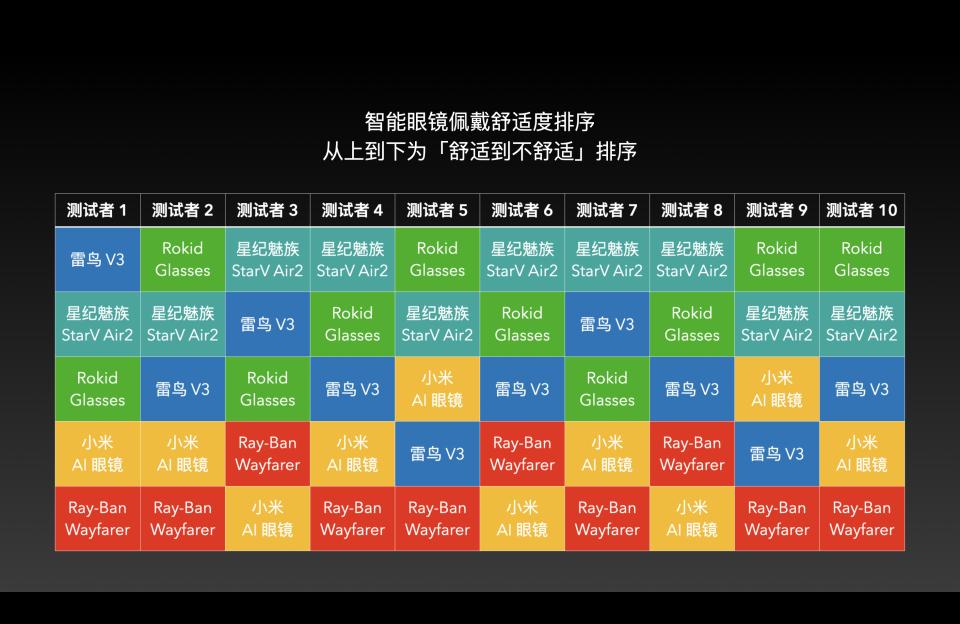
Core Viewpoint - Smart glasses have evolved from niche gadgets to practical devices, with various brands like Meta, Ray-Ban, Rokid, and Xiaomi launching their versions, each focusing on different functionalities and user experiences [1][5]. Group 1: Comfort and Usability - Comfort is crucial for wearable devices, and the best experiences were reported with StarV Air2 and Rokid Glasses, attributed to their weight distribution [2][4]. - A comparative ranking of five smart glasses showed StarV Air2 and Rokid as the top choices, with StarV Air2 excelling in design features [4][7]. Group 2: Performance and Features - In terms of imaging capabilities, Rokid Glasses and Meta Ray-Ban Wayfarer were noted for their superior photo and video quality, while StarV Air2 lacks a camera [12][22]. - Rokid Glasses demonstrated excellent video performance with some motion blur, while Ray-Ban Wayfarer provided high-quality images but was less suitable for Asian users due to design issues [21][11]. Group 3: AI Capabilities - AI functionalities varied significantly among the glasses, with Xiaomi's AI assistant being highly interactive but sometimes overly verbose, while Rokid's AI was more mature and context-aware [23][31]. - StarV Air2, lacking a camera, had limited AI capabilities but maintained good voice interaction performance [40]. Group 4: Audio and Display - Rokid and StarV Air2 were the only models with display capabilities, both using optical waveguide technology, while Meta Ray-Ban excelled in audio quality [44][45]. - The audio performance of Meta Ray-Ban was noted for its clarity and low distortion, making it stand out among the other models [44]. Group 5: Battery Life and Charging - All five models exhibited limited battery life, with Xiaomi AI glasses being the most reliable, while the Ray-Ban and Rokid models offered charging cases [46][48]. - The charging mechanisms varied, with Ray-Ban's case being more aesthetically pleasing but less user-friendly compared to others [50][52]. Group 6: Market Positioning - The analysis suggests that Rokid Glasses are the most balanced option, while StarV Air2 and Thunder V3 serve as good alternatives for users not needing extensive features [55][57]. - Meta Ray-Ban Wayfarer is recommended against for domestic users due to compatibility issues, positioning it more as a fashion accessory than a practical tool [59].
国泰海通|轻工:AI眼镜新品百花齐放,产品加速破圈
国泰海通证券研究· 2025-08-01 09:44
Core Viewpoint - The smart glasses industry is expected to enter a rapid growth phase, with related companies poised to benefit from an upward economic cycle driven by a surge in new product launches at WAIC 2025 [2][4]. Group 1: Market Trends - WAIC 2025 saw a significant increase in smart glasses brands and new product launches, contrasting with the limited exposure of products at WAIC 2024, where only XREAL and Rokid were prominent [2]. - The event highlighted the emergence of new brands such as Li Weike and Halliday, alongside major players like Alibaba, indicating a broadening market landscape [2][3]. - The market's heightened interest in smart glasses is attributed to advancements in large model functionalities, leading to innovative products like AI glasses represented by Rayban-Meta, focusing on audio, weight, and battery life for improved user experience [2]. Group 2: Product Innovations - Alibaba launched its first AI smart glasses, Quark AI glasses, integrating its ecosystem with advanced AI capabilities [3]. - XREAL introduced its flagship product, XREAL One Pro, evolving from traditional AR glasses to a versatile spatial screen adaptable to various scenarios [3]. - Rokid showcased two new products, Rokid Glasses and Rokid Cupcake, which excel in display, audio, and smart interaction, positioning them to lead the AR glasses market [3]. - New domestic brands like Halliday and Li Weike presented lightweight and user-friendly designs, with products emphasizing minimalism and extended battery life [3]. Group 3: Global Market Projections - According to Weishen Information, global smart glasses sales are projected to reach 1.52 million units in 2024, with RayBan Meta accounting for 1.42 million units, and expected to grow to 3.5 million units in 2025, representing a 230% year-on-year increase [4]. - The growth is primarily driven by the sustained sales of RayBan Meta and the introduction of multiple new AI smart glasses by major companies [4]. - The global market for smart glasses is anticipated to reach 60 million units by 2029, with a CAGR of 109% from 2025 to 2029, highlighting the significant share of the Chinese market [4].

预测中的“百镜大战”还没来,不知智能眼镜何时大爆发?
Mei Ri Jing Ji Xin Wen· 2025-07-31 13:45
近期举行的2025世界人工智能大会掀起了科技领域的狂欢,背后折射出的是新兴产业和产品的最新排 位。 在这场卡位战中,年初还以"百镜大战"之势席卷科技圈的智能眼镜却并未迎来井喷,迭代节奏和入局企 业数量都很克制,不少厂家还在观望用户反馈,期待小米、阿里这类玩家先行"教育"市场。消费方面, 刚需用户和科技爱好者还是主力军。今年6月,知名艺人刘宇宁就在出国拍摄时戴上了主打实时翻译的 智能眼镜。而为了激发用户的购买意愿,厂商也玩出了不少"花活",如Meta联名奢侈品牌Prada,老凤 祥推出了适老化AI(人工智能)眼镜,仁和药业(000650)旗下品牌推出了脑机智能眼镜等。 近日,北京智源人工智能研究院研究员、北京大学访问学者赵仲夏接受了记者的采访。他认为,智能眼 镜是企业接入AI的重要端口,已经避无可避,其核心竞争要素是大模型能力,同时需要围绕超级应 用、AI入口等搭建完整的生态。玩家方面,赵仲夏认为未来三类公司有望争得先机:有大模型的公 司、有AI应用入口的公司和有硬件生态的公司。在市场完全培育好之前,智能眼镜无妨以首饰、潮玩 等形态出现,吸引更多用户入场。 更多厂商还在观望 目前市场上智能眼镜的技术路径主要有A ...

国泰海通|电子:AI眼镜跟踪:大厂新品陆续发布,政策支持技术创新
国泰海通证券研究· 2025-07-31 12:39
Core Viewpoint - The article highlights the launch of Alibaba's "Quark AI Glasses," which deeply integrates with Alibaba and Alipay ecosystems, and discusses the supportive policies from Shanghai for AI glasses innovation [1][2]. Group 1: Product Launch and Features - Alibaba's self-developed "Quark AI Glasses" was officially unveiled during the WAIC 2025, with an expected release within the year. The glasses will have both display and non-display versions, utilizing dual Micro-LED and diffraction waveguide technology [2]. - The Quark glasses will feature advanced AI interaction capabilities, including AR navigation, payment options through Alipay, price comparison via Taobao, and travel reminders through Fliggy, marking a new paradigm in AI+AR interaction [2]. Group 2: Market Growth and Trends - Major tech companies like Xiaomi and Alibaba are set to enter the AI smart glasses market by 2025, with a significant increase in global AI glasses shipments anticipated. Meta's collaboration with Ray-Ban has already seen over 2 million units sold since its launch in September 2023 [3]. - According to Wellsenn XR, global AI glasses sales are projected to reach 2.34 million units in 2024 and 5.5 million units in 2025, representing a year-on-year growth of 135% [3]. Group 3: Policy Support - The "Next Generation Display Industry High-Quality Development Action Plan" issued by Shanghai emphasizes the development of AI+AR and AI+MR glasses, focusing on lightweight, low power consumption, high resolution, and wide field of view technologies [3]. - The plan encourages innovation in key components such as display devices, waveguide lenses, and core chips, aiming to enhance product performance and accelerate the development of portable smart glasses [3].