金融科技

Search documents
凸显新型国际财经媒体优势,界面财联社大力布局AI+金融,旗下财跃星辰AI决策系统入选上海开源典型案例
财联社· 2026-01-22 05:03
Core Insights - The article highlights the successful inclusion of ContestTrade, a multi-agent decision-making system developed by Caiyue Xingchen, in the 2025 Open Source Typical Practice Case Collection by the Shanghai Open Source Information Technology Association [1][3] Group 1: AI Innovation and Financial Integration - Shanghai is actively building a globally influential international financial center, with a focus on the deep integration of technological innovation and industry [2] - ContestTrade is a quantitative trading framework based on large language models (LLM), designed to simulate the thinking patterns of human institutional investors, creating a sustainable and self-learning "digital brain" [2] - The system incorporates an "internal competition" mechanism that allows multiple data and research agents to engage in real-time games, effectively reducing AI hallucinations and noise interference, thereby enhancing decision-making robustness [2] Group 2: Financial Information Services Development - Jiemian Financial News has been deepening its layout in the finance and economics sector, becoming a pioneer in the application of large models in the media industry [4] - The company has developed a comprehensive, cross-scenario, embedded financial information service platform, achieving a 100% accuracy rate in reviewing listed company financial reports and increasing content output by three times while improving publishing speed by five times [4] - The service has reached over 150 financial institutions, indirectly touching more than 200 million investors, establishing itself as a core entry point for real-time financial information [4] Group 3: Future Directions and Ecosystem Collaboration - The company is actively engaging with the industry ecosystem to explore new applications of vertical large models, launching various AI products tailored for different user segments [5] - Collaborations with major financial institutions aim to create intelligent advisory services and enhance user experience, including the first AI app in the futures industry and a smart application supporting complete Shanghai dialect interaction [5] - The company envisions evolving from a traditional content distribution role to a comprehensive information infrastructure that deeply integrates into financial and economic operations, leveraging AI technology to expand the boundaries of content and services [5]


春运购票可享支付立减,最高省298元!京东支付、白条释放出行优惠
Jin Rong Jie· 2026-01-22 04:11
Core Insights - The upcoming Spring Festival travel season will see an upgrade in ticket purchasing experience on the railway 12306 platform, with new payment options and benefits introduced by JD.com [1][2] - JD.com is integrating its payment and credit services into the travel decision-making process, enhancing user experience through a combination of discounts and lottery draws for free tickets [2] Group 1: Ticket Purchasing Experience - Starting immediately, travelers can use JD Pay or JD Baitiao for ticket purchases on the 12306 platform, with daily opportunities for ticket discounts up to 298 yuan per transaction [1] - In addition to discounts, JD Pay and Baitiao will launch a "10,000 free ticket lottery" to further enhance the purchasing experience during the Spring Festival [1] Group 2: Refund Policy and User Experience - The 12306 platform will also introduce a "limited-time free refund" service, allowing travelers to self-process refunds without fees under certain conditions [1] - This free refund mechanism, combined with discounts and lottery opportunities, aims to lower the barriers for ticket purchasing and enhance user confidence during peak travel times [1] Group 3: Technical Integration and User Engagement - JD.com’s collaboration with 12306 is not merely a price incentive but a strategic move to integrate payment, credit, and service offerings into high-frequency consumer scenarios [2] - The 12306 platform has a vast user base, with peak ticket sales reaching 21.626 million tickets in a single day during the Spring Festival, necessitating a stable payment system to ensure efficient ticket purchasing [2] - JD Pay and Baitiao have previously demonstrated their technical capabilities during major shopping events, ensuring a seamless payment experience that enhances overall user satisfaction [2]

吴恩达:许多年轻人陷入“只操作AI、无法成长”焦虑,要善用智能杠杆
3 6 Ke· 2026-01-22 02:42
Group 1 - AI is fundamentally disrupting traditional career ladders, with junior positions being systematically replaced as AI can generate high-quality drafts in seconds, severing the "cognitive feedback loop" that allowed for experiential learning [1][3] - There is a significant asymmetry in the workplace, where a few "super individuals" who master AI capabilities rise quickly, while many junior employees remain stuck in entry-level roles, leading to a shift from "time accumulation" to "ability proof" as the standard for promotion [1][4] - The traditional model of career progression is being replaced by a new paradigm where the ability to manage AI and demonstrate problem-solving skills becomes the core competitive advantage [5][6] Group 2 - Andrew Ng advocates for using AI as a "capability accelerator" to compress years of experience into months through simulated training, emphasizing that promotions should be based on ability rather than tenure [2][7] - Christopher Pissarides warns that unequal resource distribution could exacerbate inequality, calling for a "global new social contract" that includes public AI training funds and standardized certifications to ensure fair opportunities [2][9] - Future leaders will need to be "architects of human-machine collaborative systems," focusing on designing organizations that leverage both human creativity and AI efficiency [10][11] Group 3 - The core competencies for advancement will include the ability to decompose complex tasks for AI execution, correct AI outputs, and make informed decisions among multiple AI-generated options [5][6] - The shift towards valuing "learning speed" over "knowledge stock" reflects the need for employees to continuously adapt and update their skills in a rapidly changing environment [11] - Young professionals are encouraged to embrace AI tools and focus on problem-solving capabilities rather than traditional job titles or years of experience [12][13]
降费!又一热门赛道ETF官宣降费
Sou Hu Cai Jing· 2026-01-22 02:34
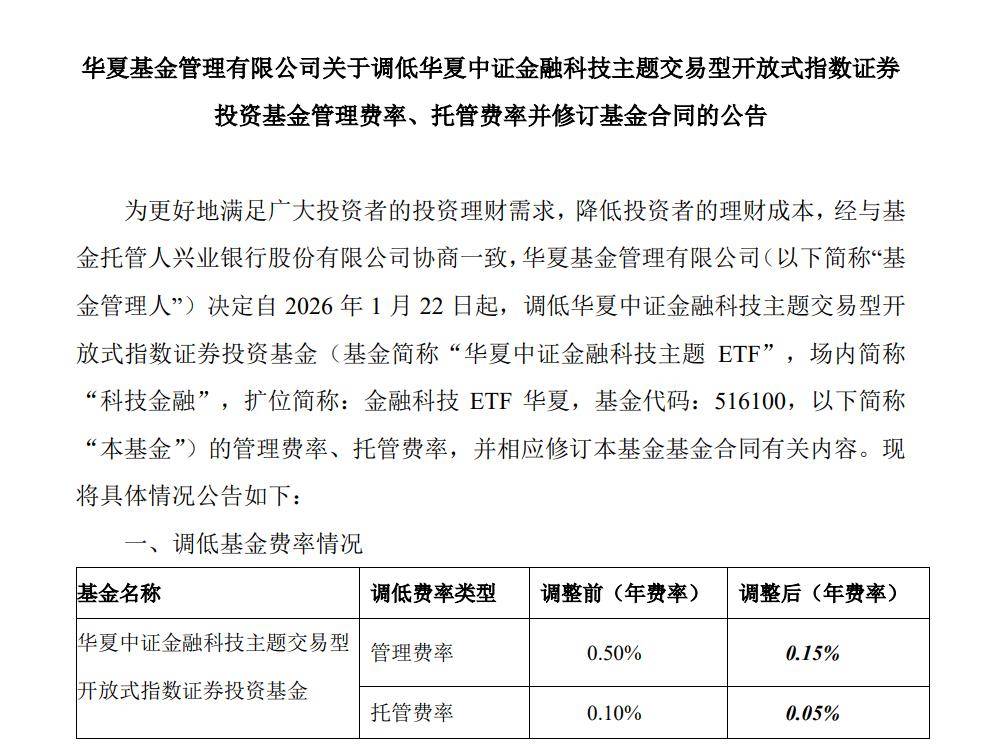
Core Viewpoint - The article discusses the reduction of management and custody fees for certain ETFs, highlighting the potential cost savings for investors and the investment opportunities in the fintech sector. Fee Adjustments - The management fee for the Huaxia CSI Financial Technology Theme ETF has been reduced from 0.50% to 0.15% [2] - The custody fee for the Open Index Securities Investment Fund has been lowered from 0.10% to 0.05% [2] - For an investment of 100,000 yuan held for one year, the total annual fees for a typical fintech ETF at 0.6% would amount to approximately 600 yuan, while the Huaxia fintech ETF at 0.2% would only cost about 200 yuan, resulting in a direct savings of 400 yuan [2] Investment Opportunities in Fintech - The CSI Financial Technology Theme Index includes popular concepts such as stock trading software, software development, digital currency, and cross-border payments, combining both financial and technological attributes [2] - Major stocks in the index include industry leaders like Tonghuashun, Dongfang Caifu, and Runhe Software, with significant exposure to cross-border payment (40.17%), stock trading software (29.48%), and stablecoins (21.83%) [4] Index Performance - Since the 934 market rally in 2024, the fintech index has demonstrated high growth and elasticity, outperforming both the broader market index and brokerage indices [5] Market Catalysts - Positive fundamentals and market sentiment are contributing to a favorable environment for fintech investments, with the Shanghai Composite Index recently breaking the 4100-point mark and achieving a record trading volume of 3.6 billion yuan [6] - The launch of the new digital RMB 2.0 mechanism on January 1, 2026, is expected to enhance its applications in payments, inclusive finance, and cross-border settlements [6] - The integration of generative AI into core business processes in the financial sector is projected to grow significantly, with over 80% of banks expected to adopt this technology by 2026 [8] Future Outlook - The fintech sector is anticipated to attract market attention due to the overall positive trend in A-shares and the clear focus on technological innovation [9] - The sector stands to benefit from increased market trading activity and is positioned at the intersection of digital financial reform and the penetration of AI technology into core business processes [9]
摩尔线程发布业绩预告;三部门:创新企业CDR个税优惠延至2027年底……盘前重要消息还有这些
Zheng Quan Shi Bao· 2026-01-22 00:23
Group 1 - The Ministry of Finance and other departments announced a tax exemption for individual investors on capital gains from the transfer of CDRs issued by innovative enterprises from January 1, 2026, to December 31, 2027 [2] - The Guangdong Provincial Government issued policies to promote high-quality development in transportation through artificial intelligence, encouraging the application of smart connected vehicles and the establishment of autonomous driving regulatory platforms [3] - Shanghai Dream Information Technology Co., Ltd. (operating the "Pinduoduo" platform) was fined 100,000 yuan for failing to report tax-related information as required [3] Group 2 - Zhite New Materials may apply for a trading suspension if its stock price continues to rise abnormally [5] - Hunan Silver's future market price for silver products remains uncertain [5] - Moore Threads expects revenue of 1.45 to 1.52 billion yuan in 2025, with a narrowing net loss [5] - Shanghai Yizhong anticipates a net profit growth of 760.18% to 903.54% in 2025 [5] - Jin'an Guoji expects a net profit increase of 655.53% to 871.4% in 2025 [5] - Limin Co. forecasts a net profit growth of 471.55% to 514.57% in 2025 [6] - Baiao Intelligent expects a net profit increase of 228.34% to 337.79% in 2025 [6] - Dajin Heavy Industry anticipates a net profit growth of 121.58% to 153.23% in 2025 [6] - Juhua Co. expects a net profit growth of 80% to 101% in 2025 [6] - Ganli Pharmaceutical anticipates a net profit increase of 78.96% to 95.23% in 2025 [6]
数字信贷的兴起与监管:印尼的经验教训
Shi Jie Yin Hang· 2026-01-21 23:10
Investment Rating - The report does not explicitly provide an investment rating for the industry Core Insights - The rise of digital lending in Indonesia has significantly impacted the financial landscape, with over 40% of borrowers having taken at least one fintech loan by the end of the sample period [3][10] - Digital lenders have expanded financial inclusion by reaching previously unbanked households, although their geographical coverage remains limited and primarily focuses on consumer financing [3][12] - A notable portion of borrowers transitioned from high-interest fintech loans to cheaper conventional credit over time, but high default rates persist among those who initially relied on digital loans [3][13] - Recent regulatory reforms, such as interest rate caps and unified reporting standards for digital and traditional loans, have been assessed for their impact on credit market stability and consumer protection [3][14] Summary by Sections Introduction - Indonesia has made significant progress in financial inclusion, driven by a wave of retail financial product innovations, particularly digital lending since around 2020 [9][10] - The expansion of fintech loans raises questions about their effectiveness in enhancing financial inclusion in underserved urban areas and supporting small business lending [9][10] Data and Methodology - The analysis is based on a unique dataset of over 139,865 anonymized personal credit records from a private credit bureau in Indonesia, covering the period from 2018 to 2024 [22][24] - The dataset allows tracking individual credit histories and understanding the role of fintech loans in the emerging digital financial ecosystem [10][11] Findings on Credit Market Trends - The average borrower in Indonesia has seen a steady increase in credit volume, with significant regional disparities in credit access and borrower characteristics [36][39] - Fintech loans, while growing rapidly, still represent a small portion of total credit, accounting for about 5% of all loans [54][55] - The majority of digital loans are used for consumption rather than productive investments, indicating a potential limitation in supporting economic growth [62][63] Borrower Characteristics and Behavior - Fintech borrowers tend to be younger, more likely to be entrepreneurs, and concentrated in urban areas, contrasting with traditional borrowers [58][59] - Borrowers who start with fintech loans exhibit higher default rates compared to those who begin with traditional loans, with a difference of 5 to 7 percentage points [13][73] Regulatory Impact - Recent regulations aimed at supporting financial inclusion have inadvertently restricted credit access for unbanked households, as lenders shift focus to lower-risk borrowers [14][15] - The report emphasizes the importance of non-traditional credit information in lending to unbanked households, highlighting the role of private credit bureaus [14][15]
全球“币”变:中国如何下好数字货币治理这盘大棋?|文摘
Sou Hu Cai Jing· 2026-01-21 13:10
Core Viewpoint - The rise of blockchain technology and cryptocurrencies poses unprecedented challenges to traditional financial systems and global financial governance, particularly through the emergence of stablecoins, which reshape currency circulation mechanisms and impact national sovereignty, cross-border payment systems, and global financial regulation [2]. Unilateral Measures: Optimizing Development Pathways and Governance Capabilities - China should enhance its internal response system to address the challenges posed by cryptocurrencies and stablecoins to national financial sovereignty and regulatory frameworks [3]. - Accelerating the development and application of the digital yuan is crucial for enhancing the international competitiveness of the yuan and addressing cryptocurrency challenges. The Bank for International Settlements (BIS) indicates that Central Bank Digital Currencies (CBDCs) are core tools for maintaining monetary sovereignty and financial stability [4]. - A multi-layered structural system encompassing CBDCs, stablecoins, and digital assets should be gradually established, with the digital yuan as the foundational currency to solidify its core position in domestic payments and settlements [4]. - Promoting interoperability between the digital yuan and emerging financial tools like digital securities and assets is essential for creating a complete financial ecosystem [5]. - Active participation in global digital currency standard-setting and cross-border interoperability construction is necessary to enhance the yuan's usage in international frameworks like the Belt and Road Initiative [5]. - The regulatory approach to cryptocurrencies must leverage advanced technologies to upgrade regulatory capabilities, emphasizing the need for unified international regulatory standards [6]. - Balancing innovation and regulation in the cryptocurrency sector is critical, with countries needing to develop reasonable policies based on their unique financial market conditions [7]. - The regulatory sandbox mechanism can support technological innovation while effectively reducing systemic risks, allowing for a controlled environment to test financial products and services [7][8]. - China should explore the innovation and application of offshore RMB stablecoins in regions like Hong Kong and Macau, leveraging their open market environments and mature financial systems [9]. Multilateral Measures: Promoting Global Governance and International Cooperation - The digital transformation of the international monetary system is essential, driven by the need for more efficient and secure digital currencies, especially in light of the dysfunction of the current system dominated by the US dollar [11][12]. - The digital transformation must avoid unilateralism and prioritize fair and inclusive solutions, with digital Special Drawing Rights (e-SDR) and CBDCs as key focus areas [12]. - Strengthening international regulatory cooperation in the cryptocurrency sector is urgent, particularly in response to the fragmented regulatory landscape exacerbated by recent US policies [14]. - A global regulatory mechanism for stablecoins, especially those pegged to the US dollar, is necessary to mitigate risks associated with cross-border capital flows and financial stability [15]. - Coordinating global regulatory efforts can enhance the resilience of financial markets and reduce regulatory arbitrage in the cryptocurrency sector [16]. - China should advocate for the inclusion of emerging market countries in global financial rule-making to enhance their voice and support in cryptocurrency governance [17]. - Strengthening international research and cooperation in the CBDC field is vital, with a focus on enhancing interoperability in cross-border payments through multilateral research and testing initiatives [18].

《科创嘉年华》四维进阶 斩获“2025最佳投教创新直播栏目”
Sou Hu Wang· 2026-01-21 09:05
Core Insights - The STIF Sixth International Science and Technology Innovation Festival and the 2025 Digital China Navigator Summit was held in Beijing, emphasizing the theme "Digital Driven, Intelligent Manufacturing Future" [1] - The original high-end dialogue live program "Science and Technology Carnival" won the "2025 Best Investment Education Innovative Live Program" award, showcasing its leadership in the investment education sector [2][4] Group 1: Event Highlights - The event attracted over 1,000 attendees and more than 300 media partners, reflecting the growing maturity of China's technology innovation system and broad social recognition [5] - The festival aims to create a diverse and open platform for communication and cooperation, showcasing technological innovation achievements and honoring contributions in the field [5] Group 2: Program Achievements - "Science and Technology Carnival" has produced 217 episodes, with total views exceeding 4.01 million and over 210,000 unique viewers, establishing a strong market reputation [6] - The program has received multiple awards, including the "Golden Bee Live Marketing Gold Award" and "Most Influential Brand in Investor Education 2024," highlighting its impact in the investment education field [2] Group 3: Industry Context - The World Intellectual Property Organization's "2025 Global Innovation Index Report" indicates that China's innovation index has entered the global top ten, with the "Shenzhen-Hong Kong-Guangzhou" innovation cluster ranking first globally [5] - The number of new A-share accounts reached 27.44 million in 2025, a 10% year-on-year increase, reflecting growing confidence in capital market reforms [8] Group 4: Future Directions - The program will continue to focus on "Four-Dimensional Collaboration" to enhance digital transformation and activate innovation engines in technology enterprises [12] - The collaboration with leading companies and experts aims to provide high-quality financial content and insights into macroeconomic trends and the long-term value of the technology innovation industry [11]

净利最高超32亿元!年报业绩超预期催化,同花顺涨超2%!金融科技ETF(159851)盘中吸金超1亿份!
Xin Lang Cai Jing· 2026-01-21 03:10
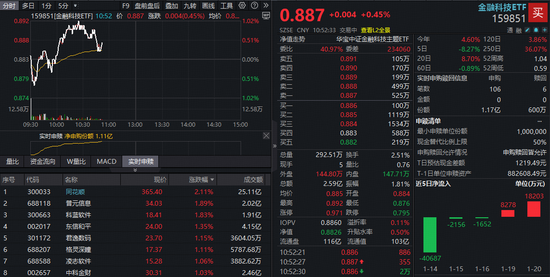
Core Viewpoint - The financial technology sector is experiencing significant inflows, with major stocks like Tonghuashun, Kela Software, and Puyuan Information leading the gains, indicating a positive market sentiment and potential growth opportunities in this sector [1][6]. Group 1: Market Performance - Financial technology stocks saw widespread gains, with Tonghuashun, Kela Software, and Puyuan Information rising over 2%, while stocks like Dongxin Peace, Green Deep Vision, and Zhongke Jincai increased by more than 1% [1][6]. - The popular financial technology ETF (159851) reached a peak price increase of over 1%, with real-time net subscriptions amounting to 110 million shares, and a total of over 260 million yuan raised in the previous two days [1][6]. Group 2: Company Insights - Tonghuashun has released an annual performance forecast, projecting a net profit attributable to shareholders of 2.735 billion to 3.282 billion yuan for 2025, representing a year-on-year growth of 50% to 80% driven by AI investments and market recovery [1][6]. - Institutions have indicated that the capital market's activity level will continue into 2025, with internet brokerages expected to see performance releases in the first half of 2026 [1][6]. Group 3: Investment Recommendations - Citic Securities suggests that the recent market adjustments are a healthy correction rather than a trend reversal, indicating a gradual shift towards a slow bull market, with the securities sector expected to participate in this process [3][8]. - The firm recommends focusing on financial technology opportunities, particularly the financial technology ETF (159851) and its linked funds, which cover a range of themes including internet brokerages, financial IT, cross-border payments, and AI applications [3][8].

胡润最新榜单显示:35%的瞪羚企业由人工智能驱动
Sou Hu Cai Jing· 2026-01-20 15:28
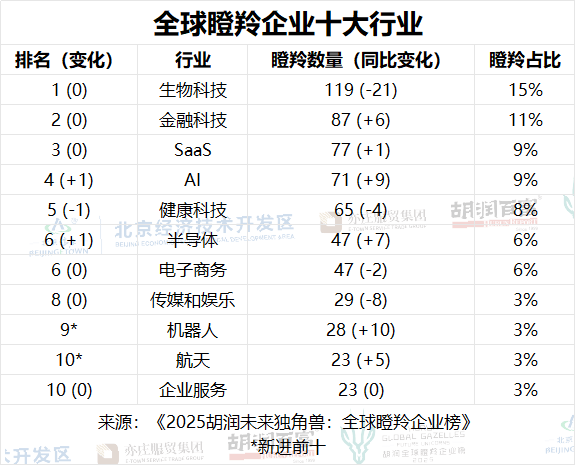
Core Insights - The HuRun Research Institute released the "2025 HuRun Future Unicorn: Global Gazelle Enterprise List," identifying 206 new companies, with significant representation from fintech (29), artificial intelligence (28), SaaS, and robotics (15 each) [1][2][3] - A total of 819 gazelle enterprises were identified globally, marking a 19% increase from 688 two years ago, spanning 43 countries and 220 cities [1][2] - The average age of these gazelle enterprises is 9 years, with an average valuation of $700 million, and 35% are driven by artificial intelligence [4][5] Industry Analysis - The fastest-growing industries projected for 2025 include robotics, artificial intelligence, semiconductors, fintech, and aerospace [3][4] - The list includes 71 artificial intelligence companies, highlighting AI's transformative impact across various sectors such as healthcare, finance, retail, and manufacturing [5] Regional Insights - China ranks second with 278 gazelle enterprises, a 20-company increase from the previous year, accounting for 34% of the global total [6][9] - The leading industries for future unicorns in China are biotechnology and semiconductors, which together represent 30% of the total [6] - Major cities for gazelle enterprises in China include Shanghai, Beijing, Shenzhen, Hangzhou, Suzhou, and Guangzhou [8][9] Investment Landscape - The report also highlights the top investment institutions, with Sequoia China being the most successful in backing gazelle enterprises, followed by CICC, SoftBank, Hillhouse, and Tiger Global [9][10] - Additionally, 22 "seed gazelle enterprises" were selected from Beijing Yizhuang, all holding national-level honors or having secured funding above Series A in the last two years, indicating potential for future growth [10]