
工业互联网

Search documents
科技赋能能源保供 南京鼓楼企业朗坤智慧打造“AI+能源”新标杆
Yang Zi Wan Bao Wang· 2025-08-29 12:33
Core Viewpoint - The implementation of a cloud-edge collaborative digital platform for thermal power safety production by Nanjing Gulou Enterprise and Langkun Smart Technology is enhancing the operational efficiency and stability of Guodian Power Development Co., Ltd during the critical summer energy supply period [1][2]. Group 1: Technology and Innovation - The AI platform has successfully prevented an unplanned load drop event by providing timely fault diagnosis and operational suggestions [2]. - The platform employs a "big model + small model" collaborative approach, enhancing operational safety and economic optimization by combining deep analysis with rapid diagnostics [4]. - The platform has achieved a significant reduction in coal consumption by 0.45 grams per kilowatt-hour and a 38% decrease in non-stop occurrences since its launch [4]. Group 2: Organizational Impact - The platform breaks down traditional management barriers in power plants, achieving a digital control goal of "five increases and one decrease" in reliability, operational levels, safety management, technical control, and production cost management while reducing labor intensity [4]. - Langkun Smart Technology is fostering a culture of innovation and AI capability enhancement through monthly competitions and specialized training for all employees [5]. Group 3: Future Development - The platform is evolving towards a "cloud-edge-end integrated" architecture to achieve deeper production automation, allowing for real-time command delivery to equipment [5]. - The success of Langkun Smart Technology exemplifies the ongoing optimization of the innovation ecosystem in the Gulou District, aiming to support technology companies in overcoming key technological challenges [5][6].



2025全球工业互联网大会将于9月5日在沈阳举行
Xin Hua Cai Jing· 2025-08-29 07:04
Core Insights - The 2025 Global Industrial Internet Conference will be held from September 5 to 8 in Shenyang, focusing on the integration of artificial intelligence and industrial internet [1][2] - The conference aims to create a high-end international communication platform to attract global industry elites for collaborative development and consensus building [1][2] Event Structure - The conference will feature one opening ceremony, one innovation achievement exchange activity, one parallel activity, three core forums, and multiple supporting activities including specialized exchanges, competitions, and international communication events [1] - The three core forums will include the "Third China Industrial High-Quality Development Forum," "Global Industrial Internet Integration Development Exchange Conference," and a digital transformation matchmaking event focused on smart supply chains [1] Highlights of the Conference - The agenda will focus on cutting-edge topics related to "AI + Industry," including themes like "artificial intelligence," "large models," "embodied intelligence," and "computational algorithms" [2] - A strong lineup of participants will include 10 academicians, 60 experts, and representatives from industry associations [2] - The conference will feature international elements with over 80 government leaders, experts, and business representatives from countries such as the USA, Brazil, Greece, South Korea, and Cambodia [2] - Innovative event formats will provide a diverse and immersive experience, integrating exhibitions, conferences, competitions, and visits [2] Industry Impact - Since 2019, the Global Industrial Internet Conference has been successfully held for six consecutive years, becoming a globally influential event in the industrial internet sector [2] - In 2024, the core industry value added of China's industrial internet is projected to reach 1.53 trillion yuan, a 10.0% increase from 2023, contributing nearly 3.50 trillion yuan to economic growth [2]
云鼎科技2025年中报简析:增收不增利,应收账款上升
Zheng Quan Zhi Xing· 2025-08-27 22:56
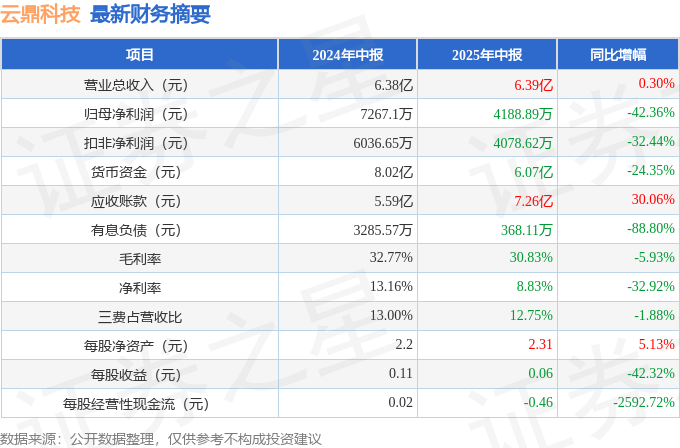
Core Viewpoint - Yun Ding Technology (000409) reported mixed financial results for the first half of 2025, with a slight increase in total revenue but a significant decline in net profit compared to the previous year [1] Financial Performance - Total revenue for the first half of 2025 reached 639 million yuan, a year-on-year increase of 0.3% [1] - Net profit attributable to shareholders was 41.89 million yuan, down 42.36% year-on-year [1] - In Q2 2025, total revenue was 331 million yuan, reflecting a 32.79% increase year-on-year, while net profit for the quarter was 10.42 million yuan, a decline of 59.19% [1] - Gross margin decreased to 30.83%, down 5.93% year-on-year, and net margin fell to 8.83%, down 32.92% [1] - Accounts receivable increased by 30.06% year-on-year, reaching 726 million yuan [1] Cash Flow and Financial Ratios - Operating cash flow per share was -0.46 yuan, a drastic decrease of 2592.72% year-on-year [1] - Total financial expenses increased by 37.19% due to a decline in deposit interest rates [3] - Net cash flow from operating activities decreased by 2598.76%, attributed to high cash expenses and bank acceptance bills [3][4] Business Model and Market Position - The company's performance is primarily driven by research and development, with a historical average return on invested capital (ROIC) of 6.09% over the past decade [5] - The company has experienced cyclical performance, with a net profit margin of 9.41% last year, indicating average value addition from its products or services [5] - Analysts expect the company's performance in 2025 to reach 123 million yuan, with an average earnings per share of 0.18 yuan [6]

杰克股份(603337.SH)拟将证券简称由“杰克股份”变更为“杰克科技”
Ge Long Hui A P P· 2025-08-27 12:16
Core Viewpoint - The company, Jack Co., Ltd. (stock code: 603337), is changing its stock name from "Jack Co., Ltd." to "Jack Technology" to align with its strategic development in industrial internet and artificial intelligence sectors [1] Group 1 - The sixth board of directors' meeting will be held on August 26, 2025, to approve the name change [1] - The change in stock name aims to reflect the company's transition beyond traditional manufacturing [1] - The implementation of the name change is subject to approval from the Shanghai Stock Exchange [1]

北路智控:营业收入和净利润主要受煤价周期性影响,同比下滑
Zheng Quan Ri Bao Wang· 2025-08-27 10:43
Core Viewpoint - The company's operating revenue and net profit have declined year-on-year, primarily due to the cyclical nature of coal prices [1] Group 1: Financial Performance - The company's operating revenue and net profit are significantly affected by the cyclical fluctuations in coal prices, leading to a year-on-year decline [1] Group 2: Innovation and Technology - The company emphasizes research and development innovation, focusing on maintaining the competitiveness of its products through new industrial internet technologies such as 5G, AI, and software [1] - Recent or completed technologies include intelligent driving, a 5G-based dispatch system, UWB high-precision positioning, and an AI video analysis-based safety monitoring system for mining [1]
上半年我国前装标配5G的乘用车新车230.5万辆 同比增72.6%
Xin Hua Cai Jing· 2025-08-27 05:38
Core Insights - The rapid growth of 5G applications in smart connected vehicles is highlighted, with 8.167 million new passenger cars equipped with 5G expected by June 2025, and a significant year-on-year increase of 72.6% in the first half of 2025 [1][3] Group 1: Innovation Capability - The innovation capability in the industrial sector has been further enhanced through the widespread application of new technologies such as 5G, industrial internet, artificial intelligence, and digital twins, leading to a transformation in industrial innovation paradigms and a nearly 30% reduction in the development cycle of key manufacturing sectors like large aircraft and new energy vehicles [1][2] Group 2: Industrial Foundation - The industrial foundation has been solidified with the deployment of 64,000 5G industry virtual private networks and the emergence of over 100 new industrial 5G terminal devices, including gateways and routers. More than 340 influential industrial internet platforms have been established, with over 6.9 trillion industrial internet identifiers registered, serving over 510,000 enterprises across 47 industries [2] Group 3: Application Scenarios - The depth and breadth of application scenarios have expanded, with 5G applications integrated into 86 out of 97 categories of the national economy, resulting in over 138,000 cases. In the industrial sector, 5G supports digital transformation, leading to a 19.6% increase in average factory capacity and a 14.5% reduction in operational costs [2][3]
“人工智能+”行动顶层设计来了! 加快实施6大重点行动 强化8项基础支撑能力
Shang Hai Zheng Quan Bao· 2025-08-26 20:25
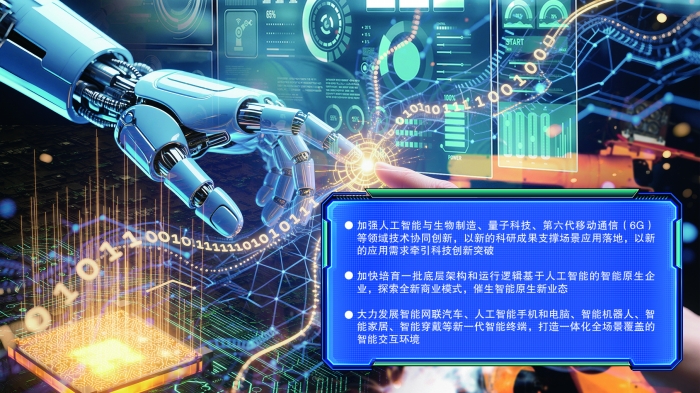
Core Viewpoint - The State Council of China has issued an opinion to accelerate the integration of artificial intelligence (AI) into various sectors, aiming for significant advancements by 2027, 2030, and 2035, ultimately supporting high-quality development and modernization of socialism [2][3][4]. Group 1: AI Integration Goals - By 2027, the goal is to achieve deep integration of AI with six key sectors, with over 70% application penetration of new intelligent terminals and agents, and a noticeable enhancement in AI's role in public governance [2]. - By 2030, AI is expected to empower high-quality development comprehensively, with over 90% application penetration of intelligent terminals and the emergence of AI as a crucial growth driver for the economy [2][3]. - By 2035, China aims to enter a new stage of intelligent economy and society, providing strong support for the realization of socialist modernization [2]. Group 2: Key Actions for AI Development - The opinion outlines six key actions, including "AI + Science and Technology," "AI + Industry Development," "AI + Consumer Quality Improvement," "AI + Welfare," "AI + Governance," and "AI + Global Cooperation" [2][3]. - In "AI + Science and Technology," there is a focus on promoting intelligent R&D tools and platforms, enhancing collaboration with fields like biomanufacturing and quantum technology, and driving innovation through application demands [2][3]. Group 3: Industry Development and Transformation - The opinion encourages enterprises to integrate AI into strategic planning and business processes, promoting intelligent development across all industrial elements and aiding the transformation of traditional industries [3]. - There is an emphasis on developing intelligent native technologies and services, fostering new business models, and enhancing the application of AI in design, production, and service operations [3][4]. Group 4: Consumer Quality Improvement - The initiative aims to promote the interconnectivity of intelligent terminals and cultivate an ecosystem of smart products, including intelligent vehicles, smartphones, and home devices [4]. - The integration of AI with emerging technologies like the metaverse and brain-computer interfaces is encouraged to explore new forms of intelligent products [4]. Group 5: Supportive Infrastructure - The opinion highlights the need for eight foundational support capabilities, including enhancing model capabilities, data supply innovation, and optimizing the development environment for AI applications [4]. - It emphasizes the importance of strengthening AI computing power, supporting innovations in AI chips, and optimizing national computing resource layouts [4]. Group 6: Expert Insights - Experts believe that China's rich application scenarios in advanced manufacturing, transportation, and healthcare provide a solid foundation for the successful implementation of the "AI +" initiative [5]. - The timing of the policy is seen as critical, as it aligns with the transition of AI from laboratory settings to large-scale industrial applications, shaping a new quality of economic growth and high-quality development [5].
东土科技2025年上半年营收实现3.90亿元
Zheng Quan Ri Bao· 2025-08-26 06:11
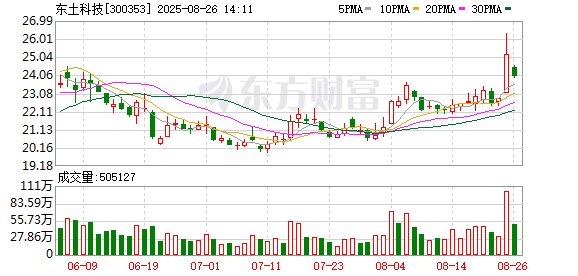
Core Insights - The company reported a revenue of 390 million yuan for the first half of 2025, representing a year-on-year decline of 7.13%. The net profit attributable to shareholders was a loss of 88.7969 million yuan, although this reflects a reduction in losses compared to the previous year [2]. Financial Performance - Revenue for the first half of 2025: 390 million yuan, down 7.13% year-on-year [2]. - Net profit attributable to shareholders: loss of 88.7969 million yuan, showing a reduction in losses compared to the previous year [2]. Research and Development - The company has focused on core technologies in industrial networking and intelligent control, particularly in "software-defined control" and "full IP industrial networking" [2]. - R&D investments from 2022 to the first half of 2025 were as follows: 220 million yuan (2022), 255 million yuan (2023), 303 million yuan (2024), and 109 million yuan (first half of 2025). The proportion of R&D investment to revenue was 19.96%, 21.93%, 29.44%, and 27.80% respectively [2]. - In the first half of 2025, the company and its subsidiaries applied for 46 new domestic and international invention patents and obtained 56 new authorized patents, totaling 1,029 authorized invention patents as of June 30, 2025 [2].

波尚琅:外资企业“山西行”活动架起与东盟合作新桥梁
Zhong Guo Jing Ji Wang· 2025-08-26 01:56
Group 1 - The "Shanxi Action" event, co-hosted by the China Council for the Promotion of International Trade and the Shanxi Provincial Government, aims to enhance cooperation between ASEAN enterprises and Shanxi in various fields, injecting new vitality into economic and trade exchanges [1] - ASEAN enterprises focused on four key areas during the event: advanced manufacturing, energy equipment, digital economy, and cultural tourism, with specific interests in high-end equipment and smart coal machinery [1] - The event significantly boosted investment confidence among ASEAN enterprises, with many expressing a newfound appreciation for Shanxi's transformation beyond its traditional image as an "energy province" [2] Group 2 - "Immersive inspections" allowed ASEAN enterprises to gain firsthand insights into Shanxi's industrial foundation, technological strength, and market potential, enhancing their investment willingness [2] - "Multi-level dialogues" facilitated communication between enterprises and government, enabling a better understanding of macro policies and specific projects, while also addressing core demands [2] - A "long-term mechanism" was established to support ongoing cooperation, including regular enterprise visits and the creation of an information-sharing platform to promote continuous collaboration [3]
东土科技:8月25日召开董事会会议
Mei Ri Jing Ji Xin Wen· 2025-08-25 15:11
Core Viewpoint - Dongtu Technology (SZ 300353) announced its seventh board meeting on August 25, 2025, to review the 2025 semi-annual report and other documents [1] Group 1: Company Performance - For the year 2024, Dongtu Technology's revenue composition shows that industrial internet and related businesses account for 90.74%, while hardware revenue makes up 9.26% [1] - As of the report, Dongtu Technology has a market capitalization of 15.5 billion yuan [1]