
航空业

Search documents
特朗普加税,朝鲜俄罗斯为何不在其中?原来是美国给自己留了后门
Sou Hu Cai Jing· 2025-06-09 07:51
Core Viewpoint - The article discusses the selective application of tariffs by the U.S. government, highlighting how Russia and North Korea have managed to avoid these tariffs while other allies face significant trade barriers. This reflects a dual standard in U.S. trade policy driven by political and economic interests. Group 1: U.S. Tariff Policy - The U.S. has refrained from imposing tariffs on Russia to avoid disrupting the ongoing Russia-Ukraine negotiations, indicating a strategic choice to separate economic measures from diplomatic efforts [3] - In the first quarter of 2024, U.S. imports of strategic materials from Russia increased by 37%, with titanium and uranium being critical for the aerospace and energy sectors, respectively [5] - The U.S. is currently seeking to restart diplomatic relations with North Korea, which has led to a lack of tariffs on North Korean goods, despite the absence of formal trade [7] Group 2: Economic Implications - The dual standards in tariff application reveal the deep intertwining of U.S. capital and political interests, as seen in the military-industrial complex where companies profit from both sides of the Russia-Ukraine conflict [8] - Imposing tariffs on Russian companies could disrupt U.S. supply chains, particularly in agriculture, where significant exports are routed through Kazakhstan to North Korea [9] - The article suggests that the U.S. is leaving an emergency channel open in global supply chains, allowing goods to be rerouted through Russia and North Korea to avoid tariffs [10] Group 3: Global Trade Dynamics - The article highlights that other countries may adopt similar strategies to bypass U.S. tariffs, using Russia and North Korea as intermediaries for exports to the U.S. [13] - The U.S. has previously imported palladium from Russia despite it being on the sanctions list, indicating a pattern of selective enforcement of trade regulations [13] - The ongoing tariff battle is reshaping global trade dynamics, encouraging businesses to find creative ways to continue operating in the U.S. market despite tariffs [15]


美国一季度工人生产率大幅下滑
news flash· 2025-06-05 13:15
Core Points - The productivity of American workers declined significantly in the first quarter, with a final value decrease of 1.5%, which is worse than the initial estimate of 0.8% [1] - This marks the first decline since the second quarter of 2022, indicating potential challenges for businesses [1] - Labor costs surged by 6.6% in the first quarter, with a year-over-year increase of 1.9%, surpassing the previously reported 1.3% [1] Economic Impact - Businesses are facing rising costs due to tariffs on imported goods, which may further strain profitability [1] - Economic uncertainty is expected to hinder consumer and business spending, leading to cautious financial guidance from companies in sectors such as airlines, retail, and automotive manufacturing for 2025 [1] - Overall, the decline in productivity and the rise in labor costs could pressure corporate profits moving forward [1]
美关税政策引航企担忧 面临航空安全与供应链双重威胁
Sou Hu Cai Jing· 2025-06-04 13:23
美国航空航天工业协会向商务部提交文件,敦促将232条款公众评论期延长90天,且至少180天内不征收 新关税。该协会还呼吁政府与业界就关税问题进一步磋商,确保关税不危及供应链与航空安全。该协会 举例称,2025年2月,美国宾夕法尼亚州一家航空航天紧固件供应商因发生火灾影响生产,且从新供应 商采购零部件困难重重,建立国内供应商并确保其通过严格安全认证可能需要长达10年。 美国航空协会也警告,关税或推高机票和运费。该协会在提交给商务部的评论中指出,增加商业航空部 门成本将削弱美国经济与国家安全,对国内商业、航空业的增长、竞争、创新和投资能力造成重大负面 影响。此外,关税还可能破坏正在复苏的航空供应链,导致假冒零部件流入市场,带来诸多挑战和意外 后果。 航空公司和制造商一直游说特朗普恢复1979年《民用飞机协定》下的免关税制度,该协定使美国航空业 每年享有750亿美元贸易顺差,且零部件需获美国联邦航空管理局认证才能免税。 中国航空新闻网讯:据外媒6月4日报道,航空航天业相关组织近日发出警告,美国对进口航空产品征收 的关税或将威胁航空安全、扰乱供应链并引发意外后果。 自美国总统特朗普4月宣布对贸易伙伴加征全面关税后,美 ...
免签“朋友圈”再扩容,这里住客九成已是外国人⋯⋯China Travel带火酒店生意
Mei Ri Jing Ji Xin Wen· 2025-06-03 11:57
Core Insights - China's visa-free policy is expanding, now including 43 countries, which is driving an increase in inbound tourism and hotel occupancy rates [3][6][12] - The hotel industry is experiencing a surge in foreign guests, with some hotels reporting foreign guest occupancy rates as high as 90% [6][8][12] - The influx of foreign tourists is prompting hotels to upgrade their services, including multilingual signage and tailored dining options [4][18] Group 1: Inbound Tourism Growth - Inbound tourism orders during the Dragon Boat Festival increased by nearly 90% year-on-year, with GMV for entrance tickets to tourist attractions growing over 150% [3] - Shanghai Yilong Hotel saw foreign guest occupancy rise from 10% to 90% in April 2023, reflecting a significant shift in guest demographics [6][12] - Other hotels in Shanghai and Guangzhou also reported substantial increases in foreign guest numbers, with some hotels experiencing over 90% year-on-year growth in foreign visitor reception [8][12] Group 2: Hotel Industry Adaptation - Hotels are adapting to the influx of foreign guests by hiring foreign staff for welcoming roles and engaging international influencers for promotions [3][7][18] - The average length of stay for foreign guests is longer than that of domestic guests, with many foreign visitors staying 3 nights or more, positively impacting hotel revenue [12][18] - The increase in foreign guests is leading to a rise in average daily rates, with some hotels reporting increases of 100 to 200 yuan during peak seasons [12][18] Group 3: Marketing and Service Enhancements - Hotels are focusing on improving service quality by training staff in cultural awareness and communication skills to better serve international guests [18][19] - Marketing strategies are evolving, with hotels leveraging international social media platforms like Instagram and TikTok to reach potential foreign customers [19] - Collaborations with international travel agencies and third-party platforms are becoming essential for hotels to expand their customer base [19]

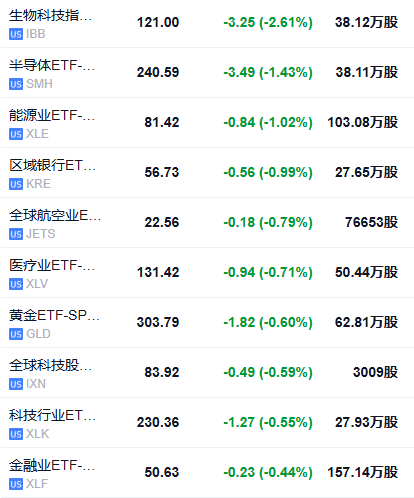
美股盘初,主要行业ETF普跌,生物科技指数ETF跌超2%,半导体ETF、区域银行ETF均跌超1%。
news flash· 2025-05-30 13:43
美股盘初,主要行业ETF普跌,生物科技指数ETF跌超2%,半导体ETF、区域银行ETF均跌超1%。 | 生物科技指 ... | 121.00 | -3.25 (-2.61%) 38.12万股 | | | --- | --- | --- | --- | | us IBB | | | | | 半导体ETF - ... | 240.59 | -3.49 (-1.43%) | 38.11万股 | | us SMH | | | | | 能源业ETF --- | 81.42 | -0.84 (-1.02%) | 103.08万股 | | us XLE | | | | | 区域银行ET ... | 56.73 | -0.56 (-0.99%) | 27.65万股 | | us KRE | | | | | 全球航空业E ... | 22.56 | -0.18 (-0.79%) | 76653股 | | us JETS | | | | | 医疗业ETF - ... | 131.42 | -0.94 (-0.71%) | 50.44万股 | | us XLV | | | | | 黄金ETF-SP ... | 303.79 | - ...
美股盘初,主要行业ETF多数走高,半导体ETF涨超2%,全球航空业ETF、全球科技股指数ETF涨幅居前。
news flash· 2025-05-29 13:49
Group 1 - Major industry ETFs in the U.S. stock market are mostly rising at the beginning of trading [1] - The semiconductor ETF has increased by over 2% [1] - The global airline industry ETF and the global technology stock index ETF are among the top gainers [1]
飞机被以军摧毁 也门航空暂停往返安曼商业航班
news flash· 2025-05-28 12:02
飞机被以军摧毁 也门航空暂停往返安曼商业航班 智通财经5月28日电,也门航空发布声明称,因为第四架飞机被以色列空袭摧毁,也门航空暂停所有往 返约旦安曼的商业航班。当天早些时候,也门胡塞武装高级官员向总台报道员证实,以色列当天上午空 袭也门首都萨那国际机场,炸毁了一架也门航空客机。这也是唯一一架仍在胡塞武装控制下,可以运行 的民航客机。以色列国防部长卡茨证实以军空袭也门萨那机场,摧毁了胡塞武装仍在使用的最后一架飞 机。卡茨称,"这是一个明确的信息,也是我们既定政策的直接延续:任何向以色列国开火的人都将付 出沉重代价"。 ...
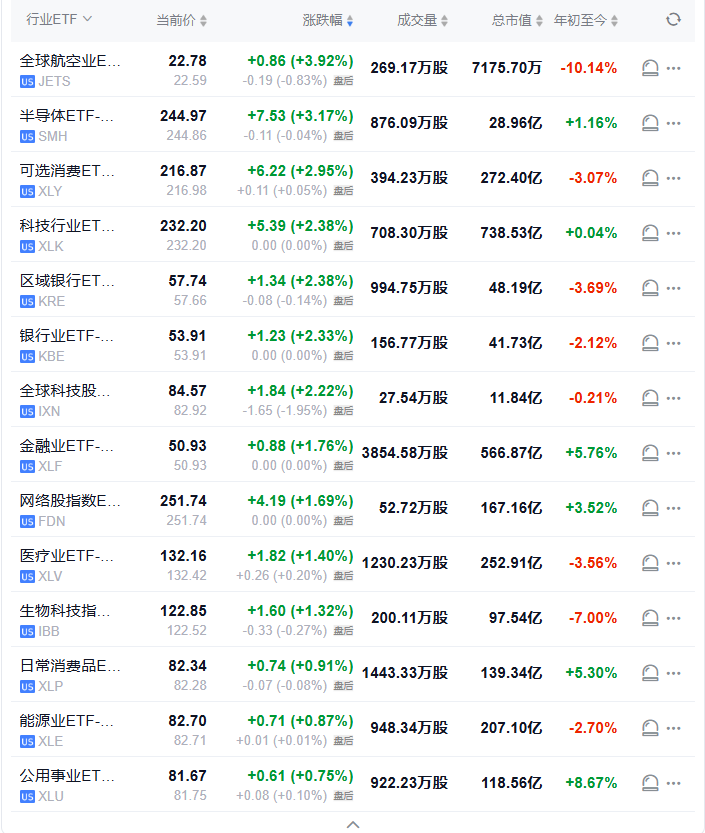
航空业ETF收涨超3.9%,和半导体ETF领跑美股行业ETF,标普可选消费板块涨超3%
news flash· 2025-05-27 20:30
标普500指数的11个板块中,可选消费板块涨3.04%,信息技术/科技板块涨2.55%,电信板块涨2.14%。 | 行业ETF v | 当前价 ◆ | 涨跌幅 ÷ | 成交量 ÷ | | 总市值 ; 年初至今 ; | 0 | | --- | --- | --- | --- | --- | --- | --- | | 全球航空业E ... | 22.78 | +0.86 (+3.92%) | 269.17万股 | 7175.70万 -10.14% | | (1) *** | | us JETS | 22.59 | -0.19 (-0.83%) 盘后 | | | | | | 半导体ETF --- | 244.97 | +7.53 (+3.17%) | 876.09万股 | 28.96亿 | +1.16% | เป็น … | | us SMH | 244.86 | -0.11 (-0.04%) 盘后 | | | | | | 可选消费ET ... | 216.87 | +6.22 (+2.95%) | 394.23万股 | 272.40亿 | -3.07% | ( ) ... | | us XLY | 216.98 ...
【财经分析】新加坡电子航运业4月表现突出 提前出货动能或延续至7月
Xin Hua Cai Jing· 2025-05-27 13:46
Core Viewpoint - Singapore's manufacturing sector continued its growth momentum in April, driven by early shipments in the electronics and aerospace engineering industries, with a year-on-year increase of 5.9% and a month-on-month increase of 5.3%, marking the tenth consecutive month of positive growth [1] Group 1: Manufacturing Performance - The manufacturing sector, excluding biomedical, saw a year-on-year growth of 8.1% in April, with the electronics sector experiencing a significant increase of 15.2% and aerospace engineering growing by 22.9% [1] - The growth in the electronics sector was primarily driven by strong export demand for communications and consumer electronics (up 67.8%), semiconductors (up 11.7%), and computer peripherals (up 11.3%) [1] - The aerospace sector was boosted by robust demand for commercial aviation maintenance, repair, and overhaul (MRO), which surged by 39.5% year-on-year [1] Group 2: Future Risks and Concerns - Despite the strong data, analysts express caution regarding future trends, noting that the current manufacturing growth is influenced by an "early shipment effect" that may not be sustainable, especially after the end of the "90-day tariff buffer window" [1] - OCBC Bank predicts that Singapore's manufacturing growth for the entire year of 2025 may only reach 0-2%, with the possibility of negative year-on-year growth in the second half of the year [2] - UOB warns that the significant growth in April was largely due to export companies rushing to ship products to avoid potential tariffs, and future trade disputes, particularly between the US and Europe, could severely impact Singapore's relevant industries [2] Group 3: Subsector Performance - Some manufacturing subsectors in Singapore showed weak performance, with biomedical manufacturing declining by 1.1%, chemicals down by 3.2%, and general manufacturing (including food, printing, and furniture) experiencing a decline of 15.2% [2] - The chemical industry faced challenges due to high inventories of refined oil and petrochemical products, compounded by raw material supply issues and maintenance activities, leading to continued output declines [2] - The biomedical sector's output was affected by changes in the product structure of active pharmaceutical ingredients (API), resulting in a year-on-year decrease in pharmaceutical output of 1.6% [2]