企业利润

Search documents
利率半月报(2026.3.16-2026.3.29):3月债市长短端行情分化-20260330
Hua Yuan Zheng Quan· 2026-03-30 11:22
Report Investment Rating - No industry investment rating is provided in the report [1] Core Viewpoints - In March, the bond market showed a divergence in short - and long - term trends. Short - term yields mostly declined, while long - term yields mostly rose. On March 27, the yields of 1 - year/3 - year/5 - year/10 - year/30 - year treasury bonds were 1.25%, 1.33%, 1.55%, 1.82%, and 2.35% respectively, down - 7.0BP/ - 5.2BP/+1.0BP/+4.2BP/+7.8BP compared to February 28 [2][80] - From January to February 2026, the total profit of industrial enterprises above designated size reached 1.02 trillion yuan, a year - on - year increase of 15.2%. The conflict between the US and Iran may narrow the decline of PPI, but due to international energy price fluctuations, enterprise profits in March may be under pressure [2][80] - The recent significant appreciation of the RMB is beneficial to the Chinese bond market. Currently, the long - bond positions of trading desks are still relatively small. The year - on - year recovery of PPI is a general market expectation, and the risk of long - term bonds may be low. It is recommended to seize trading opportunities [2][80] Summary by Directory 1. Macro News - From January to February 2026, the total profit of industrial enterprises above designated size was 1.02 trillion yuan, a year - on - year increase of 15.2%. The operating income was 20.84 trillion yuan, a year - on - year increase of 5.3%. The operating cost was 17.68 trillion yuan, a year - on - year increase of 5.0%. The operating income profit margin was 4.92%, a year - on - year increase of 0.43 percentage points [8] - In January - February 2026, both the general public budget revenue and expenditure increased year - on - year. The general public budget revenue was 4.4 trillion yuan, a year - on - year increase of 0.7%. Tax revenue was 3.6 trillion yuan, a year - on - year increase of 0.1%; non - tax revenue was 0.8 trillion yuan, a year - on - year increase of 3.4%. The general public budget expenditure was 4.7 trillion yuan, a year - on - year increase of 3.6% [10] 2. Mid - level High - frequency Data 2.1 Consumption - As of March 22, the daily average retail volume of passenger cars by manufacturers was 5.1 million vehicles, a year - on - year decrease of 7.0%, and the daily average wholesale volume was 6.2 million vehicles, a year - on - year decrease of 3.0% [17] - As of March 27, the total box office revenue of national movies in the past 7 days was 321.205 million yuan, a year - on - year increase of 35.1% [17] - As of March 20, the total retail volume of three major household appliances was 1.003 million units, a year - on - year decrease of 27.2%, and the total retail sales were 2.19 billion yuan, a year - on - year decrease of 28.9% [23] 2.2 Transportation - As of March 28, the average migration scale index in the past 7 days was 472.3, a year - on - year increase of 6.1% [27] - As of March 22, the number of civil aviation flights guaranteed in the current week was 1.23 million, a year - on - year increase of 3.4% [27] - As of March 27, the average daily passenger volume of the subway in first - tier cities in the past 7 days was 40.56 million person - times, a year - on - year increase of 0.6% [27] - As of March 22, the current - week express delivery collection volume was 3.85 billion pieces, a year - on - year increase of 4.4%, the delivery volume was 3.89 billion pieces, a year - on - year increase of 5.5%, the railway freight volume was 80.312 million tons, a year - on - year increase of 1.0%, and the highway truck traffic volume was 54.585 million vehicles, a year - on - year decrease of 0.1% [30] 2.3 Industry - As of March 27, the iron ore inventory in the current week was 176.668 million tons, a year - on - year increase of 17.9%, the rebar inventory was 6.428 million tons, a year - on - year increase of 5.4%, and the float glass enterprise inventory was 73.622 million tons, a year - on - year increase of 9.9% [32] - As of March 13, the daily coal consumption of key power plants in the current week was 4.85 million tons, a year - on - year decrease of 0.2% [35] - As of March 27, the apparent consumption of steel products in the current week was 8.88 million tons, a year - on - year decrease of 3.5%, the apparent consumption of rebar was 2.254 million tons, a year - on - year decrease of 8.1%, and the apparent consumption of wire rods was 0.92 million tons, a year - on - year decrease of 4.3% [35] - As of March 25, the blast furnace operating rate of major steel enterprises in the current week was 75.3%, a year - on - year decrease of 1.3 percentage points. As of March 26, the average asphalt operating rate was 15.0%, a year - on - year decrease of 8.0 percentage points, the soda ash operating rate was 82.0%, a year - on - year increase of 0.6 percentage points, and the PVC operating rate was 76.1%, a year - on - year decrease of 3.0 percentage points [43] 2.4 Real Estate - As of March 27, the total commercial housing transaction area in 30 large - and medium - sized cities in the past 7 days was 2.706 million square meters, a year - on - year decrease of 10.9% [44] 2.5 Prices - As of March 29, the average wholesale price of pork in the current week was 15.6 yuan/kg, a year - on - year decrease of 25.2%, and a decrease of 8.4% compared to four weeks ago [47] - As of March 27, the average wholesale price of vegetables was 4.8 yuan/kg, a year - on - year increase of 0.3%, and a decrease of 9.8% compared to four weeks ago. The average wholesale price of six key fruits was 7.8 yuan/kg, a year - on - year increase of 3.0%, and a decrease of 2.8% compared to four weeks ago [47] - As of March 27, the average price of thermal coal at northern ports was 755 yuan/ton, a year - on - year increase of 11.7%, and an increase of 3.9% compared to four weeks ago. The average spot price of WTI crude oil was 92.7 US dollars/barrel, a year - on - year increase of 34.0%, and an increase of 42.4% compared to four weeks ago [47] - As of March 27, the average spot price of rebar was 3184.4 yuan/ton, a year - on - year decrease of 0.6%, and an increase of 1.6% compared to four weeks ago. The average spot price of iron ore was 810.1 yuan/ton, a year - on - year increase of 1.6%, and an increase of 5.1% compared to four weeks ago. The average spot price of glass was 13.5 yuan/square meter, a year - on - year decrease of 10.8%, and an increase of 1.7% compared to four weeks ago [54] 3. Bond and Foreign Exchange Markets - On March 27, the overnight Shibor was 1.32%, unchanged from March 23 and down 0.30BP from March 16. R001 was 1.39%, down 0.90BP from March 23 and down 1.22BP from March 16; R007 was 1.51%, up 3.06BP from March 23 and down 0.53BP from March 16. DR001 was 1.32%, down 0.24BP from March 23 and down 0.38BP from March 16; DR007 was 1.44%, up 1.39BP from March 23 and down 1.25BP from March 16. IBO001 was 1.37%, up 0.03BP from March 23 and down 0.27BP from March 16; IBO007 was 1.47%, up 0.57BP from March 23 and down 0.97BP from March 16 [56] - The yields of most treasury bonds declined in the past week. On March 27, the yields of 1 - year/5 - year/10 - year/30 - year treasury bonds were 1.25%/1.55%/1.82%/2.35% respectively, down - 0.7BP/ - 1.0BP/ - 1.2BP/ - 3.7BP compared to March 20 and down - 2.7BP/ - 0.8BP/+0.3BP/ - 1.5BP compared to March 13. The yields to maturity of 1 - year/5 - year/10 - year/30 - year China Development Bank bonds were 1.46%/1.69%/1.96%/2.48% respectively, down - 1.3BP/ - 0.7BP/ - 1.1BP/ - 3.7BP compared to March 20 and down - 3.5BP/ - 2.9BP/ - 0.4BP/ - 2.1BP compared to March 13 [61] - On March 27, the yields to maturity of 1 - year/5 - year/10 - year local government bonds were 1.33%/1.69%/2.00% respectively, down - 4.5BP/ - 1.0BP/+1.7BP compared to March 20 and down - 1.5BP/+1.7BP/+1.7BP compared to March 13. The yields to maturity of AAA 1 - month/1 - year, AA+1 - month/1 - year inter - bank certificates of deposit were 1.43%/1.53%/1.45%/1.55% respectively, down - 3.0BP/+1.3BP/ - 3.0BP/+1.3BP compared to March 20 and down - 7.7BP/ - 0.4BP/ - 7.7BP/ - 0.4BP compared to March 13 [68] - As of March 27, 2026, the yields of 10 - year treasury bonds in the US, Japan, the UK, and Germany were 4.44%, 2.38%, 4.97%, and 3.18% respectively, up 16BP/13.5BP/21.4BP/17BP compared to March 13 [73] - On March 27, the central parity and spot exchange rate of the US dollar against the RMB were 6.91/6.91 respectively, up 243/288 pips compared to March 20 and up 134/75 pips compared to March 13 [76] 4. Institutional Behavior - The duration of medium - and long - term pure bond funds has decreased. On March 27, 2026, the median duration of medium - and long - term interest - rate bond funds was about 2.8 years, a decrease of about 0.48 years compared to March 13. The median duration of credit bond funds was about 1.7 years, a decrease of about 0.97 years compared to March 13 [77][78] 5. Investment Recommendations - In 2026, the total supply of the bond market is expected to be stable, and the supply - demand relationship in the bond market is expected to improve. It is predicted that the yield of 10 - year treasury bonds will fluctuate in the range of 1.6% - 1.9%, and the yield of 30 - year treasury bonds will fluctuate in the range of 1.9% - 2.4%. Currently, it is recommended to pay attention to the opportunities of 30 - year old treasury bonds, 10 - year China Development Bank bonds, and long - duration subordinated capital bonds [82] - The Fed's interest rate cut may be postponed to May 2026 or later. China's exports are resilient, and domestic policy rate cuts may be late, possibly in the middle of the year or later. It is expected that bond market investments may be relatively favorable in the second half of the year [82]
出厂价格继续改善——2月PMI数据点评
一瑜中的· 2026-03-07 06:17
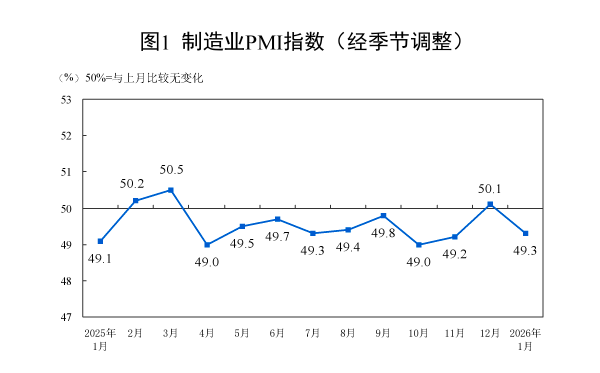
Core Viewpoint - The manufacturing PMI for February decreased to 49.0%, indicating a contraction in the manufacturing sector, influenced by the Spring Festival holiday and related factors [2][3][11]. Group 1: Factory Prices Continue to Improve - The manufacturing PMI factory price index rose to 50.6%, remaining above the threshold for two consecutive months, indicating price increases for several goods [3][7]. - The BCI survey showed that the enterprise sales forward-looking index reached 69.12%, up from 64.71%, suggesting improved sales prospects [4][7]. - The rise in factory prices is expected to enhance corporate sales, with the BCI enterprise profit forward-looking index at 51.16%, indicating profitability above the threshold for two months [4][7]. Group 2: Data on Manufacturing PMI Decline - The manufacturing PMI for February was reported at 49.0%, down from 49.3% in January, with specific indices showing declines in production, new orders, and export orders [11][12]. - The new export orders index fell to 45.0%, down from 47.8%, indicating a slowdown in export activity [11][13]. - The construction sector's business activity index dropped to 48.2%, reflecting the impact of the Spring Festival on construction projects [11][13]. Group 3: Price and Inventory Trends - The main raw material purchasing price index was at 54.8%, remaining above the threshold for eight consecutive months, indicating sustained price pressures [12]. - The procurement index for February was 48.2%, down from 48.7%, suggesting a potential decline in inventory levels [12]. - The production index for comprehensive PMI output was 49.5%, indicating a slowdown in overall production activities compared to the previous month [14].


1月制造业PMI回落至49.3%,超3成企业反映利润下降
Di Yi Cai Jing· 2026-01-31 03:39
Core Viewpoint - The manufacturing sector in China is experiencing a decline in economic activity, as indicated by the drop in the Purchasing Managers' Index (PMI) below the growth threshold, reflecting insufficient market demand and the need for stronger economic recovery measures [1][4][6]. Manufacturing Sector - The manufacturing PMI for January is reported at 49.3%, a decrease of 0.8 percentage points from the previous month, indicating fluctuations in manufacturing operations [4]. - New orders index fell to 49.2%, down 1.6 percentage points, suggesting a tightening of market demand [4]. - The production index remains in the expansion zone at 50.6%, but has decreased by 1.1 percentage points, indicating a slowdown in manufacturing production growth [5]. - The prices of raw materials and finished products are rising, with the raw material purchase price index at 56.1% and the factory price index at 50.6%, marking the first time in nearly 20 months that the factory price index has risen above the critical point [5][6]. - Over 34% of manufacturing companies reported a decline in profits, highlighting concerns regarding profitability amid rising raw material costs [6]. Non-Manufacturing Sector - The non-manufacturing business activity index is at 49.4%, down 0.8 percentage points, with the construction sector experiencing a significant decline [9]. - The service sector remains relatively stable, with a slight decrease in the service business activity index to around 49.5% [10]. - The service industry shows optimistic expectations, with a business activity expectation index of 57.1%, indicating a positive outlook for the upcoming Spring Festival consumption [10].
纯苯、苯乙烯周报:市场情绪反复,纯苯苯乙烯跟随-20260112
Guo Mao Qi Huo· 2026-01-12 07:05
1. Report Industry Investment Rating - Not provided in the document 2. Core Viewpoints of the Report - The commodity market has large sentiment fluctuations, and it is expected that benzene and styrene will mainly fluctuate [3]. - The Asian benzene market is affected by factors such as the strength of US benzene prices, downstream styrene market support, and market sentiment, maintaining a volatile state. The supply can meet the demand, and the overall demand is stable while overseas demand is weak [77]. - The Asian styrene market has rebounded, but high inventory and weak overseas demand still limit its upward space [126]. - The overseas benzene and styrene markets are both facing the dual pressures of improved supply and weak demand in the short - term, and the profitability is under pressure [68][87]. 3. Summary by Relevant Catalogs 3.1 Main Viewpoints and Strategy Overview - **Supply**: The economic situation of styrene producers in Asia has recovered but remains negative. The spread between styrene and naphtha is $290, and the spread between styrene and benzene is stable at $165 [3]. - **Demand**: As of January 5, 2026, the commercial inventory of pure benzene in Jiangsu ports was 318,000 tons, a month - on - month increase of 6.00% and a year - on - year increase of 71.71%. From December 29 to January 4, the estimated arrival was about 25,000 tons and the pick - up was about 7,000 tons [3]. - **Inventory**: As of January 5, 2026, the inventory of styrene in Jiangsu ports was 132,300 tons, a decrease of 4.68% from the previous period. The commercial inventory was 77,300 tons, a decrease of 7.20% from the previous period [3]. - **Basis**: The styrene basis has slightly strengthened. Overseas demand for blending oil has weakened, and Trump's foreign policy significantly affects oil prices. Attention should be paid to changes in cost support [3]. - **Profit**: The spread between styrene and naphtha is $290, and the spread between styrene and benzene is stable at $165. Styrene profit has slightly recovered [3]. - **Valuation**: The prices of pure benzene and styrene are at historical lows. Overseas export demand is driving up prices, and the market is paying attention to the strengthening of basis and monthly spread performance [3]. - **Macro Policy**: Trump is planning to dominate the Venezuelan oil industry, which may lower oil prices. If successful, the US will control most of the oil reserves in the Western Hemisphere and gain an important say in the final flow of crude oil [3]. - **Investment Viewpoint**: The commodity market sentiment fluctuates greatly, and it is expected to be mainly in a volatile state [3]. - **Trading Strategy**: For unilateral trading, adopt a wait - and - see approach. Pay attention to geopolitical risks [3]. 3.2 Fundamentals Overview of Pure Benzene and Styrene - **Crude Oil**: Trump's policy changes significantly affect oil prices [5]. - **Styrene**: Non - integrated styrene unit profits are average, and styrene profits have relatively expanded [14][23]. - **Pure Benzene**: Pure benzene inventory remains at a high level [32]. 3.3 Polymer Demand Overview - **Styrene Downstream - ABS**: In the off - season, demand is weak, and ABS profits are shrinking [46]. - **Styrene Downstream - PS**: PS production margins are weak, and demand is difficult to follow up [59]. - **Styrene Downstream - EPS**: EPS prices are at a low level, and inventory continues to accumulate [69]. - **Pure Benzene - Aniline**: Aniline production has declined, and margins have rebounded [79]. - **Styrene Overseas**: The overseas styrene market is in a post - holiday slump. Profits are expected to be negative in early 2026, and production is restricted by cost pressure [87]. - **Phenol**: Phenol port inventory remains at a low level [88]. - **Adipic Acid**: Adipic acid profits are low [99]. - **Caprolactam**: Caprolactam production load has declined, and inventory has been depleted [111]. - **Appliance Production**: Refrigerator and freezer production schedules and household air - conditioner production schedules are provided, but no specific analysis is given [122][124].
前11个月国企实现利润超2万亿元,私企1.93万亿元
Jin Rong Shi Bao· 2025-12-29 14:01
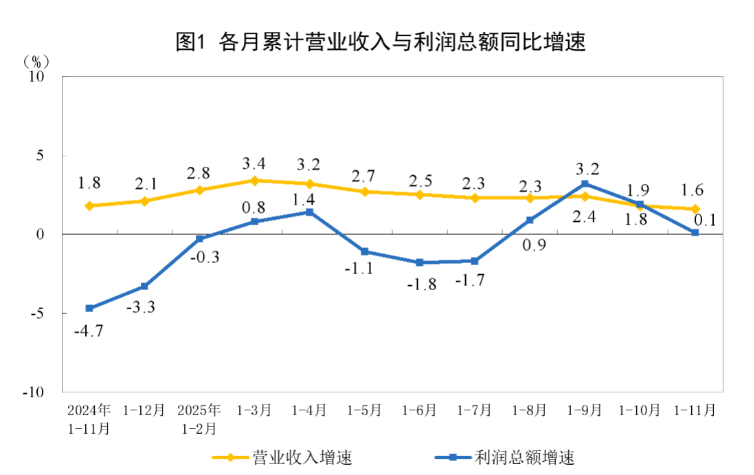
Core Insights - In the first eleven months of 2025, the total profit of large-scale industrial enterprises in China reached 66,268.6 billion yuan, reflecting a year-on-year growth of 0.1% [1] By Enterprise Type - State-owned enterprises reported a total profit of 20,083.6 billion yuan, a decrease of 1.6% year-on-year [4] - Shareholding enterprises achieved a total profit of 49,565.6 billion yuan, down by 0.4% [4] - Foreign and Hong Kong, Macao, and Taiwan-invested enterprises saw a profit of 16,355.3 billion yuan, an increase of 2.4% [4] - Private enterprises recorded a total profit of 19,319.9 billion yuan, a slight decline of 0.1% [4] By Industry Type - The manufacturing sector generated a total profit of 50,317.9 billion yuan, marking a growth of 5.0% [6] - The mining industry reported a profit of 7,896.3 billion yuan, down by 27.2% year-on-year [6] - The electricity, heat, gas, and water production and supply sector achieved a profit of 8,054.4 billion yuan, increasing by 8.4% [6] Key Industries - The computer, communication, and other electronic equipment manufacturing industry experienced a profit increase of 15.0% [7] - The automotive manufacturing sector saw a profit growth of 7.5% [7] - The agricultural and sideline food processing industry grew by 4.8% [7] - The oil and natural gas extraction industry faced a profit decline of 13.6% [7] - The coal mining and washing industry suffered a significant drop of 47.3% [7] Monthly Performance - In November, the profits of large-scale industrial enterprises fell by 13.1% year-on-year [8]
日企三季度利润同比飙升19.7% 资本支出增速显著放缓至2.9%
Xin Hua Cai Jing· 2025-12-01 01:11
Core Viewpoint - Japanese corporate profits saw a significant year-on-year increase of 19.7% in Q3 2025, surpassing market expectations of 3.7%, while capital expenditure growth was only 2.9%, falling short of the anticipated 6% [1][1][1] Group 1: Profit and Investment Trends - Corporate profits improved significantly, indicating a strong rebound compared to the previous quarter's minimal growth of 0.2% [1] - Capital expenditure growth was notably lower than expected, with a 2.9% increase, down from 7.6% in the previous quarter, signaling a decrease in investment momentum [1][1] - Overall sales revenue showed a slight year-on-year increase of 0.5%, which was marginally above market expectations [1] Group 2: Economic Implications - The disparity between strong profits and weak investment reflects a cautious attitude among Japanese companies amid increasing economic uncertainty [1] - The reported data is expected to directly influence the revision of Japan's GDP for Q3 2025, with policymakers closely monitoring these figures ahead of the Bank of Japan's monetary policy meeting in December [1][1]
能源化工日报-20251124
Wu Kuang Qi Huo· 2025-11-24 00:55
1. Report Industry Investment Rating No relevant information provided. 2. Core Viewpoints of the Report - For crude oil, although the geopolitical premium has dissipated and OPEC's production increase is minimal with supply not yet surging, short - term oil prices should not be overly bearish. A range - trading strategy of buying low and selling high is maintained, but it's advisable to wait and see for now to verify OPEC's export price - support intention [2]. - For methanol, the futures market is in a weak downward trend. High port inventories persistently suppress prices and the monthly structure. Supply remains high while demand shows little change. The market is trading on weak - reality logic, and prices may further decline [4]. - For urea, prices are oscillating at the bottom and showing relative resilience. With improved demand and cost support, the downside is limited, and it's expected to build a bottom through oscillation. A strategy of buying on dips is recommended [7]. - For PVC, the supply - demand situation is poor with strong supply and weak demand in China. Although the valuation has dropped to a low level, it still can't support the current supply - demand imbalance. A strategy of short - selling on rallies is suggested in the medium term [12]. - For pure benzene and styrene, the port inventory of styrene is decreasing significantly, and with the seasonal peak in demand, styrene prices may stop falling temporarily [18]. - For polyethylene, the price is expected to remain in a low - level oscillation. The cost - driven downward trend has shifted to the issue of South Korean ethylene clearance [21]. - For polypropylene, in a situation of weak supply and demand with high inventory pressure, there is no prominent short - term contradiction. The price may be supported when the supply - surplus situation in the cost side changes in the first quarter of next year [23]. - For PX, it is expected to experience a slight inventory build - up in November. With a neutral valuation and weakening aromatics blending data, there is a risk of valuation correction [27]. - For PTA, the supply of unexpected outages is expected to decrease, and demand may remain high in the short term. However, PTA processing fees have limited upside, and there is a risk of PXN valuation correction [29]. - For ethylene glycol, the supply - demand outlook is weak. Although the inventory build - up may slow down, a strategy of short - selling on rallies is recommended in the medium term [32]. 3. Summary by Related Catalogs 3.1 Crude Oil - **Market Information**: INE's main crude oil futures closed down 7.60 yuan/barrel, a 1.67% decline, at 447.40 yuan/barrel. Singapore's ESG oil product weekly data showed gasoline and diesel inventories increasing, fuel oil inventory decreasing, and total refined oil inventory increasing [9]. - **Strategy Viewpoint**: Maintain a range - trading strategy of buying low and selling high, and wait and see for now [2]. 3.2 Methanol - **Market Information**: Taicang's price remained stable, Lunan's price decreased by 5, Inner Mongolia's price increased by 5, the 01 contract of the futures market decreased by 12 yuan to 2004 yuan/ton, and the basis was - 4. The 1 - 5 spread increased by 3 to - 134 [3]. - **Strategy Viewpoint**: The futures market is in a weak downward trend. High port inventories suppress prices, and there is a risk of further price decline [4]. 3.3 Urea - **Market Information**: Shandong's spot price increased by 10, Henan's increased by 20, Hubei's increased by 10. The 01 contract of the futures market decreased by 11 yuan to 1654 yuan, and the basis was - 24. The 1 - 5 spread decreased by 4 to - 74 [6]. - **Strategy Viewpoint**: Prices are oscillating at the bottom and showing relative resilience. With improved demand and cost support, the downside is limited. A strategy of buying on dips is recommended [7]. 3.4 PVC - **Market Information**: The 01 contract remained unchanged at 4456 yuan. Changzhou's SG - 5 spot price was 4420 yuan/ton, and the basis was - 36. The 1 - 5 spread was - 300. The cost side remained stable, and the overall开工 rate was 78.8%, with an increase of 0.3%. The demand - side downstream开工 rate was 49.2%, with a decrease of 0.3% [11]. - **Strategy Viewpoint**: The supply - demand situation is poor with strong supply and weak demand in China. A strategy of short - selling on rallies is suggested in the medium term [12]. 3.5 Pure Benzene and Styrene - **Market Information**: Pure benzene's spot and futures prices remained unchanged, and the basis widened. Styrene's spot and futures prices increased, and the basis strengthened. The upstream开工 rate decreased by 0.30%, and the port inventory decreased by 2.65 million tons. The demand - side three - S weighted开工率 increased by 0.21% [14]. - **Strategy Viewpoint**: With the significant decrease in styrene's port inventory and the seasonal peak in demand, styrene prices may stop falling temporarily [18]. 3.6 Polyethylene - **Market Information**: The main contract's closing price was 6781 yuan/ton, a decrease of 54 yuan/ton. The spot price remained unchanged at 6855 yuan/ton, and the basis strengthened by 54 yuan to 74. The upstream开工 rate increased by 0.89%. The production enterprise's inventory decreased by 2.59 million tons, and the trader's inventory increased by 0.05 million tons. The downstream average开工率 decreased by 0.29% [20]. - **Strategy Viewpoint**: The price is expected to remain in a low - level oscillation. The cost - driven downward trend has shifted to the issue of South Korean ethylene clearance [21]. 3.7 Polypropylene - **Market Information**: The main contract's closing price was 6400 yuan/ton, a decrease of 34 yuan/ton. The spot price decreased by 15 yuan to 6505 yuan/ton, and the basis strengthened by 19 yuan to 105. The upstream开工率 decreased by 0.68%. The production enterprise's, trader's, and port inventories all decreased. The downstream average开工率 increased by 0.14% [22]. - **Strategy Viewpoint**: In a situation of weak supply and demand with high inventory pressure, there is no prominent short - term contradiction. The price may be supported when the supply - surplus situation in the cost side changes in the first quarter of next year [23]. 3.8 PX - **Market Information**: The 01 contract decreased by 80 yuan to 6750 yuan, and PX CFR decreased by 9 dollars to 824 dollars. The basis was - 19 yuan, and the 1 - 3 spread was - 14 yuan. China's PX负荷 was 89.5%, an increase of 2.7%, and Asia's was 79.7%, an increase of 1.2%. PTA's负荷 was 71%, a decrease of 4.7%. The inventory at the end of September was 402.6 million tons, an increase of 10.8 million tons compared to the previous month [26]. - **Strategy Viewpoint**: It is expected to experience a slight inventory build - up in November. With a neutral valuation and weakening aromatics blending data, there is a risk of valuation correction [27]. 3.9 PTA - **Market Information**: The 01 contract decreased by 30 yuan to 4666 yuan, and the East China spot price decreased by 15 yuan/ton to 4615 yuan. The basis was - 63 yuan, and the 1 - 5 spread was - 44 yuan. PTA's负荷 was 71%, a decrease of 4.7%. The downstream负荷 was 91.3%, an increase of 0.8%. The social inventory on November 7 was 222.7 million tons, an increase of 2 million tons compared to the previous period. The spot processing fee increased by 35 yuan to 199 yuan, and the futures processing fee increased by 22 yuan to 238 yuan [28]. - **Strategy Viewpoint**: The supply of unexpected outages is expected to decrease, and demand may remain high in the short term. However, PTA processing fees have limited upside, and there is a risk of PXN valuation correction [29]. 3.10 Ethylene Glycol - **Market Information**: The EG01 contract decreased by 14 yuan to 3808 yuan, and the East China spot price decreased by 33 yuan to 3852 yuan. The basis was 32 yuan, and the 1 - 5 spread was - 93 yuan. The supply - side负荷 was 70.8%, a decrease of 0.7%. The downstream负荷 was 91.3%, an increase of 0.8%. The port inventory increased by 7.1 million tons to 73.2 million tons [30]. - **Strategy Viewpoint**: The supply - demand outlook is weak. Although the inventory build - up may slow down, a strategy of short - selling on rallies is recommended in the medium term [32].
五矿期货能源化工日报-20251120
Wu Kuang Qi Huo· 2025-11-20 01:16
1. Report Industry Investment Rating There is no information provided regarding the report industry investment rating. 2. Core Views of the Report - For crude oil, although the geopolitical premium has dissipated and OPEC's production increase is minimal with supply not yet surging, short - term oil prices should not be overly bearish. A range strategy of buying low and selling high is maintained, but it's advisable to wait and see to verify OPEC's export price - support intention [2]. - For methanol, high port inventories suppress prices. Overseas production remains high, and with coal prices strong and enterprise profits falling, supply pressure persists. Demand is weak, so prices may decline further, and it's recommended to wait and see [3]. - For urea, the market is sensitive to news. Domestic demand lacks support, and supply is high. New export policies have improved the market atmosphere, and inventories are decreasing. Urea prices are expected to bottom out with limited downside [6]. - For rubber, the current view is bullish. Short - term bullish trading with quick in - and - out is recommended, and partial position - building for the hedge of buying RU2601 and selling RU2609 is advised [9]. - For PVC, the fundamentals are poor. Supply is strong, demand is weak, and export expectations are weakening. It's recommended to consider short - selling on rallies in the medium term [10]. - For pure benzene and styrene, the BZN spread has room to recover. Port inventories are decreasing, and styrene prices may stop falling temporarily [14]. - For polyethylene, the price may remain in a low - level oscillation. The cost - driven decline may shift to the impact of South Korea's ethylene clearance policy [17]. - For polypropylene, in a weak supply - demand situation with high inventory pressure, the price may be supported when the supply - surplus situation of the cost side changes in Q1 next year [19]. - For PX, it is expected to accumulate a small amount of inventory in November, but there is support from aromatics blending for gasoline and the long - term supply - demand structure. Mid - term valuation increase opportunities are worth attention [22]. - For PTA, it is expected to accumulate inventory in November. Although polyester load may remain high, PTA processing fees are under pressure. Pay attention to the opportunity of PTA strengthening driven by the increase of PXN in the medium term [24]. - For ethylene glycol, inventories are expected to accumulate in Q4. With a weak pattern, the valuation may be further compressed, and short - selling on rallies is recommended [27]. 3. Summary by Relevant Catalogs Crude Oil - **Market Quotes**: INE's main crude oil futures rose 2.20 yuan/barrel, a 0.48% increase, to 464.50 yuan/barrel. Fujeirah port's gasoline inventory decreased by 1.11 million barrels to 6.31 million barrels, a 14.96% decline; diesel inventory increased by 0.02 million barrels to 2.85 million barrels, a 0.56% increase; fuel oil inventory decreased by 0.25 million barrels to 10.65 million barrels, a 2.33% decline; total refined oil inventory decreased by 1.35 million barrels to 19.81 million barrels, a 6.37% decline [1]. - **Strategy**: Maintain a range strategy of buying low and selling high, and wait and see in the short term [2]. Methanol - **Market Quotes**: Taicang's price decreased by 5, Lunan remained stable, Inner Mongolia increased by 5, the 01 contract on the futures market decreased by 17 yuan to 2013 yuan/ton, and the basis was - 16. The 1 - 5 spread was - 14, reported at - 137 [2]. - **Strategy**: High port inventories, strong coal prices, and weak demand. It's recommended to wait and see as prices may decline [3]. Urea - **Market Quotes**: Shandong's spot price increased by 10, Henan's by 20, Hubei's by 10. The 01 contract on the futures market increased by 1 yuan to 1663 yuan, and the basis was - 53. The 1 - 5 spread increased by 2 to - 72 [5]. - **Strategy**: The market is sensitive to news. With high supply and weak demand, new export policies have improved the situation, and prices are expected to bottom out [6]. Rubber - **Market Quotes**: Rubber prices rebounded. Typhoons affected rainfall in Thailand. Shanghai Exchange's November natural rubber warehouse receipts are about to be delivered. The long - short views are divided. Tire factory operating rates are neutral, and inventories are mixed [8]. - **Strategy**: Bullish view, short - term bullish trading with quick in - and - out, and partial position - building for the hedge of buying RU2601 and selling RU2609 [9]. PVC - **Market Quotes**: The PVC01 contract decreased by 28 yuan to 4492 yuan. The spot price of Changzhou SG - 5 was 4450 (- 30) yuan/ton, the basis was - 42 (- 2) yuan/ton, and the 1 - 5 spread was - 306 (+ 13) yuan/ton. Costs decreased, production and demand decreased, and inventories decreased [9]. - **Strategy**: Weak fundamentals, supply is strong, demand is weak, and export expectations are poor. Consider short - selling on rallies in the medium term [10]. Pure Benzene and Styrene - **Market Quotes**: The price of East China pure benzene remained unchanged, the spot price of styrene decreased, and the futures price increased. Supply increased, demand increased slightly, and port inventories decreased [13]. - **Strategy**: The BZN spread has room to recover, and styrene prices may stop falling temporarily [14]. Polyethylene - **Market Quotes**: The futures price increased, the spot price decreased, the basis weakened. Upstream production decreased, inventories were mixed, and downstream demand was weak [16]. - **Strategy**: The price may remain in a low - level oscillation due to cost and supply - demand factors [17]. Polypropylene - **Market Quotes**: The futures price increased, the spot price decreased, the basis weakened. Upstream production increased, inventories were mixed, and downstream demand increased slightly [18]. - **Strategy**: In a weak supply - demand situation with high inventory pressure, the price may be supported when the cost - side situation changes in Q1 next year [19]. PX - **Market Quotes**: The PX01 contract increased by 102 yuan to 6870 yuan, and the PX CFR increased by 5 dollars to 832 dollars. Loads decreased in China and Asia, and some plants had maintenance or production cuts. Imports increased, and inventories increased [21]. - **Strategy**: Expected to accumulate a small amount of inventory in November, but there is support from the supply - demand structure. Mid - term valuation increase opportunities are worth attention [22]. PTA - **Market Quotes**: The PTA01 contract increased by 42 yuan to 4712 yuan, and the spot price in East China increased by 30 yuan/ton to 4640 yuan. Loads decreased, some plants had maintenance or production increases, downstream loads decreased, and inventories increased [23]. - **Strategy**: Expected to accumulate inventory in November, processing fees are under pressure. Pay attention to the opportunity of PTA strengthening driven by the increase of PXN in the medium term [24]. Ethylene Glycol - **Market Quotes**: The EG01 contract decreased by 4 yuan to 3903 yuan, and the spot price in East China decreased by 33 yuan to 3919 yuan. Supply loads were mixed, downstream loads decreased, imports were expected, and port inventories increased [26]. - **Strategy**: Inventories are expected to accumulate in Q4, and the valuation may be further compressed. Short - selling on rallies is recommended [27].
“大空头”炮轰科技巨头诈欺:人为低估折旧抬高利润
Xin Lang Cai Jing· 2025-11-11 06:57
Core Insights - Michael Burry, a legendary hedge fund manager and the inspiration for the protagonist in "The Big Short," has raised concerns about major tech companies manipulating asset depreciation to inflate profits, labeling it as a common fraud [1] - Burry estimates that companies like Meta and Oracle are extending their depreciation periods from the typical 2-3 years to 6 years, leading to an underestimation of depreciation by approximately $176 billion between 2026 and 2028 [1] - He predicts that by 2028, Oracle's earnings could be overstated by 26.9% and Meta's by 20.8%, indicating a significant potential misrepresentation of financial health [1] Company Analysis - Major tech firms, including Meta and Oracle, are reportedly increasing capital expenditures significantly, particularly in acquiring NVIDIA chips and servers to enhance computing power [1] - A previous report by Bank of America analyst Justin Post indicated that Alphabet, Meta, and Amazon are expected to see substantial growth in capital expenditures in 2024 and 2025, which will lead to accelerated depreciation expenses post-2026 [2] - The market consensus suggests that by 2027, the depreciation expenses for these three companies could be underestimated by nearly $16.4 billion, implying that their actual profitability may be much lower than currently perceived [2]





SCOTUS ruling tariffs illegal would be positive for equities, says Deutsche Bank's Binky Chadha
Youtube· 2025-11-06 19:47
Core Insights - The potential ruling by the Supreme Court on tariffs could lead to a short-term positive impact on equities, particularly for consumer companies that have not yet recovered from pandemic-related challenges [2][10] - The current bond yields are perceived to be low, with expectations that they should be closer to 4.5% for the 10-year yield, raising concerns about government revenue from tariffs and the overall deficit [4][8] - The contribution of tariff revenue to the government budget is considered overstated, as the impact on corporate profits and subsequent tax revenues must also be taken into account [5][8] Tariffs and Market Impact - The removal of tariffs could be viewed as a tax cut, potentially benefiting the market and consumer companies significantly [6][10] - There is skepticism regarding the sustainability of tariff revenue, especially in light of the overall government spending of $7 trillion, indicating that the tariffs may not significantly affect the budget [7][8] - The discussion around tariffs has been ongoing for several months, with indications that the Supreme Court may rule them illegal, which could drastically change the market landscape [9][10] Job Market and Economic Indicators - Recent job market data indicates the largest drop in layoffs in October in 20 years, suggesting a significant slowdown in the job market [11] - Despite the negative job market indicators, some high-frequency data suggests that the economy may be moving past the worst phase and approaching slightly positive conditions [12][13] - The overall assessment of the American economy indicates a prolonged slowdown, with revisions and measurement issues complicating the understanding of the current state [12][13]