
皮革

Search documents
兴业科技:持股5%以上股东减持股份超1%
Xin Lang Cai Jing· 2026-01-15 11:09
Group 1 - The core point of the article is that Fujian Chunhong Equity Investment Partnership (Limited Partnership), a shareholder holding more than 5%, plans to reduce its stake in Xingye Technology by 302.77 million shares, representing a decrease of 1.02% [1] - Before the reduction, the shareholder held 28.3566 million shares, accounting for 9.59% of the total share capital [1] - After the reduction, the shareholder will hold 25.3289 million shares, which will represent 8.57% of the total share capital [1]

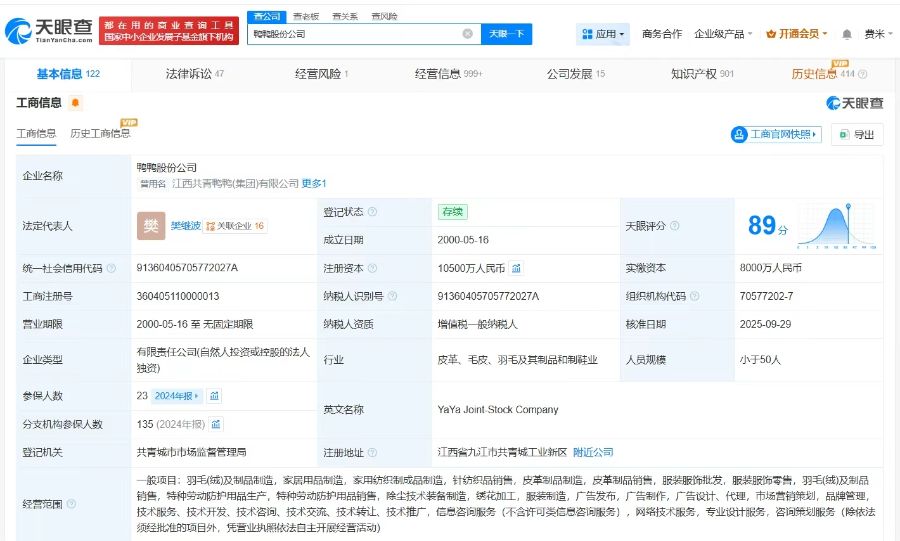
539元买的鸭鸭羽绒服疑似“双标双码”,关联公司曾被丝芭起诉
2 1 Shi Ji Jing Ji Bao Dao· 2026-01-14 03:39
| | | | 盘公司 白老板 所有 百风险 | | | | | | | | --- | --- | --- | --- | --- | --- | --- | --- | --- | --- | | | | 都在用的商业查询工具 国家中小企业发展了其全放下机构 | #236568888 | 8 | 天殿一下 | 脂 应用 · | | 商务合作 企业级产品、 文升进公安 · | ·米· | | 基本信息 122 | | 法律诉讼 47 | 经营风险 1 | 经营信息 999+ | | 公司发展 15 | 知识产权 901 | | 历史信息 414 (7) | | 对外投资 ● | | 1 2 2 5 2 | | | | | | | 2天眼查 | | 对外投资7 | | VID 对外投资(间接)30 历史对外投资7 | | | | ◎持股比例 · | 等记状态, 所属地区, | 所属行业, | ■ 导出 | | 序号 | | 被投资企业名称 | | 状态 | 成立日期÷ | 持股比例÷ | 认缴出资额; | 所属地区 | 所属行业 | | 1 | 宸虎 | 宸虎电子商务(杭州)有限公司 届 | | 存续 | 2 ...

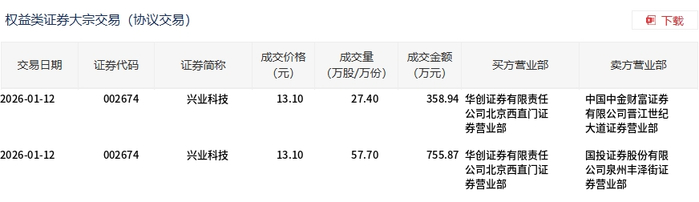
兴业科技今日大宗交易折价成交85.1万股,成交额1114.81万元
Xin Lang Cai Jing· 2026-01-12 08:59
Summary of Key Points Core Viewpoint - On January 12, 2026, Xinyi Technology executed a block trade of 851,000 shares, amounting to 11.1481 million yuan, which represented 5.77% of the total trading volume for the day. The transaction price was 13.1 yuan, reflecting a discount of 12.61% compared to the market closing price of 14.99 yuan [1]. Group 1 - The block trade involved a total of 851,000 shares at a price of 13.1 yuan per share [1]. - The total transaction value for the block trade was 11.1481 million yuan [1]. - The discount of 12.61% indicates a significant deviation from the market closing price, suggesting potential investor interest or strategic selling [1]. Group 2 - The trading date for the transaction was January 12, 2026 [2]. - The securities code for Xinyi Technology is 002674 [2]. - The transaction was facilitated by multiple brokerage firms, including Huachuang Securities and China International Capital Corporation [2].
明新旭腾:为控股子公司新增5000万元担保额度
Xin Lang Cai Jing· 2026-01-12 08:45
明新旭腾公告称,2026年1月9日,公司与宁波银行嘉兴分行签订《最高额保证合同》,为控股子公司旭 腾科技提供最高额5000万元保证担保,原3000万元担保同步失效。此次新增担保后,公司为旭腾科技担 保余额增至1亿元,净增加2000万元。截至公告日,公司及其控股子公司对外担保总额为2.45亿元,占 最近一期经审计净资产的14.65%,无逾期担保。本次担保在2024年度股东大会审议通过的额度内,被 担保对象为全资子公司,公司认为风险可控。 ...

特朗普翻出 2025 年旧账,加征印度关税,瞄准俄油,经贸博弈升级!
Sou Hu Cai Jing· 2026-01-10 22:37
Group 1 - The core issue revolves around the escalating trade tensions between the U.S. and India, driven by the Trump administration's imposition of high tariffs on Indian imports, particularly in response to India's purchase of Russian oil [1][3][6] - The U.S. has imposed a 25% tariff on Indian goods, which has increased to a total of 50% after additional punitive tariffs were added, significantly impacting various sectors in India, including textiles, leather, seafood, and gemstones [3][4] - The Indian government is responding to the tariff crisis by providing financial subsidies to exporters and encouraging businesses to explore new markets in Latin America and the Middle East, while also planning tax reforms to support small and medium enterprises [4][6] Group 2 - The U.S. has intensified sanctions against Russian oil, threatening secondary tariffs of up to 50% on countries purchasing Russian oil, which has further complicated the global energy market and increased oil price volatility [4][6] - The ongoing trade negotiations between the U.S. and India have not yielded any agreements, and the planned new round of talks has been postponed, indicating a prolonged period of trade conflict [6][7] - The current global economic landscape reflects a shift towards protectionism and unilateralism, with countries like the EU and Japan taking measures to safeguard their own interests, which may lead to a fragmented global market [6][9]
兴业科技1月9日现5笔大宗交易 总成交金额2028.18万元 其中机构买入608.53万元 溢价率为-11.00%
Xin Lang Cai Jing· 2026-01-09 09:23
Group 1 - The stock of Xingye Technology closed up by 2.25% at a price of 14.54 yuan on January 9, with a total of 5 block trades amounting to 1.5811 million shares and a total transaction value of 20.2818 million yuan [1] - The first block trade occurred at a price of 12.94 yuan for 157,000 shares, with a transaction value of 2.0316 million yuan and a discount rate of -11.00% [1] - The second block trade was executed at 12.80 yuan for 160,000 shares, totaling 2.0480 million yuan, with a discount rate of -11.97% [1] Group 2 - The third block trade was at 12.80 yuan for 300,000 shares, amounting to 3.8400 million yuan, also with a discount rate of -11.97% [1] - The fourth block trade involved 809,100 shares at a price of 12.80 yuan, totaling 10.3565 million yuan, with a discount rate of -11.97% [1] - In the last block trade, 155,000 shares were sold at 12.94 yuan, with a transaction value of 2.0057 million yuan and a discount rate of -11.00% [2] Group 3 - Over the past three months, the stock has recorded a total of 10 block trades with a cumulative transaction value of 64.1674 million yuan [2] - In the last five trading days, the stock has declined by 2.68%, with a net outflow of 37.2004 million yuan from major funds [2]
孟州市工商联:“青蓝接力”赋能民企新发展
Xin Lang Cai Jing· 2026-01-08 23:08
Core Viewpoint - The "Qinglan Relay" initiative in Mengzhou aims to cultivate a new generation of entrepreneurs, focusing on leadership and skill development, which has significantly contributed to the city's recognition as a model for private economy and investment potential [1][2] Group 1: Initiative Overview - The "Qinglan Relay" action was launched by the Mengzhou Federation of Industry and Commerce to systematically nurture young entrepreneurs, including second-generation business leaders and aspiring returnees [1] - Over half of the leaders in the 71 key enterprises being cultivated are under 50 years old, driving Mengzhou's recognition as a "provincial model city for private economy" for three consecutive years and a "national top 100 counties for investment potential" for four years [1] Group 2: Training and Support Mechanisms - The initiative includes a comprehensive training system characterized by "strong foundation, precise direction, inviting in, and going out," which involves organizing visits to red bases and offering courses in traditional culture to instill ideals in young entrepreneurs [2] - Successful older entrepreneurs are invited as "career inheritance mentors" to share experiences and guide the younger generation through various interactive formats [2] Group 3: Problem Solving and Support - The Mengzhou Federation of Industry and Commerce has addressed 52 different issues raised by enterprises, ensuring that policies benefiting businesses are well communicated and utilized [2] - Financial support includes facilitating the successful application for long-term special bonds amounting to 69.52 million yuan and assisting companies in securing 895 million yuan in financing and recruiting over 2,000 workers [2] - Additional support measures include providing talent apartments, subsidies, and assistance with children's education to help young entrepreneurs settle in Mengzhou [2]
印美关税谈判进入“决定性月份”,印度出口商焦虑
Huan Qiu Shi Bao· 2026-01-08 22:40
Group 1 - The prolonged US-India tariff negotiations are causing increasing anxiety among Indian exporters, with January being a critical month to secure trade agreements for contracts in the first half of 2026 [1] - In August 2025, the US government imposed punitive tariffs on Indian goods, raising the overall tariff rate on Indian products to 50%, significantly impacting labor-intensive sectors such as textiles, handicrafts, apparel, gems, and leather [1] - The tariffs implemented since August of last year have already harmed the order volumes for Indian exporters during the typically busy winter and Christmas seasons [1] Group 2 - Indian exporters are seeking alternative solutions, with some gemstone and jewelry companies establishing subsidiaries in the US to manage trade locally, while others are relocating parts of their manufacturing to countries like the UAE with lower tariffs [2] - Apparel suppliers are considering shifting some production to African countries, indicating a reduced reliance on US exports [2] - The Indian Embassy in Washington has hired a US lobbying firm to assist with trade negotiations and diplomatic discussions, led by former Trump advisor Jason Miller [2]
浙江自然:使用3000万元闲置募集资金购买大额存单
Xin Lang Cai Jing· 2026-01-08 10:43
Core Viewpoint - The company aims to enhance the efficiency of fund utilization by investing idle raised funds into a large-denomination certificate of deposit product with a projected annual yield of 1.55% [1] Group 1: Investment Details - The company has allocated 30 million yuan of idle raised funds to purchase the 10th phase of corporate large-denomination certificates of deposit from the Agricultural Bank of China, with a maturity period from January 7, 2026, to January 7, 2029 [1] - As of now, the company has utilized 50 million yuan of the approved 85 million yuan for cash management, leaving an unused quota of 35 million yuan [1] Group 2: Risk Management - The company acknowledges that investment in financial products carries certain risks and will implement measures to control these risks [1]

比往年更早、更猛!外贸大省组团出海今年加码
Di Yi Cai Jing· 2026-01-07 12:25
Group 1 - The Zhejiang Province's "Thousand Teams and Ten Thousand Enterprises" initiative aims to organize over 2,000 groups and support more than 20,000 companies in expanding overseas markets, targeting a goal of 100 billion yuan in intended orders [1] - In January 2026, the number of outbound groups from Zhejiang increased by nearly 20% compared to the same period in 2025, indicating a stronger push for international market engagement [1] - The leather industry in Haining is set to participate in international exhibitions, marking a strategic shift towards export, with plans to attend events in Russia, Dubai, France, Australia, and South Korea [2][3] Group 2 - The Zhejiang Province achieved over 1.8 trillion yuan in intended orders through overseas exhibitions in 2025, with total import and export values exceeding 5 trillion yuan, reflecting a 5.3% year-on-year growth [2] - The local wool sweater industry in Jiaxing plans to double the number of exhibitions attended in 2026, with exports growing by 16.63% in the first ten months of the previous year [4] - Companies are increasingly focusing on sales and compliance in international trade, moving from passive to proactive engagement in overseas markets [5] Group 3 - The textile industry is diversifying its product offerings, moving from home decor to apparel and high-end fabrics, which has led to a 20% increase in the variety of exhibitions attended [3][4] - The establishment of overseas warehouses and display centers in key markets like Moscow and Seoul is part of a strategy to enhance logistics and market reach [3] - The government is expected to play a crucial role in integrating resources and providing support to help companies navigate the challenges of international trade [5][6] Group 4 - Companies are adapting to rising operational costs by leveraging technology and innovation to improve efficiency and reduce expenses [7] - The focus on cultivating high-end talent and enhancing innovation capabilities is essential for traditional industries to remain competitive [8] - The ongoing geopolitical tensions and trade barriers are prompting companies to explore new markets while maintaining a strong presence in traditional ones [6][7]