
皮革制品

Search documents
“政策+场景”双轮驱动 海宁皮城打造春节消费新地标
Quan Jing Wang· 2026-02-09 14:08
Core Viewpoint - The 2026 Spring Festival will see a revitalization of the national consumer market, driven by the "2026 'Shopping New Year' Special Activity Plan" issued by the Ministry of Commerce and other departments, aiming to create a comprehensive consumption feast through the integration of commerce, travel, culture, sports, and health [1] Group 1: Business Strategy - Haining China Leather City is responding to the national consumption promotion call with a dual-driven strategy of "policy + scenario," showcasing resilience and innovative vitality during the Spring Festival consumption peak [1][5] - The operational plan for the Spring Festival is not a one-size-fits-all approach but a refined strategy tailored to different customer needs and business characteristics, reflecting the company's "scenario-driven" strategy [2] Group 2: Operational Details - Core retail shopping areas will have extended operating hours from the 28th day of the twelfth lunar month to the seventh day of the first lunar month, with only a slight reduction on New Year's Eve, ensuring convenient shopping throughout the holiday [2] - The new e-commerce and live streaming areas will operate year-round, with only minor adjustments during the holiday, aligning with the call to encourage online reservations and offline experiences [3] Group 3: Market Positioning - The Spring Festival strategy emphasizes the integration of cultural and tourism elements, with Haining China Leather City being recommended by travel platforms as a key destination, enhancing its appeal as a shopping and tourism hub [4] - The company is evolving from a professional procurement site to a comprehensive destination for shopping, tourism, and experiential activities, enriching the market's connotation and expanding its consumer base [4] Group 4: Long-term Strategy - The Spring Festival strategy reflects the company's long-term vision, optimizing its business structure and strategically investing in emerging sectors like healthcare and industrial services [4] - The "non-stop" operation during the Spring Festival is expected to enhance property rental value, increase merchant sales, and ultimately boost rental income, while attracting diverse customer traffic through e-commerce and varied business formats [4][5]

泪目!印度14亿人苦等20年,终于挨来欧洲的拥抱
Sou Hu Cai Jing· 2026-02-02 14:46
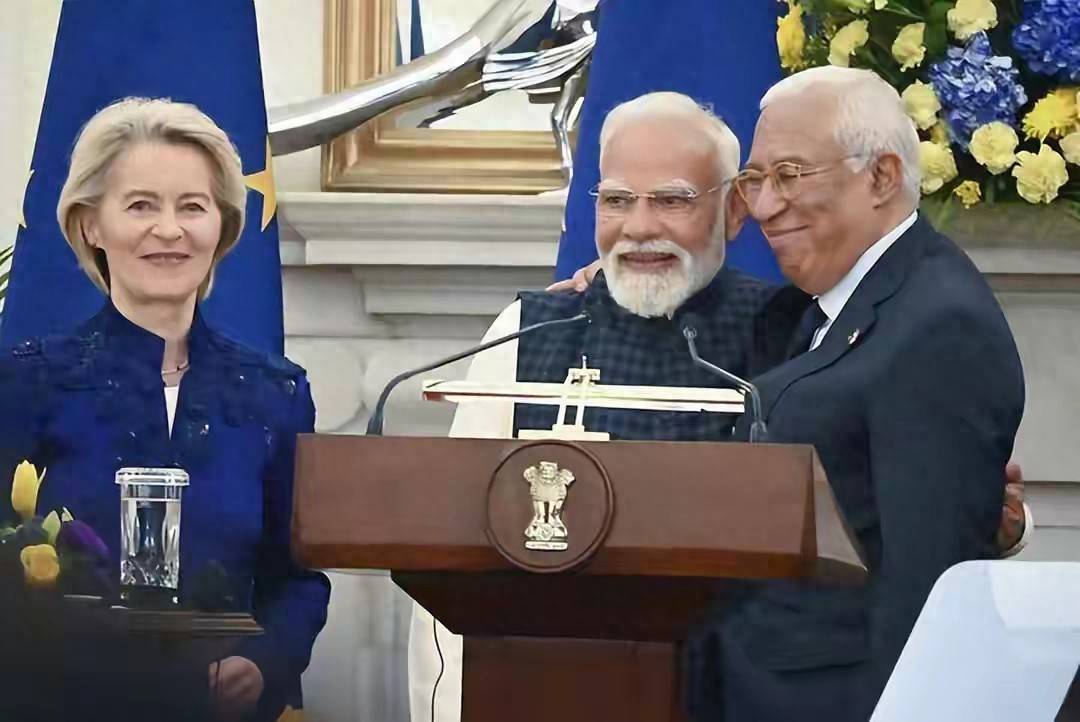
Core Insights - The signing of the free trade agreement between India and the EU marks a significant shift in global trade dynamics, creating a super trade zone that encompasses a population of 2 billion and accounts for a quarter of global GDP and a third of global trade volume [2][3]. Trade Dynamics - The agreement results in the elimination or substantial reduction of tariffs on over 90% of EU export goods, with India committing to phase out tariffs on more than 90% of EU goods within seven years [4]. - Notably, India's import tariff on European cars will be reduced from a high of 110% to 40%, with potential further reductions to 10%, facilitating access for major European automotive brands to the Indian market [4]. Labor Mobility - The agreement includes provisions for labor mobility, allowing EU member states to issue up to 100,000 multi-year work permits and at least 35,000 graduate residence permits to Indian citizens over the next five years [5][8]. Historical Context - The negotiation process for the free trade agreement spanned nearly 20 years, beginning in 2007, and faced significant challenges, particularly in areas such as automobiles and agriculture, leading to a nine-year stalemate [9][10]. - The negotiations were revitalized in 2022, influenced by external pressures, particularly from U.S. trade policies under the Trump administration, which prompted both India and the EU to seek closer cooperation [12]. Strategic Considerations - The cooperation between India and the EU extends beyond trade and labor mobility, encompassing security and defense partnerships aimed at enhancing strategic autonomy and balancing regional influences, particularly concerning China [13][16]. - The agreement is viewed as a strategic choice for both parties, driven by mutual interests and geopolitical considerations, potentially reshaping the global trade landscape and fostering new opportunities for both populations [15].

欧盟与印度达成“终极贸易协定” 欧股上涨
证券时报· 2026-01-27 15:10
Core Points - The article discusses the landmark trade agreement signed between the EU and India, which is expected to create a free trade area covering 2 billion people and significantly boost economic development for both parties [1] Group 1: Agreement Highlights - The agreement includes substantial tariff reductions and breakthroughs in market access, with nearly 97% of EU export products receiving tariff reductions or exemptions from India, potentially saving European companies up to €4 billion annually in tariff costs [3] - Key tariff reductions include a decrease in India's automotive tariffs from 110% to 10%, wine tariffs from 150% to 20%, and the complete elimination of tariffs on processed foods like pasta and chocolate [3] - In return, Indian industries such as textiles, jewelry, and leather will gain broader market access in the EU, with European companies receiving privileged access in sectors like financial services and maritime logistics [3] Group 2: Trade and Economic Impact - The EU-India bilateral trade in goods reached €120 billion in 2024, a nearly 90% increase over the past decade, with service trade adding an additional €60 billion [5] - The agreement is expected to double EU exports to India and provide critical support for India's infrastructure upgrades and job creation, with the EU being a significant source of technology and investment [5] Group 3: Strategic Cooperation - The trade agreement represents a strategic partnership between the EU and India, showcasing an alternative to a fragmented global landscape, with plans for additional agreements to facilitate the movement of seasonal workers, students, and skilled professionals, as well as enhance security and defense cooperation [8] - The collaboration aligns with the EU's goal to reduce dependence on the US and India's aim to diversify its military imports away from Russia, thus enhancing both parties' autonomy [8] Group 4: Next Steps - The core negotiations of the agreement have been completed, and it will now enter the internal approval process for both parties, with expectations for it to be implemented in the near term [9]

达威股份(300535.SZ):没有直接和比亚迪建立供应链或项目合作
Ge Long Hui· 2026-01-16 07:06
Group 1 - The core viewpoint of the article highlights that Davi Co., Ltd. has over 400 leather chemicals certified by the ZDHC initiative, which is a global environmental initiative launched by several well-known brands and retailers [1] - The industry has various strengths and weaknesses in product processes, customer structures, and regional layouts, making it difficult to determine a clear leader among companies [1] - The company acts as an indirect supplier to automotive enterprises, providing leather products and automotive interior materials to well-known domestic and international car manufacturers, and does not have a direct supply chain or project cooperation with BYD [1]


关税压力下,印度预计2026财年经济增长仍达7.4%
Hua Er Jie Jian Wen· 2026-01-07 16:17
Group 1 - The Indian government expects the economy to grow over 7% this fiscal year, maintaining its position as one of the fastest-growing major economies globally [1] - The GDP is projected to grow by 7.4% for the fiscal year ending in March, slightly below the economists' median forecast of 7.5% [1] - The nominal GDP is expected to reach approximately 357.14 trillion rupees (4 trillion USD) [1] Group 2 - Concerns arise among economists regarding the nominal GDP growth being lower than expected, indicating potential pressure on the government to cut spending to meet deficit targets [1] - The high tariffs imposed by the U.S. on Indian exports, particularly a 50% tariff on certain goods, are creating uncertainty in the economic outlook [1][2] - The labor-intensive export sectors in India, such as textiles, gems, and leather products, have been significantly impacted by these tariffs [2]
安徽万邦达新材料科技有限责任公司成立
Zheng Quan Ri Bao Wang· 2026-01-06 13:49
Group 1 - The core point of the article is the establishment of Anhui Wanbangda New Materials Technology Co., Ltd. with a registered capital of 100 million yuan [1] - The company's business scope includes new material technology promotion services, leather product manufacturing and sales, automotive decorative products manufacturing and sales, and automotive parts and accessories manufacturing [1] - The shareholders of the company are Wanbangda holding 90% and Wuhu Chery Technology Co., Ltd. holding 10% [1]

万邦达、奇瑞汽车合资公司登记成立 注册资本1亿
Xin Lang Cai Jing· 2026-01-05 01:58
Group 1 - The core point of the article is the establishment of Anhui Wanbangda New Materials Technology Co., Ltd., which aims to promote new material technology and manufacture automotive interior products [1] - The company has a registered capital of 100 million RMB and is co-owned by Wanbangda (90%) and Wuhu Chery Technology Co., Ltd. (10%) [1] - Wanbangda announced a joint investment with Wuhu Chery Technology to establish a joint venture for a project with a total investment of 1 billion RMB focused on environmental new materials for automotive interiors [1]
1500亿亏空!工厂停工、每天损失6个亿,印度人哭求莫迪早日投美
Sou Hu Cai Jing· 2025-12-24 15:42
Core Viewpoint - The imposition of a 50% punitive tariff by the U.S. on Indian goods has severely impacted India's manufacturing sector, leading to significant job losses and economic downturns across various industries, including textiles, seafood, and gemstones [1][3][5]. Group 1: Textile Industry - The textile manufacturing hub of Tirupur, employing over 600,000 workers, has seen a 25% drop in production, with many workers facing reduced hours and wages due to the tariff [3]. - The Tamil Nadu region has lost orders worth 150 billion rupees, with daily losses nearing 6 billion rupees [1]. Group 2: Seafood Industry - India's seafood exports, which account for one-third of its total seafood market, have experienced a 30% to 35% year-on-year decline since the tariff's implementation, leading to factory shutdowns in major shrimp-producing areas [3][5]. - The demand from U.S. buyers has diminished significantly, affecting over 5 million jobs directly and indirectly in the seafood sector [3]. Group 3: Gemstone and Jewelry Industry - The U.S. is the largest market for Indian gemstones and jewelry, with exports reaching $9.23 billion in the 2024-2025 fiscal year, representing nearly one-third of the total exports in this sector [5]. - The tariff could jeopardize the jobs of 170,000 skilled workers in the diamond cutting and polishing industry, leading to increased prices for consumers in the U.S. [5]. Group 4: Economic Impact - The Indian rupee has depreciated over 6% against the dollar, with the currency falling below the 91 mark, making it one of the worst-performing currencies in Asia [9]. - Foreign direct investment in India has plummeted to $35.3 million in the 2024-2025 fiscal year, a stark decline from previous years [9]. Group 5: Government Response - The Indian government has suspended import tariffs on certain raw materials and is accelerating trade negotiations with other countries to diversify export markets [12]. - Despite these measures, the manufacturing sector continues to face immense pressure, with many foreign companies reconsidering their operations in India due to an unstable business environment [14].
三门峡逸朝跨境电子商务有限责任公司成立 注册资本1万人民币
Sou Hu Cai Jing· 2025-12-18 05:31
Group 1 - The company Sanmenxia Yizhao Cross-Border E-Commerce Co., Ltd. has been established with a registered capital of 10,000 RMB [1] - The legal representative of the company is Ye Zhaohui [1] - The business scope includes internet sales (excluding items that require permits), manufacturing of adult products (excluding pharmaceuticals and medical devices), and sales of bags, leather products, daily miscellaneous goods, and daily necessities [1]
南城县利宏皮革制品有限公司成立 注册资本5万人民币
Sou Hu Cai Jing· 2025-12-18 00:36
Group 1 - A new company, Nancheng Lihong Leather Products Co., Ltd., has been established with a registered capital of 50,000 RMB [1] - The legal representative of the company is Zheng Xiaowen [1] - The business scope includes manufacturing and sales of leather products, bags, and various electronic and communication devices [1] Group 2 - The company is also involved in internet sales and the repair of communication equipment [1] - The operations are conducted under the business license without the need for additional approvals for most activities [1]