私募

Search documents
“星耀领航计划”走进因诺资产 解码量化私募的科创赋能与责任担当
Zhong Guo Zheng Quan Bao· 2025-11-06 00:39
深耕科技沃土 在量化投资领域,科技能力是毋庸置疑的"护城河"。因诺资产自创立以来,将科技创新刻入发展基因, 构建了一套兼具实用性与前瞻性的科技投入体系。徐书楠在接受中国证券报记者专访时介绍,公司的科 技战略清晰地区分为硬件与软件两大板块。 近日,"中国银河证券·中国证券报私募行业星耀领航计划"调研团队走进国内知名量化私募机构上海因 诺资产管理有限公司,与公司创始人、总经理兼投资总监徐书楠进行深度对话。 本次调研围绕量化投资的科技内核、私募与科创企业的双向赋能路径以及企业的社会责任实践等问题展 开,共同探讨量化私募在推动科技金融落地、服务实体经济高质量发展中的独特价值与模式。作为以科 技为驱动的资产管理机构,因诺资产的实践为行业提供了"硬科技赋能投资、软实力回馈社会"的鲜活样 本。 "星耀领航计划"不仅关注机构的科创能力,同样重视其守正发展的社会责任担当。在这一维度,因诺资 产形成了从本职坚守到公益回馈的完整实践体系。 徐书楠表示,履行社会责任的首要前提是做好本职工作。这意味着公司必须坚持合法合规运营,为投资 者创造持续、稳健的价值回报。在此基础上,因诺资产积极贡献自身的专业力量,配合监管部门进行课 题研究、行 ...
十佳私募创始人业绩揭晓!但斌第1!海之源梁勇、海南盛丰林子洋上榜!
私募排排网· 2025-11-04 03:43
Core Insights - The article highlights the performance of top private equity founders in the past six months, showcasing their investment strategies and product performance [2][4]. Group 1: Performance Overview - As of October 24, 2025, 25 private equity founders had over 10 products each that met ranking criteria, with a total of 432 products and a combined scale of approximately 71.11 billion yuan, achieving an average return of 22.86% [2]. - The top 10 private equity founders based on performance include: Dan Bin from Dongfang Gangwan, Wang Wen from Rido Investment, Xie Xiaoyang from Tianyan Capital, Gao Simeng from Jukuan Investment, Liang Yong from Haiziyuan Investment, Zhu Xiaokang from Longqi Technology, Liang Hong from Hainan Xiwa, Zou Yitian from Heiyi Asset, Lin Ziyang from Hainan Shengfeng Private Equity, and Gao Kang from Yanfu Investment [2][3]. Group 2: Individual Founder Insights - **Dongfang Gangwan (Dan Bin)**: Managed 69 products with a total scale of approximately 10.02 billion yuan, achieving an average return of ***% in the past six months, leading the rankings [5][7]. - **Rido Investment (Wang Wen)**: Managed 18 products with a total scale of approximately 13.68 billion yuan, with most products achieving returns above ***%, ranking second [8][9]. - **Tianyan Capital (Xie Xiaoyang)**: Managed 12 products with a total scale of approximately 2.25 billion yuan, primarily focusing on quantitative stock selection, with returns above ***% [10]. - **Jukuan Investment (Gao Simeng)**: Managed 42 products with a total scale of approximately 3.38 billion yuan, achieving an average return of ***% [11]. - **Haiziyuan Investment (Liang Yong)**: Managed 11 products with a total scale of approximately 1.27 billion yuan, ranking fifth with an average return of ***% [13]. - **Longqi Technology (Zhu Xiaokang)**: Managed 16 products with a total scale of approximately 2.66 billion yuan, achieving an average return of ***% [16]. - **Hainan Xiwa (Liang Hong)**: Managed 23 products with a total scale of approximately 4.51 billion yuan, with most products achieving returns above ***% [18]. - **Heiyi Asset (Zou Yitian)**: Managed 19 products with a total scale of approximately 2.36 billion yuan, achieving an average return of ***% [20]. - **Hainan Shengfeng Private Equity (Lin Ziyang)**: Managed 12 products with a total scale of approximately 2.33 billion yuan, ranking ninth with an average return of ***% [24].


又一家新晋百亿量化私募!业绩Top10,自营起家,深耕中低频 | 私募深观察
私募排排网· 2025-11-03 03:33
Core Viewpoint - The article focuses on the investment management firm Square and Investment, highlighting its strong performance in the quantitative hedge fund sector and its commitment to research-driven investment strategies [2][6]. Company Overview - Square and Investment Management Partnership (Limited Partnership) is a registered quantitative hedge fund company established in August 2015, recognized with over 70 prestigious awards [6]. - As of October 2025, the firm has surpassed a management scale of 10 billion [2]. Investment Strategy and Team - The company adheres to a core value of "research-driven excellence," with a team composed of experienced fund managers and senior quantitative researchers, each with over 15 years of industry experience [8][10]. - Square and Investment employs a combination of mathematics, statistics, computer science, and finance to develop quantitative hedge fund strategy models aimed at delivering stable long-term performance across different market cycles [8]. Core Strategies and Representative Products - The market-neutral strategy aims to achieve excess returns (alpha) independent of market movements by employing a long-short equity approach [12]. - The firm offers various products, including the Square and Smart Growth No. 1 Private Securities Investment Fund, which focuses on maintaining low correlation with market indices and achieving stable excess returns [14][16]. - The Square and Enhanced Index No. 9 Securities Investment Fund aims to closely track indices while generating potential excess returns through quantitative models [20]. Research and Risk Management - The strategy framework has evolved through localization and continuous iteration, adapting to market changes while maintaining core principles [26]. - The risk management system encompasses pre-trade, intra-trade, and post-trade controls, ensuring comprehensive risk oversight [31][32]. Competitive Advantages - Square and Investment's strategies have demonstrated resilience over a decade, effectively navigating various market conditions [43][44]. - The firm combines traditional and cutting-edge technologies to continuously refine its strategies, ensuring they remain relevant and effective [46]. - The investment team is composed of elite professionals from prestigious institutions, contributing to a robust research and investment culture [47]. Future Development Plans - The company is implementing its "third five-year plan" to balance research and operational efficiency while ensuring growth aligns with strategy capacity [51]. - Plans include expanding data sources, enhancing factor evaluation systems, and developing new model structures to improve service customization [52][54]. - The talent strategy focuses on attracting industry experts and establishing a comprehensive training system to support growth and innovation [55].

高毅、九坤等35家百亿私募A股持仓出炉,44股涨超50%!邓晓峰重仓股涨超9倍!
私募排排网· 2025-11-01 03:05
Core Viewpoint - The article analyzes the latest A-share holdings of major private equity firms in China, highlighting their investment preferences and market performance as of the end of Q3 2025. Group 1: Overview of Holdings - As of October 31, 2025, 35 private equity firms held a total market value of approximately 718.57 billion yuan in A-shares, with notable firms like Gao Yi and Guo Feng Xing Hua each holding around 230 billion yuan [2][3]. - Among these firms, 18 increased their positions, while 34 reduced their holdings, indicating a preference for long-term investments [2][3]. Group 2: Performance of Major Private Equity Firms - Gao Yi Asset and Guo Feng Xing Hua are the only firms with holdings exceeding 230 billion yuan, while firms like Xuan Yuan Investment and A Ba Ma Investment also showed significant holdings [3][4]. - The average increase in the stock prices of the top holdings by these private equity firms was 26.68%, outperforming the Shanghai Composite Index during the same period [3][4]. Group 3: Notable Stock Performances - A total of 44 stocks held by these private equity firms saw price increases exceeding 50%, with significant contributions from the machinery and electronics sectors [5]. - ST Zhen Tong, heavily invested by A Ba Ma Investment and Xuan Yuan Investment, experienced a remarkable price increase of over 139% in the first three quarters [5]. Group 4: Specific Holdings and Changes - Gao Yi Asset's top holdings include Hikvision and Zijin Mining, with the latter seeing a price increase of over 99% in the first three quarters of 2025 [10][12]. - Xuan Yuan Investment's largest holding is Dongfang Shenghong, with a market value nearing 1.4 billion yuan and a price increase of approximately 16% [14]. Group 5: Investment Strategies - The investment strategies of these private equity firms vary, with 18 firms employing subjective strategies, 11 using quantitative methods, and 4 adopting a combination of both [3][4]. - A Ba Ma Investment, known for its quantitative approach, has shown strong performance, with its holdings primarily in the machinery and electronics sectors [18][19].



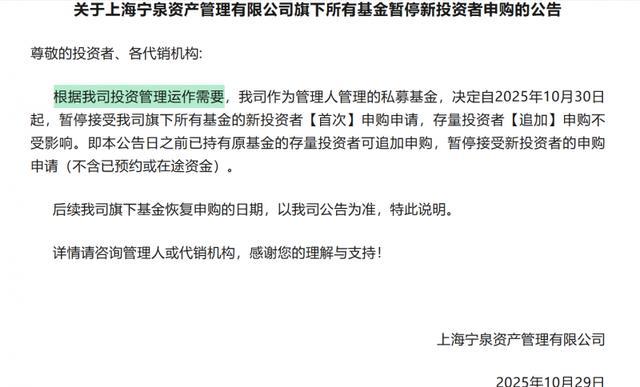
4000点关口百亿级私募“闭门”:宁泉资产“封盘”背后的冷静信号
Hua Xia Shi Bao· 2025-10-31 11:15
Core Viewpoint - Ningquan Asset's decision to suspend new investor subscriptions amid the A-share market reaching the 4000-point milestone reflects a cautious approach to investment management, prioritizing the interests of existing investors over expansion [2][3][4]. Group 1: Company Actions - On October 29, Ningquan Asset announced it would suspend new investor subscriptions starting October 30, allowing only existing investors to add to their holdings [2][3]. - The firm emphasized that this decision was made for the needs of investment management operations, without specifying a timeline for reopening subscriptions [4][5]. Group 2: Market Context - The Shanghai Composite Index closed at 4016.33 points, marking a significant moment as it reached this level for the third time in history [3][8]. - The current market environment is characterized by a mix of new growth opportunities in sectors like technology and traditional industries seeking recovery, indicating a complex landscape for investors [7]. Group 3: Industry Insights - The decision to "close the door" to new investments is seen as a responsible move by private equity firms during periods of market exuberance, aimed at controlling management scale and protecting existing investors' interests [4][5]. - Industry experts interpret this action as a sign of professional risk awareness, suggesting that firms are prioritizing long-term stability over short-term growth [6][8].
深圳量化私募地图曝光!新晋百亿量化大道投资、超量子基金在列!
私募排排网· 2025-10-31 10:00
Core Viewpoint - Shenzhen has become a significant hub for quantitative private equity, with a total of 125 firms and an average return of 24.43% in the first three quarters of the year [2]. Group 1: Overview of Quantitative Private Equity in Shenzhen - Shenzhen is one of China's four first-tier cities and a frontier for opening up, attracting world-class financial, professional services, and technology companies [2]. - The city has a solid policy and industrial foundation for the development of quantitative private equity [2]. Group 2: Distribution of Quantitative Private Equity Firms - The majority of quantitative private equity firms are located in Futian District (59 firms) and Nanshan District (53 firms), accounting for nearly 90% of the total [4]. - Futian District is identified as the traditional financial center, while Nanshan is recognized as the technology center of Shenzhen [4]. Group 3: Top Firms in Futian District - The leading firms in Futian District include Chao Quantum Fund and Chengqi Asset, both managing over 10 billion [7]. - The top firms in terms of employee count include Youmeili Investment, Chao Quantum Fund, and Qianhai Guoen Capital, each with over 30 employees [7]. Group 4: Performance of Top Firms - Chengqi Asset achieved the highest average return among its products, with a management scale of over 100 billion [9]. - Chao Quantum Fund, established in 2015, focuses on stock quantitative strategies and has also reached a management scale of over 100 billion [10]. Group 5: Overview of Nanshan District - In Nanshan District, the top firms include Hanrong Investment and Dadao Investment, with the latter being a newly established firm managing over 100 billion [11][14]. - The firms in Nanshan are also characterized by a strong focus on quantitative strategies and advanced technology [11]. Group 6: Performance of Top Firms in Nanshan - Hanrong Investment leads in performance with an average return from its products, while Dadao Investment has also shown strong results since its establishment [13][14]. - The firms in Nanshan are noted for their innovative approaches, including the use of machine learning and advanced statistical methods [13]. Group 7: Other Districts - Other districts such as Longgang, Luohu, Baoan, and Yantian collectively host 13 small-scale quantitative private equity firms, all managing between 0-5 billion [15]. - These firms primarily focus on niche strategies and have smaller employee counts compared to those in Futian and Nanshan [15].

当下真的是买量化的好时点吗?
雪球· 2025-10-31 08:19
Core Viewpoint - The current market conditions suggest that the A-share market may be entering a bullish phase, with the 4000-point level on the Shanghai Composite Index being a significant milestone for potential upward movement [4][10]. Private Equity Market - Recent trends indicate a recovery in quantitative strategies within the private equity market, with various strategies such as index enhancement and small-cap index enhancement showing strong performance due to favorable market conditions [7][9]. - The market has shifted towards a more balanced and rotational rhythm, alleviating previous concentrated investments in technology stocks, which is conducive for quantitative strategies to identify excess returns [8]. - Small-cap stocks, previously under pressure, are becoming more active, providing opportunities for quantitative strategies to accumulate excess returns [8]. Investment Strategy - Investors holding quantitative strategies are encouraged to maintain patience and confidence, while those observing the market may find this a valuable window for investment [9]. - Concerns exist regarding the challenges of further upward movement beyond the 4000-point mark, as well as uncertainties in the market environment for quantitative excess return extraction [10]. - A shift in investment approach from timing to allocation is suggested, emphasizing the importance of diversified asset allocation to mitigate risks and enhance returns [11]. Strategy Performance - A specific quantitative strategy has demonstrated resilience during market downturns, maintaining stable performance through a diversified approach that includes equities, convertible bonds, and cash management [13]. - The strategy's success is attributed to its multi-asset allocation, which balances risks and smooths overall volatility, as well as its focus on undervalued assets to enhance safety margins and potential returns [14][15]. - The multi-strategy approach allows for adaptability to market changes, with various sub-strategies catering to different market conditions, thereby improving the overall risk-return profile [14]. Conclusion - The improvement in market conditions has brought quantitative strategies back into focus, presenting a favorable time for investment consideration. Multi-asset strategies centered on quantitative equity may provide a more secure investment avenue amidst market uncertainties [16].

百亿私募巨头,暂停新客申购
2 1 Shi Ji Jing Ji Bao Dao· 2025-10-30 12:35
Core Viewpoint - The A-share market continues to show strong fluctuations, with the Shanghai Composite Index closing at 4016.33 points, marking a nearly ten-year high, but concerns arise as Ningquan Asset announces a suspension of new client subscriptions for all its funds starting October 30, 2025, signaling caution in a potentially overheated market [1][3][12]. Market Performance - The Shanghai Composite Index reached 4016.33 points, the third time it has closed above 4000 points in history, following similar peaks in May 2007 and April 2015 [1]. - Ningquan Asset's management scale exceeded 450 billion yuan as of September, positioning it among the top tier of domestic stock private equity firms [3]. Ningquan Asset's Strategy - Ningquan Asset's decision to limit new subscriptions is interpreted as a prudent signal amid market overheating, with the firm emphasizing that "scale is the enemy of performance" [3][12]. - The firm has a total of 27 employees, with 19 in the investment research team, focusing on sectors like new energy, TMT, semiconductors, pharmaceuticals, and consumer finance [3]. Investment Philosophy - Ningquan Asset adopts a "farming-style" investment approach, seeking stable returns over time rather than chasing high-risk opportunities [6][7]. - The firm primarily invests in high-dividend, stable businesses, viewing them as a "stabilizing force" during market volatility [7]. Portfolio Management - As of August, Ningquan Asset maintained a stock position of over 70% in its flagship product, with a diversified industry allocation, including real estate, basic chemicals, and electric power [9]. - The firm has actively increased its holdings in Hong Kong stocks, including major companies like Vanke and Country Garden [9]. Market Sentiment and Trends - The private equity sector is experiencing a wave of subscription limits, with several firms, including quantitative leaders, taking similar actions to manage growth and performance [12]. - Ningquan Asset's caution reflects broader market concerns about structural bubbles in certain sectors, while still identifying valuable investment opportunities [13]. Future Outlook - Different private equity firms exhibit varied outlooks on the A-share market, with some expressing optimism for a "slow bull" market, while others remain cautious due to economic uncertainties [15][16]. - The investment community is closely monitoring the potential for structural shifts in market preferences, particularly towards low-valued cyclical assets as economic conditions evolve [16][17].
百亿私募主动“封盘”再添一例,宁泉资产暂拒新客,原因何在?
Xin Lang Cai Jing· 2025-10-30 12:20
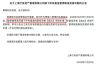
Core Viewpoint - Ningquan Asset, a well-known private equity firm, announced it will suspend new investor subscriptions for all its funds starting October 30, 2025, while existing investors can still make additional subscriptions. This move has raised concerns about potential market risks and bearish signals due to the firm's history of accurately predicting market trends [1][2]. Company Summary - Ningquan Asset was founded by Yang Dong in January 2018 and has seen its managed assets exceed 40 billion yuan as of the end of Q1 this year [1]. - Yang Dong has a notable background in investment management, having previously held senior positions at Industrial Securities and Xincheng Fund, and is recognized for his accurate market risk warnings in 2007 and 2015 [1]. - The firm has registered nine new products this year, with the latest being "Ningquan Xinxing No. 4," established on September 24 [2]. Market Analysis - Industry insiders suggest that the decision to "close the fund" may reflect a cautious outlook on future market conditions or a need to manage the rapid growth of assets under management [2]. - Despite the suspension of new subscriptions, Ningquan Asset's latest monthly report indicates that while some market bubbles are evident, the firm does not chase hot stocks and holds a significant amount of "old" stocks, suggesting that there are still valuable investment opportunities available [2]. Holdings Overview - As of October 30, Ningquan Asset's products were among the top ten shareholders in five companies that disclosed their Q3 reports, with a total market value of approximately 378 million yuan [3]. - The firm increased its holdings in Zhuhai Ming Technology by 657,210 shares and became the eighth largest shareholder in Fuanna with 605,120 shares [3][4]. Industry Context - Several other large private equity firms have also chosen to control their fundraising pace this year, indicating a broader trend in the industry [5]. - The overall performance of the A-share market remains strong, with the Shanghai Composite Index recently surpassing 4,000 points, despite the "closing" actions of these private equity firms [6].

百亿私募巨头,暂停新客申购
21世纪经济报道· 2025-10-30 11:35
Core Viewpoint - The A-share market has shown strong performance, with the Shanghai Composite Index closing at 4016.33 points, marking a near ten-year high, but concerns about market overheating have emerged, particularly highlighted by Ningquan Asset's decision to halt new client subscriptions for all its funds starting October 30, 2025 [1][3][11]. Market Conditions - The rapid rise in market temperatures has led to visible bubbles in certain hot sectors and stocks, prompting Ningquan Asset to issue a cautious signal [3][12]. - Ningquan Asset's management scale has exceeded 45 billion yuan, positioning it among the top tier of domestic stock private equity firms [3]. Ningquan Asset's Strategy - Ningquan Asset's investment philosophy is characterized as "farming-style," focusing on stable, high-dividend assets rather than chasing high-risk, high-reward opportunities [6][10]. - The firm has maintained a diversified portfolio, with significant holdings in real estate, basic chemicals, and electric power sectors, reflecting a conservative approach to investment [9][10]. Industry Trends - A trend of limiting subscriptions has been observed across the asset management industry, with several private equity firms taking similar actions to balance growth and performance [11][12]. - The market is experiencing a shift in investment focus, with some firms expressing optimism about structural opportunities despite overall market caution [15][17]. Future Outlook - Some institutions are optimistic about a "slow bull" market, while others remain cautious, emphasizing the need for earnings support for further market growth [15][17]. - The investment landscape is evolving, with firms adjusting their portfolios in response to changing market conditions and potential economic recovery [18].