
Semiconductor

Search documents
研报掘金丨群益证券(香港):予通富微电“买进”评级,AMD获Meta大单,公司间接受益
Xin Lang Cai Jing· 2026-02-26 06:16
Core Insights - Meta and AMD have announced a collaboration to deploy a total of 6,000 megawatts of AMD chips (MI450), which is expected to generate over $100 billion in revenue for AMD in the coming years [1] Group 1: Company Impact - Tongfu Microelectronics, as AMD's core packaging and testing manufacturer, is expected to benefit significantly from the increased business scale with major clients, leading to a 5% upward revision in profit forecasts for 2027 [1] - The total order value from this collaboration is anticipated to exceed $100 billion, positively impacting Tongfu Microelectronics [1] - Tongfu Microelectronics has stakes of 15% in AMD's Penang and Suzhou factories, which will contribute to increased revenue for the company [1] Group 2: Strategic Opportunities - Through a private placement, the company aims to seize strategic opportunities in AI and domestic substitution, further enhancing its influence in the packaging and testing sector [1] - The long-term outlook for the company remains positive due to these developments [1] Group 3: Valuation Metrics - The current stock price corresponds to a price-to-earnings (PE) ratio of 40 times for 2026 and 26 times for 2027, with a "buy" rating recommended [1]


美国砸5万亿搞AI,中国却靠“省钱”逆袭?2026年格局定了
Sou Hu Cai Jing· 2026-02-26 03:46
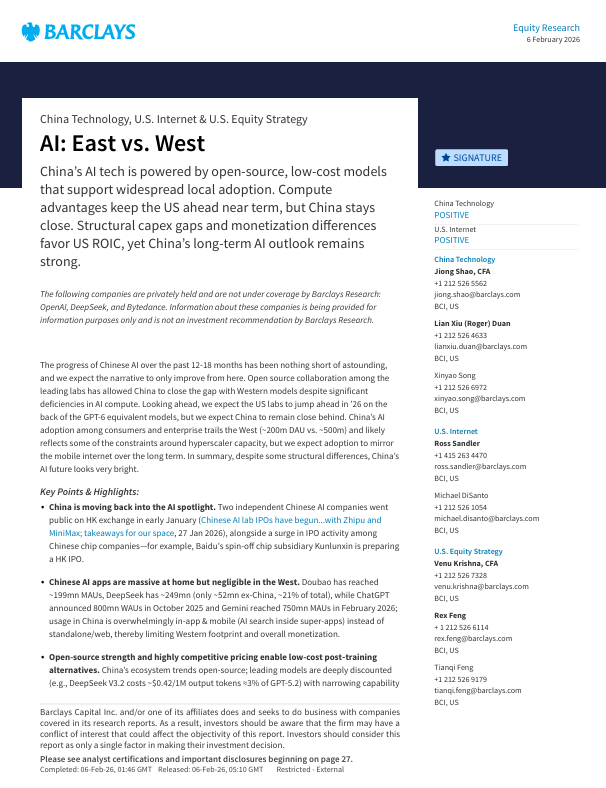
Core Insights - The report from Barclays titled "AI: East vs. West" analyzes the competitive landscape of AI between the US and China, highlighting that the US currently leads due to its financial resources and early advantages, while China is rapidly catching up with its cost-effective and highly applicable AI solutions [1][4]. Market Status - The AI market is experiencing a dichotomy where the US is "on fire" with soaring valuations and performance, while China is "recovering" from previous downturns, particularly in the tech sector [3][11]. - The S&P 500's forward P/E ratio has expanded from 15.3x at the end of 2022 to 21.7x, driven largely by AI advancements [13][56]. Competitive Dynamics - The report categorizes the AI industry into three layers: Application, Model, and Compute, with distinct strategies from both countries in each layer [1][12]. - In the application layer, US AI applications have a broader global reach, while Chinese applications are predominantly domestic, with DeepSeek and Doubao leading in user numbers but lacking significant overseas penetration [10][40]. - The model layer shows that Chinese companies are adopting an open-source approach, significantly reducing costs, with DeepSeek's latest model priced at approximately 3% of GPT-5.2's cost, while US companies maintain a more closed, proprietary model strategy [3][10][49]. - In the compute layer, US tech giants are expected to spend over $500 billion in capital expenditures, significantly outpacing Chinese firms, which are constrained by access to high-end chips [3][29][38]. Investment Implications - The competition between the US and China in AI is expected to lead to more affordable and accessible AI applications for consumers, benefiting the overall market [2][4]. - Chinese AI is no longer viewed merely as a "follower" but is demonstrating unique strengths in application deployment and cost management, indicating a shift in the competitive narrative [2][4]. Future Outlook - The report suggests that while the US may maintain a short-term lead in AI capabilities, China's long-term outlook remains strong due to its innovative approaches and large domestic market [4][5]. - The ongoing competition is likely to evolve from a focus on technological superiority to one centered on practical applications that can transform everyday life and work [2][4].

申万宏源五家被投企业荣登“投中榜·2025年度锐公司榜单”
申万宏源证券上海北京西路营业部· 2026-02-26 02:25
Core Viewpoint - The "2025 Annual Sharp Company List" has been officially released, highlighting five companies backed by Shenwan Hongyuan Group that excel in cutting-edge fields such as artificial intelligence computing power, embodied intelligent robots, commercial aerospace, and semiconductors [1]. Group 1: Company Highlights - Jita Semiconductor, established in 2017, focuses on semiconductor manufacturing and has completed E-round financing [2]. - Aurora Starlink, founded in 2020, specializes in commercial aerospace and has secured A+ round financing [2]. - Wuwen Xinqiong, a 2023 startup in artificial intelligence, has also completed A+ round financing [2]. - Star Motion Era, another 2023 company in embodied intelligence, has completed A+ round financing [2]. - Galaxy General Robotics, focusing on embodied intelligent robots, has completed B+ round financing [2]. Group 2: Financing Achievements - Jita Semiconductor achieved nearly 500 million RMB in A round financing in 2025, setting a record for domestic AI infrastructure startups [3]. - Galaxy General Robotics completed 1.1 billion RMB in B round financing and over 300 million USD in B+ round financing in 2025, reaching a valuation of approximately 30 billion RMB [4]. - Star Motion Era secured nearly 1 billion RMB in A+ round financing in November 2025, with a post-financing valuation of nearly 4 billion RMB [5]. - Aurora Starlink completed nearly 300 million RMB in A4 round financing in early 2026, supported by national industrial funds and market capital [6]. Group 3: Strategic Insights - The collective recognition of these five companies underscores their strong technological capabilities, innovation potential, and growth prospects, affirming Shenwan Hongyuan Group's strategic focus on hard technology sectors aligned with national innovation strategies [7]. - The companies are driving high-quality industrial development through technological breakthroughs and innovative business models [7]. - Shenwan Hongyuan Group aims to continue fostering "new productive forces" and contribute to national technological innovation by implementing its "research + investment + investment banking" strategy [7].



一家AI芯片初创公司:不搞ASIC,用FPGA
半导体行业观察· 2026-02-26 01:30
Core Insights - ElastixAI, an AI hardware startup based in Seattle, has launched an FPGA-based inference platform that claims to reduce total cost of ownership by up to 50 times and power consumption by 80% compared to Nvidia GPU deployments [2] - The company completed a $18 million seed funding round led by Fuse VC in May 2025, with plans to ship its Elastix Rack product by mid-2026 [2] Group 1: AI Training vs. Inference - The core argument is that GPUs are designed for compute-intensive workloads like LLM training, but their efficiency drops significantly for memory-intensive workloads such as LLM inference, leading to low utilization rates [3] - Rastegari emphasizes that training relies heavily on computation, while inference relies on memory [3] Group 2: Hardware Limitations - The inflexibility of hardware exacerbates the issue, as operators must build software kernels around GPUs like the H100, which can only utilize about 10% of their potential [5] - ElastixAI focuses on metrics that impact total cost of ownership, such as cost per bandwidth and cost per capacity, leveraging low-cost hardware to maximize performance [5] Group 3: FPGA vs. Custom Chips - FPGAs are preferred over custom chips due to the rapid pace of machine learning development, which can outstrip the chip development cycle [7] - Rastegari notes that custom chips take over three years to design and produce, while FPGAs can be reconfigured to meet changing demands [7] Group 4: Performance Metrics - Naderiparizi states that ElastixAI can achieve performance improvements of 10 to 50 times in cost compared to Nvidia's B200, depending on user latency requirements [9] - Power consumption is also significantly lower, with a fivefold reduction in power per token at the same throughput [9] Group 5: Integration and Market Strategy - Integration is achieved through the vLLM plugin, which replaces Nvidia's CUDA backend while maintaining compatibility with OpenAI's API, allowing for seamless migration from GPU infrastructure [11] - ElastixAI plans to open its model conversion tools to machine learning researchers, aiming to create a developer ecosystem similar to Nvidia's CUDA [11] Group 6: Market Readiness - Currently, ElastixAI is only available to select enterprise partners and data center operators, with hardware shipments expected to begin in mid-2026 [12]

Chip titan Nvidia posts record $68B in sales in latest quarter despite AI bubble worries
New York Post· 2026-02-25 23:48
Group 1 - Nvidia reported $68 billion in sales for its fiscal fourth quarter, a 20% increase that surpassed analyst expectations, indicating strong demand in the computing sector [1][3] - The company's net income reached $43 billion, reflecting a 35% year-over-year growth [2][7] - Nvidia's data center business, which includes chips and networking gear for AI and cloud services, accounted for 91.4% of total sales, amounting to $62.3 billion [3] Group 2 - Nvidia is currently valued at nearly $5 trillion, making it the most valuable publicly traded company and a key indicator for the AI sector [4] - The company's research and development budget of $20 billion has significantly contributed to its revenue growth [4] - Nvidia's stock price has fluctuated due to concerns over potential overinvestment in AI technology, but it has shown resilience, closing at $195.56 before earnings were announced [5]

AMD与Nutanix建立战略合作伙伴关系,向后者投资1.5亿美元
Sou Hu Cai Jing· 2026-02-25 23:31
Group 1 - AMD and Nutanix announced a strategic partnership, with AMD investing $150 million and providing an additional $100 million for collaboration [1] - The partnership aims to develop an open, full-stack AI infrastructure platform to support AI applications across various environments [1] - The collaboration will optimize Nutanix's cloud platform and Kubernetes platform on AMD EPYC CPUs and AMD Instinct GPUs, integrating AMD's ROCm software ecosystem and enterprise AI platform into Nutanix's solutions [1] Group 2 - Nutanix reported FY2026 Q2 earnings, achieving $722.8 million in revenue, a 10% year-over-year increase [3] - The company's annual recurring revenue (ARR) rose to $2.36 billion, reflecting a 16% year-over-year growth [3]

联华电子高管人事变动:现任联席总经理王石升任CEO
Sou Hu Cai Jing· 2026-02-25 23:25
Group 1 - The core point of the article is the announcement of executive personnel changes at United Microelectronics Corporation (UMC), including the positions of General Manager and CEO [1][2] - UMC has experienced significant market capitalization growth, approximately fivefold since 2017, under the leadership of co-general managers Wang Shi and Jian Shanjie, who focused on strategic transformation towards high-growth specialty technology markets [2] - The personnel changes aim to implement a succession plan for senior management and ensure the company's ongoing competitiveness in a rapidly changing industry environment [2] Group 2 - Wang Shi has been promoted from co-general manager to CEO [5] - Xu Mingzhi has been appointed as General Manager and Chief Operating Officer, and has been elected to the board of directors [5] - Jian Shanjie, previously co-general manager, will become the chairman of the invested company, Xinxing Electronics [5]


Xanadu and Mitsubishi Chemical Make Breakthrough Quantum Algorithms for Next-Generation Semiconductor Manufacturing
Globenewswire· 2026-02-25 22:00
Core Insights - Xanadu Quantum Technologies, in collaboration with Mitsubishi Chemical, has introduced a novel quantum simulation technique aimed at enhancing semiconductor chip research and development, particularly in extreme ultraviolet (EUV) lithography [1][4] - The new quantum simulation algorithms are designed to address the challenges posed by radiation-induced blurring in EUV lithography, which is critical for producing advanced semiconductor chips [2][3] Company Overview - Xanadu is a Canadian quantum computing company founded in 2016, recognized as a leader in quantum hardware and software, and is developing an open-source software library called PennyLane for quantum computing [5] - Mitsubishi Chemical, established in 1933, is a global chemical manufacturer involved in various sectors, including semiconductors, and aims to be a "Green Specialty Company" focused on innovative solutions [6] Industry Context - EUV lithography is a key technology in the manufacturing of advanced semiconductor chips, but it faces significant challenges due to complex quantum phenomena that existing classical computing methods struggle to simulate [2] - The collaboration between Xanadu and Mitsubishi Chemical represents one of the first industrial applications of quantum computing in the semiconductor sector, potentially leading to the production of smaller and more complex chips [4] Technological Advancements - The proposed quantum simulation technique can predict critical details of the EUV photoabsorption spectrum, targeting fewer than 500 qubits, which is essential for early utility-scale fault-tolerant quantum computers [3] - The work aims to provide a method for accurately simulating and mitigating radiation-induced blurring, thereby improving lithographic resolution in semiconductor manufacturing [4] Business Development - Xanadu has announced a business combination agreement with Crane Harbor Acquisition Corp, which is expected to result in approximately US$500 million in gross proceeds, facilitating further development and commercialization of its quantum technologies [8]

Exclusive: DeepSeek withholds latest AI model from US chipmakers including Nvidia, sources say
Reuters· 2026-02-25 20:32
Core Insights - DeepSeek, a Chinese AI lab, is withholding its upcoming flagship model from U.S. chipmakers like Nvidia and AMD, which deviates from standard industry practices [1] - The decision to grant early access to domestic suppliers, including Huawei, is seen as part of a broader strategy by the Chinese government to disadvantage U.S. hardware and models in China [1] - DeepSeek's models have gained significant traction, with over 75 million downloads on the open-source platform Hugging Face, surpassing models from other countries [1] Group 1: Company Actions - DeepSeek has not provided access to its forthcoming model, V4, to Nvidia and AMD, allowing Chinese chipmakers a head start for optimization [1] - The lab's decision to withhold the model is unusual, as AI developers typically collaborate with leading chipmakers to ensure software efficiency [1] - DeepSeek may attempt to obscure its use of U.S. AI chips in its training process and claim to have used Huawei's chips instead [1] Group 2: Market Impact - The impact on Nvidia and AMD is considered minimal, as most enterprises do not run DeepSeek, which serves primarily as a benchmarking model [1] - New AI coding tools are reducing the time required to optimize software for hardware, potentially mitigating the impact of DeepSeek's decision [1] - The rise of Chinese open-source models has intensified discussions in Washington regarding the export of advanced U.S. AI chips to China [1] Group 3: Financial Context - Demand for AMD's MI308 chip, designed for AI inference, was significant, generating $390 million in sales in the most recent quarter [1] - U.S. authorities allowed shipments of Nvidia's H20 and AMD's MI308 chips to China, while licenses for more advanced processors remain restricted [1]
赛微电子(300456.SZ):MEMS芯片产业仍处于发展初期,体量仍小,未来发展前景广阔
Ge Long Hui· 2026-02-25 15:36
Core Viewpoint - The MEMS industry is currently experiencing slow overall growth, but the company believes that the future market size will expand significantly due to the increasing demand for connectivity between the physical and digital worlds, driven by the Internet of Things and smart sensing technologies [1] Industry Summary - The arrival of the Internet of Things and the smart sensing era necessitates a bridge between the physical and digital worlds, highlighting the importance of perception and connectivity among people, devices, and the natural world [1] - Various basic components such as sound, heat, light, electricity, magnetism, and motion are essential for achieving this perception and connectivity [1] - The application scenarios for basic sensing and actuator devices are becoming increasingly diverse, indicating a growing market for MEMS chips [1] Company Summary - MEMS chips, manufactured using standardized semiconductor processes, are characterized by their miniaturization, low cost, low power consumption, and high integration [1] - The company notes that MEMS chips are beginning to penetrate and replace some traditional sensor devices, suggesting a shift in the market landscape [1] - Compared to the scale of the IC chip industry, the MEMS chip industry is still in its early development stage, indicating significant growth potential in the future [1]
