
军工

Search documents
A股收评:创业板指冲高回落跌近2%,商业航天概念股集体退潮,两市超3500只个股走低,成交额再创新高
Jin Rong Jie· 2026-01-13 07:19
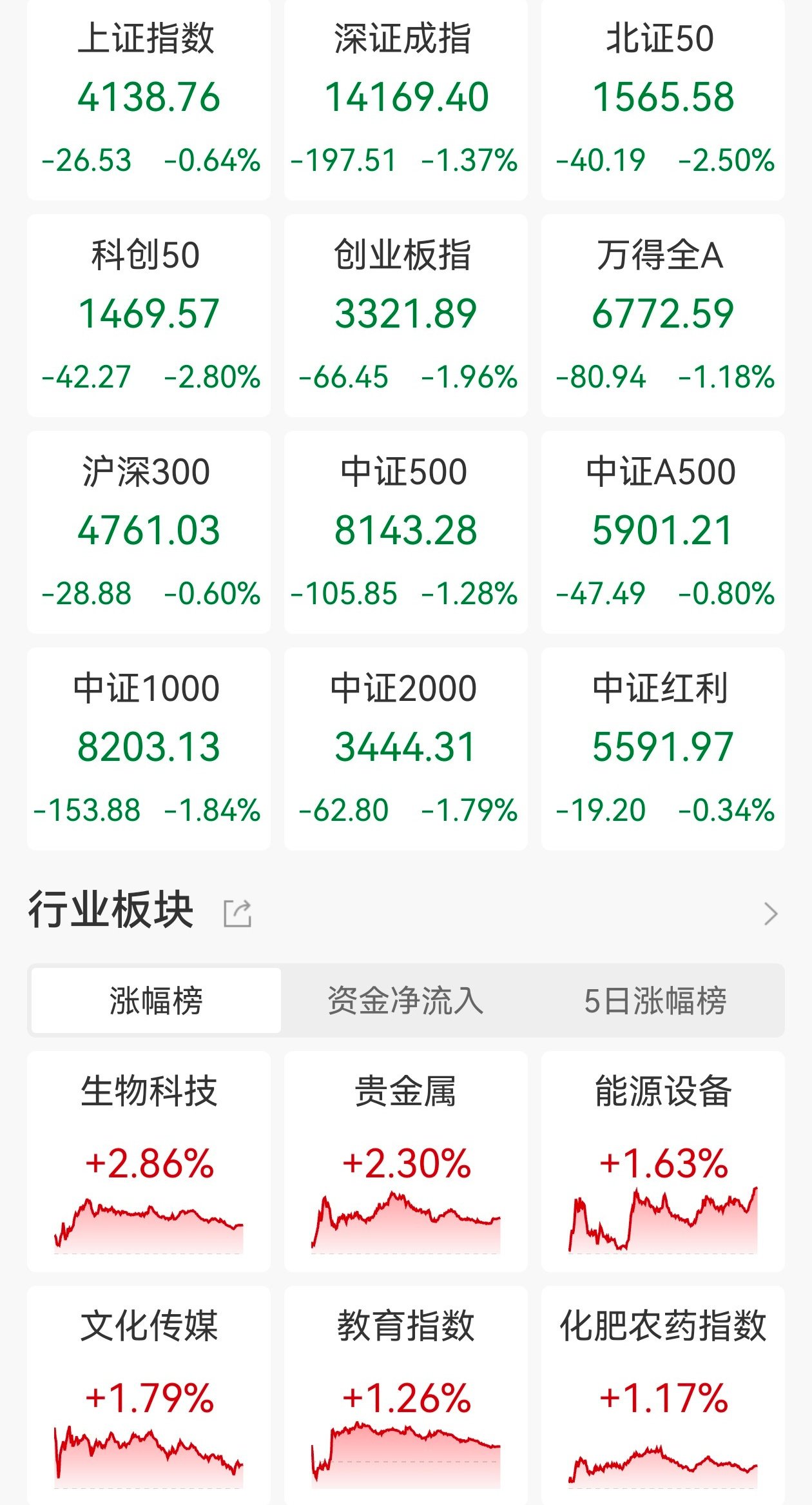
1月13日,A股三大股指早盘冲高回落,午后震荡下跌,截止收盘,上证综指下跌26.53点,跌幅0.64% 报4138.76点;深证成指下跌197.51点,跌幅1.37%报14169.4点;沪深300指数下跌28.88点,跌幅0.6%报 4761.03点;创业板指下跌66.45点,跌幅1.96%报3321.89点;科创50指数下跌42.27点,跌幅2.8%报 1469.57点;盘中创业板指一度跌超2%,沪指跌近1%;全天成交额较昨日再度放量,两市成交额录得 3.65万亿再创历史新高,两市超3500只个股下跌。 盘面上,AI应用概念逆势上涨,十余只成分股涨停,引力传媒、利欧股份、省广集团涨停。AI医疗概 念反复活跃,美年健康3连板,泓博医药、新赣江等多股涨停。电网设备概念午后走强,特变电工、三 变科技涨停;零售概念表现活跃,三江购物2连板;贵金属板块走高,晓程科技涨超8%;减肥药板块拉 升,普洛医药逼近涨停;创新药、锂矿概念及游戏等板块涨幅居前。下跌方面,多家公司公告提示风 险,商业航天、卫星互联网板块大退潮,航天电子、中国卫通、航天科技等近百股跌超8%;大飞机、 军工板块走低,中天火箭、雷科防务等多股跌停;可控核 ...

A股收评:3.7万亿元!成交额再创历史天量,深证成指、创业板指跌逾1.3%,商业航天板块大退潮
Ge Long Hui· 2026-01-13 07:12
Market Overview - The three major A-share indices collectively declined, with the Shanghai Composite Index down 0.64% to 4138 points, the Shenzhen Component Index down 1.37%, and the ChiNext Index down 1.96% [1] - The total market turnover reached a record high of 3.7 trillion yuan, an increase of 54.2 billion yuan compared to the previous trading day, with over 3700 stocks declining [1] Sector Performance - The commercial aerospace and satellite internet sectors experienced significant downturns, with nearly 100 stocks, including Aerospace Electronics, China Satellite Communications, and Aerospace Science and Technology, falling over 8% [1] - The large aircraft and military sectors also declined, with stocks like Zhongtian Rocket and Leike Defense hitting the daily limit down [1] - The controllable nuclear fusion sector saw a drop, with Wangzi New Materials hitting the daily limit down [1] - The communication equipment sector fell, with Changjiang Communication hitting the daily limit down [1] - Other sectors with notable declines included Beidou Navigation, quantum technology, 3D printing, CPO concepts, and F5G concepts [1] Positive Sector Movements - The pharmaceutical sector saw a broad increase, with recombinant proteins, CRO, and medical services leading the gains, and stocks like Baihua Pharmaceutical and Boji Pharmaceutical hitting the daily limit up [1] - The precious metals sector rose, with Xiaocheng Technology increasing over 8% [1] - Pfizer announced plans to launch a GLP-1 weight loss drug by 2028, boosting the weight loss drug sector, with Prolo Pharmaceutical nearing the daily limit up [1] - Other sectors with notable gains included innovative drugs, lithium mining concepts, and gaming [1]

每日市场观察-20260113
Caida Securities· 2026-01-13 05:12
Market Overview - The market experienced a comprehensive rise on January 12, with a trading volume of 3.64 trillion, an increase of approximately 490 billion compared to the previous trading day[1] - Most sectors saw gains, particularly media, computer, military, and communication, while oil, coal, and real estate sectors faced declines[1] - Since mid-December, the market has shown a recovery with a continuous rise, achieving 10 consecutive days of gains, indicating a strong upward trend supported by increasing trading volume[1] Sector Performance - The commercial aerospace sector continues to show strong upward momentum, with no signs of slowing down, while the AI sector is shifting focus from hardware to software[2] - Significant gains were noted in the computer and media sectors, largely influenced by the popularity of domestic model companies listed in Hong Kong and the natural evolution of AI infrastructure over the past two years[2] Fund Flows - On January 12, net inflows into the Shanghai Composite Index were 38.22 billion, and into the Shenzhen Composite Index were 38.35 billion, with the top three sectors receiving inflows being software development, IT services, and advertising[5] - Since the beginning of 2026, public funds entering the market are estimated to exceed 45 billion, driven by new ETF listings and active funds entering the market[14] Policy and Economic Outlook - The Ministry of Industry and Information Technology plans to implement new policies to support the high-quality development of specialized small and medium-sized enterprises, focusing on enhancing technological innovation and digital transformation[6][11] - The government has introduced measures to evaluate and guide investment funds, encouraging collaboration with high-ranking funds to support quality projects[8] Agricultural Market - As of January 12, the average price of pork in national wholesale markets was 17.83 yuan/kg, a decrease of 0.8% from the previous week, while beef and lamb prices saw slight increases[13]
17连阳下的市场怎么看
Jin Rong Jie· 2026-01-13 04:38
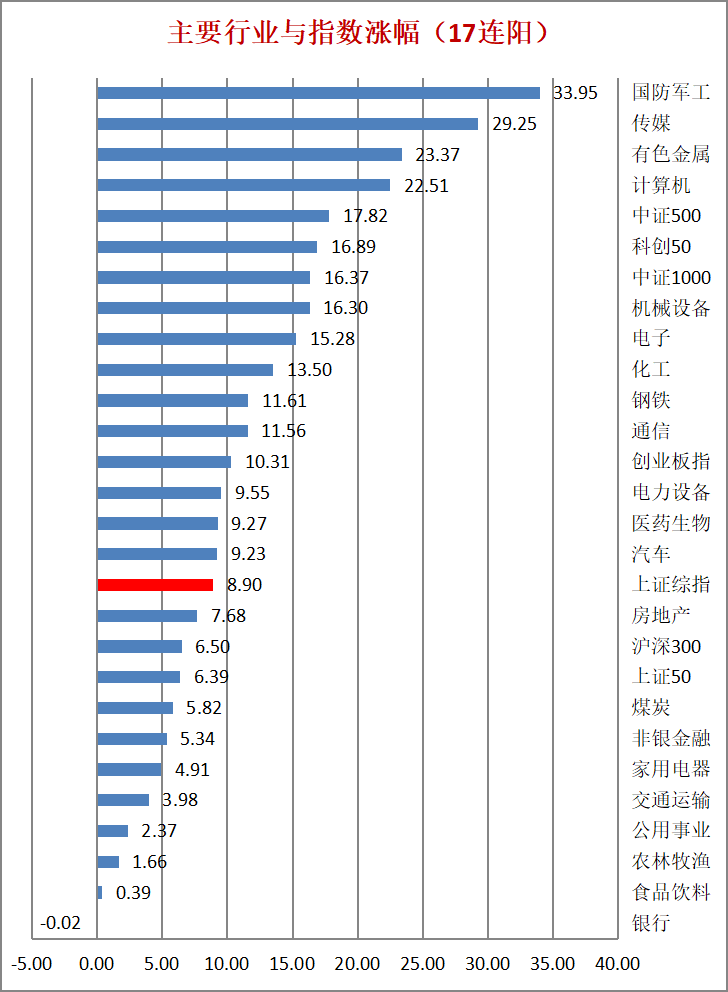
Market Overview - On January 12, the A-share market continued its strong performance since the beginning of the year, with the Shanghai Composite Index surpassing 4165 points, an increase of 1.09%. The total trading volume exceeded 3.64 trillion yuan, setting a historical high [1] - The ETF market also showed a strong upward trend, with non-currency ETFs totaling 400.24 billion yuan in trading volume [1] - Sectors such as media, computer, and defense industries saw significant gains, while oil, coal, and real estate sectors experienced declines [1] Performance Review - The Shanghai Composite Index has accumulated an increase of 8.9% during the 17 consecutive days of gains, indicating significant market differentiation [2] - Notable sector performances include military industry, media, and non-ferrous metals, which rose by 33.95%, 29.25%, and 23.37% respectively. The banking sector was the only one to decline, with a decrease of 0.02% [4][5] Expert Insights - A leading analyst, J, expressed skepticism about the market's ability to sustain a bull run, citing that many company earnings reports are not favorable. The market may not remain optimistic after the first quarter earnings announcements [8] - There has been a noticeable shift in focus from performance-based stocks to concept-driven and speculative investments, with stocks that have strong earnings not seeing significant price increases [9] - The analyst has gradually shifted to a defensive stance, anticipating increased pressure on indices following the release of annual reports [10] ETF Performance - As of January 12, among 90 ETFs, 80 have achieved positive returns, with the aerospace ETF (159227) leading at a 48.98% increase, followed by the military industry ETF (512660) at 43.52% [12] - Other top-performing ETFs include general aviation (159230) at 41.29% and semiconductor equipment (159516) at 29.02% [12]
早盘直击|今日行情关注
申万宏源证券上海北京西路营业部· 2026-01-13 03:33
首先,春季行情继续演绎。 2026年一开局,市场便连续放量上行,原因在于市场对扩大内需的战略方针抱有期待,对"十五五"的开门红有所企盼。 从实际情况看,股票市场的成交金额出现连续放大的趋势,显示增量资金正在集中入场。成长性行业继续表现领先,体现投资者风险偏好提升,资金进攻 欲望较强的市场特征。以上各种信号与传统的春季行情的特征较为相符,并且已经处于快速上行阶段,热点或有进一步的扩散。 其次,周一两市再次上涨,量能放大。 沪指高开后,一路震荡反弹,收盘于全天高点附近,与5天均线的乖离率有所加大。深圳成指表现更强,延5 天均线不断上移重心。两市成交金额超过3.6 万亿元,较上个交易日有所增加。当天市场热点主要集中在TMT和军工行业。投资风格方面,中小盘和科技 股领涨。从运行节奏看,沪指完成小双底形态,正在向前期高点挑战。沪指分别于2025年11月下旬和12月中旬向下调整,止跌的位置基本相。随后进入了 持续反弹的进程,目前已经越过了小"双底"形态的目标位,正在挑战更高的点位。未来需要关同,形态类似于"双底"注量价配合的状况。 风险提示: 国际贸易、地缘冲突超出预期;上市公司业绩增速回落超预期;全球经济衰退超预期。 ...

突发!美国急召60%需求国开会,要切断对华关键矿产依赖,能成吗
Sou Hu Cai Jing· 2026-01-13 03:14
Core Viewpoint - The U.S. is leading an urgent initiative among several countries to reduce dependency on China for critical minerals, emphasizing the need for a strategic "decoupling" from Chinese supply chains [1] Group 1: Meeting and Participants - The meeting was convened by the U.S. Treasury Secretary and included representatives from the G7, the European Union, Australia, India, South Korea, and Mexico, collectively accounting for 60% of global demand for critical minerals [1] Group 2: Current Situation and Concerns - China dominates the extraction and refining of key minerals such as copper, lithium, cobalt, graphite, and rare earths, with refining ratios exceeding 50% in many cases and approaching 90% for some minerals [1] - These minerals are essential for industries like military, semiconductors, renewable energy, and batteries, highlighting the strategic importance of reducing reliance on China [1] Group 3: Challenges Ahead - Despite the urgency expressed in the meeting, the path to reducing dependency on China is complex and cannot be achieved quickly, as it involves multiple steps including locating minerals, extraction, refining, investment, and risk management [1]
开源证券:AI+的高beta现阶段依然有望获得支撑 本轮行情为科技+周期双主线
智通财经网· 2026-01-13 02:13
Group 1 - The core viewpoint is that the current AI+ high beta still has support, but a more balanced investment approach is recommended, focusing on performance improvements in AI hardware and opportunities in AI application sectors with lower institutional positions [1] - The first year of the 14th Five-Year Plan should emphasize new themes transitioning to main lines, such as commercial aerospace and brain-computer interfaces [1] - The current market trend is characterized by a dual focus on technology and cycles, with price increase clues and anti-involution support making cyclical styles promising [1] Group 2 - The hardware cycle discussion highlights the concept of "stronger becoming stronger" and the potential for valuation digestion if ΔG shows signs of weakness, although no significant turning point for ΔG has been observed yet [1] - The 2000 US tech bubble serves as a reminder that during the bubble formation phase, many tech companies experienced rapid valuation increases disconnected from actual profitability, driven by blind expectations and emotions [2] - The "6+6" model illustrates the process from bubble to disillusionment, emphasizing that true market survivors possess technological leadership, clear profit paths, and sound capital management [2] Group 3 - The end of the mobile internet era in A-shares from 2013 to 2015 reflects a similar disconnect between valuation and profitability, with weak macro cycles leading to concentrated trading in high-demand sectors [3] - The acceleration of leveraged funds contributed to a lack of safety margins in valuations, and the sustainability of industry competition and business models became critical considerations post-bubble [3]
任泽平:A股此轮大牛市十年一遇
Xin Lang Cai Jing· 2026-01-12 23:31
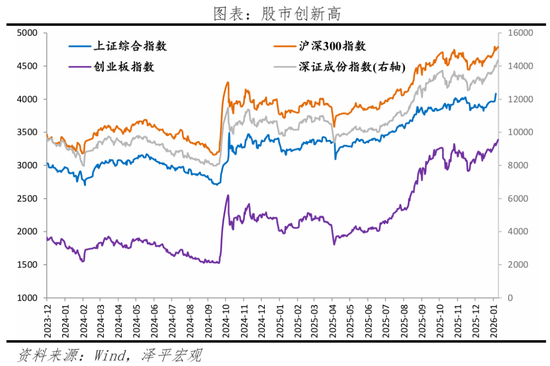
Core Viewpoint - A new bull market has begun since September 24, 2024, driven by significant policy easing, abundant liquidity, and a new wave of technological revolution, termed the "Confidence Bull" [2][31][34]. Group 1: Characteristics of the Bull Market - This bull market is described as a once-in-a-decade event, comparable to previous major bull markets in 2004-2007 and 2014-2015, with the current market driven by policy easing and technological advancements [4][34]. - The bull market has already seen substantial gains, with the Shanghai Composite Index rising by 45.5% and the ChiNext Index by 109.8% from September 24, 2024, to January 12, 2026 [7][35]. - Trading volume has surged from a few hundred billion before September 2024 to over 3 trillion recently, indicating a significant increase in market activity [9][37]. Group 2: Drivers of the Bull Market - The bull market is supported by three main drivers: continuous policy easing, a new technological revolution, and abundant liquidity, creating a combination of policy, technology, and liquidity-driven confidence [11][37]. - Policy easing has included interest rate cuts, relaxed housing market restrictions, and substantial fiscal measures, which have significantly boosted market risk appetite [38]. - The technological revolution is characterized by advancements in artificial intelligence, semiconductors, robotics, and innovative pharmaceuticals, leading to a strong performance in high-risk growth sectors [12][38]. Group 3: Historical Missions of the Bull Market - The bull market is expected to support the development of new productive forces, assist in major power competition, and repair household balance sheets, highlighting its strategic importance [15][41]. - It aims to provide capital market support for new economy sectors, which often struggle to secure financing through traditional banking systems [41]. - The bull market is also seen as a means to counteract the negative wealth effects from the real estate market downturn, with the A-share market's value increasing from under 70 trillion to over 100 trillion, creating a wealth effect of over 30 trillion [16][42]. Group 4: Future Outlook - The sustainability of the bull market will depend on continued macroeconomic policy easing, including further interest rate cuts and fiscal measures to stimulate demand [44]. - There is a need for effective regulation of leverage in the market to ensure healthy development, given the characteristics of the A-share market, which is primarily retail investor-driven [45][46]. - The potential for a long-term bull market could significantly impact the recovery of consumer spending and the real estate market, particularly in major cities [42][44].
诺德基金罗世锋:A股行情或由估值修复向基本面驱动转变
Xin Lang Cai Jing· 2026-01-12 21:04
Core Viewpoint - The A-share market is expected to show significant structural differentiation in 2025, reflecting profound changes in industry prosperity and China's economic structure. The trend of economic transformation and upgrading is anticipated to deepen in 2026, potentially driving improvements in corporate profitability and supporting market upward momentum [1][2]. Group 1: Market Structure and Performance - In 2025, sectors such as technology, high-end manufacturing, and non-ferrous metals are expected to perform strongly, while consumer sectors may lag. The market capitalization of technology manufacturing sectors like electronics, power equipment, machinery, and military industry has increased by nearly 5 percentage points since the beginning of the year, indicating a shift in market structure [1]. - The changes in market structure reflect varying industry prosperity and suggest that technology manufacturing may become a driving force in China's economy [1]. Group 2: Corporate Profitability and Market Drivers - Corporate profitability, as indicated by the return on equity (ROE), has stabilized for four consecutive quarters, with a slight improvement noted in Q3 2025. This improvement in profitability is expected to provide new momentum for the stock market [2]. - The primary factor driving the A-share market upward in 2025 is valuation enhancement, while in 2026, the market's upward momentum is likely to shift from valuation recovery to being driven by fundamentals [2]. Group 3: Industry Focus and Future Trends - In 2026, the A-share market is expected to continue its structural differentiation, with a focus on technology, advanced manufacturing, domestic consumption, and overseas industrial chains amid economic transformation [2]. - The technology and advanced manufacturing sectors, particularly those related to artificial intelligence, are currently in a phase of significant capital expenditure to enhance large model applications. China is deeply involved in various segments of the AI industry chain and holds a competitive advantage in key areas such as large models and computing power [2]. - The consumer sector, particularly food and beverage, is gradually showing long-term investment appeal after nearly five years of adjustment, with expectations for related policy implementations to support domestic demand [2]. - The overseas industrial chain is also seen as a sector with long-term potential, with exports performing well in 2025, showcasing China's strong competitive edge due to its comprehensive industrial system and engineering talent [3].
北京理工导航控制科技股份有限公司股票交易异常波动暨风险提示公告
Shang Hai Zheng Quan Bao· 2026-01-12 18:09
Core Viewpoint - Beijing Institute of Navigation Control Technology Co., Ltd. experienced a significant stock price fluctuation, with a cumulative increase of 30% over two consecutive trading days, prompting a risk warning announcement [2][4]. Group 1: Stock Trading Anomalies - The company's stock price increased by 55.45% since January 7, 2026, significantly outpacing the 13.52% increase in the Shenwan Military Industry Index and the 5.77% increase in the Sci-Tech Innovation 50 Index, indicating potential market overreaction [3][10]. - The stock price is currently at a historical high, raising concerns about the sustainability of this increase and the risk of a rapid price correction [3][10]. Group 2: Company Operations and Financials - The company confirmed that its daily operations remain normal, with no significant changes or major contracts being negotiated as of the announcement date [5][7]. - The company's main products include inertial navigation systems and components, primarily used in remote-guided munitions, with business revenue for January to September 2025 reported at approximately 154.40 thousand yuan (unaudited) [8][12]. Group 3: Financial Performance Risks - The company reported a net loss attributable to shareholders of 8.775 million yuan for the fiscal year 2024 and a net loss of 7.1652 million yuan for the first nine months of 2025, highlighting ongoing financial challenges [11][12]. - The company's rolling price-to-earnings ratio stands at 313.75 times, significantly higher than the industry average of 167.40 times, indicating a potentially overvalued stock [12].
