智能穿戴设备

Search documents
小米AI眼镜即将发布
第一财经· 2025-06-25 11:06
Core Viewpoint - Xiaomi is set to launch its new AI glasses on June 26, positioning it as a next-generation personal smart device, with a focus on first-person perspective photography and video recording capabilities [1][3]. Industry Overview - The AI glasses market is experiencing explosive growth, with IDC projecting global shipments to reach 12.05 million units by 2025, representing an 18.3% year-on-year increase [4]. - Various brands, including Baidu and Huawei, are actively entering the AI glasses market, indicating a competitive landscape [4]. Product Features and Market Position - Xiaomi's AI glasses are expected to integrate multiple functionalities, including camera, Bluetooth headset, and AR capabilities, making them a strong candidate for the next generation of mobile terminals [5]. - Current AI glasses face challenges such as short battery life, insufficient SLAM accuracy, high gesture recognition error rates, and poor device compatibility, which Xiaomi will need to address [5]. Competitive Landscape - Meta has partnered with Oakley to launch a new high-performance AI glasses model, focusing on sports applications, which is expected to enhance market acceptance and competition [6].



小米AI眼镜明天亮相:小爱秒回应+第一视角拍摄,自媒体人必备神器?
Hua Er Jie Jian Wen· 2025-06-25 07:51
Core Viewpoint - Xiaomi officially announced its first AI glasses, defined as "next-generation personal smart devices," which will feature AI object recognition and video recording capabilities [1][4]. Product Features - The Xiaomi AI glasses have a common D-shaped frame design with thin temples, resembling regular glasses, and the camera is located on the left side [3]. - The glasses are equipped with AI capabilities, allowing users to ask questions about what they see using the built-in Xiao Ai assistant, which provides real-time responses [4][7]. - The glasses support first-person video recording, enabling users to capture activities hands-free by simply saying "Xiao Ai, start recording" [7][9]. Market Positioning - Xiaomi's AI glasses are positioned to compete directly with Meta's Ray-Ban smart glasses, featuring AI functions, audio modules, and camera modules, with a projected shipment of over 300,000 units [6][10]. - The glasses are expected to have a hardware cost of approximately $177.5, which is higher than Meta's Ray-Ban at $149, suggesting a potential retail price of around 1499 yuan [11]. Competitive Analysis - The competitive landscape for such products is characterized by high hardware configuration similarities, with both Xiaomi and competitors using Qualcomm AR1 chips and Sony image sensors [10]. - Differentiation among products may arise from AI capabilities, social attributes, and fashion accessory appeal, with Xiaomi potentially leveraging domestic AI models for enhanced functionality [10].

小米官宣将发布AI眼镜 智能眼镜今年出货激增
Zheng Quan Shi Bao Wang· 2025-06-25 05:41
Group 1 - Xiaomi announced the launch of its new AI glasses on June 26, positioning it as a next-generation personal smart device [1] - The AI glasses feature a first-person perspective recording capability, activated by voice command to the AI assistant [2] - The glasses will utilize a dual-core architecture and aim to compete with brands like Ray-Ban and Meta, integrating photography, AI voice interaction, and audio playback [2] Group 2 - The demand for smart glasses has surged, with significant increases in search interest on platforms like Taobao and Tmall, showing a 380% rise for Rokid brand and 140% for "AI smart glasses" [3] - XREAL reported strong demand for its AR glasses, leading to stock shortages in international markets, with a global sales figure of approximately 600 million RMB last year [3] - Meta and Oakley announced a new series of AR glasses, with pre-orders starting on July 11, priced from $399 to $499 [3] Group 3 - Rokid Glasses, developed in collaboration with Lens Technology, will be the first smart glasses to feature payment functionality, set for mass delivery by the end of June [4] - IDC predicts that global AR device shipments will exceed 40 million units by 2025, with the consumer market accounting for over 60% [5] - The growth of smart glasses is creating new opportunities for optical lens suppliers, as manufacturers seek direct partnerships to address optical prescription needs [5]
Rokid与蓝思科技联合开发的AI+AR眼镜正式量产
news flash· 2025-06-24 12:31
Core Insights - Rokid and Lens Technology have jointly developed the AI+AR glasses, Rokid Glasses, which have officially entered mass production at Lens Technology's Xiangtan base [1] - The product is noted as the world's first consumer-grade AI+AR glasses to achieve large-scale production, with global pre-sale orders reaching 250,000 units [1]

以消费级AR眼镜变革全球语言服务市场,亮亮视野的出海之路
2 1 Shi Ji Jing Ji Bao Dao· 2025-06-24 05:42
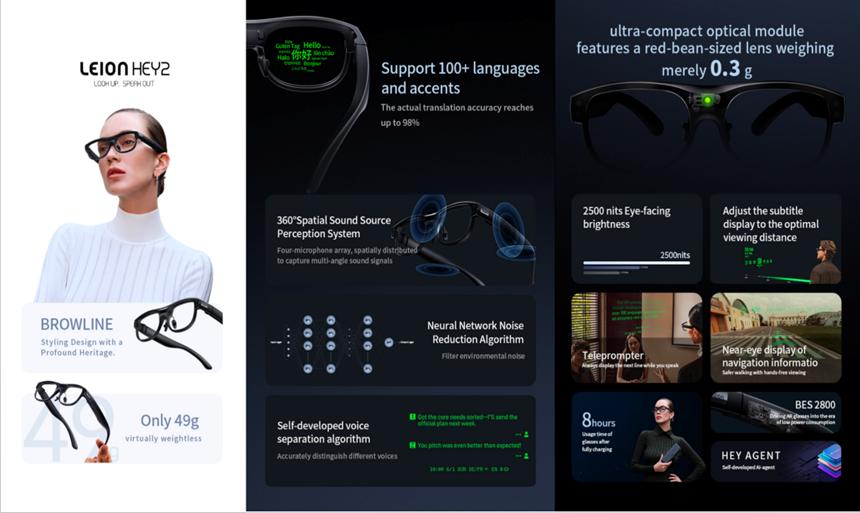
Core Insights - The global language services market is projected to reach $53.91 billion in 2024, increasing to $61.87 billion in 2025, and potentially exceeding $90.82 billion by 2029, with China's market expected to grow by 20% to approximately 198.2 billion RMB in 2024 [1][2]. Company Overview - Liangliang Vision, a Chinese AR company, has been actively entering the billion-dollar language services market, leveraging its 11 years of experience in augmented reality technology [1][3]. - The company has developed smart glasses that have been implemented in various B2B scenarios, including manufacturing, healthcare, security, and logistics [1][3]. Product Launch and Features - The company launched the Leion Hey2 AR translation glasses in Seoul, capable of real-time translation in over 100 languages within 0.5 seconds, targeting diverse scenarios such as international meetings and travel [2][5]. - The Leion Hey2 weighs 49 grams and can operate continuously for 8 hours, with a portable case extending its battery life to 96 hours, achieving a balance in the "lightweight-performance-endurance" triangle [7][9]. Market Strategy - Liangliang Vision aims to consolidate its leading position in the enterprise market while strategically expanding into the global consumer market with the Leion series [5]. - The company has received significant investment from various institutions and has established a strong market presence, holding approximately 60% of the professional AR device market share in China [3][4]. Technological Innovation - The company has accumulated over 270 AR-related patents, covering critical areas such as optical design and AI algorithms, creating a robust technological moat [9]. - The integration of AI capabilities into AR devices has enabled large-scale applications in sectors like healthcare and security, enhancing the overall user experience [9]. Future Outlook - The AR glasses market is expected to grow rapidly, with the potential for AR devices to become as ubiquitous as smartphones, driven by increasing demand for cross-language communication and smart assistant applications [9].
中国智能眼镜望向世界
Xin Hua She· 2025-06-23 06:51
吴晗介绍,这副智能眼镜不仅能连接手机进行实时翻译,还可两副眼镜直接匹配,"我和游客各戴一 副,就可以用各自的母语直接对话,沟通压力荡然无存"。 这款来自四川影目科技有限公司的眼镜,利用了衍射光波导成像技术,导入了DeepSeek、豆包等国产 大模型,目前已支持40种语言及90种口音。该公司线下市场品牌经理刘宇说:"我们的产品持续迭代升 级,有拍照、游戏、办公等多种功能,已出口至日本、俄罗斯等19个国家和地区,今年将加速拓展国际 市场。" 新华社成都6月23日电(记者陈子薇、萧永航、余里)在人流涌动的四川省成都市天府广场,巡逻民警 吴晗用一副智能眼镜,30秒内就帮满脸困惑的外国游客解决了问路难题。 四川影目科技有限公司CEO杨龙昇表示,在即将到来的成都世界运动会上,影目科技计划探索智能眼镜 的文旅应用,通过翻译等功能帮助国际友人深度体验成都文化与美食,展现这座城市的独特魅力。 中国银河证券发布研报称,智能眼镜有望成为继智能手机后的下一代主流计算终端,带动整个产业链 (芯片、光学、传感器、代工等)进入高速增长期。 随着人工智能技术逐渐发展成熟,智能眼镜在中国的发展势头日益强劲。国际数据公司预测,2025年全 球智 ...
价格被打下来,AI眼镜就能上桌了?
创业邦· 2025-06-22 10:21
Core Viewpoint - The AI glasses market is experiencing a surge in product launches and consumer interest, but significant issues regarding user experience and product functionality remain unresolved [3][5][8]. Group 1: Market Dynamics - The AI glasses sector is witnessing intense competition, with major tech companies and startups launching new products to capture market share [3][19]. - Sales data from the 618 shopping festival indicates a dramatic increase in the AI glasses market, with transaction volumes rising over 800% year-on-year, and projections suggest a compound annual growth rate exceeding 60% from 2025 to 2029 [8][9][21]. - The market is expected to see a shipment of 2.75 million units in 2025, representing a staggering 107% increase compared to previous years, positioning China as the global leader in this segment [8][21]. Group 2: Consumer Feedback and Challenges - Consumer feedback highlights critical issues such as inadequate battery life, discomfort in wearing, and sound leakage, leading to a perception that many AI glasses are "flashy but impractical" [5][11][14]. - Despite the initial excitement, many users report that the actual performance of AI glasses does not meet their expectations, with common complaints about short battery life and complex operations [9][12][14]. - The weight of new AI glasses has improved, with most products now under 40 grams, but battery life remains a significant pain point, with many devices only lasting a few hours under active use [11][13][14]. Group 3: Industry Outlook - Industry experts suggest that many current AI glasses prioritize conceptual features over practical user needs, which may hinder their integration into daily life [11][24]. - The competitive landscape is characterized by rapid product launches, with companies focusing on establishing a foothold in the market before refining product quality [16][24][26]. - The AI glasses are viewed as a gateway to future smart device ecosystems, with companies aiming to create a comprehensive ecosystem to attract developers and users [25][26].

贴身“助手”变“内鬼”?
Qi Lu Wan Bao· 2025-06-20 21:31
Core Viewpoint - The National Security Department has issued a warning regarding the data leakage risks associated with smart wearable devices, urging the public to avoid using them in sensitive areas [2][8]. Group 1: Market Overview - The global wrist-worn device market is projected to ship 190 million units in 2024, with China accounting for 61.16 million units, reflecting a year-on-year growth of 19.3%, making it the largest market for wrist-worn devices [2][3]. Group 2: Security Risks - Smart wearable devices, equipped with cameras, microphones, and location tracking, pose significant data leakage risks, as they can collect sensitive biometric and health data [2][3]. - Cloud storage associated with these devices has vulnerabilities, including potential hacking, system flaws, and foreign espionage, which can lead to unauthorized access to stored information [3]. - Bluetooth and Wi-Fi connections used by these devices are susceptible to security threats, with reports indicating that some Bluetooth earphones can be exploited for tracking and eavesdropping [3][4]. Group 3: Children's Smart Watches - The market penetration of children's smart watches in China is approximately 30%, with one in three children owning such devices, raising concerns about their security [5][6]. - Tests have revealed that some children's smart watches have privacy vulnerabilities, allowing malicious software to access sensitive information without user consent [5][6]. Group 4: Technological Concerns - Experiments have demonstrated that smart glasses can pose privacy risks by using facial recognition technology to gather personal information from public databases [6][7]. - A security flaw in a mixed reality headset allowed hackers to infer user input data, highlighting the potential for new types of attacks on wearable technology [7]. Group 5: Recommendations for Security - The National Security Department recommends prohibiting the use of smart wearable devices in sensitive areas and implementing strict access controls [8]. - Users are advised to purchase devices from reputable sources, regularly update software, manage permissions carefully, and avoid storing sensitive information on these devices [8].

出货量翻倍,中国AI眼镜超级繁荣的“三重门”
2 1 Shi Ji Jing Ji Bao Dao· 2025-06-19 11:33
Core Insights - The smart glasses market is rapidly expanding, with a notable increase in shipments and a shift towards lightweight and aesthetically pleasing designs that cater to a broader audience [2][5][9] - Major players like Qualcomm and Google are entering the market, promoting standardization and the transition towards lightweight smart glasses [1][4] - The integration of advanced AI models is enhancing the functionality of smart glasses, making them more appealing to consumers [6][7] Market Trends - In Q1, global smart glasses shipments reached 1.487 million units, a year-on-year increase of 82.3%, with China accounting for 494,000 units, up 116.1% [2] - The lightweight smart glasses segment is gaining traction due to its broader applicability and lower entry barriers for consumers, leading to faster commercialization compared to traditional devices [5][9] - The AR/ER market is shifting focus, with Q1 shipments reaching 86,000 units, representing a 63.8% market share and a 64.0% year-on-year growth [4] Competitive Landscape - Domestic manufacturers are increasingly competing with established brands like Meta, focusing on innovative applications and leveraging AI capabilities [4][10] - The audio and audio-capturing glasses market saw a shipment of 359,000 units in Q1, marking a 197.4% increase, driven by products from companies like Xiaomi and Huawei [3] - Partnerships between smart hardware manufacturers and traditional eyewear companies are becoming more common, enhancing distribution channels and market reach [10] Technological Developments - The development of powerful AI models is crucial for the advancement of smart glasses, improving their semantic understanding and multi-modal interaction capabilities [6][7] - The challenge of balancing lightweight design, high performance, and long battery life remains a significant hurdle for manufacturers [7][8] - The use of advanced chips, such as Qualcomm's Snapdragon AR1, is essential for achieving the desired functionality while maintaining a lightweight form factor [8]
下一个25年,AI可以为人类做什么?
首席商业评论· 2025-06-19 04:02
Core Viewpoint - The article discusses the evolution of AI assistants and their potential impact on daily life by 2049, emphasizing the transition from smartphones to smart glasses and the emergence of a "mirror world" where virtual and real experiences blend seamlessly [2][18]. Group 1: AI Assistants - AI assistants are expected to evolve from specialized tools to general-purpose assistants, similar to how Swiss Army knives emerged from single-use tools [7]. - In the next five years, practical AI assistants will likely appear, initially as retail assistants on e-commerce platforms, eventually evolving into comprehensive personal assistants [7][12]. - The future AI assistants will be interconnected through APIs, leading to a B2B (bot to bot) era where they can collaborate without human intervention [11][12]. Group 2: Smart Glasses - By 2049, most smartphones are predicted to be replaced by smart glasses, which will facilitate more natural human-machine interactions [8]. - Smart glasses will enable users to interact with the virtual world using gestures, voice commands, and eye movements, marking a significant shift from traditional input methods [8][9]. - The development of transparent and image-displaying smart glasses is crucial for realizing this future, as current technology is not yet fully mature [8]. Group 3: Mirror World - The "mirror world" concept refers to a reality where digital information overlays the physical environment, enhancing user experiences through augmented reality (AR) [15][18]. - Smart glasses will collect vast amounts of personal data, allowing for tailored experiences and interactions in the mirror world [16][17]. - The mirror world is anticipated to become the next generation of the internet, providing immersive experiences that reduce reliance on traditional screens [18][19].