
水泥制造

Search documents
万年青: 关于债券持有人持有公司可转换公司债券变动比例达到10%的公告
Zheng Quan Zhi Xing· 2025-07-25 16:26
Group 1 - The company, Jiangxi Wannianqing Cement Co., Ltd., issued 10 million convertible bonds with a total value of 1 billion yuan, which were listed on July 2, 2020 [1] - Recently, the company received a notification that Xinhua Life Insurance Co., Ltd. transferred 1,027,330 bonds, accounting for 10.27% of the total issuance [1] - The bonds have a maturity period of 6 years, and the issuance was approved by the China Securities Regulatory Commission [1]

7月25日涨停分析
news flash· 2025-07-25 07:19
Group 1 - A total of 45 stocks hit the daily limit up, with 9 stocks achieving consecutive limit ups [1] - 26 stocks failed to maintain their limit up status, resulting in a limit up rate of 63% (excluding ST and delisted stocks) [1] - Super water power concept stocks showed significant divergence, with Huitong Group achieving 7 limit ups in 11 days [1] Group 2 - Tibet Tianlu and Xining Special Steel reached 5 consecutive limit ups [1] - However, companies such as Zhongshe Shares, Zhonghua Rock and Soil, Huaxin Cement, and Subote experienced limit downs [1]
2025Q3产业债策略:挖掘“”反内卷”下的行业配置机会
Orient Securities· 2025-07-24 15:42
1. Report Industry Investment Rating No relevant content provided. 2. Core Viewpoints of the Report - The market's focus is shifting towards medium - quality entities within industries such as steel, coal, real estate, local state - owned construction enterprises, and non - bank finance. In Q3, it is advisable to explore large - scale medium - quality entities in each industry. For institutions with high risk tolerance, there are opportunities to compress the liquidity premium of some high - quality private enterprises. For industries with low overall risks like public utilities, regular allocation is sufficient [5]. - For ultra - long credit bonds, it is time to gradually take profits, shorten the duration for defense, and switch to more liquid varieties, waiting for the next opportunity to attack [6]. - In Q3, different industries present various investment opportunities and risks. For example, the construction industry may see marginal improvement in prosperity but still face pressure; the steel industry has strong expectations of marginal improvement in fundamentals; the coal industry needs to select high - quality entities for exploration; the real estate industry has high - valued state - owned enterprises with certain investment potential; the non - ferrous metal industry has a differentiated prosperity; and the cement industry has limited opportunities [7]. 3. Summary According to Related Catalogs 3.1 Q3 Ultra - long Credit Bond Strategy: Gradually Take Profits and Wait for Subsequent Attack Opportunities 3.1.1 Primary Issuance - In Q2, the supply of ultra - long credit bonds increased month - on - month, with large industrial central state - owned enterprises remaining the main financing force. The total issuance in H1 was 539.8 billion yuan, and Q2 increased by 63% month - on - month, accounting for 9.27% of all credit bonds, but still lower than Q3 last year. The issuers were mainly industrial, accounting for about 72%, and large central state - owned enterprises such as State Grid had large issuance volumes [16]. - Since early July, the bond market has adjusted, and the supply of ultra - long credit bonds may be frustrated in the short term, and its subsequent recovery remains to be observed [18]. 3.1.2 Yield Analysis - To obtain significant excess returns from extending the credit duration, either interest rate decline or spread compression must occur, and the amplitude should be large enough [31]. - The trigger for the sharp decline of ultra - long credit bonds in recent years is mostly the reversal of institutional behavior. Currently, although it is predicted that there will be a double - bull market for stocks and bonds in the second half of the year, the short - term risk cannot be ignored due to the impact of the "stock - bond seesaw" on market sentiment [34]. - In terms of capital gains, the odds of ultra - long credit bonds are decreasing; the one - two - level arbitrage space is difficult to find; and the coupon protection ability is weak, making it difficult to increase the winning rate. Therefore, it is recommended to gradually take profits and switch to more liquid varieties such as 5Y bank secondary perpetual bonds [37]. 3.1.3 Strategy - For most institutions, it is time to gradually take profits from ultra - long credit bonds. The reasons include the difficulty in continuing the excess returns in the future, the fragility of the market's optimistic sentiment, the lack of obvious coupon advantages and protection ability, and the relatively small advantage compared with 5Y bank secondary perpetual bonds [46][51]. 3.2 Q3 Industrial Bond Strategy: Explore Industry Allocation Opportunities under "Anti - involution" 3.2.1 Construction - In 2025, the construction industry has been under pressure since the beginning of the year, and the downward trend in prosperity continued into Q2. In Q3, although factors such as accelerated capital arrival, the "anti - involution" initiative, and overseas growth are expected to bring marginal improvement in prosperity, the industry will still be under pressure overall, and industry concentration may further increase, benefiting leading central state - owned enterprises [48][52]. - In terms of bond valuation, the industry's valuation declined steadily in the second quarter. The spread of central state - owned enterprises narrowed, and some local state - owned enterprises had a large decline in valuation, but the valuation of some enterprises was still unstable [55]. - The strategy is to mainly explore subsidiaries of central state - owned enterprises and selectively allocate local state - owned enterprises. For institutions with low risk tolerance, continue to explore high - valued subsidiaries of central state - owned enterprises or leading local state - owned enterprises; for institutions that can accept a certain degree of credit quality downgrade, local state - owned enterprises provide greater return space, but it is not recommended to over - explore them [56]. 3.2.2 Steel - In Q2, steel prices fluctuated downward, but rose rapidly in early July under the support of cost and the expectation of "anti - involution" policies [60]. - In terms of fundamentals, supply is cautiously released, demand recovery in Q2 was less than expected, and total inventory is expected to further decline. In the short term, steel prices and steel enterprise profits are expected to be strong, but there is a risk of a callback [61][65][67]. - Medium - quality entities have strong motivation to compress spreads, and it is expected that the spreads of medium - grade mainstream entities such as HBIS and Shandong Steel will continue to compress. They can be appropriately allocated [71]. 3.2.3 Coal - In the second quarter, the price of thermal coal fluctuated downward and then rebounded at the end of the quarter, while the price of coking coal rose briefly in April and then fell, also rebounding at the end of June [74]. - In terms of fundamentals, the supply structure is relatively loose, and production inspections may lead to subsequent tightening. The demand for thermal coal is seasonally improving, while the probability of "oversupply" of coking coal is relatively large. Port inventories are continuously being depleted [76][80]. - It is expected that the coal price rebound may continue, with thermal coal being stronger than coking coal. In Q3, exploration still needs to select high - quality entities, and Jinmei Group is still the target of exploration by mainstream institutions [7][80]. 3.2.4 Real Estate - In Q3, the downward pressure on the real estate industry may continue to increase. The real estate sector is currently the highest - valued sector among state - owned enterprises, with a certain thickness of coupon and potential for exploration. Although the market is concerned about the emotional fluctuations brought about by Vanke's support willingness, the fluctuations are relatively controllable under the attraction of absolute returns, and it has cost - effectiveness [7]. 3.2.5 Non - ferrous Metals - In the non - ferrous metals industry, for gold, the market is mainly speculating on the Fed's interest rate cut expectation, and the long - term upward trend of the central price remains unchanged; for copper, the mining end is generally tight but with marginal increments, and the demand side is weak; for aluminum, the inventory has been depleted more than expected, and the demand - side risk is small, and the profit space of electrolytic aluminum plants is expected to continue [7]. - In terms of strategy, the valuations of high - quality but over - valued entities such as Nanshan Group, Hongqiao New Materials, and Luoyang Aluminum Industry are expected to continue to decline, while there are few opportunities for other entities [7]. 3.2.6 Cement - In Q2, cement prices almost declined unilaterally, and manufacturers faced the risk of losses. Attention should be paid to the implementation of over - production governance under "anti - involution." Currently, except for Hongshi, the spreads of the cement sector are basically compressed within 30bp, and it is difficult to obtain excess returns, so the overall opportunities in the cement sector are limited [7]. 3.2.7 Strategy - In Q3, explore large - scale medium - quality entities in each industry. The current spread of entities with a spread of 40 - 50bp is about 20bp different from that of leading entities, and it is expected that the spread will be compressed in Q3 [5]. 3.3 Q2 Industrial Bond Market Review: Convergent Trends and Deviation from Fundamentals 3.3.1 Issuance and Financing Situation - In Q2, industrial bonds had a large net inflow of 732.1 billion yuan, and public utilities led in net financing [14]. 3.3.2 Yield and Spread Trends - After the yield was repaired in Q2, it fluctuated at a low level. The trading logic was that the loose capital tone ran through the entire quarter, and the performance of different industries in the industrial bond market was not significantly differentiated, and the spread trend deviated from fundamentals [9]. 3.3.3 Liquidity - Since Q2, the liquidity of credit bonds has been continuously improving, and the trading heat of ultra - long credit bonds reached its peak in mid - June [14]. 3.3.4 Credit Risk - In Q2, there were 2 entities with substantial bond defaults and 4 domestic entities with rating/ outlook downgrades, but the overall credit risk was controllable [9].
2025Q3产业债策略:挖掘“反内卷”下的行业配置机会
Orient Securities· 2025-07-24 09:42
Group 1: Q3 Super Long Credit Bond Strategy - The report suggests gradually taking profits on super long credit bonds and switching to shorter-term, more liquid varieties while waiting for the next investment opportunity [6][10][26] - In Q2, the issuance of super long credit bonds increased significantly, with a total of 539.8 billion yuan, marking a 63% increase from the previous quarter [10][12] - The report indicates that the current market conditions do not support further exploration of super long credit bonds due to declining odds of capital gains and limited arbitrage opportunities [26][27] Group 2: Q3 Industry Bond Strategy - The strategy focuses on identifying investment opportunities under the "anti-involution" initiative across various industries [6][10] - In the construction sector, while there is a marginal improvement expected due to funding acceleration and the "anti-involution" initiative, the overall industry remains under pressure [6][10] - The steel industry shows strong expectations for marginal improvement, with opportunities for continued compression of spreads among mid-tier players like Hebei Steel and Shandong Steel [6][10] - The coal sector anticipates a rebound in prices, with a focus on major players like Jin Energy, while cash flow improvements may exceed expectations [6][10] - The real estate sector faces increasing downward pressure, but state-owned enterprises still present attractive absolute returns [6][10] - In the non-ferrous metals sector, the report highlights a divergence in market conditions, with opportunities for compression in spreads among quality private enterprises [6][10] - The cement industry is under significant pressure, with risks of losses and limited opportunities for excess returns [6][10] - The overall strategy recommends focusing on medium-quality entities across industries, particularly in steel, coal, real estate, and construction, while keeping an eye on the "anti-involution" initiative and the commencement of the Yajiang Hydropower Station [6][10]
海螺水泥:积极参与雅鲁藏布江水电工程项目及配套工程建设
news flash· 2025-07-24 07:36
Core Viewpoint - Conch Cement is actively participating in the construction of the Yarlung Tsangpo River hydropower project and its supporting infrastructure, leveraging its product advantages and regional positioning in Tibet [1] Group 1 - The company emphasizes the importance of the Yarlung Tsangpo River hydropower project and is preparing relevant resources [1] - Conch Cement aims to contribute to significant national strategic projects through its involvement in this initiative [1]
雅江水电工程开工引爆A股,多家概念股公司紧急“降温”
Huan Qiu Wang· 2025-07-24 02:25
Group 1 - The Yarlung Tsangpo River downstream hydropower project, with a total investment of approximately 1.2 trillion yuan, officially commenced on July 19, igniting enthusiasm in the A-share market [1] - Related concept stocks surged, with 16 stocks including Xining Special Steel and *ST Zhengping hitting the daily limit on July 23, showcasing a strong market response [1] - Several listed companies, including Huaxin Cement and *ST Zhengping, issued clarifications emphasizing that their current business does not involve this major project, despite some having relevant operational capabilities [1][2] Group 2 - Companies like Zhujian Design clarified that their main business is architectural design and consulting, lacking the qualifications for hydropower project design [2] - Other firms, including Jindun Co., Kailong Co., and Dayu Water-saving, also stated that they have no direct business relationship with the Yarlung Tsangpo project, or that the bidding process has not yet started [2] - Market analysts believe that the Yarlung Tsangpo project, as a significant national hydropower initiative, is expected to create new demand in construction, electrical equipment, and civil explosives sectors, although the actual benefits may be limited to a few leading companies with the necessary technical capabilities [2]


韩建河山连收4个涨停板
Zheng Quan Shi Bao Wang· 2025-07-24 02:23
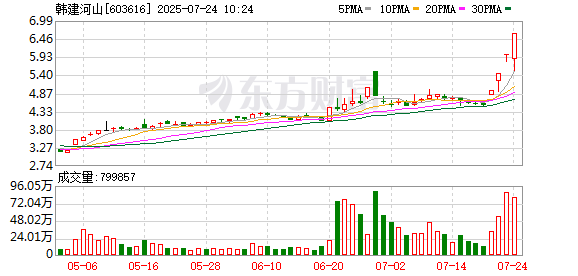
Core Viewpoint - The stock of Han Jian He Shan has experienced a significant surge, achieving four consecutive daily limit-ups, with a total increase of 46.56% during this period [2] Performance Summary - As of 9:45 AM, the stock price reached 6.61 yuan, with a turnover rate of 19.17% and a trading volume of 73.12 million shares, amounting to a transaction value of 446 million yuan [2] - The stock's limit-up order amount was 120 million yuan, and the total market capitalization of A-shares reached 2.587 billion yuan, with a circulating market capitalization of 2.521 billion yuan [2] Trading Data - The stock was listed on the Dragon and Tiger List due to a cumulative price deviation of 20% over three trading days and a daily price deviation of 7% [2] - Institutional investors net bought 8.7312 million yuan, while total net selling by brokerage seats amounted to 15.0597 million yuan [2] Financial Performance - The company reported a total operating revenue of 117 million yuan for Q1, representing a year-on-year increase of 191.96%, and a net profit of 3.8556 million yuan, up 133.16% year-on-year [2] Recent Stock Performance - Recent daily performance data shows significant fluctuations, with notable net inflows from main funds on specific days, including a net inflow of 48.8692 million yuan on July 21, 2025 [2]

龙虎榜机构新动向:净买入17股 净卖出14股
Zheng Quan Shi Bao Wang· 2025-07-23 13:33
Core Viewpoint - On July 23, the Shanghai Composite Index rose by 0.01%, with institutional investors appearing on the trading lists of 31 stocks, net buying 17 and net selling 14 [1] Institutional Trading Summary - Institutional special seats were present in 31 stocks, with a total net selling amount of 437 million yuan, marking the fourth consecutive day of net selling [1] - The stock with the highest net buying amount was Tianshan Shares, which closed down 6.27% with a turnover rate of 3.18% and a transaction amount of 1.371 billion yuan, net buying 60.08 million yuan by institutional seats [2] - Shangfeng Cement closed down 9.27% with a turnover rate of 7.12% and a transaction amount of 675 million yuan, net buying 53.10 million yuan by institutional seats [2] - Qingyun Technology closed up 15.09% with a turnover rate of 24.52% and a transaction amount of 924 million yuan, net buying 48.72 million yuan by institutional seats [2] Market Performance Analysis - A backtest of stocks with net institutional buying over the past month showed a 48.97% probability of rising the next day and a 46.90% probability of outperforming the Shanghai Composite Index [3] - Among the stocks with net institutional buying, 8 companies released half-year performance forecasts, with 2 expecting profit increases and 1 expecting profit [3] - Sichuan Jinding had the highest expected net profit increase of 25.50 million yuan, representing a year-on-year increase of 328.45% [3] Detailed Institutional Trading Data - The following stocks had significant institutional net buying on July 23: - Tianshan Shares: -6.27% change, 3.18% turnover, 60.08 million yuan net buying [4] - Shangfeng Cement: -9.27% change, 7.12% turnover, 53.10 million yuan net buying [4] - Qingyun Technology: +15.09% change, 24.52% turnover, 48.72 million yuan net buying [4][5] Stock Connect Activity - On July 23, 18 stocks on the trading list had appearances from the Shenzhen-Hong Kong Stock Connect, with net buying in stocks like Xue Ren Group and Zhongyuan Haike, totaling 132 million yuan and 26.31 million yuan respectively [6] - Stocks with net selling included Haixia Shares and Lansheng Shares, with net selling amounts of 51.60 million yuan and 40.99 million yuan respectively [6][7]





震惊!7月份暴涨640%,“20cm”涨停连板10天,打破了A股“20cm”连板记录!股民:记下了,又是一个穿越必买股...
雪球· 2025-07-23 09:20
Market Overview - The market experienced a high and then a pullback, with the Shanghai Composite Index briefly surpassing 3600 points, closing slightly up by 0.01%. The Shenzhen Component Index fell by 0.37%, and the ChiNext Index was down by 0.01%. The total market turnover was 1.8984 trillion yuan, a decrease of 30.3 billion yuan from the previous day, with over 4000 stocks declining [1]. Hainan Free Trade Zone - The Hainan Free Trade Zone received positive news regarding its closure date, confirmed for December 18, 2025. This closure will establish a "special area" under customs supervision, allowing for free movement of goods, capital, and personnel with foreign countries, while imposing import taxes on goods from the mainland [6]. - The range of "zero tariff" products is expected to increase significantly from approximately 1900 tax items before the closure to about 6600 tax items afterward, enhancing the attractiveness of Hainan for foreign investment [6]. Stock Performance - The stock of Upwind New Materials faced a significant pullback after achieving 11 consecutive trading limits, closing up by 19.73% but failing to extend its streak. The stock price surged from 7.78 yuan to 57.7 yuan, marking a 641.6% increase over the period [9][10]. - The company is undergoing a change in control, with Zhiyuan Robotics set to acquire a controlling stake through an agreement and tender offer, which has been interpreted as a reverse merger, although the company clarified it does not constitute a major asset restructuring [11]. Yarlung Tsangpo River Project - The Yarlung Tsangpo River downstream hydropower project has a total investment of 1.2 trillion yuan, with an installed capacity of 60-70 million kilowatts and an annual power generation of approximately 300 billion kilowatt-hours, equivalent to three Three Gorges projects. This project is crucial for China's "dual carbon" strategy and energy security [15]. - The construction of this mega project is expected to stimulate demand across various sectors, particularly in geotechnical engineering, explosives, and building materials in the initial phase, with long-term benefits for the power grid and operations sectors as the project progresses [15].


亚泰集团四年半亏123.5亿负债率93.64% 拟12.57亿出售吉林银行3亿股“保壳”
Chang Jiang Shang Bao· 2025-07-22 23:21
Core Viewpoint - Yatai Group is planning to sell financial assets, including shares in Jilin Bank, to address "shell protection" pressures due to continuous financial losses and high debt levels [1][5][6]. Group 1: Asset Sale Details - Yatai Group intends to publicly transfer 300 million shares of Jilin Bank at a minimum total price of 1.257 billion yuan [1][3]. - After the sale, Yatai Group's stake in Jilin Bank will decrease from 6.88% to 4.6% [1][2]. - The transaction is not classified as a related party transaction or a major asset restructuring [1]. Group 2: Financial Performance - Yatai Group has reported net losses for four consecutive years, with total losses exceeding 12.349 billion yuan [6][7]. - The company's net profit for 2021 to 2024 was reported as losses of 1.254 billion yuan, 3.43 billion yuan, 3.947 billion yuan, and 2.918 billion yuan respectively [6][7]. - As of March 2025, Yatai Group's total assets were 42.195 billion yuan, with a debt ratio of 93.64% [8]. Group 3: Market Context - The decline in demand for cement in Northeast China and increased competition have contributed to Yatai Group's financial struggles [6][7]. - The real estate sector remains under pressure, affecting the company's profitability [7]. Group 4: Shareholder Actions - Yatai Group has engaged in share buybacks and shareholder increases to stabilize its stock price, which fell below 1 yuan per share in July 2024 [8]. - As of June 30, 2025, the second largest shareholder, Changchun City Development Investment Holding Group, had invested 110 million yuan to increase its stake [8]. Group 5: Current Market Position - As of July 22, 2025, Yatai Group's A-share price was 1.91 yuan, with a total market capitalization of 6.173 billion yuan [9].
